Showing posts with label US Military. Show all posts

Wednesday, December 26, 2007

NASSG Oceanographers Guide Ships Through the Storm

NASSG Oceanographers Guide Ships Through the Storm

Story Number: NNS071215-06
Release Date: 12/15/2007 9:57:00 PM

By Mass Communication Specialist 1st Class (AW/SW) Leslie L. Tomaino, Nassau Strike Group Public Affairs

NORFOLK (NNS) -- As the ships of the Nassau Strike Group (NASSG) prepare for deployment, they rely heavily on the expertise of its Strike Group Oceanography Team (SGOT) to help guide them through and around the various weather patterns that could be encountered.

While expressions like, "Red skies at night, Sailors delight. Red skies at morning, Sailors take warning," may have been sufficient for the ancient mariner, today's Navy requires highly skilled professionals able to read maps, graphs and decipher historical data to formulate educated conclusions on the actions of weather patterns and their potential effects on operations.

"We cannot use 'weather.com' for tactical operations; weather.com does not predict weather for the ocean," explained Aerographer's Mate 1st Class (AW) Victor Gonzalez, leading petty officer for the SGOT attached to the amphibious assault landing ship USS Nassau (LHA 4). "Weather conditions are needed for the coast as well as the ocean. Where we really come into play is in the middle of the ocean or in transit."

The NASSG SGOT consists of a combination of the USS Nassau Meteorological and Oceanographic (METOC) team, Navy Aerographers from the Navy's Meteorology and Oceanography Center, two Marine Corps aerographers from the 24th Marine Expeditionary Unit (24 MEU), and a technician who all work together to deliver accurate information. The SGOT also provides tactical decision aides that outline how specific sensors and weapons will perform during current conditions. Using a plethora of tools, technical systems and even basic weather balloons, the SGOT provides a wide variety of information that allow leaders to make decisions generated by weather concerns.

"The general forecast is the most recognized product we put out, and is often mistaken for the only product," said Lt. Jeremy Callahan, SGOT METOC officer. "The Impacts Forecast is the second most popular that is used by both planners and operators. Commonly called a 'Stoplight Chart,' it outlines the level of impact environmental conditions have on different operations such as Landing Craft Units (LCU) operations, rotor wing operations, and replenishment-at-sea just to name a few."

Because weather is one of the various factors that can affect a weapon's performance, Aerographers also train to how weather affects a weapon's performance in order to provide guidance in various situations.

"The knowledge that a weapon will be impacted by current conditions, or that certain areas are conducive or detrimental to sensors will help mission planners put the right asset, in the right location, at the right time," said Callahan.

The NASSG is made up of the amphibious assault ship USS Nassau (LHA 4); amphibious transport dock ship USS Nashville (LPD 13); amphibious dock landing ship USS Ashland (LSD 48); guided-missile cruiser USS Philippine Sea (CG 58); guided-missile destroyers USS Ross (DDG 71) and USS Bulkeley (DDG 84); the attack submarine USS Albany (SSN 753); and a Marine Landing Force from the 24th MEU.

Currently preparing for its regularly scheduled 2008 deployment, the NASSG is made up of more than 5,000 Sailors and Marines, and projects sea power ashore by maintaining the capability of landing amphibious forces by helicopters, amphibious track vehicles, air cushion landing craft, and assault craft whenever and wherever the need arises.

For more news from the Nassau Strike Group Navy visit http://www.navy.mil/local/esg8/


NPR Science Out of the Box

Scientists Seek Cause of Mysterious 'Rogue' Waves

Listen Now [4 min 19 sec] add to playlist

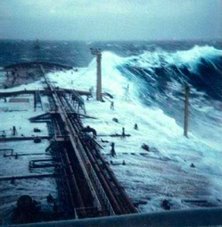
All Things Considered, December 15, 2007 · "Rogue waves" are monsters of the open ocean — the powerful "walls of water" can destroy even large ships. Satellite measurements have found them to be up to 100 feet tall. So far, scientists have disagreed about what causes the waves, but researchers at UCLA think that they may have found a clue.

Related NPR Stories


FROM gCaptatin.com ... Rogue waves are no joke...


RS

Friday, November 16, 2007

Combat Weathermen

Combat Weathermen

From Air Force News Service

by Chief Master Sgt. Gary Emery

HURLBURT FIELD, Fla. -- Slashing through Burmese jungles with Maj. Gen. Orde Wingate’s Chindits; hunkering down far above the DMZ in North Vietnam; infiltrating into Northern Iraq to ensure the success of a thousand-man airborne jump -- not the average day at the office for most weather forecasters.

But those missions and many more have been business as usual since 1942 for the Air Force special operations weather teams assigned of the 10th Combat Weather Squadron here.

The battle-trained meteorologists of special operations weather have been at the tip of the spear for more than 60 years. They have deploying with other special operators from every branch of the armed forces. They provide combatant commanders with the weather data and analysis they need to plan and execute missions at the tactical, operational and strategic levels of war.

Elite members of the Air Force Battlefield Airman program, special operations weathermen receive specialized training far beyond that of other meteorologists, squadron director of operations Maj. Don Shannon said.

“Our guys have first gone through the normal weather training and served in an operational weather squadron before they can volunteer for SOWT,” he said.

Major Shannon said, “We typically work with special operations forces from the U.S. Army Special Operations Command, but because of the unique capability we provide, we also work with special operations teams from the other services. Because of the types of individuals we team with, we undergo much of the specialized training they do so we can keep up with them in the field.”

Weather team members are jump-qualified and may hold ratings as military freefall parachutists, air assault specialists, Rangers, combat diver qualifications and more, the major said.

Some team members have received specialized training in military snow skiing, snowshoeing and avalanche forecasting to better align with their SOF counterparts’ mission, he said.

“We know that when we put out a forecast, someone is going to use it downrange,” said Capt. Don Garrett, the squadron’s assistant director of operations. “We provide the real-time, eyes-on, ground truth about conditions that can critically impact the mission.

“That’s why this is a total volunteer outfit,” he said. “We’re all willing to give it one hundred percent every day.”

Major Shannon agrees the people are what make the weather teams unique.

“These people have great attitudes. They’re tough guys who get it done no matter how rough it gets,” he said. “There aren’t a lot of us, so we all know each other and know how to work as a team.”

In fact, there are very few SOWT operators in the Department of Defense. They are currently listed on the Global Military Force Policy low-density, high-demand asset list.

There are roughly 100 SOWT operators in the Air Force, including 20 to 25 officers, Major Shannon said. Most are with the Hurlburt squadron. But others serve with AFSOC special tactics units in the United States and overseas, he said.

A “typical” SOWT mission was like that performed by Staff Sgt. Dave Mack. He infiltrated into Iraq with an Army special forces operational detachment alpha team during the early stages of Operation Iraqi Freedom. Tasked with collecting weather data, the team endured sandstorms that buried them in their sleeping bags.

They survived 12 missile attacks, one which destroyed their humvee, and endured almost continuous small-arms attack. At one point, Sergeant Mack provided 36 continuous hours of weather observations so aircraft could evacuate seriously wounded Soldiers from Baghdad. He also performed security and weapons details with the other team members.

“You get so much satisfaction from this mission,” Major Shannon said. “Everyone works together and you affect the mission at every stage, from planning to execution to redeployment.”

Staff Sgt. Jody Ball, a four-year veteran of special operations weather, agrees.

“The combination of the people and the mission is what makes this job so great,” he said. “I work with Rangers, (Army) special forces, (pararescue jumpers), combat controllers -- it’s an elite group.

“It’s much more than you can get working in a regular weather station,” he said. “It’s not your standard workday.”


Update on the Cosco Busan Incident
From Holland & Knight

San Francisco – oil spill update

The US Coast Guard issued a press release updating the status of the response effort for the recent oil spill in San Francisco Bay. The National Transportation Safety Board (NTSB) issued a press release stating that they have sent a team to San Francisco to investigate the accident. Meanwhile, Representative Elijah Cummings (D-MD) issued a press release stating that the Subcommittee on Coast Guard and Maritime Transportation of the House Committee on Transportation and Infrastructure has scheduled a hearing on November 19 to examine the causes of and response to the oil spill. (11/13/07).

and

San Francisco – update re oil spill response

The US Coast Guard issued a press release providing an update on the response to the recent oil spill. A second press release states that a new USCG representative to the Unified Command has been appointed so that the Commander of USCG Sector San Francisco can return to his regular duties. The local press is reporting that the crew of the ship involved in the accident is refusing to talk with NTSB investigators. This is not surprising in that the US Attorney has opened a criminal investigation. (11/14/07).
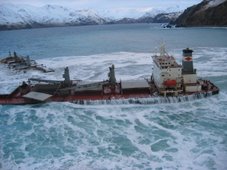

Update on PEMEX Rig Collision

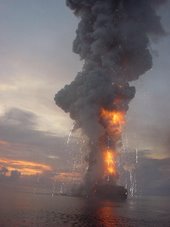
Pemex Says Leaking Oil Well Catches Fire
by Anthony Harrup
Dow Jones Newswires 11/14/2007

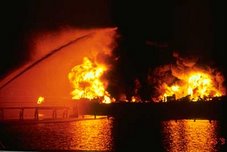
Mexican state oil monopoly Petroleos Mexicanos, or Pemex, said Tuesday that fire broke out at an offshore well where workers are attempting to plug a leak caused last month by a rig colliding with another platform.

In a press release, Pemex said the fire at the KAB-101 well was caused by a spark as workers were attempting to stop the leak by injecting mud into the well.

Pemex said no injuries were caused by the incident, and that four firefighting vessels were working to control the blaze.

On Oct. 23, an oil rig crashed into an offshore platform in the oil-rich Campeche Sound amid stormy weather. The accident killed 21 workers and ruptured the well.


RS