Showing posts with label m/v pusha bulker. Show all posts

Tuesday, May 27, 2008

Report: CG safety inspectors unqualified

Report: CG safety inspectors unqualified

(Robin's Note: The following article misses one of the main points of the OIG's report. The difference between inspections and investigations.

I have always believed that merging the USCG with DHS was a huge mistake and while the Coast Guard comes to some of the same conclusions as the OIG much of this has to do with the shifting new priorities that the USCG now has and the lack of experienced field level management people.

Here is the actual Department of Homeland Security (DHS) Office of Inspector General OIG-08-51 report).

By Philip Ewing - Staff writer
Posted : Wednesday May 21, 2008 8:24:22 EDT

The Coast Guard’s maritime safety inspection program is staffed by unqualified personnel who don’t follow proper procedures and mismanage their backlog of thousands of unfinished investigations, according to an internal report by the inspector general of the Department Homeland Security.

The findings, which could have broad implications for the future of U.S. maritime oversight, were unveiled Tuesday before a House panel.

Among a sample of 22 safety investigators, 15 were not fully qualified under U.S. regulations and four were not qualified at all, the investigation found, although a senior Coast Guardsman defended the service’s 136 maritime investigators as a group.

Coast Guard inspectors did not give hundreds of maritime accidents, known as “casualties,” the formal inspections they warranted under official rules, the report says. And in 2006, when the backlog of old investigations got too cumbersome, the Coast Guard closed 3,848 cases it deemed “low risk” even though DHS inspectors found many were worthy of “high risk” treatment, according to the report.

Members of the House Transportation subcommittee on the Coast Guard and maritime transportation and the chairman of the full House Transportation Committee lambasted the Coast Guard about the findings of the investigation during the hearing. They were especially upset because its findings were similar to previous reports from 10 years ago and as far back as 1981.

“I find it to be a disservice to the American people when government kicks around the same issues year after year — or, in this case, decade after decade,” said Maryland Rep. Elijah Cummings, the Democratic chairman of the Coast Guard subcommittee.

Minnesota Rep. James Oberstar, the Democratic chairman of the full committee, said it was time to re-examine the Coast Guard’s maritime oversight powers from the ground up.

The inspector general’s findings and Oberstar’s comments revived a congressional debate, in limbo for several months, over whether the Coast Guard’s maritime inspection and rule-making powers should be given to another federal agency or an altogether new one.

A new twist on that question is a legislative bid by the National Transportation Safety Board to increase its power in investigations of major maritime accidents. Currently, the Coast Guard and the NTSB collaborate on investigations using an unofficial “memorandum of understanding,” but the agreement puts neither one in charge.

Coast Guardsmen defended their oversight powers Tuesday.

The Coast Guard’s director of prevention policy, Rear Adm. James Watson, told committee members that “your alarm has reverberated throughout the Coast Guard.”

But he said the service wants to keep its maritime oversight powers, even after gaining a slew of new post-Sept. 11 security responsibilities. Ceding high-level maritime investigations to the NTSB could have many unintended consequences and be seen worldwide as a “demotion of the authority of the commandant” of the Coast Guard, Watson said.

Watson said that, for the most part, the Coast Guard agreed with the findings of the report.

The Coast Guard has agreed to increase its number of maritime inspectors, change its personnel management to encourage longer port-security tours and adopt more stringent rules for vessel inspections. The service already asked for 276 new sector-level billets in its fiscal 2009 budget requests. All those changes, top Coast Guardsmen say, will strengthen the service’s ability to make sure ships are safe.

Even with those changes, the NTSB wants Congress to make it the automatic lead investigative agency in major marine incidents, said board member Kathryn O’Leary Higgins, who also appeared before the subcommittee.

Maritime casualties are the only type of transportation accident over which the NTSB doesn’t have automatic authority, she said. In the case of accidents such as air crashes or bridge collapses, the NTSB investigates alongside other federal agencies, such as the Federal Aviation Administration or the National Highway Traffic Safety Administration.

But Congress didn’t give the NTSB authority in maritime accidents, so it uses the memorandum of understanding with the Coast Guard and informal personal ties between officials.

Coast Guard Commandant Adm. Thad Allen “is a good friend of mine,” Higgins said.

Officials from both the Coast Guard and NTSB agreed that the agencies work well together in inspecting most major maritime casualties, except the most recent one — the November accident in which the freighter Cosco Busan rammed the San Francisco Bay Bridge and spilled 58,000 gallons of oil into San Francisco Bay.

In that case, Higgins said, NTSB investigators didn’t respond to the spill for three days because the first Coast Guardsmen on the scene erred in assessing the size of the spill, believing it was too small to warrant NTSB involvement.

The lost time meant the NTSB couldn’t immediately secure the Cosco Busan’s voyage data recorder — the ship’s “black box” — or test the ship’s crew for alcohol or drugs.

Ohio Rep. Steve LaTourette, the ranking Republican on the subcommittee, defended the relationship between the Coast Guard and the NTSB, pointing out that even though it criticized the Coast Guard, the DHS report did not look into the qualifications of NTSB inspectors as potential replacements. And since there has never been a serious deadlock over which agency would take the lead on a casualty investigation, LaTourette said, there’s no need to change the system.

Cummings disagreed, saying such a system can’t rely on the personalities of its participants.

“I would hope that everybody who takes on the job as commandant would be as good as Adm. Allen,” Cummings said. “But what about when we’re all gone, having hearings up in heaven?”

THE PLAN

The US Coast Guard issued its Marine Safety Performance Plan. The goals of the plan are to: (1) reduce maritime casualties; (2) improve service to mariners, the industry, and the public; (3) improve program process and management; and (4) improve human resource capabilities. Note: These goals will not easily be achieved due primarily to capacity limitations (monies and personnel).

While Congress has belatedly appropriated monies and authorized increased personnel for the marine safety program, it will take time to grow the talent and experience required to effect the planned improvements. The Coast Guard, though, has both the tradition and the attitude needed to accomplish this mission. The Plan is intended to be a living document and public input is important. Comments should be submitted within the next 60 days to: MSPerformancePlan@uscg.mil (5/22/08).

ADDITIONAL INFORMATION

One of my contacts who retired from the USCG and is familiar with these issues wrote to me recently with regards to this OIG report. Here is what he had to say...

I concur with the OIG findings 100%, except I also understand the Coast Guard’s concerns. The Coast Guard does a fine job 95-99% of the time with its limited resources and increase in responsibilities.The problem is the lack of qualified personnel at the field and management levels.

The Coast Guard has basically combined its major mission areas under one Mission Commander, the Sector Commander and has combined its’ Headquarters staff elements or diverted Marine Safety elements to other Directorates. While this provides ready access to resources for all missions, it has not effectively and sufficiently maintained a qualified workforce. How can it do so?

Before last year’s reorganization and before I left the Coast Guard, I noted the following (these are similar to OIG’s findings in the report):

(1) It takes 2-3 years to fully qualify an inspector to be a Machinery, and/or Small Vessel Inspectors; at least 1 year to fully train a field investigator.

(2) There were is a limited number of quotas for Port Operations, Marine Inspections, and Basic Investigator Courses.

(3) Qualified Inspectors and Investigators were either diverted to other higher priority mission areas, were transferred to another Sector/another Command (COMDT, Area/District Staff, Instructor duty, or retired prior to the arrival of a new investigator/inspector. This effectively stifled the training process for new inspectors/investigators.

(4) New investigators had little prior experience or had not performed field investigative duties for several tours 6(when the training and qualification process was different).

(5) Managers at the District or Headquarters levels often have less experience than their field counterparts (or no experience). The Coast Guard would regularly assign junior officers to Staff positions.

(6) While some of the Inspections and Investigation functions have been civilianized. Job burnout, poor management, or other issues often hamper effective performance of some of these investigators/inspectors.

Also, there are an insufficient number of civilian investigators to adequately prosecute existing investigations.

(7) The Coast Guard, cognizant of its limited workforce, set the bar too high for which cases it would actively pursue. Often, smaller cases hide larger issues. This was a big problem when I was doing facility inspections in the late 70s and again in the late 80s.

(8)Since 9-11-2001, many of the qualified enlisted and officer populations are prosecuting Homeland Security issues (L/E and immigration enforcement).

Here are my recommendations:

(1) Civilianization of inspection/investigation process would increase the numbers, but enforcement actions could not be performed because of legislative limitations. Only Coast Guard Officers/Petty Officers can perform law enforcement activities on vessels. See 14 USC 89.

(2) One possible workaround is pairing of military and civilian personnel on inspections/investigations. This means you also have to increase the number of military as well as civilian inspectors/investigators.

(3) You need career paths for inspectors/investigators. This means that inspectors and investigators would be have to be trained early on and retrained at regular intervals to maintain currency and continuity with respect to changing regulations and/or laws.

(4) No one should be transferred to a staff position earlier than their mid-career point (i.e. after 8-12 years of field experience in a particular specialty, e.g. inspections, investigations, port control (international standards compliance), etc.

(5) Lengthen the tour at each unit to 5 years for military inspectors/investigators. Rotate only 10-20% of your inspection force every year (but not internally to another Department). The rotation dates should overlap.

(6) No personnel should be transferred to a field unit with less than 3 years remaining on their enlistment contract or with less than 3 years to mandatory retirement, unless they are needed to train less qualified personnel or head the Department. Heads of Departments should be 3rd tour in a particular specialty (that means they have no less than 8 years field experience).

(7) Career incentives (i.e. advanced training, monetary rewards, etc.) should be given to those who display exceptional ability/mentoring skills.

WEATHER NOTE


Twister season active, deadly

The United States is experiencing its deadliest tornado season in a decade and may be on pace to set a record for the most tornadoes in a year. But are there really more twisters, or are we just getting better at counting them? And does global warming have anything to do with it?

The numbers

At least 100 people have been killed by tornadoes through mid-May, the highest number for that period since 1998. A preliminary tally shows 868 tornadoes were reported through May 18, a pace about equal to that in 2004, which saw an unprecedented 1,819 tornadoes, according to the National Weather Service's Storm Prediction Center in Norman, Okla.

Early start


This year, 136 tornadoes were reported in January and 232 in February. That's way over the 1953-2005 average of 19 tornadoes in January and 21 in February.


Only on paper?


In the 1950s, there were about 550 tornadoes recorded in a year. Now there are more than twice that number. . But experts say the increase probably is just on paper, the result of improvements in weather radar, better public awareness and the proliferation of video cameras that mean many more small tornadoes are officially tracked. "There's no trend," said Greg Carbin of the Storm Prediction Center.

A double dose


Don't try telling John Hill that twisters aren't getting worse. Hill, 31, lost his job Feb. 2 when a huge twister demolished the boat factory in Clinton, Ark., where he worked as a welder. Little more than three months later, Hill lost his house, cars and cash savings to another tornado. "I've lived in Arkansas most of my life, and I've never seen this many tornadoes," he said.


Getting warmer?


Scientists don't know whether global warming is a factor in this rough season for tornadoes. Robert Trapp, an associate professor of atmospheric science at Purdue University, has found that if human contributions to greenhouse gas emissions raised the global mean temperature by 3.6 to 10.8 degrees by the end of the century, the number of days with conditions that could create severe thunderstorms could double in cities in the South and along the Eastern Seaboard. But Trapp and other experts agree that there is not enough good data to link tornadoes and global warming.

Severe Weather Leaves Death and Destruction in US Heartland


26 May 2008

Flakus report - Download (MP3) audio clip
Flakus report - Listen (MP3) audio clip

A band of storms stretching from the Texas Panhandle to Wisconsin has caused death and destruction in the central United States during the past few days. At least 7 people were killed in Iowa and Minnesota by tornadoes on Sunday. As VOA's Greg Flakus reports from Houston, this is the worst storm season in a decade in the central plains states.

According to the National Weather Service more than 100 people have died in tornadoes this year, the worst toll in a decade, and there may be many more storms to come.

The worst tornado Sunday was the one that hit the town of Parkersburg, Iowa. Mayor Robert Haylock says about a third of the town of about 1,000 residents was destroyed. He said early warning sirens sent people scrambling to underground shelters.

"We had real good notice," said Haylock. "Our sirens all went off well in advance. People were down in their basements waiting for it."

Emergency crews arrived shortly after the storm struck. Some residents were able to visit the rubble of what had been their homes, but officials cautioned people to be wary of downed electrical lines and broken gas pipes.

Iowa's governor and two senators toured the disaster site and say they plan to ask President Bush for federal help.

In a VOA telephone interview, Emergency Management Coordinator Steve Ulrich said Parkersburg has been left uninhabitable for the moment.

URLICH: "The whole town really has no place to stay. We have no water, electricity, gas or anything, so there is no place right now."

FLAKUS: "What is being done for those people?"

URLICH: "Being Iowans that we have here and hardy, and neighbor taking care of neighbor, and relative taking care of relative, a lot of them are going to their family, friends and staying with them. We are providing some shelter for those who do not have any of those resources."

A tornado also hit the town of Hugo, near St Paul, Minnesota Sunday.

On Saturday, severe thunderstorms and tornadoes raked across Oklahoma destroying some buildings and uprooting trees, but causing no injuries.

In the neighboring state of Kansas, crews continue to clean up after a storm system that spawned 17 tornadoes last week and left two people dead. A tornado also killed one person in northern Colorado and damaged nearly 600 homes.

Weather experts say there could be more destructive storms ahead because of atmospheric conditions this year that favor storm formation. Tornado activity typically peaks in early summer and then decreases until late fall, when there is often another spike in severe storms


MARITIME NOTE

Skipper hit over grounding

THE master of the Pasha Bulker was mainly to blame for the ship running aground on a Newcastle beach, a federal investigation has found.

But the Australian Transport Safety Bureau has also criticised the Newcastle Port Corporation for acting too slowly and the masters of other ships in the area at the time for engaging in risky behaviour.
Pic gallery: The Pasha Bulker story
The 225m Panamanian-registered coal carrier turned into an instant tourist attraction when it became wedged on a sandbar off Nobbys Beach, near Newcastle, during wild storms in June last year. It remained stranded just metres from the shoreline for 25 days while a major salvage operation was planned and executed.

The ATSB's final report into the incident found the ship's master ignored signs that a dangerous situation was developing and made a string of bad decisions.

"The unwise decision not to ballast the ship for heavy weather and remain at anchor were the result of his inadequate knowledge of issues related to ballast, anchor-holding power and local weather," the report said.

The ship's South Korean master had had too little sleep in the previous 24 hours, ATSB spokesman Peter Foley said.

"He became increasingly overloaded by fatigue, anxiety and uncertainty and he had had little effective assistance from other members of the crew."

But the Pasha Bulker's master had not been the only one who made poor decisions.

"Only seven of the 57 ships in the anchorage at the time took the prudent course to leave the anchorage before the onset of the heavy weather," Mr Foley said. "In essence, the actions taken by most of the masters in the anchorage at the time, including Pasha Bulker's, were just too little, too late."

Mr Foley also pointed the finger at the Newcastle Port Corporation.

"It was found the port corporation was not sufficiently responsive to the increasing seriousness of the situation and, as a result, notifications to the Commonwealth authorities . . . was late," he said.

Newcastle Vessel Traffic Information Centre did not provide weather advice to ships off the port until after weather conditions had already become extreme, the report also found.

The report, which makes 11 recommendations, also found the queue of 57 ships off Newcastle at the time of the incident increased the risks of collision and grounding.

Marine Safety Investigation Report - Final

Independent investigation into the grounding of the Panamanian registered bulk carrier Pasha Bulker on Nobbys Beach, Newcastle, New South Wales on 8 June 2007

On 23 May 2007, the Panamanian registered bulk carrier Pasha Bulker anchored 2.4 miles off the coast near Newcastle, New South Wales. The ship had sufficient water ballast on board for the good weather at the time, and was not expected to load its coal cargo for about three weeks.

At midday on 7 June, Pasha Bulker's master veered more anchor cable after a gale warning was issued. The weather deteriorated and shortly after midnight, the wind had reached gale force.

At 0500 on 8 June, the wind had increased to strong gale force and the weather was severe. At 0625, Pasha Bulker started to drag its anchor. The master decided to put to sea and at 0748, the anchor was aweigh. The ship was now 1.2 miles from the shore and, with the southeast wind fine on the starboard bow, it made good a north-easterly course. At 0906, the master altered the ship’s course to starboard to put the wind on the port bow in an attempt to make good a southerly course on a south-southeasterly heading. However, its heading became south-westerly and, with the wind on the port beam, the ship started to rapidly approach the coast.

At 0931, with Nobbys Beach 0.8 of a mile away, the master attempted a starboard turn. The manoeuvre did not succeed and at 0946, with grounding imminent, he requested assistance from authorities ashore. At 0951, Pasha Bulker grounded on Nobbys Beach and the ship's momentum carried it further onto the beach. The crew were evacuated by helicopter during the afternoon.

On 2 July, Pasha Bulker was successfully refloated. The ship was temporarily repaired in Newcastle and on 26 July, taken in tow to Vietnam to undergo permanent repairs.

The report identifies a number of safety issues and issues recommendations or safety advisory notices to address them.

Download complete report [4.6 MB PDF]

Marine Safety Recommendations

[MR20080009] [MR20080010] [MR20080011] [MR20080012] [MR20080013] [MR20080014] [MR20080015] [MR20080016] [MR20080017] [MR20080018] [MR20080019]

Safety Advisory Notices

[MS20080015] [MS20080016] [MS20080017] [MS20080018]


SHIP HAPPENS

very close

RS


Friday, April 18, 2008

Forecasters Implement New Hurricane-tracking Technique

Forecasters Implement New Hurricane-tracking Technique

ScienceDaily (Apr. 15, 2008)
A new technique that helps forecasters continuously monitor landfalling hurricanes, giving them frequent and detailed images of a storm's location, will be implemented this summer.

(Picture Left -VORTRAC will provide hurricane forecasters with detailed updates on hurricanes as storms approach land. (Credit: Michael Bell, NCAR)

The new system, developed by National Science Foundation (NSF)-funded researchers at the National Center for Atmospheric Research (NCAR) in Boulder, Colo., and the Naval Research Laboratory (NRL) in Washington, D.C., will be implemented at the National Hurricane Center (NHC).

The technique, known as VORTRAC (Vortex Objective Radar Tracking and Circulation), was successfully tested by the hurricane center last year.

"VORTRAC is an excellent example of the application of basic research to help improve short-term hurricane warnings," says Steve Nelson, program director in NSF's Division of Atmospheric Sciences.

The system, which relies on existing Doppler radars along the U.S. coast, provides details on hurricane winds and central pressure every six minutes, indicating whether the storm is gathering strength in the final hours before reaching shore.

"We are very gratified by the decision of the National Hurricane Center to adopt this new now-casting tool," says NCAR scientist Wen-Chau Lee. "VORTRAC will enable hurricane specialists, for the first time, to continuously monitor the trend in central pressure as a dangerous storm nears land. With the help of VORTRAC, vulnerable communities can be better informed of sudden changes in hurricane intensity."

Lee, NRL's Paul Harasti, and NCAR's Michael Bell led the technique's development. Funding came from NSF and the National Oceanic and Atmospheric Administration (NOAA).

One of VORTRAC's strengths is that it can use radar data to calculate the barometric pressure at the center of a hurricane, a key measure of its intensity.

"VORTRAC allows us to take the wind measurements from the radar, turn the crank, and have a central pressure drop out of a calculation," says Colin McAdie, a meteorologist at NHC. "This will be a valuable addition to the tools available to the forecaster."

Rapidly intensifying storms can catch vulnerable coastal areas by surprise. Last year, Hurricane Humberto struck near Port Arthur, Texas, after unexpectedly strengthening from a tropical depression to a hurricane in less than 19 hours. In 2004, parts of Florida's southwest coast were caught unprepared when Hurricane Charley's top winds increased from 110 to 145 miles per hour in just six hours as the storm neared land.

Lee and his collaborators applied VORTRAC retroactively to the two hurricanes and found that the technique would have accurately tracked their quick bursts in intensity.

"VORTRAC has demonstrated that it can capture sudden intensity changes in potentially dangerous hurricanes in the critical time period when these storms are nearing land," Bell says.

VORTRAC uses the Doppler radar network established by NOAA in the 1990s.

About 20 of these radars are scattered along the Gulf and Atlantic coastlines from Texas to Maine. Each radar can measure winds blowing toward or away from it, but no single radar could provide an estimate of a hurricane's rotational winds and central pressure until now.

The VORTRAC team developed a series of mathematical formulas that combine data from a single radar near the center of a landfalling storm with general knowledge of Atlantic hurricane structure in order to map the approaching system's rotational winds. VORTRAC also infers the barometric pressure in the eye of the hurricane, a very reliable index of its strength.

"By merging several techniques, we can now provide a missing link in short-term hurricane prediction," Harasti says.

Forecasters using VORTRAC can update information about a hurricane each time a Doppler radar scans the storm, which can be as often as about every six minutes. Without such a technique, forecasters would need at least two coastal radars in close proximity to each other in order to obtain the same information. But most of the network's radars are too far apart to qualify.

Each radar can sample conditions out to about 120 miles. This means VORTRAC can track an incoming hurricane for at least several hours, and possibly even as long as a day or more, depending on the storm's speed, trajectory, and size.

To monitor the winds of a landfalling hurricane, forecasters now rely on aircraft to drop instrument packages into the storm that gather data on winds and pressure. But due to flight logistics, the aircraft can take readings no more than every few hours, which means that coastal communities may not be swiftly alerted to changes in approaching hurricanes.

VORTRAC may also help improve long-range hurricane forecasts by using data from airborne Doppler radars or spaceborne radars to produce detailed information about a hurricane that is far out to sea.

Forecasters could input the data to computer models to improve three- and five-day forecasts


WEATHER NOTE


EARTHQUAKE IN SOUTHEAST ILLINOIS FELT ACROSS CHICAGOLAND

The U.S. Geological Survey reported that a magnitude 5.4 earthquake occurred at approximately 437 AM CDT Friday morning in southeast Illinois. It was centered 7 miles east of West Salem Illinois. This is 41 miles north-northwest of Evansville Indiana and 128 miles east of St. Louis Missouri. The earthquake was felt across northern Illinois and northwest Indiana including at the National Weather Service Forecast Office in Romeoville.

According to the USGS web site www.earthquake.usgs.gov this earthquake equalled the magnitude of the largest historical earthquake in that region, which damaged southern Illinois in 1968.

U.S. Geological Survey National Earthquake Information Center (24 hours): 303-273-8500

Changes to Local Hazardous Weather Outlook

National Weather Service Chicago routinely issues a Hazardous Weather Outlook (HWO) daily at 430 AM and 430 PM Central Time. The HWO highlights any potentially hazardous weather that is anticipated over the next several days. It can be found at the NWS Chicago web page, http://weather.gov/chicago. From the main menu on the left, under “Current Hazards”, click on “Outlooks”. The top item on the Outlooks page is “Latest Local Hazardous Weather Outlook”.
Effective April 15, 2008 the HWO will be also updated at 1100 AM during the warm season from March through September 30. This will be mainly to enhance the forecast thunderstorm threat. When thunderstorms are forecast in the Day 1 period, the HWO will be enhanced with three sections;
1. The “WEATHER HAZARDS EXPECTED” section will list the hazards expected during the day one period, including the potential magnitude and coverage or probability of occurrence.
2. The “AREAS AFFECTED AND TIMING” section will highlight the portions of the outlook that are expected to be impacted, as well as the time(s) that the hazards are expected to occur.
3. The “DISCUSSION” section will be used to briefly elaborate on the hazardous weather that is expected during the day one period. (Continued)
Maritime Note

Award flagged for Pasha Bulker rescuers


A helicopter team from the NSW Hunter region has been nominated for a bravery award for the rescue of 22 people from the stranded bulk carrier, the Pasha Bulker.

The federal government nominated the Westpac Rescue Helicopter Service (Hunter Region) for the International Maritime Organisation's (IMO) Award for Exceptional Bravery at Sea, Leader of the House Anthony Albanese said in a statement on Monday.

In gale force winds and heavy seas, the Pasha Bulker became stranded at Nobby's Beach off Newcastle in June last year.

The night-time helicopter rescue involved the winching of each crew member from the stranded ship in severe weather conditions, with all safely evacuated without injury, Mr Albanese said.

On board the helicopter were pilots Ian McFadden and Ian Osborne, and crew members Graham Nickisson, Peter Praniess, Glen Ramplin and Nathan Langham.

Each man "risked their own lives" during the operation, believed to be the largest-scale rescue from a bulk carrier in recent maritime history, Mr Albanese said.

Nominations for the bravery awards closed last Wednesday and winners will be judged by an international panel selected by the IMO.

Winners will be announced in September.

Kotuku was not seaworthy
Apr 18, 2008 7:04 AM

Accident investigators say the Kotuku which sank off Bluff two years ago with the loss of six lives should never have gone out to sea.

And they say the fact it had been given a safety clearance is a warning for hundreds of other similar vessels around the country.

The Transport Accident Investigation Commission report says those who died and their families have been failed by the maritime inspection system.

Hours into the Kotuku's voyage six people were dead and investigators say the boat was not seaworthy.

"Simply put, the Kotuku shouldn't have been issued with a Fit for Purpose Certificate," says Doug Monks, chief investigator.

When two big waves tipped over the Kotuku, the Topi family's kaumatua, Peter Topi, his daughter Tania and nine-year-old grandsons Shane topi-Tairi and sailor Trow Topi were all trapped inside.

The skipper's friend, Shorty Hayward, died in the water and deckhand Clinton Woods later succumbed to hypothermia.

After raising the wreckage, investigators found it should not have passed inspection because of the poor state of its hull, unknown stability capability and poor deck drainage.

"The vessel wasn't seaworthy and that was proven by the fact it was unable to negotiate its way out of the conditions," says Pauline Winter, Deputy Chief Commissioner.

But an angry skipper disagrees. John Edminson says the report is full of errors, he stands by his boat and is waiting to read the Maritime New Zealand report.

He has plenty of support in Bluff.

"It's rubbish. She a very good sea boat and she was very well maintained," says Alex Mullinder, Bluff resident.

"If it was a warrant of fitness for a car, and they got it wrong, heads would roll," says a local woman.

The wife of one of the passengers who died that day, Judy Hayward, says her husband would never have gone out on the muttonbirding trip if he thought the boat was unsafe.

Hayward says Edminson did all he could to support the survivors and her family will be always grateful to him for that.

Hayward says her husband had all the faith in the world in his friend and in the trip he was going on.

But the report says the Kotuku in fact was not approved for passengers. There weren't enough lifejackets onboard and the life raft was wedged in and didn't float free.

All these issues pointed to problems with the maritime inspections.

"The commission really hopes, the commission expects that future practice will change significantly. says Winter.

The commission says it's not about blame and is just trying to stop tragedies like this happening again.

Maritime safety investigator Tom Sawyer says the lessons learned from the tragedy should be a monument to the six people who died. He says the report into the sinking needs to be read by the right people and acted on.

Sawyer says the Kotuku should not have been given a fit for purpose certificate. But he says like people with a car, you trust the people who give you a warrant of fitness.

Professional Skipper magazine editor Keith Ingram says it really is up to the owners to ensure their boats are seaworthy. Ingram says the reality is that there are at least 200 boats in New Zealand waters that shouldn't be.

Maritime New Zealand, the organisation responsible for regulating the industry, says the commission's recommendations have been accepted and progress is well under way in implementing them.

Director Catherine Taylor says a number of factors combined to cause the accident and MNZ accepts that elements of the Safe Ship Management (SSM) system needed improving.

Introduced in 1996, SSM requires vessel owners to be responsible for the day-to-day safety of their vessels and covers all aspects of safety, including occupational safety and health systems, crew qualifications, hazard identification, condition of the vessel and its fitness for purpose.

Taylor says the vast majority of the 3200 vessels in its SSM system are operating safely and older commercial wooden vessels like Kotuku make up only a very small proportion of vessels in the system.

She says MNZ took immediate steps after the accident to ensure important safety messages arising out of it were communicated to others in the industry.

"MNZ issued safety bulletins about the importance of keeping vessel freeing ports clear to allow water to drain off the deck, and of ensuring that life raft cradles were properly fitted so that the life raft can release in the event of an emergency," she says.

"MNZ is also continuing to work closely with representatives from the Bluff fishing community and local Iwi prior to the muttonbird seasons to raise awareness of these issues and help foster a good safety culture."

From Holland and Knight

Caribbean Sea – tanker rescues mariners after sinking

The US Coast Guard issued a press release stating that a nearby tanker diverted to rescue the 11-man crew of a Korean freighter that sank in the Caribbean Sea. The freighter sank after its cargo shifted in a storm. (4/16/08).

Messing About In Ships podcast episode 19

April 17, 2008, 4:31 am
Filed under: podcast, shownotes

Episode 19 of Messing About In Ships has launched.

(49 minutes)

Download MP3: Messing About In Ships Episode 19 - April 17, 2008

Shownotes: coming soon

Finally... The Research Ship James Cook in a Atlantic storm!


Enjoy your weekend!

RS

Thursday, April 17, 2008

Hurricane Watching on the Cheap

Hurricane Watching on the Cheap

By Phil Berardelli
ScienceNOW Daily News
15 April 2008

It might be much less adventurous than piloting an aircraft directly into the eye of a Category 5 hurricane, but researchers have found that simply listening to a storm using underwater microphones can provide much of the same information about its destructive power.

Over the past several decades, scientists have vastly improved their ability to track hurricanes and cyclones. The best tools are weather satellites, which photograph the storms from various Earth orbits, and so-called hurricane hunters, rugged research aircraft filled with iron-nerved crew members. Aircraft are particularly important, because they can provide precise information about the intensity of the storm, which satellites cannot. These details help officials in coastal areas make critical decisions about whether to order evacuations as the storms bear down. But flying the aircraft costs millions of dollars per year.

Now a team from the Massachusetts Institute of Technology (MIT) in Cambridge has developed what might become a bargain-basement way to stay on top of hurricane intensity. The solution is a Cold War leftover: sensitive hydrophones that can perceive underwater sounds--whether generated by enemy submarines or an approaching tempest.

"We had a couple of strokes of good luck," says ocean scientist Nicholas Makris of MIT's Laboratory for Undersea Remote Sensing. He and former graduate assistant Joshua Wilson ran across some acoustic data collected in 1999 by sensors in deep water along the mid-Atlantic ridge. The National Oceanic and Atmospheric Administration (NOAA) put them there to monitor seismic activity, but the sensors happened to record the noise of winds as Hurricane Gert passed overhead. Then, within a day, a NOAA aircraft flew into Gert's eye. "There was almost a perfect correlation" between the wind speeds interpreted from the hydrophone data and the speeds collected by the aircraft, says Makris, who, along with Wilson, will report the findings in an upcoming issue of Geophysical Research Letters.

The technology is so inexpensive that just about any nation can use it routinely, Makris says. At its simplest, it requires only a small plane to drop a submerged hydrophone array in the path of an approaching storm and then collect the data by retrieving the sensors. A more elaborate variation is to station a permanent array that is wired to the mainland along known hurricane paths. That is what Makris has been planning to do in cooperation with the Mexican navy. They have planted such sensors near Isla Socorro, off the country's west coast, which is reputed to experience more hurricanes than anywhere on Earth--although the region has been untouched now for months. "We're still waiting," Makris says.

The technique is a "novel and practical approach" to gauging hurricane intensity safely and cheaply, says applied physicist Jeffrey Simmen of the University of Washington, Seattle. Simmen, an underwater acoustics specialist, says he likes the idea that the sensing technique is "truly passive," using the noise generated by hurricanes to collect data. That makes it nondisruptive to whales and other sound-sensitive marine creatures, he says.

WEATHER NOTE

Canyoners on fatal trip missed severe weather warning

As Elim Christian College in Auckland grieves over the deaths of six students and a teacher in a flash flood in on Tuesday, questions have been asked about the response to a severe weather warning.

The students and teacher were on a canyoning trip run by the Sir Edmund Hillary Outdoor Pursuits Centre near the Tongariro National Park.

The centre says it did not receive a weather forecast predicting heavy rain.

However, the MetService says it issued a severe weather warning - the most serious caution possible - for the area at 8.30am on Tuesday, forecasting steady rain with sudden pockets of heavy downpours. MetService forecasting manager Peter Kreft says the warning contained an extra comment to watch for rapidly rising rivers.

The centre's chief executive, Grant Davidson, says a MetService fax at 6.15 that morning, which was used to brief staff, had no indication of heavy rain warnings. He says the issue surrounding the forecast will be investigated in a review of the tragedy.

Recovery of the victims

Five of the group, including an adult instructor, were rescued on Tuesday night. Four students and a teacher were found dead at the same time. Search teams later found the bodies of two other teenagers, at about 4am on Wednesday.

Police released the names of the victims on Wednesday. They were: Natasha Bray, of Pakuranga; Portia McPhail, of Manurewa; Huan (Tom) Hsu, of Farm Cove; Anthony Mulder, of Howick; Floyd Fernandez, of Howick; and Tara Gregory, of Mt Wellington. All were 16. The teacher was Anthony McLean, 29, of Howick.

The deaths have been referred to the Palmerston North Coroner for investigation.

School community mourns

Hundreds of supporters and mourners gathered on Wednesday at Auckland's Elim Christian College and special assemblies were held as the tragedy hit home.

Principal Murray Burton says the school has lost "a fine bunch of students". He says all had great leadership skills and their teacher was "an incredible person" who was in charge of redeveloping sports.

Prime Minister Helen Clark says the deaths are an unspeakable tragedy. She has pledged support from government agencies for the affected families and the school community, and is sending her condolences.

The Minister of Education Chris Carter visited the school on Wednesday, and says a trauma response team has been there since Tuesday night and extra staff will be provided if required. He would not be drawn on whether there will be an investigation by education authorities into health and safety issues around the adventure course.

Parliament passed a notice of motion expressing its deep sorrow at the deaths. The leaders of all political parties voiced their sympathy in Parliament for those affected by the tragedy.

Students wore lifejackets

The Outdoor Pursuits Centre's chief executive, Grant Davidson, says the wave of water that swept away the group was a freak occurrence. He says a young girl also died in the area after slipping under a log in the water in 1976.

Mr Davidson says the instructor leading the group had been working with the centre for several months and was fully qualified. He says the students were equipped and all were wearing wetsuits, lifejackets and helmets.

He says staff and the centre's trustees are devastated by the tragedy. The centre will investigate what happened and fully co-operate with all other investigations.

The Outdoor Instructors Association says the canyon where the group got into difficulty usually provides for a fairly straightforward trip. Chief executive Matthew Cant worked at the centre some years ago and says the Mangatepopo Gorge is relatively easy to navigate. He says the river is not a huge challenge to somebody who is well prepared and is being led.

Mr Cant says the centre has been conducting the Upstream Gorge trip for 36 years, giving tens of thousands of young people a "terrific" experience.

Ruapehu police district commander Steve Mastrovich says it appears the group was simply caught in the wrong place at the wrong time. "This is an alpine environment, so weather and other conditions are subject to pretty rapid change. This tragedy is completely unusual."

MARITIME NOTE

From gCaptain: What Went Wrong Aboard the MV Pasha Bulker?


Pashabulker1_2

While we're on the subject of management lessons, Master Mariner John Konrad, our esteemed colleague over at gCaptain, has some harsh words to say about the captain of the MV Pasha Bulker, a 225 meter bulk cargo ship that ran agound on Nobby's Beach in Newcastle, New South Wales, Australia last summer when the area was hit by a major storm that generated gale force winds and extremely high seas.

Pasharescue_2 There were 56 ships moored at Newcastle when the storm warning was issued by local authorities, and all but 10 of them sailed far offshore to avoid the heavy weather. The captain of the Pasha Bulker decided to stay, but when the huge storm finally struck, he then tried desperately to head out to sea — but it was too late. The ship ran aground at 9:15 am on a public beach not far from downtown Newcastle, and shortly thereafter it "hogged" — meaning, the spine of the ship cracked under the stress of the crashing waves. How embarrassing.

Pashabulk2 The ship was eventually refloated and salvaged, but not before it provided a bonanza for dozens of Australian Flickr photographers. Now a formal investigation of the incident is underway, and the judgment of the Pasha Bulker's captain has been called into question. Indeed, though gCaptain's MM Konrad is normally quite mild-mannered, as an expert mariner himself, the reports prompted him to issue some stern words about the management decisions that were made aboard the Pasha Bulker. Regarding the decision not to head out to sea, MM Konrad says:

46 ships decide to leave port to avoid dragging anchor in an unprotected harbor and the Pasha Bulker stays, while this action is questionable the decision is not necessarily breaking the rule of prudent seamanship. The next morning Port Authorities “try again” to evict the remaining ships. I do not have details on the warning but it’s normal procedure to give the availability of tug boats that could help a ship in danger. Either way rescue tugs never showed and were apparently not requested by the captain.

At this point in the time line the captain became a danger to the vessel and crew. A master’s disagreement with port authority suggestions is understandable and the choice to ignore the warnings are his prerogative but one necessary step was not taken; vigilance. This is the time for a captain to ask himself the questions mentioned above, this is the moment to question your own decision, this is your chance to solidify a bridge team management plan and put the crew on high alert.

Pashaprop The chronology from here was a comedy of errors, but the the Pasha Bulker soon ran aground, and when it did, the captain ordered his crew to abandon ship even though the engines were still sound and the ship was resting securely on the beach. To which MM Konrad says:

Panic is the number enemy number one in an emergency situation. While some have more difficulty than others avoiding it a captain should never panic. This is a primary reason it takes 10 years of sailing experience and school to obtain a master’s license. In these 10 years you will be exposed to situations at sea that test your panic trigger, if you are unacceptable to panic or indecision at the time if crisis you should not take command of a ship. Many mariners face difficulty getting promoted to second mate for this very reason, as this officer position is the highest pay grade obtainable without the need for making life threatening decisions in the face of danger. I have met few captains to which the Peter Principal applies.


RS

Tuesday, June 19, 2007

The rescue of the M/V Pusha Bulker


Here is another recent story of a ship running aground off Nobbys Beach (near the extrance to Newcastle Harbour in Australia) after getting into trouble, during gale-forced winds on 8 June 2007.

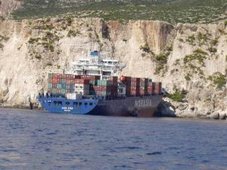
The m/v Pusha Bulker, owned by Lauritzen Bulkers, is a 738 foot/ 225/m, 76,741 mt, Panama Flagged Bulkcarrier, hauling coal, built in 2006 by Sasebo Heavy Industries Co., Ltd. The Salvage operations is being conducted by s Svitzer Salvage, a division of A.P. Moller-Maersk. It was reported and determined that the ship's hull was breached by the continued pounding of the waves.

As of this writing, the vessel could be stranded until late June and until tides and seas are favorable. Salvage continues, with the 22 member salvage team, stabilizing the ship, preparing it for re-float and transfering fuel and oil to tanks that are higher and not impacted by the waves.

There are some 20 marine and environmental agencies involved in the operations.

As you can see in the video, people lined the beaches in heavy rain and gale-force winds as the rescue operations retrieved the 22 member Filipino crew. Now just imagine the force of this storm that caused this vessel onto the beach.

Here ia another amazing photo, ( Courtesy of Cargolaw ).


This town will never forget the m/v Pusha Bulker. We will keep you posted....

RS