Showing posts with label hurricane felix. Show all posts

Thursday, September 6, 2007

Henriette and Felix Update


Hurricane Felix (Again these are very early reports!)


Summary

At the last observation, on 2007/09/05 9:00 UTC, tropical cyclone FELIX is a Tropical Depression with maximum sustained wind speeds of 13 m/s (48 km/h, 26 knots). Within 100km of its eye there are 2.7 million people. Within 200km there are 8.4 million people.

The storm is affecting the provinces Valle in Honduras (144.2 thousand people), La Union in El Salvador (371.1 thousand people), Comayagua in Honduras (268 thousand people), La Paz in Honduras (127.3 thousand people), Francisco Morazan in Honduras (0.9 million people), Olancho in Honduras (341.3 thousand people), Yoro in Honduras (401 thousand people), Choluteca in Honduras (355.3 thousand people), El Paraiso in Honduras (275.2 thousand people), Chinandega in Nicaragua (364.4 thousand people), Esteli in Nicaragua (186.6 thousand people), Madriz in Nicaragua (97.8 thousand people), Nueva Segovia in Nicaragua (134.7 thousand people). The closest 6 cities are Tegucigalpa, Comayagua, Talanga, La Paz, Danl¡, El Para¡so.

FEMA National Situation Update

Atlantic/Caribbean/Gulf of Mexico:
Hurricane Felix
Tropical Depression Felix

Felix weakened as it moved into Honduras, all coastal watches and warnings are discontinued but flooding danger continues. Maximum sustained winds have decreased to near 30 mph, with higher gusts. The center of Tropical Depression Felix was located near Tegucigalpa. Heavy rain and isolated thunderstorms continue over Nicaragua and Honduras and could produce life-threatening flash floods and mud slides.


Hurricane Henriette


Summary

At the last observation, on 2007/09/05 18:00 UTC, tropical cyclone HENRIETTE is a Tropical Cyclone Category 1 with maximum sustained wind speeds of 33 m/s (120 km/h, 65 knots). Within 100km of its eye there are 505.6 thousand people. Within 200km there are 1.6 million people. The storm is affecting the provinces Sinaloa in Mexico (2.3 million people), Sonora in Mexico (1.9 million people). The closest 6 cities are Yaqui, Navajoa, Huatabampo, La Curva, Campo Cinco, Colonia Militar.

FEMA National Situation Update

Eastern Pacific:
Hurricane Henrietta

Henriette is a category one Hurricane on the Saffir Simpson scale. Little change in strength is forecast prior to landfall. Maximum sustained winds are near 75mph with higher gusts. Hurricane force winds extend outward up to 15 miles and tropical storm force winds extend outward up to 125 miles from the center. The government of Mexico has replaced the Hurricane Watch and Tropical Storm Warning with a Hurricane Warning along the coast of mainland Mexico from Topolobampo northward to Bahia Kino. Moisture form the remnants of Henriette should make it into the southwestern United States during the next few days.

FEMA National Situation Update

Other Tropical Activity - Atlantic
Low Pressure


A non-tropical area of low pressure is located about midway between Bermuda and the northeast Florida coast. The associated shower activity has become more concentrated east of the center. A tropical or subtropical depression could form from this system today as the system moves slowly and erratically. An Air Force Reserve Hurricane Hunter aircraft is scheduled to investigate the system this afternoon.

Maritime Note:

This is an interesting report on wind effects on ships. Thanks Dennis!

New Zealand – report wind effect on ships

The New Zealand Transport Accident Investigation Commission (TAIC) issued the report of its investigation into two recent incidents where strong winds caused restricted limit passenger vessels to heel excessively and lose directional control. The report recommends, among other things, that operators in areas subject to sudden strong winds implement maximum meteorological parameters. MAR 05-212 (8/23/07).


Stay Posted!

RS


Tuesday, September 4, 2007

A CAT 5 "Felix" Makes Landfall

Hurricane Felix has made landfall in Northeast Nicaragua, northeast of Puerto Cabezas. Felix is now a Cat 5 storm.

Felix's current storm position as of
Sep 4 - 12:00 UTC is Latitude: 14.3
Longitude: -83.2 with maximum winds of 160 mph and a pressure of 935 mb.

During the morning hours Felix gained Category 5 strength from the warm Caribbean waters. This is a very powerful and dangerous storm.

Up to 40,000 Hondurans were evacuated to shelters but some 15,000 people were unable to find transportation and were forced to ride out the storm in their homes.
Its too early to report on any damage but we will be updating through out the day, so stay tuned.....


In the Pacific....

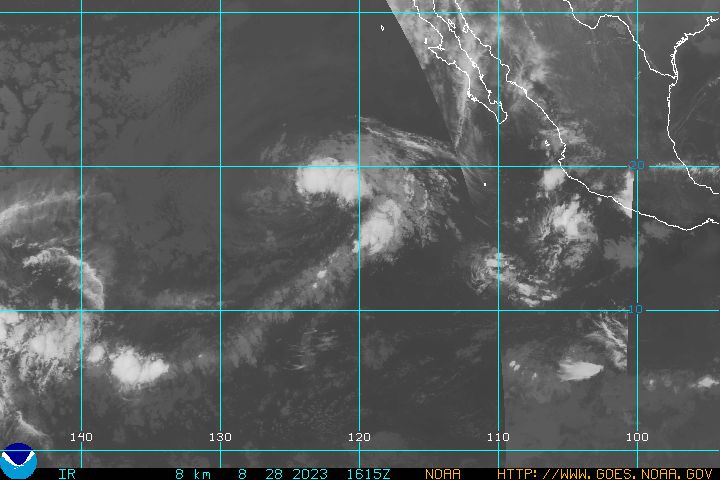
TS Henriette is now Hurrciane Henriette a Category 1 Hurricane with its outer bands approaching the southern tip of Baja California....

Henriette forecast storm position as of Sep 4 - 09:00 UTC was
Latitude: 21.4/ Longitude: -109.1
Maximum winds of 75 mph.


latest goes west infra red hurricane image


We will keep you posted!
RS

Felix Inbound Nicaragua UPDATED

This is an updated report.

Hurricane Felix a Category 4 and gaining strength. The storms current position as of
Sep 4 - 06:00 UTC is approximately 93 miles/ 80 nautical miles (Latitude: 14.3 Longitude: -81.9 off the Nicaragua coastline.

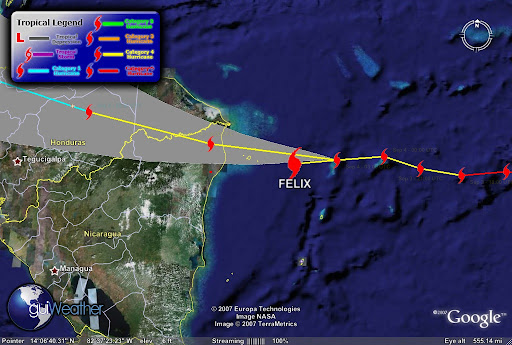
According to guiWeather track (see track below). The storms track indicates that the storm is currently deviating from its westerly track slightly to the south and if it maintains course will pass north of Pureto Cabezas on the Nicaragua coastline. The storm is packing maximum winds of 150 mph with a pressure of 940 mb.

Felix is moving toward the west near
20 MPH/32 KM/HR. A south westward track with some decrease in speed expected. The storm has strengthened and may further strengthen before landfall. Hurricane Force winds extend outward up to 35 miles and Tropical Storm Force winds extend outward to 195 miles.

This is a very dangerous storm. The deep ring of red in the satellite photo below indicate
intense thunderstorm or intense convection activity ongoing.


The track below also indicates that Felix is driving slightly south of it westerly track and will drive deep into Central America and we can expect
tropical torrential rains that can cause major flooding and mud slides in mountainous and low lying areas.


According to press reports," local officials pleaded with residents of Honduras, Nicaragua, Belize and Guatemala to evacuate low-lying areas especially Honduras’ nine offshore islands and otherwise prepare for inevitable disaster". Tourist have been evacuating resort areas jamming area airports.

On the Pacific side...

Tropical Storm Henriette is very close to becoming a hurricane. Henriette is tracking for tourist resorts in Baja California after killing seven people, five of them children, in Mexico's Pacific coastal state of Chiapas. Local Civil Protection Services reported that Henriette dumped torrential rains in Guerrero state on Friday, triggering a rockslide that buried six people in their homes in the resort city of Acapulco. Another man was killed when his vehicle was crushed under another rock slide in jungle ravine in neighboring Chiapas State.


TS Henriette current storm position as of Sep 3 - 18:00 UTC tracking North/Northwest at Latitude: 19.8 / Longitude: -108.3 with maximum winds of 060 knots with gusts to 075 knots.


Keep Posted!

RS

Monday, September 3, 2007

Felix the Cat -4 ! Update!

Central America is preparing for a battering by Hurricane Felix, which now a category four storm as it rages through the Caribbean.

Honduras expects to be hit Tuesday and has issued a hurricane warning for some coastal areas. With wind speeds now around 135MPH.

Felix was well above the minimum force for a category five storm. It comes just two weeks after Hurricane Dean killed 18 people in the region.


This makes Felix as well as Hurricane Dean stronger storms than any typhoons seen in the Pacific this year so far, even though Pacific typhoons are generally more frequent and powerful than Atlantic hurricanes.

Historically there have been 8 Category 5 hurricanes in the past 5 years (Isabel, Ivan, Emily, Katrina, Rita, Wilma, Dean, Felix).

This season there have been two Category 5's Dean and Felix; only three other seasons have had more than one (1960, 1961, 2005).


Felix is an awesome storm to watch. But its destructive power is something that we can do
without. Wind shear in the sector is very low and the hurricane is moving into the warmest part
of the Caribbean. Amazing drop to 64mb in just 24 hours. I have asked the NHC about this.
Though NHC thinkiing is that Felix may diminishing more in intensity when it hits the Honduran
coastline and then become a Cat 3 heading toward Belize. Will it pick back up as it enters
warmer waters?

We need to watch the track on this storm when it reaches the Bay of Campeche.

Stay tuned!

RS

The Persian Gulf and Hurricane Felix

Once again I am going to start the blog about something that this blog was not created for, politics and war.

However, serious rumors of war with Iran have now hit my industry and that is not a good sign.

Yes I have a political point of view. And since this is not a political blog I will keep my political views to myself.

There are a plethora of blogs both right wing and left wing that can confuse a group of rocket scientists, so just do a web search and knock yourself out if your all ready blindly deposed one way or the other.

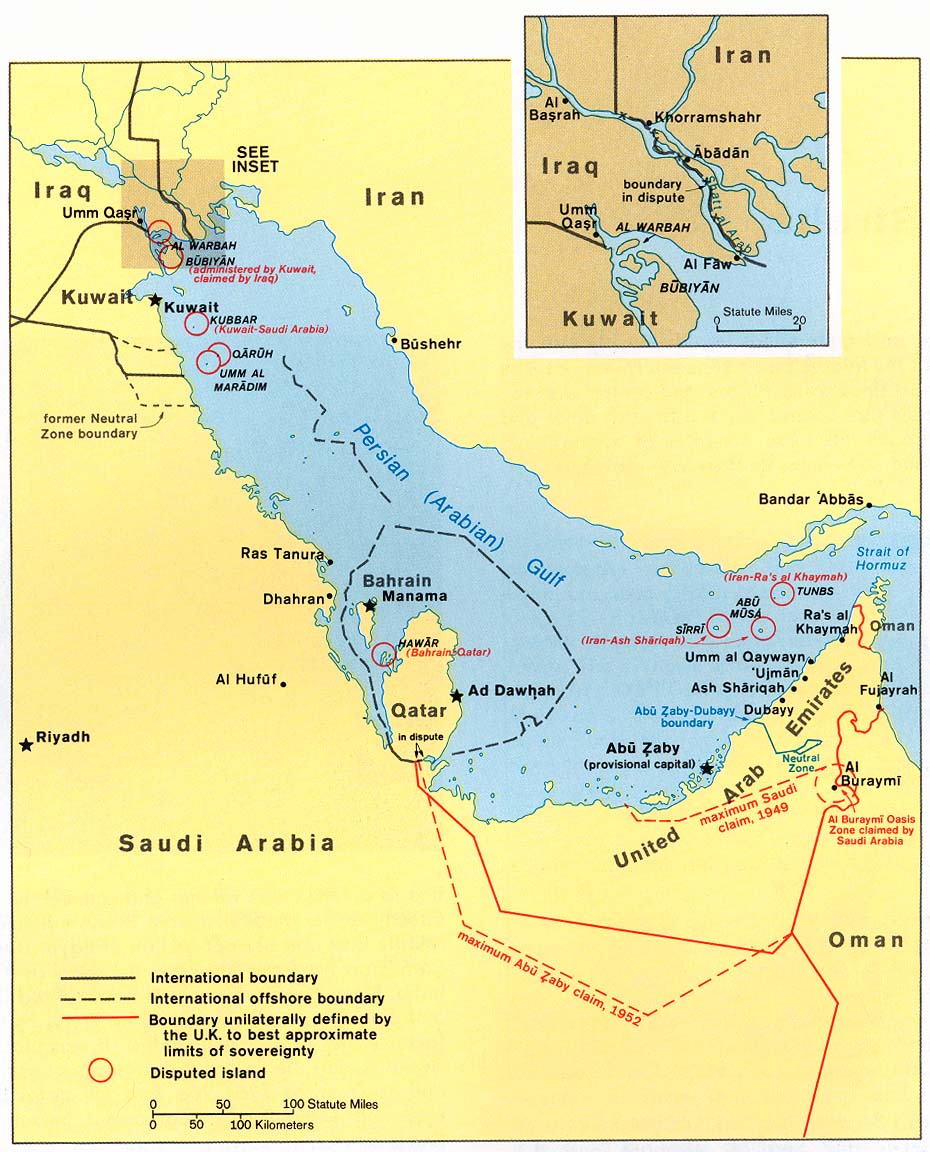
However as a professional marine salvor I wish to take a different approach in discussing the potential of going to war with Iran in the Persian Gulf .

The potential maritime and economic loss of war in the Persian Gulf to both sides as well as the rest of the world.

Most blogs and news reports focus on the ramification of going to war with Iran in terms of terrorism or in military terms. But there is another picture. The economic picture.
While I have no great love for the current Iranian regime and since I am sure, that most of the Iranian people do not wish to go to war with the United States, as most citizens of countries normally feel about going to war, unless they are attacked without just cause or buy a political hook, line and sinker. Yes we are not the only ones, try the German people during WWII and they paid a very heavy price, much heavier than anything we have ever paid.

While we are have the freedom of speech and opinion. Most of the time, none of us actually know what is really going on, but we all have some real interesting opinions. So I say to my readers, do not let the media or government meld with your mind, do your own research. And seriously research all sides then come to a conclusion.

Yes the United States Military is very capable of successfully striking Iran. Though we need to remember the British Falklands Island campaign. Ship losses took a heavy toll and we can expect the same thing in the Persian Gulf on both the military and merchant sides.

Daily in the Gulf there are some 30 merchant ships entering and exiting the Gulf every 24 hours. During both the Gulf War and the Iraq/Iran War the US and its Allies escorted some 9000 merchant vessel, even re-flagging some to the US Flag for additional protection. The Persian Gulf is a key economic waterway to the world.

Currently we have three Carrier Battle Groups operating in the Gulf. Depending on the mission each battle group can have as many as 12 or more combat ships within each of its groups. This is not just a strike force but a fleet protection force as well. Protection for both fleets, military and merchant.

Yes we know how and where to strike Iran and the Iranians know, we know, and they know how to strike back. Yes we are prepared to ensure that the Gulf remains open to the merchant fleet. You can also bet that the Iranians are prepared to attempt to close it down as well. They have done it before and odds are they will attempt it again.

So I end here. Not much has changed since the Iraq/Iran war except that weapons systems have advanced 10 fold and yes we have a huge advantage on that frront. But the same navigational and economic concerns and problems in the Gulf still exist.

Listed are some choice studies for my readers to start with. So as the political and media campaign to war starts remember, "do not let the media or government meld with your mind, do your own research" !


1. Iran-Iraq War 1980-1988
The Tanker War, 1984 - 1987

Much of Iraq's export capability was lost during the Iran-Iraq War, either to war-related damage or due to political reasons. In 1982, for instance, Syria (allied with Iran at the time) closed the 500-mile, 650,000-bbl/d-capacity Banias pipeline, which had been a vital Iraqi access route to the Mediterranean Sea and European oil markets. By 1983, Iraq's export capabilities were only 700,000 bbl/d, or less than 30% of operable field production capacity at that time.

Iran's revenue share fell after the 1978-79 Iranian Revolution, followed soon thereafter by the Iran-Iraq War for much of the 1980s. All Iranian onshore crude oil production and output from the Forozan field (which is blended with crude streams from the Abuzar and Doroud fields) is exported from the Khark Island terminal located in the northern Gulf. The terminal's original capacity of 7 million bbl/d was nearly eliminated by more than 9,000 bombing raids during the Iran-Iraq War.

The tanker war seemed likely to precipitate a major international incident for two reasons. First, some 70 percent of Japanese, 50 percent of West European, and 7 percent of American oil imports came from the Persian Gulf in the early 1980s. Second, the assault on tankers involved neutral shipping as well as ships of the belligerent states.

The tanker war had two phases. The relatively obscure first phase began in 1981, and the well publicized second phase began in 1984.


2. If Iran Provokes an Energy Crisis: Modeling the Problem in a War Game by James Jay Carafano, Ph.D. and William W. Beach

From December 2006 to March 2007, Heritage Foundation scholars conducted a computer simula­tion and gaming exercise that examined the likely economic and policy consequences of a major oil disruption in the Persian Gulf. The exercise utilized a realistic scenario, state-of-the-art macroeconomic modeling, and a knowledgeable team of subject-matter experts from government, business, aca­demia, and research institutes from around Wash­ington, D.C.

This project was a proof-of-principle investiga­tion that combined computer modeling and gaming to capture how U.S. decisions during a crisis might affect how global energy markets and the U.S. econ­omy adjust to sudden and significant disruptions of oil supplies. In this scenario, the United States responded to a crisis precipitated by an attempted Iranian blockade of the Strait of Hormuz.

3. The Future of Oil: Four Scenarios Standard & Poor's RatingsDirect

If anything underscores how geopolitical forces have played havoc with oil prices, it's the latest armed conflict in the Middle East, pitting the Israeli military against Hezbollah guerrillas in open warfare in Lebanon. Already heightened by the U.S.-led confrontation with Iran over its nuclear ambitions, fears about the stability of oil supplies have only increased since the Gaza bombings earlier in July and have intensified sharply since Israel began targeting Lebanon. The outcome is now even more uncertain than it appeared just a few weeks ago.

How long the conflict continues—and whether it spreads to surrounding countries—will determine the future of energy prices, at least in the short run. With Iranian President Mahmoud Ahmadinejad saying on July 25 that the fighting could trigger "a hurricane" of broader war in the Middle East, the prospects look dire to many observers—especially oil traders—around the world.

Having survived higher energy prices relatively unscathed so far, the U.S. economy is more sensitive to costlier oil now than it was a year ago. Inflation, even excluding energy, has accelerated, leading the Federal Reserve to raise interest rates 425 basis points in response. Consumers are already spending more than they earn. And Standard &Poor's expects the economy to slow down to 2.5% growth in gross domestic product in 2007 from an estimated 3.5% in 2006.

UNCERTAINTY PREVAILS. The falloff in U.S. growth means it takes a smaller shock to cause a recession than it did a year ago. Continued strong world oil demand, with usage in both China and Europe accelerating, will continue to put rising pressure on oil supplies despite a U.S. slowdown, thus raising the odds of an oil price surge causing a U.S. recession.

Whether the current Mideast conflict causes a recession depends mostly on how big the impact on oil supplies and prices becomes. This is still highly uncertain. At Standard & Poor's, we continue to believe that the most likely outcome is that cooler heads will eventually prevail and that oil prices will drop back from current peaks. (Of course, there are other, non-military factors—like hurricanes or production disruptions on the order of BP's [BP ] Aug. 6 closure of its Prudhoe Bay field in Alaska—that could have an effect as well [see BusinessWeek.com, 8/7/06, BP's Pipeline Trouble].)

4. TANKERS AT WAR - JAMES H. RAND 1984-1987
Published: 12 January 2001 00:00
Updated: 05 July 2006 17:09

In his first ‘Chairman’s Report’, in the 1984 Annual Report, Jim Rand noted that “promotion of free enterprise and safety at sea are key issues for INTERTANKO”.

Further, he added that “free competition has also for centuries been a cornerstone of American society”. Perhaps someone should have told the United States Congress. Although, for a change, no flag preference proposals gained any speed in Congress, American proposals for taxation of foreign shipping were tabled in 1986. These proposals required tax returns from foreign owners and planned to levy taxes according to American theories of the owner’s domicile rather than the ship’s flag - a burdensome intrusion.

American tax was not the main feature of this time. This was provided by the more spectacular events in the Middle East Gulf, where the Iran-Iraq War now made the waters of the Gulf one of its main theatres. Both sides routinely attacked non-military shipping regardless of its association in any way with either of the combatants.

In 1984, eleven Very Large Crude Carriers (VLCCs) were damaged beyond repair by military strikes. More seriously, 25 sailors were killed and 25 more injured in the attacks. Some tanker owners refused to sail their ships to load at the Iranian export terminal at Kharg Island, despite high freight rates obtainable.


Back to the Weather!

Latest on Hurricane Felix:

Felix becomes a Category Five!!

Felix's projected path is just north of Honduras, then Belize one more time!


And


- - click on image for animation - -

And

[full basin map of tropical cyclone activity]


More From Aruba!


Keep you posted!

RS