Wednesday, April 2, 2008

Calm after the storm

Calm after the storm

Tourism in Fiji was floored by the 2006 coup. But the island nation has plenty to offer and little to fear. Peter Bingham reports.

Fiji's greatest earner is on the ropes.

Tourism, which outstrips sugar cane production for income, is reeling from its third sucker punch in 20 years.

People from the main markets of Australia and New Zealand have stayed away in droves since the December, 2006 coup led by Colonel Frank Bainimarama.

It floored the industry after the governments of the trans-Tasman neighbours slapped grade one travel warnings on the island republic.

The flow of visitors from Australasia dried up overnight just as it did following the coups of 1987 (Sitiveni Rabuka) and 2000 (George Speight).

There are other pressing problems facing this interim regime such as corruption, drugs, street crime, roading, inflation and unemployment.

But tourism is its backbone and the industry is just staying afloat thanks to support from Europe, Asia, and the Americas.

Scraping itself back off the canvas is the Fiji Islands Visitors Bureau which has the job of getting Kiwis and Ockers back on its beaches.

And it has lofty aims.

"We have a target of 570,000 tourists in 2008 and we hope at least 100,000 of those will be Kiwis," Tom Valentine, the bureau's senior marketing officer, said.

"We have to be smart with our marketing. There is tough competition from our rivals in Indonesia, Singapore, Hong Kong and Thailand and our budget is minute compared to theirs."

By smart he means concentrating on things such as Fiji's allure as a wedding venue.

"That's a growth business. Someone gets married in Fiji every day and more and more tourists are tying the knot at our resorts or on our beaches."

Diving, water sports, cruising and backpacking are other top attractions.

The bureau was well aware of the dangers of dependence on Kiwis and Australians.

"We are always diversifying and can't rely on the golden goose to keep laying eggs. Recently Gordon Brown (England's new PM) agreed to wear a red flower behind his ear and appear on our advertising in London. We had huge hits on our website but their press took exception to their PM being involved in such a campaign and we had to stop."

You can't fault the optimism and enthusiasm of the bureau and inviting journalists over to view the state of the republic under military rule is part of the campaign.

Suva (Mr Bainimarama's base), was not part of the itinerary but there was no sign of the military anywhere else other than the Fiji Army's sevens team at a tournament in Nadi (they won it after a protest).

The first stop was two days at the Warwick Fiji Resort and Spa on the Coral Coast about midway between Nadi and Suva.

The second stint involved 48 hours on Tai (Beachcomber) Island and then two days on Denarau Island's Radisson resort.

WARWICK FIJI RESORT: A freak tidal surge caught the 250-room resort by surprise a few years ago sucking tables, chairs, fridges and other whiteware out to sea as the waters retreated.

"You should have seen them bobbing in the waves," long-time manager Jack Stark said.

"The electrical gear was ruined and the furniture "disappeared"; there were a few happy villagers I believe."

The quirk of nature didn't phase Stark. It just provided an opportunity to develop the vision he has for the resort.

"The waves smashed in to our southern end hardest and destroyed our store room. I'd been wanting to add a spa for some time so that's what we did."

This is a user-friendly resort. One wing is dedicated to family bookings and the other to adult visitors which provides welcome relief from the ankle biters. The same rules apply to the respective pools.

A wedding stopped plans for an evening meal in the Wicked Walu Restaurant, sitting atop an outcrop of rock and specialising in seafood.

Weddings are a big part of the Warwick's business. So much so that the guest pack itemises all costs from involved in tying the knot.

"Usually the biggest hiccup is couples forgetting to get a marriage licence. The office closes at 4.30pm on a Friday in Sigatoka and that's that ... no licence, no wedding.

"People see other couples getting married and want to do the same straight away," Mr Stark said.

Half an hour back down the road from the Warwick is the Kula Eco Park, Fiji's only wildlife sanctuary.

It was originally a bird park established in the 1980s but it was eventually abandoned and left in a shocking condition.

"We re-opened in 1997 with an elevated walkway and have built the park up to its current state over the past 10 years," co-owner Ramesh Chand said.

Iguana, falcon and ground frog breeding programmes are a key part of the park's business which employs 24 people.

"We are privately funded and have yet to break even but we see the park as a vital part of Fiji's education system," he said.

In their best year (2005), 40,000 people visited the park including 15,000 school children.

Illegal trade in iguana and native parrots was of concern.

"There is a case going on in Los Angeles now where a man is charged with illegally importing a pair of Fijian banded iguana with a street value of $30,000.

"We know locals have caught and traded native parrots for $100 each to passing yachties who resell them for much, much more. Fiji has no resources to control that so it is a concern."

The second tourist venue of the morning was Tavuni Fort Hill on the Sigatoka River.

It was the highly fortified settlement of Tongans who arrived on the island in the early 1800s.

It harbours the history of fierce tribal wars but lay overgrown for years once the Tongans were forced out by the British troops in 1876.

Clearing of the site began in the 1970s and once restoration was complete the fort was opened to the public in 1997.

Albert Kurivitu has been its guardian since clearing began and has a distinctive style as he tells tales of the site's bloody past.

"They were smart warriors and there were few ways to get in," he said.

"When the Fijian raiders came, many were caught and were dragged to the killing stone, held down, clubbed and carried off to be cooked and eaten."

Takeaways were born.

The killing stone remains although it mysteriously split in three once Christianity came to the island.

"Legend says it was God's way of showing the days of killing and cannibalism were over."

BEACHCOMBER ISLAND: I arrived late on this outcrop ... by about 30 years. This is the Ibiza of the South Pacific and I should have been wary when the ferry skipper announced it "was an island where the young go to get lucky". Comforting for a 54-year-old.

At first I thought I was at a conference of the illiterate.

A prominent sign clearly stated nude or topless bathing on the main beach was offensive to island staff.

Three girls couldn't read. But they could dance and were all go as the sun went down and the band tuned up.

An auction of hermit crabs for an "international" race was a highlight of the first night's entertainment and the only chance of a punt.

Marley of Jamaica won from Ronaldo of Brazil. Bruce Lee of China was scratched for wont of a bid and All Black of New Zealand (which I bought for $12) didn't get started just like in the World Cup.

This island offers cheap fare for the young tourists. Accommodation in a 90-bed dormitory goes for $88 a day which includes three meals-a-day and the food is outstanding. Drinks are extra.

This is definitely not the retreat for those in the health and safety game. The weekly visit of the supply freighter Kaiwai would have given them apoplexy.

There were the workers, unloading kegs, 44-gallon drums and other cargo in bare feet and baseball caps and not a missing digit to be seen. Even the tractor driver was shoe/bootless. What a refreshing sight.

RADISSON RESORT: Gate-controlled Denarau Island is home to a host of top-of-the-range resorts and the Radisson is as plush as they come and only three storeys.

Nothing in Fiji is more than three storeys because building law dictates no building can be higher than a mature coconut tree. I like that.

The bed in room 359 was as big as they come. You could lie crossways and still not touch the sides. Bit of a waste for a solo traveller, really.

The recreation area was massive with three pools and a shark-netted area for those preferring salt water.

But it was the Harmony Island section that intrigued me.

Not knowing quite what to expect, I ventured in and a very pleasant receptionist asked if I would like a look at one of the thatch roofed rooms.

The directions were unfortunately muddled in translation and I peeked in to an occupied unit much to the dismay of the occupant(s).

A very embarrassed Kiwi retreated to the bush with a brochure in hand.

This was a retreat to massaging bliss apparently and everything was itemised.

There was the basic 30-minute Harmony Island massage ($50), a stone massage which involved an hour of something, a four-hand massage and a massage for couples.

The last three set you back $190-apiece.

I was just sad I had run out of money.

The Radisson is directly opposite the 18th fairway of the Denarau Golf and Racquet Club, former home of the Fiji Open.

An early morning tee time was prearranged and I was joined by the only cluster of three Aussies encountered in three days.

They were good blokes, Damien (plumber), Shane (dairy farmer) and Mike (sales manager), but like me were bemused as to why Fiji re-routed its water system through the middle of the course.

In between more than a few birdies, pars, oaths and water-bound balls we did our bit for trans-Tasman relations and wondered why others from our countries took so much notice of government warnings. There is holiday danger because of the coup.

Peter Bingham travelled to Fiji courtesy of Air Pacific and the Fiji Islands Visitors Bureau.

WEATHER NOTE

Companies must plan for disasters

Dubai: The UAE's private sector needs risk assessment plans as companies need to be prepared for potential natural disasters among other risks and adopt international best practices, oficials say.

With the business continuity management system, companies will be able to assess their main operational areas, and plan and test necessary alternatives in case of disasters.

"Companies in UAE are aware of potential disasters but don't have actual plans in place," said Theuns Kotze, managing director for the Middle East and Africa, BSI, a management systems assessment services company, which is holding roadshows in the UAE this week.

Fragile

In a thriving economy such as Dubai, companies are dangerously unprepared for disaster. "A fast growing economy is fragile to potential disaster that can halt business. Companies here expect business to do well all the time, so they don't keep in mind that anything disastrous can happen," said Kotze, whose company will certify companies that have gone through the process of verified tests.

"An economy is only as strong as its ability to recover from disaster. If the companies are prepared, the economy will be prepared," Kotze said. "If companies struggle, the economy will struggle."

While natural disasters are hardly considered in Dubai, financial risks are very much assessed.

"A lot of companies are doing risk assessments as world prices go up," said Kotze. "Companies should not take risks that are not sustainable. Even if perfect alternatives cannot be found, companies need practical alternatives," he said.

The Northwest Indiana AMS/NWA Great Lakes Meteorology Conference

The 6th Annual Great Lakes Meteorology Conference will take place on April 5, 2008. It will be held at Old Town Banquet Center in Valparaiso, Indiana, and will feature keynote speaker Dr. Louis Uccellini, director of the NOAA National Centers for Environmental Prediction. Also speaking will be Dr. Jeff Trapp, Mike Umscheid, and Ginger Zee, among others.

REGISTRATION INFORMATION IS POSTED BELOW.

Doors open and registration will begin at 9 AM CST and the conference will officially begin at 10 AM CST. Continued

Watch for warning signs of severe weather

By Jim Nitz , Lincoln County Emergency Management Director

Once again, the severe weather season is approaching in Nebraska. While almost everyone is aware of the types of severe weather to be expected, there is a lot of information that people do not know, or tend to ignore, which can save your life in an emergency.

Almost everyone is familiar with the weather indicators which are indicative of pending severe weather; warm temperatures, high humidity and developing cumulus clouds indicating thunderstorm development with lightning. When these conditions are observed it is time to listen closely to the electronic media regarding weather conditions.

One of the best sources for information is a NOAA weather radio. With a NOAA radio, you can get weather forecasts as well as an alert tone if severe weather notices are issued 24-hours a day.

The National Weather Service office has back up generation capability to enable them to broadcast weather information to battery operated radios even if commercial power sources are interrupted. A complaint about the older style of NOAA radio was that it broadcast watches and warnings for the entire area covered by the local National Weather Service office whether your county was included in the watch/warning area or not.

The newer NOAA radios have a specific code built into them which allows you to receive only the watch/warning information issued for your county. And, NOAA radio can be used by Emergency Management to broadcast other emergency information that is not weather related. Severe weather forecasting has improved immensely over the past few years due to improved technology. Information now issued is very timely and forecasts indicate what time a storm could be entering your particular area and the severity of it allowing you and your family to take protective actions.

Watches
This is an awareness issue. When a severe weather watch is issued, it simply means that conditions are favorable for the development of severe weather in and close to the watch area. At this time, people need to check their emergency kit to and be prepared to move to a place of safety if threatening weather approaches.

Warnings
A warning is issued by the National Weather Service when radar, or a storm spotter, detects severe weather. Information in the warning will include the affected areas and the threats associated with the storm. Those in the warned area should seek shelter immediately. Last year, a severe thunderstorm drove hail through windows and across rooms in the Sutherland area. Severe thunderstorms can produce tornadoes with little or no warning. Occasionally, warnings can be issued without a watch already in effect. Warnings will be issued by the E911 center over cable television when received from the National Weather Service. But, depending on the age of your TV you may, or may not, receive them. This is due to a technical issue with the cable TV operator, not the E911 center. A NOAA weather radio is particularly important if you have satellite TV because you will not receive local warning information over satellite TV.

Sirens
There is misunderstanding as to what the sirens are supposed to accomplish. Most folks think the sirens are designed to wake them up out of a sound sleep in their homes. Depending upon the location of the siren and the direction and speed of the wind that may happen. But, the fact is the sirens are designed to alert people who are outside that something is occurring and that they should go inside and listen to the media for information. Federal law limits the audio output of sirens so that they don’t damage the hearing of those very close to them. While most people want to hear the sirens, the problem becomes one of “NIMBY”.

In other words, we need sirens, but “Not In My Back Yard”. A few years ago, the city of North Platte moved some sirens in order to provide more effective coverage of some areas of the city. All areas of the city are covered by at least one siren. Most areas are covered by two sirens that overlap the coverage area. And this does not include the sirens at Bailey Yard. Each siren covers an area of three square miles. In North Platte, a policy has been in effect for a number of years that sirens will be sounded if a tornado is approaching the city and gets within five miles of the city. This policy also applies to the Lake Maloney area for which the E911 Center controls the sirens.

MARITIME NOTES

Stricken cargo vessel off Esperance
31st March 2008, 15:30 WST

A Bahamas registered cargo ship is sitting 150 nautical miles off the Esperance coast after a fire forced it to shut down its engines.

Emergency services crews in Esperance are on standby while they wait to hear whether an evacuation or rescue is required.

The vessel, MSC Lugano, reported the fire to the Australian Maritime Safety Authority at 12.30pm today sparking an emergency response that included a search and rescue aircraft being sent from Perth to monitor the vessel.

A spokesperson for AMSA said the fire has been extinguished and the vessel's master was waiting for the engines to cool before the extent of the damaged could be assessed.

The spokesperson said none of the 25 crew had been injured in the fire and the ship was expected to restart its engines later this evening or by tomorrow.

"There are no pollution issues, the vessel is at anchor and not drifting, it is not sitting in any shipping lanes and no one is injured," the AMSA spokesperson told the west.com.au.

The 35958 tonne ship was travelling from Adelaide and Fremantle when the fire started.

JANE HAMMOND

RS

Tuesday, April 1, 2008

A paper worth reading!

Information Seeking Behavior and Viewpoints of Emergency Preparedness and management professionals concerned with Health and Medicine

Final Report

Prepared for the National Library of Medicine

By Murray Turoff and Starr Roxanne Hiltz

March 6, 2008

Executive Summary

A study for the National Library of Medicine (NLM) was conducted to assess the information requirements for health-related issues in emergency preparedness and response. The overall goal of the study was to identify the views of potential users about the most significant knowledge, information, and services they are seeking, some of which might be incorporated into the development of the Disaster Information Management Research Center (DIMRC) planned by the National Library of Medicine or into other related efforts.

The emphasis of the study was on determining the current information seeking behavior, existing preferred sources of information, and unmet information needs of professionals involved with the medical and public health aspects of emergency planning, preparedness, and response. The report summarizes responses to questions around the following topics: current sources, desired sources, organizing the information, examples of important materials and missing materials on the Web, librarian roles, information needs in extreme events, methods for dealing with information overload and organizing information, international issues, and level of experience with NLM resources. Detailed appendices include examples of grass roots efforts to mitigate information overload, a copy of the self report guide, a complete compilation of responses organized by type of respondent, and a list of international websites compiled by one of the respondents.

The study results address a full range of information needs, including the formal published literature, comprehensive databases for the management of specific types of disasters, practice-based documents that are typical of the gray literature, aids to developing and maintaining practitioner documents, and improved methods of organizing information of all types. Roles for librarians as well as disaster community experts were identified for enhancing access to important information at the time it is needed. Continued

Elementary Students Prepare for Weather Disasters

Severe weather season will soon be upon us and kids in the Kearney area will soon be a little more prepared to plan for it.

The Kearney Fire Department's safety trailer was on hand today as students from Bryant Elementary learned about severe weather. Firefighters taught students what to do when a tornado strikes as well as how to plan for a weather disaster.

The trailer will visit every school in Kearney before severe weather week April 5th through the 9th.

Disasters - Preparedness and Mitigation in the Americas Mar 2008

Peru Rebuilds Health Services Affected by the 2007 Earthquake

PAHO/WHO, with the support of the Spanish Agency for International Cooperation (AECID) and the Swedish International Development Cooperation Agency (SIDA), are supporting Peru's Ministry of Health and regional authorities with the health needs resulting from the earthquake of 15 August 2007 in Ica.

The project encompasses the construction of a maternal and child center in Pisco; recovery of services in the primary health network of Ica and Huancavelica; strengthening technical capacity for the epidemiologic surveillance system; improving the regional public health laboratory; and increasing coordination for disaster and emergency response among different sectors at the national, regional, and local levels by setting up Emergency Operations Centers and developing technical capacity.

The 7.9 magnitude earthquake, which affected several provinces, killing 519 people, injuring 1,366, and affecting 863,597 people. The public and social security health networks suffered considerable damage. According to official reports, 11 facilities were completely destroyed and 111 suffered different levels of damage. The 110-bed San Juan de Dios hospital was the most severely impacted. In addition to the health services, Pisco's water and sewerage systems were severely affected. There are major diffi culties in the process of latrine construction and supply of safe water, both in terms of quantity and quality. The management of solid waste, surveillance of food management, and proliferation of harmful fauna continue to be matters of concern.

For more information on progress in restoring health services in this area, contact Dr. José Luis Zeballos,at jzeballo@per.ops-oms.org.

Yellow Fever Outbreaks in the Americas

Yellow fever, commonly found in the tropical regions of South America and Africa, has two epidemiological cycles: jungle and urban. In the jungle cycle, the virus circulates in the primate population and humans are infected when they enter the jungle and are bitten by infected mosquitoes. Urban yellow fever was eradicated from the Americas (the last cases occurred in 1942 in Brazil). In mid-January of this year, Paraguayan health authorities detected an outbreak of jungle yellow fever.

The clinical manifestations of yellow fever virus infection are acute fever and jaundice (yellowing of the skin and eyes), followed by hemorrhage in 15% to 25% of infected patients. Case fatality can reach 50%.

Since the 1970s jungle yellow fever cases were limited to the northern region of South America. Between 1985 and December 2007, a total of 3,837 cases of jungle yellow fever and 2,229 deaths were reported.

In 2007 and at the beginning of 2008, six states in Brazil (Goias, Federal District, Mato Grosso do Sul, Minas Gerais, Tocantins, and São Paulo) recorded an intense and extensive increase in epizootic yellow fever. These outbreaks of the disease in animal populations were confirmed by laboratory and/or by clinical-epidemiological criteria through the State Health Secretariats. In January and February 2008, human cases were reported in three states (Goias, Mato Grosso do Sul, and the Federal District); of the 26 confirmed cases, there were 13 deaths. While the affected areas have high vaccination coverage, health authorities intensified vaccination campaigns for individuals over six months of age who had not been immunized previously and/or reside in/or frequent affected areas.

As of 21 February 2008, seven cases of yellow fever had been confirmed in Paraguay, all inthe rural area of San Pedro Department, about 300 km northeast of Asunción, the capital. Five other suspected cases were reported in Central Department, which neighbors Asunción; four of these cases died with signs and symptoms highly suggestive of yellow fever. If these cases are confirmed, it would validate the circulation of the virus in urban areas.

In response to these outbreaks, the authorities have expanded epidemiologic surveillance for the detection and testing of suspected cases. Yellow fever vaccination has been intensified in Asunción, Central and San Pedro departments, and in border areas in order to protect the population living in high-risk areas.

To achieve this level of coverage, approximately 3 million doses of vaccine are needed. Thanks to the support of PAHO/WHO, 850,000 doses are being sent from Brazil, 144,000 from Peru, and 2 million doses from the WHO Global Fund. With the support of the Spanish Agency for International Cooperation (AECID), the U.S. Office of Foreign Disaster Assistance (OFDA/USAID), and the Government of Italy, PAHO/ WHO has been able to implement emergency projects to intensify epidemiologic surveillance and vector control, increase laboratory diagnosis, expand communications about the risk, and carry out vaccinations in at-risk areas.

In Argentina, authorities reported that on 17 January 2008 dead monkeys were found in Piñalito park, in the department of San Pedro, province of Misiones. In February, yellow fever was confirmed in one of the primates through molecular techniques. Despite the high vaccination coverage in the area, authorities have intensified vaccination activities for previously unimmunized individuals who reside in or travel to the area.

Currently, the recommended yellow fever vaccination strategy is to direct efforts at the population that lives in, or is traveling to the areas where epizootics or human cases were recently registered and where risk of transmission exists. This approach avoids indiscriminate mass vaccination or revaccination.

PAHO/WHO is providing technical support through advisers from country offices and headquarters, in accordance with requests from the countries.

For more information, write to ugarteci@paho.org. In addition, the publications Control of Yellow Fever—Field Guide and Zoonoses and Communicable Diseases Common to Man and Animal, 3rd edition, can be consulted at http://publications.paho.org.

Floods: History Repeats Itself in Bolivia

The heavy rains produced by the La Niña phenomenon have left nine Bolivian departments under water. Flooding in Beni, Chuquisaca, Cochabamba, La Paz, Oruro, Pando, Potosí, Santa Cruz, and Tarija have affected 73,776 families and caused 63 deaths. The most affected areas are Trinidad, capital of the department of Beni (with 20,000 affected families) and the department of Santa Cruz (19,818 affected).

The floods reveal once more how vulnerable the population is to chronic hydrometeorologic disasters. There continue to be deficiencies in managing nutritional requirements and shelters and in gathering health information in remote areas.

Since November 2007, Bolivia has suffered from climatological phenomena that, according to experts, are more severe than those caused by El Niño at the beginning of 2007. The World Food Program (WFP) has reported that 80% of the people who suffered from floods in early 2007, suffered again with the recent heavy rains. The flooding has increased the risk of epidemics and there have been reports of cases of dengue, yellow fever, hemorrhagic dengue, hanta virus, malaria, conjunctivitis, diarrheal diseases, leptospirosis, and respiratory diseases.

PAHO/WHO has concentrated its efforts on coordinating disaster response in the areas of international cooperation, epidemiologic surveillance, vector control, mental health care, logistical support, and resource mobilization.

For more information, write to cgarzon@ecu.ops-oms.org

Investigating Weather Systems in the Montessori Classroom

North Carolina is in a severe drought. Currently, we are short approximately 10.5 inches of rain for the past two years. Severe water restrictions are in effect and hearing that neighboring towns have less than 100 days of water left is a frequent occurrence. That being said, we are entering our rainy spring season which also brings months of tornado warnings. Naturally curious, children want to know what causes weather, especially severe weather.

The Montessori classroom is a great place for children to learn, explore, and research naturally occurring phenomenon such as thunderstorms, hurricanes, and tornados. These concepts are usually introduced during the upper elementary years. Here, in North Carolina, we experience both hurricanes and tornados and this is enough to spur discussion and interest. If you live someplace where these weather systems do not occur, you can peak student interest by announcing that there are approximately 40,000 thunderstorms around the globe each day and that the class will have an opportunity to investigate how thunderstorms, hurricanes, and tornados form.

Before presenting these lessons to the children, it is important to have illustrative charts made of sea and land breezes, cold fronts, and warm fronts, as well as a map of high and low pressure systems and a variety of photographs (or video) of thunderstorms, hurricanes, and tornados. There is also a variety of vocabulary that needs to be explained before children can begin their investigations.

  • Sea breeze
  • Land breeze
  • Cold front
  • Warm front
  • High pressure system
  • Low pressure system
  • Convection
  • Coriolis effect

It may be helpful to watch the weather reports together over a period of several days in order to discuss and understand the terminology. You might also gather the weather report over a period of about two weeks and make predictions as a class as to what weather will be developing.

For more information for teachers, visit the National Hurricane Center website.

For informative, interactive games for students, visit Federal Emergency Management Agency website.

NAMC’s Upper Elementary Physical Geography curriculum manual provides background information and presentations on many weather related topics, including: Weather Systems and Weather Maps, Investigating Hurricanes and Thunderstorms, and Investigating Cold and Warm Fronts.

By AMANDA PODGORNY

When disaster strikes, strike back.

Preparing yourself for a natural disaster is not as difficult as it may seem.

Rich Gallati, operations manager for the DeKalb chapter of the American Red Cross, said there are three actions to take to be prepared for an emergency.

“What we’d recommend is to first get a first–aid kit and some first–aid training,” Gallati said. “Second, make an evacuation plan from where you are working or living, and the third step is to be informed.”


The American Red Cross offers numerous items for emergency preparedness.
These items include, but are not limited to: flashlights, AM/FM radio, emergency blankets and particle masks, as well as adult and youth comfort kits that include hygiene items. The youth comfort kit has crayons and a coloring book, as well as hygiene items. “The Illinois Department of Health does not do anything different from season to season,” said Melaney Arnold, with the Department of Health.

MARITIME NOTE

UK – update re wreck of MSC NAPOLI

The UK Maritime and Coastguard Agency (MCA) issued a Press Notice regarding the wreck of the MSC NAPOLI. In May, the salvor is scheduled to commence the breakup and removal of the remaining portion of the stern section. Work is expected to take approximately five months. (3/27/08).

Ships continue on way after collision in Mackinaw Straits; No pollution or spills reported

The U.S. Coast Guard continues to probe a collision that occurred Friday when a freighter went to the assistance of another vessel mired in ice in the Straits of Mackinaw.

Both the Cason J. Calloway and the American Republic were damaged, but neither took on water, Coast Guard Sector Sault Sainte Marie reported.

Marine inspectors checked both ships, and they were allowed to continue their voyages Saturday morning, said command duty officer Keith West.

The 767-foot Calloway, a USS Great Lakes Fleet self-unloader, travelled to Gary, Ind. for repairs and to unload its cargo of iron ore.

The Republic, a 634-foot self-unloading bulk freighter, owned by American Steamship Co., headed to Sturgeon Bay, Wis. to be repaired. The collision occurred about 3:40 p.m. when the Calloway was trying to assist the Republic, which was caught in the ice, about 15 miles west of the Mackinac Bridge.

The Calloway attempted to clear the ice impeding the other vessel when it sheered in the ice and made contact with the Republic.

Both freighters were damaged on the starboard side of their forward peaks.

No pollution or spills were reported, West said on Sunday.

A helicopter crew from Air Station Traverse City surveyed the collision site Friday and confirmed there was no sign of pollution

Ice congestion in the Straits, which connects Lakes Huron and Michigan, 87 kilometres south of Sault Ste. Marie, is heavy.

"Depending where you are at, it's a couple of inches to 18 inches of ice,'' said West, who indicated there wasn't much shipping traffic in the Straits Sunday.

RS

Monday, March 31, 2008

Why don't tornadoes hit cities more often?

Why don't tornadoes hit cities more often?

Joshua Wurman, president of the Center for Severe Weather Research in Boulder, Colo., whips up a response.


The glib answer for why tornadoes don't strike urban areas that often is: Cities are small.

If you take a look at Google Maps and see what percentage of the U.S. urban and suburban areas cover, it's a pretty small fraction. The regions where you have peak tornado frequencies—from Texas up through Kansas, and even east toward Atlanta and the Southeast—are open country, so that's where most tornadoes spend the overwhelming fraction of their lifetimes.

It's very rare that one encounters a city, as happened in Atlanta last weekend. In 1999 there was a tornado that hit Oklahoma City and killed about 40 people. It was a long-track tornado that lasted about an hour—but most of its lifetime was spent over pretty open country. It crossed two subdivisions, and that's where most of the fatalities happened.

The Atlanta twister has not been characterized as a violent tornado. Tornadoes are rated using the Enhanced Fujita (EF) Scale, which scores the damage caused by a particular twister on a scale from 0 to 5. Violent tornadoes are classified as EF4 and EF5, significant ones EF2 and EF3. EF5 damage is typically quite catastrophic: Houses are not only just destroyed but destroyed down to their foundation—no walls left standing--and the tornado might cause structural damage to larger, well-engineered buildings that are designed to survive even very intense winds. The tornado that went through Atlanta, although it broke lots of windows, didn't cause major damage to any downtown buildings. I believe that tornado has been rated an EF2.

As to whether global warming will increase the number of tornadoes—making it more likely that they will encounter cities—we have no clue.

Climate change predictions are uncertain, even on a global scale. One could be confident that the global temperature is going to go up; however, the error ranges on what's going to happen locally—whether the temperature is going to go up in Atlanta, or here in Boulder—are much wider.

In the case of hurricanes, there's a reasonable, if unproved, hypothesis that the storms might get more intense if global temperature rises and the surface temperature of the earth's oceans rises—after all, in terms of the physics, warm water is key to creating a hurricane. With tornadoes, you can't even make that basic statement because the effect of an increase in local temperature on tornado frequency or tornado intensity is unclear. Brazil is pretty hot, but it doesn't have a lot tornadoes. Oklahoma and Texas are really hot in July and August, but that's not the peak of their tornado season; spring is when those states see the most tornadoes.

So it is possible that climate change could shift the tornado season to earlier in the year as spring creeps into winter. Perhaps it will move the distribution of where the stronger tornadoes occur. A warming climate does not necessarily make for more tornadoes; it could cut off tornadoes completely or could cause their incidence to double.

WEATHER NOTE

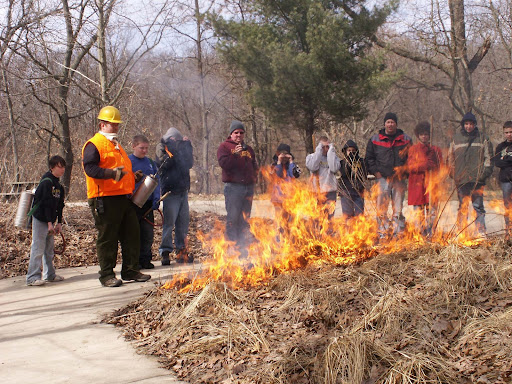
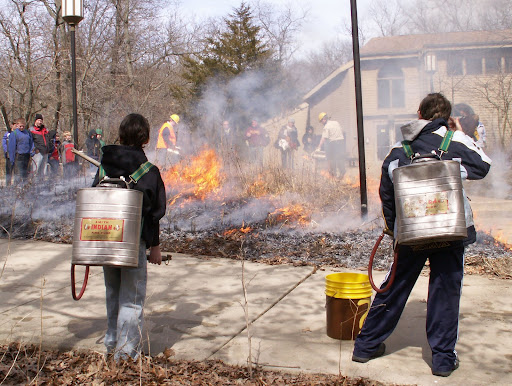
Brad Baumgardner of Indiana Dunes State Park showing the Boy Scouts how the parks department starts controlled burns.


MARITIME NOTE

Coast Guard struggles with homeland security

The Coast Guard is struggling to meet its homeland security missions in addition to its traditional missions, according to a new report from Homeland Security Inspector General Richard Skinner.

“The Coast Guard continues to experience difficulty in meeting its homeland security performance goals,” the report states.

The Coast Guard did not meet performance goals for two of its homeland security missions in fiscal 2006, the most recent year studied. The unmet goals were defense readiness, which it failed to meet for the sixth year in a row, and interdiction of illegal migrants, which it failed to meet in four of the six years surveyed, the report states.

The Coast Guard blamed the shortcomings on its aging cutter fleet, which sometimes made too few boats available for use. In the case of defense readiness, it also blamed limited time for training.

Setbacks related to the Coast Guard’s $24 billion Deepwater asset modernization program, which has encountered delays, cost increases and rejection of new assets because of structural problems, have contributed to the difficulties in maintaining a ready fleet, the inspector general said.

The Coast Guard is continuing to face difficulties in Deepwater, including problems with the Fast Response Cutters, the report states. The report also notes that the Rescue 21 program “ has been “plagued by delays, technical problems, cost escalation and a delay in full implementation, which has slipped by five years.”

Among its traditional missions, the Coast Guard failed to meet its performance measure for marine safety. It came very close to — but technically did not achieve — performance benchmarks for search and rescue, protecting marine resources, and aids to navigation. The inspector general said those were mostly technicalities, and the benchmarks themselves were imperfect.

The Coast Guard’s Deepwater and Rescue 21 programs have been among the largest contracting programs in the Homeland Security Department. The programs include not only ship construction but also acquisition of and integration electronics and computer equipment and software.

Alice Lipowicz writes for Washington Technology, an 1105 Government Information Group publication.


Slow going prevails in shipping season start
By JACK STOREY

ST. MARYS RIVER - Shipping traffic up and down the St. Marys River continued intermittently through the traditional first day of the season Tuesday.

Ships in the river overnight hove-to or tied up where they were to await daylight and the resumption of icebreaker escorts, starting with two thousand-foot self unloaders making the first downbound trips of the season.

Coast Guard operations manager Mark Gill said the 1,000-foot Indiana Harbor and Edwin H. Gott opted to lay over the nighttime hours at the Soo Locks pier wall after locking down late Tuesday. Gill explained that while the commercial ships waited, two Bay-Class tugs completed the initial opening of the often-troublesome West Neebish Channel in preparation for the two wide-bodied vessels due down early today.

He said Coast Guard ice escorts are suspended during nighttime hours because of very limited visibility and safety concerns. However, an extra hour of daylight in the evening and a bright moon overnight aided the tugs Katmai Bay and Biscayne Bay in their joint channel-clearing operation at West Neebish.

Downriver of that passage on the upbound side, a cluster of four ships waited in the ice overnight at Mud Lake before resuming their first upbound passages of the season in heavy ice conditions. Stewart J. Cort, James R. Barker, Algorail and Canadian Transfer were all expected to get underway early today after waiting out the night in the ice.

Gill expressed some worry about the West Neebish Channel, even though the wide, powerful thousand footers are ideal vessels to attempt first passages through the ice-congested channel. “We'll see how it goes,” Gill said of the often ice-choked West Neebish.

Gill said he also expects ice trouble later a short distance downriver at two other traditional choke points - the Moon Island turn, Winter Point an in Mud Lake itself.

Addressing traffic in the other direction, Gill said he expects ice trouble off Stribling Point, where the upbound channel turns sharply around the northern end of Neebish Island.

Above the Soo Locks, downbound shipping traffic seemed to be moving well enough early today. The Canadian vessel CSL Laurentian followed the two thousand footers downbound shortly after daybreak today. Despite a westerly wind that tends to pack broken ice into Whitefish Bay, two vessels - John J. Munson and Algoville - were reportedly making way downbound at various points on Whitefish Bay.

On the Straits of Mackinac, the steamer Philip R. Clarke was reportedly beset in the ice there. With St. Ignace-based Biscayne Bay otherwise occupied on the St. Marys, Gill said he hopes incoming shipping traffic on the Straits will free the stranded Clarke without pulling a tug off the lower St. Marys.

Eventually, he said he hopes to have the Bay-Class tug Mobile Bay available from Green Bay to stand in on the Straits.

The site of a ferry-stopping ice jam on Monday and early Tuesday, the Sugar Island ferry crossing cleared of ice from ship traffic and a shift of the wind late in the day on Tuesday. Ferry service back and forth to Sugar Island and Sault Ste. Marie was suspended for several hours at a time on Monday and early Tuesday.

Gill made it a point to publicly thank the US Army Corps of Engineers for assigning the Corps tug Owen Frederick to ice-clearing efforts around the Sugar Island ferry crossing. Frederick worked in tandem with the larger Katmai Bay in the tedious work of breaking up the ice jam that idled the ferry Sugar Islander II.

Gill said the loan of the Frederick was emblematic of a close working relationship between Corps and Coast Guard. The extra icebreaking tug came in very handy in the close-clearance Sugar Islander passage at Mission Point, Gill said, repeating his thanks to the Corps of Engineers.

The Coast Guard official held out some hope that additional icebreaking help will become available from farther west as the struggle with heavy river ice continues. He said at breakout, the Coast Guard can usually count on at least three Bay-Class tugs for the ice-choked lower St. Marys. However, heavy ice at Green Bay, Port Huron and at several ports on Lake Erie tied up available icebreaking vessels just as the river began to clog this year.

More a matter of ice clearing that ice breaking, the job at hand is one of influencing broken channel ice to flow downriver more easily. Or, as Gill put it, “... Breaking big chunks of ice into smaller ones.”

He suggested the going will be slow for early season shipping until several big vessels have cleared the St. Marys in both directions over coming days. He said the weather - always a major player in ice season - appears to be somewhat favorable with gradually moderating winter temperatures in the forecast.

Well aware that more ice trouble is always possible before the thaw sets in for good, Gill said, “We're not out of the woods yet.”

Ships that ply the lakes

Posted By Skip Gillham

Calumet, a former member of the Grand River Navigation fleet, rests in the outer harbour at Port Colborne. The ship was sold to International Marine Salvage in November following a minor accident at Cleveland. The laker is waiting its turn at the scrapping berth.

This vessel was one of the oldest, and many say one of the best looking, ships on the Great Lakes. It dates from 1929 and originally sailed for U.S. Steel as the Myron C. Taylor.

The 185.85-metre long steamship operated in the ore and coal trades and had a three-tiered pilothouse to provide extra accommodations for corporate guests.

U.S. Steel had the Myron C. Taylor converted to a self-unloader in 1956 and it was transferred to its Bradley Transportation division for work as a limestone carrier. With the development of taconite ore pellets, the ship experimented with an early delivery of this cargo and was a success.

A Nordberg diesel engine replaced the original triple-expansion steam plant in 1968 and this, along with its self-unloading abilities, led to the prolonged 78-year career.

While most of the ship's service was on the upper four great Lakes, Myron C. Taylor came through the Welland Canal on Dece. 1, 1983, with sand for Hamilton. It also called at Port Colborne to load stone in 1987 and brought salt to a Lake Ontario destination in 1998.

The ship joined Grand River Navigation as Calumet in 2001, and occasionally returned to the Niagara area. It is shown at Sarnia on May 17, 2005, in a photo by Marc Dease.

Age, plus extensive use in the salt trade, led to a decision to retire the vessel at the end of 2007. However, when the ship was damaged hitting a dock at Cleveland on Nov. 15, 2007, it was sold for scrap rather than make repairs for another few weeks of service. Calumet arrived at Port Colborne on Nov. 19 and, after the remaining fuel had been pumped out, the ship was towed to the scrap berth the next day.


RS

Friday, March 28, 2008

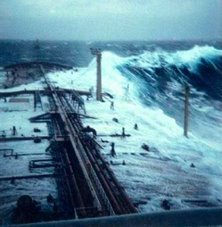
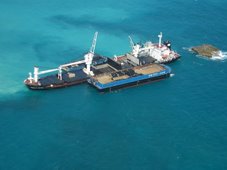
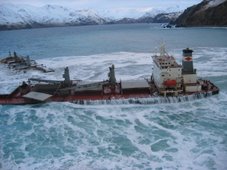
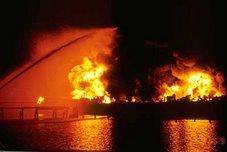
DRAMATIC INCREASES IN MERCHANT SHIP TOTAL AND PARTIAL LOSSES

DRAMATIC INCREASES IN MERCHANT SHIP TOTAL AND PARTIAL LOSSES

There has been a dramatic increase in the number of ship total and partial losses, and the upward trend looks likely to continue.

New statistics released today by the International Union of Marine Insurance (IUMI), which represents marine underwriters worldwide, indicate that the total figure for the 2006 year has jumped from an early estimate of 67 to 92 (all figures relate to ships of 500 gross tons and over), an increase of 37%.

Reported so far for 2007 are 82 total losses (compared to 67 for 2006 at the same point). If reports increase at the same level as 2006, says IUMI, by March 2009 the total will be 112. The downward trend of total losses over recent years, therefore, will be sharply arrested.

There has been an equally dramatic increase in major serious or partial losses. IUMI states: “727 serious incidents have been reported for 2006, a 6% increase since the last report, and a staggering 914 so far for 2007. This is a 270% increase in one decade, 1998-2008.”

The statistics, relating to the marine and offshore energy markets, collated and analysed by IUMI’s facts and figures, ocean hull and offshore energy committees, are based on information from a number of authoritative sources, including Lloyd’s Marine Intelligence Unit, Clarkson, Rigzone, Willis, and the International Association of Drilling Contractors.

Other highlights are:

The increase in tonnage lost in 2006 since the March 2007 report is 40% (508,141 gross tons has risen to 715,032 gt). Tonnage lost in 2007 is slightly down on 2006 at the same point – 481,741 gt.

The increase in total losses is also noticeable as a percentage of the world fleet where the percentage of tonnage lost has almost doubled from 2005 (0.06%) to 2006 (0.11%), with 2007 at this stage being 0.08%.

Weather remains the major cause of total losses but collisions have overtaken groundings as the next most common proximate cause. Of the weather losses, a total of 14 general cargo vessels over 25 years old were total losses in 2007.

The 270% increase in major serious losses over the 10-year period is equivalent to 0.64% of the fleet suffering a serious partial loss in 1998 to 1.73% in 2007. Machinery damage continues to be the major cause of serious partial losses, with a frequency of approximately 35% in the past five years.

In the offshore energy market, there is a long-term trend towards greater severity of the average loss since the early 1990s. However, the average loss frequency for 2005, 2006 and 2007 does not appear significantly higher than that seen in the early 1990s.

Analyzing the offshore losses, excluding the spate of hurricanes in 2004/5, there is a moderate trend for an increase in loss attributable to mechanical failure and design/workmanship.

Commenting on the statistics, Deirdre Littlefield, the New York-based president of IUMI, said: “These figures underline the relentless surge in marine claims that has come about due to a number of factors, not least being the shipping boom itself with ships and crews being driven harder than anyone can remember. Further, the figures dramatically demonstrate the volatility of marine risks.

“Regrettably,” she added, “this dangerous spiking of the casualty graph is happening when the worldwide premium base for marine insurers is flat and competition is rife. Underwriters are struggling to obtain realistic increases in their pricing of risks. But they can and must help themselves by showing discipline and practising responsible underwriting.

“Risk calculation, not risk taking, must be the underwriter’s primary concern.”

A new feature of this year’s statistics and analysis concerns cargo insurance. IUMI says that 2007 was another exceptional year of development in world trade. In just five years, the volume of goods moved by sea has risen by 50% and values by more than 110%.

The demand from emerging markets is still high, and also contributes to the massive increase in prices of raw materials: iron ore and scrap metals up by 200% since 2000, crude oil by 137%, coal by 130%, agricultural products by 55%.

“This creates a very positive environment for cargo insurers,” states IUMI. It adds that although undoubtedly there are uncertainties in the future, there has been no sign of a slowdown in trading activities.

In its shipping analysis, IUMI notes the continuing growth of the world tanker fleet, with 412 vessels delivered in 2007 and only 75 scrapped. However, a net growth of 337 compares with the much stronger net growth of 411 tankers in 2006.

A significant increase in the bulk carrier fleet is evident, with a net growth of 312 vessels (261 in 2006).

Also, “extraordinary growth in the container sector continued in 2007, with a net increase of 350 vessels (344 in 2006), and an increase of 2.623m. TEU capacity. Overall, the container fleet has reached 10.742m. TEU.

In shipbuilding, more than 80% of contracted gross tonnage is with South Korea, China and Japan.

Scrapping of the tanker and bulker fleets remains very low, about 0.5% of the world fleet in both sectors. Unsurprisingly, only 13 bulkers were scrapped in 2007, compared to an average of 125 per annum between 1998 and 2006. Scrap prices have reached a new high of $500 per lightweight ton.

Freight rates in the bulker market reached an all-time peak of over $40,000 a day – against $7,500 in 2002. However, tanker earnings dropped sharply in 2007, being approximately $30,000 per day, compared to nearly $40,000 in 2006; but this remains strong compared to the $20,000 in 2002. In 2007, secondhand tonnage prices in the bulker sector reached a new peak of $1,200 per dwt, comfortably exceeding the historical high for new buildings at $900 per dwt.

In its analysis of mobile offshore drilling unit statistics, IUMI says there has again been significant growth in the size of the world fleet, currently standing at 937 units. But the 49% increase since 1999 has not been reflected in the Gulf of Mexico where the fleet size has been largely static.

The surge in construction activity continues, it being estimated that 142 units are due for delivery between this year and 2010. By that year, comments IUMI, the contracted fleet will be 889 units, a 98% increase since 1999.

All the statistics and accompanying graphics can be found on the title page of IUMI’s website, www.iumi.com -ENDS-

NOTE

IUMI currently has 54 national associations as members, protecting and advancing their interests. It also provides an essential annual forum to discuss and exchange ideas, information and statistics of common interest. IUMI’s roots date back to 1874.

ISSUED BY: Denzil Stuart Associates, 67 George Row, London, SE16 4UH

Tel. +44 (0)20 7231 9963 / Fax +44 (0)20 7232 1738 / Email: ds@dsa-pr.com

Robins Note

Since 1 January 2008 there have been some 352 casualties worldwide of which some 88 were caused by heavy weather. The loss of life to date totals some 112 seafarers and passengers.

MARITIME NOTES

Jeff Charlton of 911team.org in London asked a interesting maritime question on the IAEM list-serve the other day that I thought needed to be answered.

Jeff's question?

"What if the need arises to replace a master or pilot because the ship has been affected by plague, terrorism, CBRn incident? How many have the competence or training to work in level A or B PPE (personal protection equipment)?

How many crew could assist him if a vessel was out of control? What if a ship was utilised as a terrorist vector agent and required mobility rather than destruction?"
So thanks to my shipmate at gCaptain here is the response by John Denham a former SF Bay Pilot.

First, who will be in charge. The COSCO BUSAN incident is a current example of the lack of a single responsible agent with authority to mobilize, coordinate, and direct a catastrophic event recovery operation in the San Francisco Bay area. The closest single authority to my knowledge is the Bay Area Conservation and Development Commission (BCDC) Yours truly a member of the Scientific and Technical Advisory Committee. As a state ( next level of responsible government) agency , BCDC has the civic and political sub-structure ( members from all contiguous communities) to organize, coordinate and direct what ever exists to respond, but lacks any experience. 9/11 experienced a similar problem to a lesser degree as only New York city was involved. Leadership is the critical survival element.

Second: Consider a nuclear weapons attack with CB fallout-out directed on the city of San Francisco. Without details consider San Francisco and the immediate 15 mile area is devastated. In such a scenario the leadership would probably come from out of the area. Sacramento would probably respond, and in so doing would call for federal assistance; that politically implies we can handle it but need help The federal government will probably respond with support, i.e. we will take charge and fix things as we see fit. And that may be worse than the bomb.

I have an ID card identifying me as a Department of Defense employee and shipyard pilot at the Mare Island Naval Ship Yard. I have no idea what program that was and I have no idea what I was to do; I left that job in 1981. But under the Civilian Defense organization, at one time there was a plan for identifying and organizing critical persons.

Some one (authority), will eventually make a decision that vessels must be moved, for some reason. Some to depart, some to arrive. Some just to be moved from A to B. The bay waters to my knowledge will be basically unaffected by the destruction and bad effects of man's attempt to resolve a problem with explosives. Therefore it is considered safe to move about on the water if there are no navigation restrictions e.g., bridges blocking passages .

Case 1: a heavily contaminated vessel must be moved from a pier to anchorage . The availability of a pilot is questionable as only those that live out side the bay area are probably unscathed, but the "authority" has quarantined San Francisco. No one in-out without permission.( A CD ID badge would be nice). Probably some tugs will be serviceable but crews are questionable due to blast damage, radiation and CB fall-out. If tugs are available and the decision is critical, then one tug ,with an experienced tug master and a couple SF Fireman with "bunny suits" can move the dirty ship to anchorage. It may not be a professional " no paint scratched" job but the ship is out and away from the pier. Some hero has to let go the ship's anchors. Any SF Fireman can do that (no USCG papers required) But he has to be properly clothed, unless the time exposure limit is acceptable, and instructed. Anchoring a ship is a technique, no skill required but instructing some one to do it properly is a skill. The average fireman will probably need 10 minutes of instruction to learn to lift the pawl, disengaged the wild cat and release the brake; and when the chain stops running, tighten the brake, drop the pawl and haul ass. Let the current do the rest.

Pilots are mostly needed for ship handling, docking, undocking and directing tugs. For expert, non-accident and timely ETA and ETD maneuvers they excel but if none of the professional criteria is required any one with a basic understanding of ship handling and seamanship can navigate a vessel from A to B. Local knowledge is helpful, but in an emergency one must use what is available. On December 7, 1941 a junior officer got a battleship underway to exit Pearl Harbor. He was not a qualified OOD.

An essential in bay area navigation is an understanding of the tides and currents. Any licensed deck officer should be able to determine the current and tide, many yachtsmen are more proficient than harbor pilots in that. Essentially one cannot expect perfection in emergencies, only results are needed.

Case 2. Terrorism is a case special situation. As I see it, there is no defense or procedure to deter a captured vessel proceeding from sea at full speed and ramming the south tower of the Golden Gate Bridge, or proceeding into San Francisco Bay to hit some thing. Frankly there are no worthwhile targets, except

may be making the evening news. However detonating a weapon of mass destruction is another case, and that has been presented. Piloting and navigation will have little affect.

Case 3. Any ship that is uncontrolled, unmanned and or not boardable. is a situation the USCG must resolve and as far as I know they have no afloat equipment readily available to manage that situation. With local help and time it is possible to disable the propeller; with tugs forcibly change the direction of movement and intentionally ground the vessel.(Alcatraz is handy) .If perchance a team of USCG personnel could be landed on board, say by aircraft ,VTS or a harbor pilot could communicate direction for navigation via radio to safely route the vessel to some alternate solutions e.g., grounding east of Treasure Island.

Case 4. A contaminated vessel or one with severe contagious disease is allegedly covered by government and international regulations requiring status ":pratique" be resolved before entering a port. In that case, the ship would anchor off shore in a quarantine status until the health situation was resolved. No pilot required. There have been cases where the USCG has crewed a vessel and brought it into port with the use of U.S. seaman. If, the culprit did not request entry and order a pilot he would not be boarded by the pilots and therefore be reported to the USCG. However if a renegade vessel attempts to sneak into the harbor, only the pilot boat, if on station, is available to report it to the VTS. However a USCG off shore surveillance radar may detect the rascal and attempt communication. Again the USCG has a flotilla of small cutters in near ready status to respond. A 15 knot ship will be in the bay in 45 minutes.

My experience with weapons, piloting and terrorism leads me to believe that the most probable man made scenario is a shipboard launched threat toward the harbor in Oakland for effect (less people but greater economic affect) or a strike to downtown San Francisco ( more people less affect). Essentially, there are no essential strategic target in the bay area at this time. Natural disasters such as earthquakes, hurricanes, tsunami or political rampage must be viewed as to degree of effect. Earthquakes, tsunami heading the list.

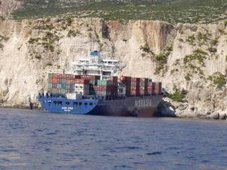
USA. MSC Napoli stern to be removed from Lyme Bay in May

Thursday, 27 March 2008

Work to remove the remaining section of MSC Napoli from Lyme Bay will begin in early May 2008. The remaining part of the stern section of the vessel remains aground in Lyme Bay with a list of 40 degrees to starboard.

Shaped explosives will be used to remove the propeller, the rudder, and to cut the propeller shaft. They will also be used to weaken the structure of the main engine to assist its removal. The aft section will then be systematically removed. The whole operation is expected to take roughly five months. SOSREP (Secretary of State's Representative for Maritime Salvage and Intervention) has made the decision to cut up the remaining section and take it away in small pieces, rather than removing it in larger pieces, following analysis of all options available. The option to cut the remaining section into smaller pieces is preferable since there could be issues with anchoring and cutting through the main engine and propeller shafting if the stern were cut up into larger pieces.

A pollution control plan will be in place throughout the entire operation. Following removal from the site, material will be transhipped to Holland for recycling. On completion a full underwater survey will be carried out to ensure that the seabed has been cleared of all recoverable debris from the MSC Napoli.

Throughout the winter, weather permitting, contractors have been conducting an inspection of the wreck, in daylight, on a fortnightly basis. When on site they have been checking for any change in status of the wreck and any evidence of pollution. They have also been recording photographs showing the status of the wreck. Inspections have been co-ordinated with periodical aerial inspections which have been carried out by MCA surveillance aircraft.

The Napoli's owners also have a response team from DRS, based in Branscombe, who have been monitoring the wreck and the Branscombe area daily. They have been patrolling and clearing any material which may have originated from MSC Napoli from all beaches in the Lyme Bay area.

Despite periods of severe weather over the last few weeks there is still no change in the status of the wreck.

Coast Guard Rescue: 4 Dead, 2 Missing Off Alaska


The Coast Guard says four crew members are dead and one missing after a Seattle-based fishing boat sank off Alaska's Dutch Harbor. The other crew members who abandoned ship were recovered safely. (March 24)

Spring is here ...we think?
Enjoy your weekend!

RS
Flag from the bridge.....
Congrad's to John Konrad of gCaptain who is a dad for the second time.....

Thursday, March 27, 2008

Preparing for disaster

Preparing for disaster

NEW YORK -- A new computer modeling program can help government, law enforcement, and first responders figure out how to react to disasters and best help people affected by catastrophes.

Planning with Large Agency-Networks against Catastrophes, or Plan-C for short, is a program developed at New York University's Center for Catastrophe Preparedness and Response. The program allows disaster relief agencies to simulate a catastrophic event like a hurricane or terrorist attack. But unlike other modeling software that runs similar simulations, this one also tries to predict how citizens will react, based on a whole slew of factors including their level of fear and how much they know about what's going on.

“The way you should approach disasters, that there are an infinite number of [factors] - the weather's good, the weather's bad, the people are all elderly, it's a festival of children or whatever it is,” said Lewis Goldfrank, NYU’s Chairman of Emergency Medicine.

Most crisis scenarios are pretty rare, but where local, state, and federal officials value this new software for helping them prepare for the most unexpected of the unexpected situations.

"And you've got to understand that the world has so many vulnerable people and so many special populations, that you've got to design your work to address all the critical issues," continued Goldfrank.

“We don't see hurricanes of category 4 in New York City, but if we had one we'd want to know the impact would be,” said Commissioner Joseph Bruno of the New York City Office of Emergency Management.

“That's really a pretty basic model - what kind of housing we have, how many people in the zones, what we can expect, how many we move out. Plan C gives us kind of a more sophisticated view of that impact,” continued Bruno.

Plan C has been in development for three years, and NYU now plans to get input about the program from local, state, and federal officials, in order to better tailor it to their particular needs.

news-leader.com

March 26, 2008
Preparing for disasters

Convoy of Hope program helps groups respond.

Linda Leicht
News-Leader

In the Springfield area alone, there have been at least six weather disasters in less than two years -- including ice storms, tornados and flooding.

Rob Clay, associate director of Convoy of Hope's U.S. Disaster Response, said Tuesday such disasters have heightened the need for preparation and response, especially on the part of the faith community.

"How can your church minister to the community in times of emergency?" Clay asked about 200 people gathered Tuesday, representing churches and other faith-based organizations from around the Ozarks.

He answered that churches -- like every organization -- must engage their members in personal preparation so they can then turn to community outreach.

Tuesday was the first gathering of HOPE (Helping Others Prepare for Emergencies) Begins Here, a new project of Convoy of Hope, a faith-based organization that responds to disasters around the world.

The program is delivered in three phases -- the first to the faith-based community, then to businesses and other organizations April 23, and then a preparedness festival for families May 3. It is meant to help organizations learn how to respond to emergencies of all types, for their members and communities.

Springfield, Convoy's home base, is the first community to host the series. Convoy plans to take it around the country.

Ice Storm

The ice storm of January 2007 became a learning opportunity for many churches in the area.

The American Red Cross turned to churches to serve as shelters for the hundreds of people who were left without heat or power, some for more than two weeks.

Debi Meeds, executive director of the Greater Ozarks Chapter of the Red Cross, said the lessons learned in those weeks have helped churches and the Red Cross recognize their interdependence.

"We have proven that when churches and the Red Cross partner together amazing things can happen," she said.

Mistakes have also been educational. With the obvious need arising, some churches opened their doors without first coordinating with the Red Cross or any other outreach agencies.

Meeds said after the first few hours, many of those churches realized they needed more help. Their calls for help put additional stress on the Red Cross, which sometimes could not provide what was needed.

As churches opened their doors and hearts to their neighbors, they didn't always realize that other churches nearby were also open, she said. In that way, resources were not being used wisely.

Another problem was that the public was not informed about some church shelters because the media was unaware of them.

The Red Cross's First Steps program allows churches and other facilities to be utilized in the best way for the community and for the church, said Chris Harmon, disaster services coordinator.

Schweitzer's Efforts

Schweitzer United Methodist Church in Springfield has been active in the disaster ministry.

Ed Hewlett, who heads up the ministry, talks about how the church was able to accomplish that.

In 2003, when Hewlett began the ministry, the church had no plans for a disaster. Since then, Schweitzer has not only served as a shelter in times of need, the church has been able to reach out beyond its doors to other communities and other churches, he said.

"You can't budget for it," he admitted.

The church's emergency response trailer, truck and about $20,000 in equipment were all donated, he said. And the work done has been accomplished by volunteers.

"You have to realize this is a ... ministry, not a program of the church," Hewlett said.

But before that ministry could be implemented, the church had to have plans in place. "If you're not prepared, you're part of the problem," he said.

Schweitzer is now a designated Red Cross shelter, housing both those affected by disasters and volunteers who have traveled here to assist. The church also has a regular outreach to churches that are serving as shelters in other communities.

Last summer, the church was the first in the area to be designated as a point of dispensation, or POD, in case of a pandemic or bioterrorist event.

In the case of a flu pandemic, the health department has arranged for several places where the public would be able to obtain anti-viral medication, such as Tamiflu or Relenza.

But staying out of public places is an important part of controlling a pandemic, said Molly Holtmann, health department pandemic health planner.

Organizations would be asked to take care of their own, she said.

Schweitzer volunteers have been trained to distribute the medication to its membership, something every church should do, she said: "We have to take care of each other," she said.

Schweitzer has also participated in the Community Emergency Response Team training through the Office of Emergency Management in Greene County.

"Churches need three or four CERT members in the congregation," said Director of Emergency Management Ryan Nichols.

The training prepares individuals how to take care of themselves and their family, check on neighbors, and then move on to help in the community.

Learning To Help

Leslie Jones and Anthony Johnson attended the HOPE Begins Here program to get credit for a sociology class at Central Bible College. They learned more than they expected.

"I didn't know it takes three to five days for the government to respond to a disaster," said Johnson, 20, who plans to be a pastor.

"I want to help out the community any way I can," added Johnson, who later asked how to get a HOPE Begins Here program in his hometown of Springfield, Ill.

Jones, 19, said her family home in Clinton was destroyed by a fire four years ago. "My church didn't really reach out much," she said.

She plans to take the lessons she learned to her home church and with her when she becomes a missionary.

Learning what needs doing and what a church can do is the next challenge for Troy Teague, pastoral care pastor at Grace Church in Rogersville.

A "team concept church," Grace already has 13 ministry teams, and with about 90-100 members who meet in a strip mall, the church is limited, he said.

"I want to develop a team for one specific area, to be a small part of something big," Teague said. "It could be anything."

The half-day program gave Teague plenty to think about and take back to his church.

"This is an eye opener," he said, "and a heart opener."

MARITIME NOTES

Coast Guard recalls Bering Sea rescue
(Published March 25, 2008)

JUNEAU, Alaska — The call came at 2:52 a.m. Sunday.

"Mayday. Mayday. This is the Alaska Ranger ... . We are flooding, taking on water in our rudder room."

Within minutes two Coast Guard helicopters and a search plane lifted off while a cutter equipped a third helicopter headed for the doomed fishing vessel from different parts of Alaska, all converging on a location 120 miles west of Dutch Harbor in the Aleutian Islands.

Even with the immediate scramble, it still would take rescuers time to reach the crew, who had abandoned ship.

Nearly 2 1/2 hours.

That left 47 crew members clinging to life in an ice-cold sea and being bandied around by 20-foot water swells. Ultimately 42 of them were rescued by the Coast Guard and the Ranger's sister ship, the Alaska Warrior.

Bodies of four of the five crew members who died, including the captain, were recovered. Alaska State Troopers say the four were in the water, not life boats, for about six hours, and they died of hypothermia. One man was lost at sea.

Coast Guard officials say it was one of the largest rescue efforts in recent memory, but not a total success. One crew member fell out of the rescue basket as it was being hoisted up to a helicopter. No one is certain, but he may have been the crewman who was lost.

A Jayhawk helicopter was the first to arrive, and what flight commander Lt. Brian McLaughlin saw stunned him.

"As we approached the scene, we saw three strobe lights and we assumed those were rafts," McLaughlin said. "The scene was very grim.

"We got a little closer and there was a fourth light, then a fifth, and a sixth and the numbers just kept growing. The ocean was flashing at us over about a mile-long stretch."

By then, the Alaska Ranger could no longer been seen. It sank, within 15 minutes, making its way 6,318 feet to the sea floor. That's deep enough to stack the Statue of Liberty and its foundation atop one another 20 times over.

What remained were a stretch of crew in survival suits - some illuminated in small pods, others alone - and a series of life rafts holding fishing crew.

Another helicopter and a search plane were slowed by head winds, so it was up to the Jayhawk to perform the initial rescues while it waited for the Coast Guard cutter, Munro, and its Dolphin helicopter to arrive.

While McLaughlin surveyed the area, Petty Officer 2nd Class O'Brien Hollow prepared to drop into the unlit waters. Waiting for daylight that was still hours away was not an option if rescuers were to save as many as possible.

Attached to a steel cable, Hollow descended into the water littered with crew members to see who needed the most immediate attention. He placed 13 survivors one-by-one into a basket-like gurney. He stayed in the water watching as each was hoisted into the aircraft.

"We were moving 30 to 50 feet sometimes with the swell," Hollow said of the time he was in the water, trying to stay in sync with the helicopter pilot. "We moved left, right, north, south, east, west.

As the 33-year-old Hollow worked, neither the Munro nor the Alaska Warrior had arrived.

But once the cutter got to within 80 miles, it launched its rescue helicopter, the Dolphin, armed with four crew members, said Munro Capt. Craig Lloyd.

Within 10 minutes after the Dolphin took off and about three hours after the fishing vessel's mayday call, the Jayhawk approached the cutter with its first group of survivors.

The Jayhawk first tried to take them to the Warrior because the vessel arrived before the Munro, but the Warrior's deck was filled with fishing gear and covered with sheets of ice.

"In the end, it would have been too dangerous to lower them on board," McLaughlin said.

So the Jayhawk flew another 50 miles to the cutter, which was not equipped to have this size aircraft land, but, unlike the Warrior, it could accommodate a passenger transfer.

One by one, survivors found themselves again in baskets. They were lowered to the ship, greeted by two crew members, then escorted to a mess hall that received a quick conversion into a medical ward.

Survivors received attention in the ad-hoc emergency room, replete with heaters, bags of intravenous fluids, special sleeping bags to fight hypothermia and warm blankets fresh out a dryer.

In the meantime, the Warrior was able to rescue crew members from life rafts, and the helicopters were able to pluck the rest from the Bering Sea. And the rescue didn't come without some amount of sacrifice on the part of the Coast Guard crew. Petty Officer Third Class Abe Heller at one point remained in the water so there would be enough room on the helicopter for the survivors and to keep close tabs on three remaining crew members still in the water.

Watching the survivors regroup after the rescue, Lloyd, the captain of the Munro, spotted one fisherman designing a new tattoo: that of an anchor featuring the words, "Ranger Survivor."

Coast Guard members say their efforts worked not just because of their rigorous training, but the quick thinking of the crew.

The captain of the Alaska ranger, Eric Peter Jacobsen, made certain his men had survival jackets before going overboard, according to second-hand reports from friends of crew members. The crew themselves were ordered not to talk to the media by the vessel's owner, the Seattle-based Fishing Company of Alaska.

The 42 survivors were ultimately returned to Dutch Harbor, where the fateful journey began for the Alaska Ranger.

The Munro brought the last group in late Monday. Only one crewman, Alex Olivares, spoke as he and others were hustled from the ship to waiting cabs.

"Glad to be alive," he said.


RS