Showing posts with label nasa. Show all posts

Friday, January 23, 2009

New NASA Balloon Successfully Flight-Tested Over Antarctica

New NASA Balloon Successfully Flight-Tested Over Antarctica


ScienceDaily (Jan. 12, 2009) — NASA and the National Science Foundation have successfully launched and demonstrated a newly designed super pressure balloon prototype that may enable a new era of high-altitude scientific research. The super-pressure balloon ultimately will carry large scientific experiments to the brink of space for 100 days or more.

This seven-million-cubic-foot super-pressure balloon is the largest single-cell, super-pressure, fully-sealed balloon ever flown. When development ends, NASA will have a 22 million-cubic-foot balloon that can carry a one-ton instrument to an altitude of more than 110,000 feet, which is three to four times higher than passenger planes fly.

"This flight test is a very important step forward in building a new capability for scientific ballooning based on sound engineering and operational development," said W. Vernon Jones, senior scientist for suborbital research at NASA Headquarters in Washington. "The team has further work to do to enable the super pressure balloon to lift a one-ton instrument to a float altitude of 110,000 feet, but the team has demonstrated they are on the right path."

Ultra-long duration missions using the super pressure balloon cost considerably less than a satellite and the scientific instruments flown can be retrieved and launched again, making them ideal very-high altitude research platforms.

The test flight was launched Dec. 28, 2008, from McMurdo Station, which is the National Science Foundation's logistics hub in Antarctica. The balloon reached a float altitude of more than 111,000 feet and continues to maintain it in its 11th day of flight. The flight tested the durability and functionality of the scientific balloon's unique pumpkin-shaped design and novel material. The material is a special lightweight polyethylene film, about the thickness of ordinary plastic food wrap.

"Our balloon development team is very proud of the tremendous success of the test flight and is focused on continued development of this new capability to fly balloons for months at a time in support of scientific investigations," said David Pierce, chief of the Balloon Program Office at NASA's Wallops Flight Facility at Wallops Island, Va. "The test flight has demonstrated that 100 day flights of large, heavy payloads is a realistic goal."

In addition to the super pressure test flight, two additional long-duration balloons have been launched from McMurdo during the 2008-2009 campaign. The University of Hawaii Manoa's Antarctic Impulsive Transient Antenna launched Dec. 21, 2008, and is still aloft. Its radio telescope is searching for indirect evidence of extremely high-energy neutrino particles possibly coming from outside our Milky Way galaxy.

The University of Maryland's Cosmic Ray Energetics and Mass, or CREAM IV, experiment launched Dec. 19, 2008, and landed Jan. 6, 2009. The CREAM investigation was used to directly measure high energy cosmic-ray particles arriving at Earth after originating from distant supernova explosions elsewhere in the Milky Way galaxy.

The super-pressure balloon was highlighted in the National Research Council's decadal survey "Astronomy and Astrophysics in the New Millennium," and will play an important role in providing inexpensive access to the near-space environment for science and technology.

NASA and the National Science Foundation conduct an annual scientific balloon campaign during the Antarctic summer. The National Science Foundation manages the U.S. Antarctic Program and provides logistic support for all U.S. scientific operations in Antarctica.

The Wallops Flight Facility is a division of NASA's Goddard Space Flight Center in Greenbelt, Md. Wallops manages NASA's scientific balloon program for the Science Mission Directorate. Launch operations are conducted by the Columbia Scientific Balloon Facility of Palestine, Texas, which is managed for NASA by the Physical Science Laboratory of New Mexico State University in Las Cruces.

Track the balloons online at: http://www.csbf.nasa.gov/antarctica/ice0809.htm
For information about the NASA balloon program visit: http://sites.wff.nasa.gov/code820

WEATHER NOTE

Tornado-proof dome under construction

A concrete dome capable of withstanding 300-mile-an-hour tornadoes is sure to become a landmark around the small Webster County town of Niangua, Webster County's emergency management director said of a project that will make major progress today.

A heavy plastic membrane that will act as a mold for concrete shot onto steel reinforcing bar will be inflated today, Emergency Management Director Bill Sexton said.

The dome will be the first monolithic dome approved for use by the Federal Emergency Management Agency for use as a tornado shelter, Sexton said.

The 61-foot-wide dome also can shelter students of the nearby Niangua School and other people, with a maximum capacity of 400.

Ninety percent of the structure's $311,000 cost is being financed by FEMA.

New emergency sirens going in rural areas

Rural Winona County residents will be better alerted in case of flood or tornado after county crews install 10 new sirens paid for by a $242,000 state grant.County commissioners earlier this month accepted the grant, which will pay to buy and install the sirens as early as this spring. The new sirens will alert residents to floods or tornadoes in areas that previously didn’t have sirens or are covered by aging sirens, County Emergency Management Director Bob Bilder said.

Officials in Stockton and Minnesota City said sirens there didn’t go off during a tornado warning in 2008, and Stockton leaders bought a new siren for their city last year.The new sirens won’t rely on electricity in an emergency: they’re solar-powered with battery backups, Bilder said.

New sirens are slated to be installed in the following locations:

Twin Bluffs near Pickwick on County Road 7
near the Gunderson subdivision in Goodview
Dresbach
Elba
Minnesota City
Green Terrace Mobile Estates near La Moille
In the mobile home park in Stockton
Near the Springbrook Addition on County Road 17,
And in the Hidden Valley Mobile Home Park.

County leaders still are trying to obtain funds to install six more new sirens, said Dave Belz, an emergency grants contractor for the county.Those locations are in Homer, Cedar Valley, Dakota, the Sunny Acres subdivision in Goodview, Minneiska and Whitewater State Park.

MARITIME NOTE

He serves hot soup in rough seas
By Mozart PastranoPhilippine Daily Inquirer


WHEN THE GOING GETS ROUGH, CHEF Choi goes beyond his comfort zone — he makes hot, steaming soup.

“It’s the most difficult thing to do in the galley of a ship caught up in big waves or some storm, and it’s SOP not to prepare soup during such times, but I have realized that it’s the best comfort food to whip up for my officers and crew,” confides the game 27-year-old chief cook of an international shipping lines.

His usual standbys are borsch, a traditional spicy Russian concoction made of beetroot, and eintofp, a German broth where all kinds of sausages and meats and beans broil in savory delectation.

And he makes these soups every now and then when his ship crosses, say, the Mediterranean Sea and the treacherous Indian Ocean. The video he took of one Indian Ocean crossing shows his ship heaving and dipping and facing head-on waves as impossibly tall as churches.

But Chef Choi—full name: Ian Jul Banghal, of Cagayan de Oro City—waves off these stomach-churning moments, saying, “What I keep in mind are our destinations.” He rattles off: Palma de Mallorca or Party Island in Spain; Marseilles, France; Salerno and Palermo, Italy; Rotterdam, the Netherlands; Hamburg, Germany; Swansea and Liverpool, UK; Istanbul, Turkey; Antwerp, Belgium, and even picturesque Chennai, the third largest city in India.“Once,” he chuckles, “we snaked through the Suez Canal in Egypt for the longest time. We also docked at the mythical island of Thessalonike in Greece, and I explored its nooks and crannies. For spooky kicks, nothing can beat our adventure at Constanza in Romania, home of Dracula. Then there were those memorable safari trips in Kenya and Tanzania. And the time I saw the breathtaking lay of the land from a mountaintop in the Croatian city of Split. But my favorite outing of all was our stop at the Seychelles Island. It’s paradise.

Paradise and hellish waves spice up Chef Choi’s thrilling ride through life.

When he graduated from the prestigious Liceo de Cagayan High School in Cagayan de Oro in 1998, he wanted to do three things in college: study architecture, major in voice and pursue stage acting. At the time, however, there were not many college opportunities for these artsy things in the city. So his parents, Juliano, a CPA, and Agustina, a businesswoman, sent him to the nearest possible school for such inclinations—the University of Mindanao in Davao City, where he took up BS Architecture.

Upon graduation, he worked for Comfac Corp., a multinational firm engaged in designing and producing furniture and fixtures. He was the interior designer and estimator. (“I designed the products and made the budget and production estimates.”)

Growing up in the kitchen

It paid well and allowed him to continue his involvement with Pasundayag, a community theater group in Cagayan de Oro. He got to do a successful Valentine’s concert with his sister Julie Ann in a hotel ballroom.

But he was also into cooking and baking. His mother ran a thriving restaurant and catering business, and he continued to help out when he could. He was known for treating his friends to wondrous culinary adventures.

One friend happened to mention to him that there was a scholarship for aspiring chefs. The successful applicants would be flown to a culinary school in Germany for a one-year course. Even better, the graduates of that course would be automatically offered jobs in an international shipping line —as chefs traveling around the world on the high seas.

He applied for the scholarship. During the interview, he was told, “You don’t belong here. You have no professional experience in the kitchen.”

Nonplussed by such putdowns—his theater background apparently prepared him for these dramatic moments—he replied, “While it’s true that I’m an architect by profession, I grew up in the kitchen. Food is my passion. It’s my life. All this I bring with me wherever you’ll take me. And I’m a very good student. Teach me.”

He got the scholarship.

Lessons in Germany

During the six-month preparatory training in General Santos City and in Manila, he surprised even himself by topping the class. “My classmates were professional chefs and they knew everything, but I was a newcomer and I wanted to learn everything,” he says now, leafing through his certificates and photographs.

In Germany, he had a grand time savoring the hands-on lessons in the kitchen. “Our teachers were European chefs, and they shared their professional secrets. They were very exacting. But they were also very helpful. My enthusiasm and diligence endeared me to them. I absorbed everything, not just the kitchen tricks, their ways of seeing and preparing and presenting—but also the culture, their way of thinking. I learned a lot.”

Chef Choi began his new career as a second cook in a freighter that carried container vans to ports all over Europe. It was a brave, new world for him. “It was not so much work as fun because I got to see the world for the first time,” he beams.

He had no trouble adjusting to life in the ship either. “In theater,” he says, “I learned how to deal with all sorts of personalities and egos in such a way that I could work with anyone well so the show could go on. I applied this mind set in the ship, and I was able to navigate through the various nationalities and their cultural quirks.”

In no time at all, he was promoted chief cook. It was then that he decided he was not going back to architecture.

“Food and travel—these are my life now,” Chef Choi declares.

World’s windiest ocean locale

With the whole world as his stage, guess what is Chef Choi’s most prized souvenir from all his travels. What would you know, but a certificate attesting that he has sailed across the Equator.

“This was not even in my dreams,” he lets out.

“This is like magic. Suddenly I’m doing all this. The world is no longer out there. It’s here. And I’m traipsing about it like crazy.”

Thar she blows: A weather report from the world’s windiest ocean locale

A buoy anchored southeast of Greenland dutifully gathered wave and weather data in one of the world’s most hostile environments for more than five months, until the really rough weather of winter arrived and the buoy snapped free — but not before it confirmed satellite data suggesting the region is the world’s windiest for oceans.

The seas east of Greenland’s southern tip, a desolate point called Cape Farewell, are notoriously storm-tossed, says Ian Renfrew, an atmospheric scientist at the University of East Anglia in Norwich, England. As storm systems race eastward from northernmost Canada, their frigid winds either pass over Greenland’s kilometers-thick ice sheet and gain speed as they rush down its eastern slope, or they spill around the southern tip of the island. Waters in the area are likewise buffeted by storm systems that approach the island from the east and are then steered southward by Greenland’s icy blockade.

The region’s bad weather is what spurred Renfrew and his colleagues to tether a weather buoy to the 3-kilometer–deep seafloor there in the summer of 2004. At least 10 times that summer and fall, and sometimes for extended intervals, instruments on the floating platform measured winds exceeding speeds of 20 meters per second (about 45 miles per hour), the researchers reported January 13 at the annual meeting of the American Meteorological Society in Phoenix. Then on December 7, after less than six months in service, either high winds or huge waves — or both — pummeled the buoy and broke its tether.

Satellite-based sensors supplied data in recent years indicating that the ocean region east of Cape Farewell is the windiest in the world, says Renfrew. Furthermore, he notes, the buoy’s measurements suggest that the wind speeds inferred from the satellite data are accurate — a calibration that’s useful for analyzing similar data gathered for other parts of the ocean.
Renfrew and his colleagues estimate that 20 percent of the time winds at the site east of Cape Farewell blow even faster than 20 meters per second.

Rain machines: Tropical cyclones supply bulk of rain for some places

Tropical cyclones, the immense rotating storm systems that include hurricanes and their weaker cousins, typically last only a short time and cover a relatively small part of Earth’s surface. Nevertheless, at some latitudes these storms provide a substantial part of the region’s rainfall, a new study suggests.

For each year from 1998 through 2007, meteorologists tallied between 90 and 100 tropical cyclones that had peak wind speeds of at least 17.5 meters per second (about 39 miles per hour), says Christopher L. Williams, a recent graduate of Georgia Tech in Atlanta. Using satellite data, he and colleague Frank Marks Jr. of NOAA’s Hurricane Research Division in Miami estimated total worldwide rainfall for those years, as well as the amount of precipitation dumped only by the tropical cyclones.

Overall, tropical cyclones drop between 2 and 3 percent of the world’s rainfall, the researchers reported January 13 at the annual meeting of the American Meteorological Society in Phoenix. And that fraction is particularly small at latitudes near the equator, where rainfall is plentiful but the forces that drive large-scale atmospheric rotation and cause cyclones to develop are practically nonexistent, says Williams.

However, at latitudes between 15° and 30° — a swath that in the Northern Hemisphere stretches from central Honduras to just north of New Orleans — rainfall is less abundant, and tropical cyclones account for as much as 17 percent of annual rainfall.

Sea diamond sinking


Messing About In Ships Podcast


HAVE A WONDERFUL WEEKEND!

RS

Thursday, January 22, 2009

Hazards Of Severe Space Weather Revealed

Hazards Of Severe Space Weather Revealed

ScienceDaily (Jan. 12, 2009) — A NASA-funded study describes how extreme solar eruptions could have severe consequences for communications, power grids and other technology on Earth.

The National Academy of Sciences in Washington conducted the study.

The resulting report provides some of the first clear economic data that effectively quantifies today's risk of extreme conditions in space driven by magnetic activity on the sun and disturbances in the near-Earth environment. Instances of extreme space weather are rare and are categorized with other natural hazards that have a low frequency but high consequences.

"Obviously, the sun is Earth's life blood," said Richard Fisher, director of the Heliophysics division at NASA Headquarters in Washington.

"To mitigate possible public safety issues, it is vital that we better understand extreme space weather events caused by the sun's activity."

Besides emitting a continuous stream of plasma called the solar wind, the sun periodically releases billions of tons of matter called coronal mass ejections.

These immense clouds of material, when directed toward Earth, can cause large magnetic storms in the magnetosphere and upper atmosphere. Such space weather can affect the performance and reliability of space-borne and ground-based technological systems.

Space weather can produce solar storm electromagnetic fields that induce extreme currents in wires, disrupting power lines, causing wide-spread blackouts and affecting communication cables that support the Internet. Severe space weather also produces solar energetic particles and the dislocation of the Earth's radiation belts, which can damage satellites used for commercial communications, global positioning and weather forecasting. Space weather has been recognized as causing problems with new technology since the invention of the telegraph in the 19th century.

A catastrophic failure of commercial and government infrastructure in space and on the ground can be mitigated through raising public awareness, improving vulnerable infrastructure and developing advanced forecasting capabilities. Without preventive actions or plans, the trend of increased dependency on modern space-weather sensitive assets could make society more vulnerable in the future.

NASA requested the study to assess the potential damage from significant space weather during the next 20 years. National and international experts from industry, government and academia participated in the study. The report documents the possibility of a space weather event that has societal effects and causes damage similar to natural disasters on Earth.

"From a public policy perspective, it is quite significant that we have begun the extremely challenging task of assessing space weather impacts in a quantitative way," said Daniel Baker, professor and director of the Laboratory for Atmospheric and Space Physics at the University of Colorado in Boulder. Baker chaired the panel that prepared the report.

"Whether it is terrestrial catastrophes or extreme space weather incidents, the results can be devastating to modern societies that depend in a myriad of ways on advanced technological systems," said Baker. "We were delighted that NASA helped support bringing together dozens of world experts from industry and government to share their experiences and begin planning of improved public policy strategies."

The sun is currently near the minimum of its 11-year activity cycle. It is expected that solar storms will increase in frequency and intensity toward the next solar maximum, expected to occur around 2012.

The Heliophysics Division of NASA's Science Mission Directorate in Washington provided funding for the study. The division seeks to understand the sun, its solar processes and the interaction of solar plasma and radiation with Earth, other planets and the universe.

Understanding the connections between the sun and its planets will allow better prediction on the impacts of solar activity on humans, technological systems and even the presence of life itself in the universe.

The National Academies are chartered by Congress to provide independent technical and scientific advice to the federal government.

For images related to the study and more information about the Heliophysics Division, visit: http://nasascience.nasa.gov/heliophysics

To view the National Academy of Sciences' complete report, visit: http://www.nap.edu/catalog/12507.html

WEATHER NOTE

Satellites Used To Measure Inland Floods

ScienceDaily (Dec. 23, 2008) — Satellites that were designed to measure sea level over the world's oceans can serve a valuable purpose over land, a new study has found. Researchers used NASA's TOPEX/Poseidon satellite and the European Space Agency's ENVISAT satellite to measure the height and extent of flooding in North America, South America, and Asia.

The study shows that satellites can supplement the measurements that the United States Geological Survey (USGS) gathers from flood gauges on the ground -- at little or no cost, said C.K. Shum, professor of earth sciences at Ohio State University.

"After a flood, we can look back at the satellite data to pinpoint when the flood began, and find out how far the flood waters extended, which is really important for flood modeling," he said.

Satellites such as TOPEX/Poseidon measure the height of land or water by bouncing radio signals off of surfaces and measuring how long the signals take to return.

Rough surfaces scatter some of the signal in other directions, and cause errors in a satellite's on board tracking system. This often happens over land. Scientists use "re-tracking" software to fix the errors, and make the satellite's measurements more precise.

That's what the Ohio State software does -- it re-tracks the satellite data, but in a way that enables detailed measurements of water on land.

The key to the software is an algorithm that can tell the difference between water and snow cover. Ohio State postdoctoral researcher Hyongki Lee developed the algorithm and graduate student Manman Zhang applied the algorithm for her doctoral thesis.

Zhang presented the work in a poster session at the American Geophysical Union meeting in San Francisco.

Shum, Zhang, and their colleagues used the software to process TOPEX/Poseidon data from the 1997 Red River flood in the upper Midwest of the United States, an area with abundant farmland and wetlands. They detected flooded regions within four river basins: the Red River Basin in North Dakota and Minnesota; the Missouri River Basin in North Dakota and South Dakota; and the Minnesota River Basin and the Mississippi River Basin, both in Minnesota and Iowa.

The flood happened in April of that year, as winter snows began to melt. Zhang's algorithm differentiated between the scattered radar signal produced by water and by areas still covered by snow. As the floodwaters began to move down the Red River, the satellite measurements provided estimates of flood levels.

After re-tracking, the satellite data agreed with USGS ground measurements taken at the time. For example, the software determined that flood waters in Grand Forks, North Dakota, rose 20 feet (6 meters), which matched data recorded from flood gauges there.

The researchers did the same for the June 2008 Iowa City flood that killed three people and damaged 2 million acres of farmland. They found that they could track the ebb and flow of that flood over a scale of several hours. For that part of the study, they worked with Carrie Huitger, a USGS hydrologist who supplied the flood gauge data. They performed similar studies with TOPEX/Poseidon data for a flood in the Amazon River Basin, and with ENVISAT data for a flood in southwestern Taiwan -- both with similar results.

The satellites can't be used to forecast a flood because the data isn't processed very quickly and the spatial coverage of the satellite measurements is limited, Shum explained. Even preliminary processing takes hours. But after a flood, such data can add to data collected on the ground, to help scientists better understand how floods happen.

Next, the researchers want to automate the software so that it can build an archive of flood data. Since the satellites are already in orbit collecting the data, there would be little cost beyond building the database and enabling scientists to access it.

In the future, a new satellite may enable more extensive and detailed measurements. Ohio State scientists lead an international team that has proposed the Surface Water Ocean Topography (SWOT) mission. The SWOT satellite will feature dual antennas that will gather high-resolution data over a much wider surface of the earth than is possible with today's satellites.

Collaborators on this project include Doug Alsdorf, associate professor of earth sciences, and Frank Schwartz, professor and Ohio Eminent Scholar in Hydrogeology.

This work was funded by the National Science Foundation and NASA.

Hail tornado severe storms lightning video Australia


MARITIME NOTE

Thousands urge rescue boat return

The crew of a Devon rescue boat is sending out its own SOS to get its vessel reinstated. A petition of 5,000 signatures is being handed in to parliament on Wednesday, saying lives are being put at risk.

The story made headlines last summer when the crew used the boat to rescue a teenage girl at Hope Cove.

The Maritime and Coastguard Agency (MCA), which had warned the crew that the boat was unsafe, impounded it. The MCA is due to hold talks on the issue.

The MCA later brought the boat back, with a restriction that it could be used within a certain distance from the beach in the South Hams area of Devon.

But two months ago the boat was locked away again, this time until a consultation was carried out.

The crew has said the boat is safe and fears lives are being put at risk.
MP Anthony Steen said: "The rescue boat had been successfully operated by four men who were able to launch the boat at a moment's notice in the event of an emergency since they worked locally.

"Now a large stretch of the south Devon coastline is suddenly without adequate sea rescue coverage."

The MCA said Hope Cove was covered by the nearby Salcombe lifeboat.
It said in a statement: "We will be consulting with stakeholders soon to discuss beach safety provision in the South Hams."

FROM HOLLAND AND KNIGHT

Singapore – comments sought re draft amendments to MARPOL Annex I The Singapore Maritime and Port Authority (MPA) issued a circular stating that it is seeking comments from owners, operators, masters, and others regarding draft interim guidelines and draft amendments to MARPOL Annex I adopted by the recent session of the IMO Marine Environment Protection Committee (MEPC). The draft documents relate to: (1) the method of calculation of the energy efficiency design index for new ships; (2) the Supplement to the IOPP Certificate; (3) prevention of pollution during transfer of oil cargo between oil tankers at sea; (4) amendments to Regulations 1, 12, 13, 17, and 38; (5) the IOPP Certificate; and (6) the Oil Record Book. The draft amendments are expected to be adopted at the next session of the MEPC, scheduled for July 2009. Shipping Circular No. 5 of 2009 (1/6/09).

UK – report on container ship-fishing vessel collision The UK Marine Accident Investigation Branch (MAIB) issued the summary of its preliminary examination of a collision between a container ship and a fishing vessel that occurred in good weather off Lizard Point on 18 September 2008. Visibility from the bridge of the container ship was impaired. Neither vessel was maintaining a good lookout or making proper use of their radar. (1/6/09).

UK – contract awarded for MSC NAPOLI wreck removal The UK Maritime and Coastguard Agency (MCA) issued a press notice stating that a contract has been awarded for removal of the stern section of the wreck of the MSC NAPOLI. The scrap is to be delivered to a recovery facility in the Netherlands. (1/6/09).

RS

Thursday, January 8, 2009

Technological advancements improving accuracy in predicting weather

Technological advancements improving accuracy in predicting weather

Study weather reports online, and you might want to give up on meteorology.

"Deadly" storms fizzle, while weaker-looking fronts devastate. Temperatures often soar above predicted highs or plummet below predicted lows.
But for all the obvious errors, weather forecasting has gotten much better over the past couple of decades, and the improvements have saved many lives and dollars.


Further forecasting improvements will provide exponentially more benefits to individuals and businesses, although meteorologists doubt they'll ever be able to see more than a couple weeks out.

"Just having really accurate seven-day forecasts will change the world in countless ways," said Walt Zaleski, a warning coordination meteorologist from the National Weather Service office in Fort Worth.

"Airlines could move flight times to avoid storms. Retailers could schedule more workers for nice days. Utilities could prepare for surging power demands."

We're not there yet, of course, but we're much closer than we were 20 years ago.

The two-day forecast of today is as accurate as the one-day forecast was in 1988. The seven-day forecast now is as accurate as the five-day forecast was then.

Extreme-weather forecasts have improved even more over the same period.

People who once received on average five minutes' warning before a tornado – and no warning at all 74 percent of the time – now get 13 minutes' warning on average, and receive some warning 69 percent of the time.

Flash flood forecasts now come, on average, more than an hour before the floods themselves.


Radar improvements

Much of the improvement comes from a new generation of radar that went into service in the early 1990s. Unlike older radar technology, which basically bounced off storms, today's Doppler radar units can peer through fronts and measure things such as wind speed.

The improvement of radar and other weather-sensing technology complements the continual upgrades to computers. More sensors generate more numbers. Faster computers crunch those numbers. And the cycle keeps repeating.

"Not only will we become more accurate over longer periods, we hope to shrink our forecast areas and to forecast different conditions inside the same forecast area," said Mark Fox, a weather service meteorologist in Fort Worth.

"For example, rather than forecasting rain for the entire Dallas-Fort Worth area, we might be able to say it will rain in Dallas but not Fort Worth – or that the rain will hit Fort Worth at 3 and Dallas at 4.

"If you look far enough into the future, we might be able to say it will rain in West Plano but not in East Plano, but that's a long ways off."

Getting to that point will require far better equipment and some big discoveries.
Researchers have already developed the next generation of radar, which sees in all directions at once rather than spinning around.

Perhaps more important, dozens of companies are developing cheap sensors that can provide computers with real-time information in numerous locations.

Rather than getting data from a few dozen spots in any given area, meteorologists will eventually get data from thousands of spots.


Affecting businesses

Many companies already use weather forecasts to save money. Shippers route their trucks away from storms, for example. Farmers cover crops on frosty nights. Builders wait for sunny weeks to pour concrete.

More accurate forecasts will make all of that much easier.
A shipper who sends trucks 500 miles out of the way might eventually be able to cut the detour to 100 miles. Builders will see fewer surprise showers that keep their cement from drying properly.

Optimists see even more potential.

Weather affects nearly everything – crime rates, health, even how many people go to stores, restaurants and movies. Accurate forecasts could allow police departments, hospitals, restaurants and other organizations to optimize their staffing for any given day.

Sound far-fetched? British hospitals already work with forecasters to predict surgeries for various ailments affected by the weather. They use those predictions not just to set staffing levels but also to schedule nonemergency procedures on days that are likely to produce fewer emergencies.

"Another area we're excited about is getting more factors into our forecasts, things beyond temperature and precipitation," said Harold Brooks, a research meteorologist at the National Oceanic and Atmospheric Administration's Severe Storms Lab in Boulder, Colo. "People now might decide that Friday looks like a good day to cut the lawn because we say that it's going to be sunny and cool, but they might change their minds if we could tell them to expect a high UV index and a lot of pollutants in the air.

"That's quite a few years away, but we'll get there."


WEATHER NOTE

NASA Ames Goes Green with Launch of New Web Site

MOFFETT FIELD, Calif. – NASA today launched a new "Greenspace" Web site to showcase several environmentally friendly projects that are underway at NASA's Ames Research Center to improve life here on Earth.

The Web site offers in-depth information about Ames' work on global prediction, monitoring and response of changing weather conditions to better understand why climate change is taking place, enhance our awareness and improve disaster response.

Ames also is working on alternative and clean energy to help us become energy independent and reduce our production of greenhouse gases.Ames is working on sustainable systems in the area of life support for NASA's new mission to return to the moon. The center is also supporting the green government initiative to develop greener, cleaner facilities."Greenspace is the first NASA Web site that houses all the green-related research and activities in one place," said Jeffrey Smith, deputy chief of Ames' entrepreneurial initiatives division. "The site makes it easy for anyone to read about Ames' cutting-edge climate change, renewable energy and sustainability research and how that makes Ames a greener place to work and a good Bay Area neighbor."

Ames is partnering with leaders in Silicon Valley and around the globe to put NASA's data and assets to work mitigating climate change through innovative partnering and intensive collaboration.

For more information about the green initiatives at Ames, visit:http://green.arc.nasa.gov

MARITIME NOTE

Rescue chopper has a record year
by Abi Thomas


Northland Electricity rescue helicopters flew two missions on average each day last year.
Their crews also fitted an extra month's flying time into the year, doing the equivalent of 13 months' work in the past 12.

So says Northland Emergency Services Trust chairman John Bain, after 2008 began with the "busiest month we've had in 20 years" last January.

Job numbers for the trust's two choppers were up nearly 10 per cent last year. Many were simple jobs like hospital transfers, but others involved difficult rescues in remote bush or coastal areas. The most recent high-profile job was Tuesday's winch rescue of four people off a boat off the Bay of Plenty coast.

Mr Bain said that over the past six years the workload of the trust helicopters had increased by 8 or 9 per cent annually, and 2009 would be no different. "But when we fly more, our costs go up," he said.

The trust paid for maintenance, fuel and even insurance in US dollars, and while the exchange rate had become more favourable in mid-2008, fluctuations made the helicopters' costs uncertain.

Fixed costs had gone up by 50 per cent last year.

Mr Bain was grateful to the Northland public for supporting the trust's annual appeal, which combined with donations from Top Energy and Northpower raised $300,000. Mr Bain was most proud of last year's rescues which involved use of the helicopter's winch. "There have been about 14 or 15 times when we've used the winch, and it means we've got that advantage."

Proud moments for the crews were "when you know you've given someone the best shot at staying alive".

Mr Bain urged people heading out to enjoy bush areas and coastlines to be prepared. The most efficient thing people could do in an emergency was trust the 111 number and to carry an emergency position-indicating radio beacon (epirb) and a light source to aid rescue, he said.


RS

Wednesday, September 3, 2008

How do you like your skies ... Natural or man-made?

How do you like your skies ... Natural or man-made?

We believe that no one, no government agency or private corporation, has the right to pollute our air or drinking water supplies, modify our weather, or impact the living environment around us – including the upper atmosphere.. Read more

NASA: Persistent jet contrails cause climate change

NASA noted in an October 2005 newsletter, that increasingly persistent jet contrails may turn into man-made clouds that are "trapping warmth in the atmosphere and exacerbating global warming".

NASA, based on its research and studies, goes on to state, "Any change in global cloud cover may contribute to long-term changes in Earth's climate.

Contrails, especially persistent contrails, represent a human-caused increase in the Earth's cloudiness, and are likely to be affecting climate and ultimately our natural resources." Related NASA news release | Contrails and Cirrus Clouds - NASA Langley Research (PDF document) | NASA Pathfinder Contrail Studies

CLOUDS CAUSED BY AIRCRAFT EXHAUST MAY WARM THE U.S. CLIMATE

NASA scientists have found that cirrus clouds, formed by contrails from aircraft engine exhaust, are capable of increasing average surface temperatures enough to account for a warming trend in the United States that occurred between 1975 and 1994.

"This result shows the increased cirrus coverage, attributable to air traffic, could account for nearly all of the warming observed over the United States for nearly 20 years starting in 1975, but it is important to acknowledge contrails would add to and not replace any greenhouse gas effect," said Patrick Minnis, senior research scientist at NASA's Langley Research Center in Hampton, Va. The study was published April 15 in the Journal of Climate. "During the same period, warming occurred in many other areas where cirrus coverage decreased or remained steady," he added.

"This study demonstrates that human activity has a visible and significant impact on cloud cover and, therefore, on climate. It indicates that contrails should be included in climate change scenarios," Minnis said.

West coast contrails

Minnis determined the observed one percent per decade increase in cirrus cloud cover over the United States is likely due to air traffic-induced contrails. Using published results from NASA's Goddard Institute for Space Studies (New York) general circulation model, Minnis and his colleagues estimated contrails and their resulting cirrus clouds would increase surface and lower atmospheric temperatures by 0.36 to 0.54 degrees Fahrenheit per decade. Weather service data reveal surface and lower atmospheric temperatures across North America rose by almost 0.5 degree Fahrenheit per decade between 1975 and 1994.

Minnis worked with colleagues Kirk Ayers, Rabi Palinkonda, and Dung Phan from Analytical Services and Materials, Inc., of Hampton, Va. They used 25 years of global surface observations of cirrus clouds, temperature and humidity records from the National Centers for Environmental Prediction (NCEP) reanalysis dataset. They confirmed the cirrus trends with 13 years of satellite data from NASA's International Satellite Cloud Climatology Project.

Both air traffic and cirrus coverage increased during the period of warming despite no changes in the NCEP humidity at jet cruise altitudes over the United States. By contrast, humidity at flight altitudes decreased over other land areas, such as Asia, and was accompanied by less cirrus coverage, except over Western Europe, where air traffic is very heavy.

Cirrus coverage also rose in the North Pacific and North Atlantic flight corridors. The trends in cirrus cover and warming over the United States were greatest during winter and spring, the same seasons when contrails are most frequent. These results, along with findings from earlier studies, led to the conclusion that contrails caused the increase in cirrus clouds.

"This study indicates that contrails already have substantial regional effects where air traffic is heavy, such as over the United States. As air travel continues growing in other areas, the impact could become globally significant," Minnis said.

Humidity is the amount of water vapor in the air and determines how long contrails remain in the atmosphere. Contrails that persist for an extended period of time are most likely to impact the climate.

East coast contrails

Contrails form high in the atmosphere when the mixture of water vapor in the aircraft exhaust and the air condenses and freezes. Persisting contrails can spread into extensive cirrus clouds that tend to warm the Earth, because they reflect less sunlight than the amount of heat they trap. The balance between Earth's incoming sunlight and outgoing heat drives climate change.

NASA's Earth Science Enterprise funded this research. NASA's Earth Science Enterprise is dedicated to understanding the Earth as an integrated system and applying Earth System Science to improve prediction of climate, weather, and natural hazards using the unique vantage point of space.

Next up: Hannah and Ike

tab Eastern Pacific tab tab Atlantic tab
tab
Click for Eastern Pacific
TC Activity


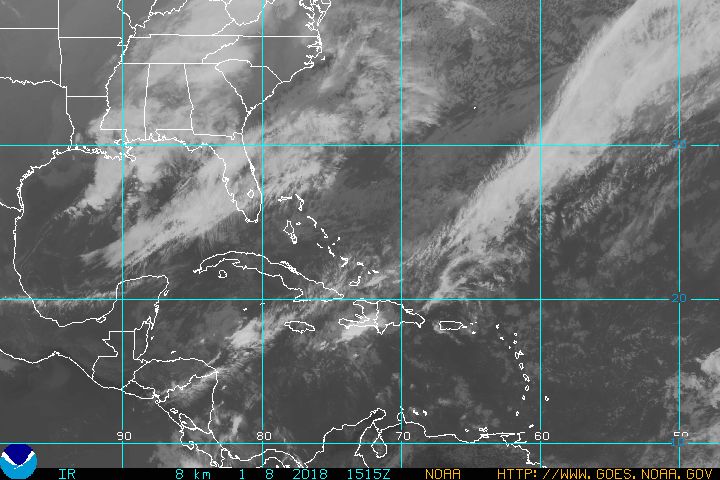
A busy Atlantic hurricane season moved into top gear yesterday when Hurricane Hanna developed near the Bahamas just as Gustav's winds lashed New Orleans and the newly formed ninth storm of the year looked set to eventually threaten the U.S. or the Caribbean.

The flurry of storms was the latest evidence that predictions for a busier than normal season were on the mark, and was worrisome news for U.S. oil and natural gas producers in the Gulf of Mexico, millions living in the Caribbean and on U.S. coasts, and farmers fearing flooded fields.

goes east infra red hurricane sector image

Hurricane Hanna was intensifying near Mayaguana Island in the southeastern Bahamas, the U.S. National Hurricane Centre said.

Hanna, which had meandered for days, bewildering hurricane forecasters, was expected to churn northwest through the Bahamas before striking the U.S. east coast between north Florida and the Carolinas.

In addition to Hanna - and eventually posing perhaps a bigger menace - Tropical Storm Ike formed yesterday midway between Africa and the Caribbean and was expected to strengthen rapidly into a hurricane.

Mayaguana, the most southeasterly of the Bahama islands, has a population of about 1,000 people.

The nearby Turks and Caicos Islands were also hit by heavy rain and strong winds as Hanna gathered pace.

Approach of Hurricane Gustav


RS


Friday, August 29, 2008

NASA Mission To Be Crystal Ball Into Oceans' Future, Mirror To The Past

NASA Mission To Be Crystal Ball Into Oceans' Future, Mirror To The Past

ScienceDaily (July 21, 2008)
Imagine the lives that could be saved from flash floods and drought, the millions of dollars in fuel costs that could be avoided for fishing vessels, and the homes that could be spared from the effects of coastline erosion if only scientists could more accurately predict the dynamics of Earth's often unpredictable oceans. Armed with increasingly more accurate forecasts, weather services in countries across the globe are improving time-sensitive warnings of cyclones, flooding and high sea winds, as well as information about when it's safe to scuba dive, sail, or fish 48 kilometers (30 miles) or more beyond coastlines.

NASA and several other international organizations have joined forces to launch into space a "crystal ball" to give scientists an extended satellite data record. The data can be used to improve ocean forecasting and to test the accuracy of climate and weather models using knowledge of past ocean conditions.

The newly-launched Ocean Surface Topography Mission/Jason 2 is made up of next-generation, state-of-the-art, satellite-based instruments that will provide a global view of Earth's sea surface height every 10 days. Scientists will use these data to create complex simulations of how ocean currents, tides and eddies might behave. Similarly, the data will also allow scientists to "hindcast"--that is, to test how accurate the simulations of past ocean forecasts were.

"To borrow from an old saying, 'it's the motion of the ocean' that is of most interest to us as scientists, and our ability to forecast it and learn lessons from it," said one of the mission's science team members, Robert Leben, an associate research professor at the University of Colorado in Boulder. "The further we can look into the past with the record of ocean measurements, the better we can predict future events. That is to say, if one day we can look back at a 20- or 30-year data record, we can more accurately say what will happen in the next 10 or 15 years because we will have a data record that indicates trends or correlations that lead to specific or expected outcomes. OSTM/Jason 2 is going to add to knowledge we've gained from the Topex/Poseidon and Jason 1 missions and put us closer to this goal."

To create the simulations, also called models, that predict ocean behavior, scientists combine information about factors such as wind speed, wave height, sea level pressure, temperature and air pressure with data gathered by satellite altimeters that measure the height of the oceans' surface (more commonly known as sea level). Radar altimeters, like those on OSTM/Jason 2, measure sea level by sending a radar pulse to the sea surface and clocking the time it takes for the signal to reflect back. All these data are fed into a computer program, allowing scientists to see into the future or to gain further insight from simulations of the past when hindcasting.

OSTM/Jason 2 is slated to orbit Earth and collect this important data set for at least three to five years. It will provide scientists with significantly more data to test their models, and extend the record of information available about ocean circulation and how the ocean affects global climate. During the mission's lifetime, scientists hope to add to what they currently understand about weather phenomena like El Niño and La Niña. During an El Niño, the eastern Pacific Ocean temperatures near the equator are warmer than normal, while during La Niña the same waters are colder than normal. These fluctuations in the Pacific Ocean temperatures can wreak havoc on climate conditions around the Pacific and beyond, leading to increased rainfall or drought.

"A longer period of data from the OSTM/Jason 2 mission can tell scientists more about how El Niño and La Niña are coupled not only to seasonal or yearly changes but to decade-to-decade oscillations of the Pacific Ocean," said Leben. "Owing to data from the mission's forerunner Topex/Poseidon and Jason 1 missions, scientists have already determined that decadal fluctuations in the Pacific enhance the frequency and intensity of shorter-term ocean events such as El Niño and La Niña. Just think of what more we'll learn as we collect future data from OSTM/Jason 2."

Knowing more about the oceans' behavior, including what El Niño and La Niña climate conditions may bring, will improve our quality of life and benefit industry. "For example, forecasts of ocean currents can predict the oceans' salt balance, which can be used to study the global water cycle," said science team member Yi Chao, a satellite oceanographer at NASA's Jet Propulsion Laboratory in Pasadena, Calif. Water evaporates from the ocean surface, and water from rivers and land-runoff cycle back into the ocean, so more precise forecasts of these movements will boost our knowledge of and ability to manage our most precious natural resource. This mission can help us determine the role of ocean circulation in completing the global water cycle."

"On the commercial front, offshore industries such as oil and gas exploration and production require accurate information about ocean circulation to minimize the impacts from strong currents and eddies," said Leben. "Search and rescue officials, marine operators, recreational boaters, and marine animal researchers all benefit from increasingly more accessible near real-time data."

"The Topex/Poseidon and Jason 1 missions got us off to a great start," said Chao. "When the two missions operated together in tandem, they doubled the coverage area and sharpness of the resolution of the sea level data so that we could 'see' more detail. This higher resolution is critical for extending the global sea level data into coastal zones, which of course are regions of great societal importance. OSTM/Jason 2 will provide another opportunity for a tandem mission with Jason-1."

Leben pointed out that with this new mission, the focus moves from research objectives to practical ways to apply the data that benefit society in tangible and essential ways.

For more information on OSTM/Jason 2, visit: http://www.nasa.gov/ostm .


WEATHER NOTE

http://www.weather.gov/nwr/images/NOAA_All_Hazards_Color.jpg
‘America Is Safer When Our Schools Are Safer’:
U.S. Schools Receive Life-Saving NOAA Public Alert Radio


Federal agencies have begun distributing more than 182,000 Public Alert Radios to preschools, Head Start programs, K-12 nonpublic schools and nonpublic school central offices, K-12 school district offices and post-secondary schools. In two earlier phases, the federal government distributed radios to all 97,000 K-12 public schools across the country, bringing the program to a close this September with life-saving radios in every school in the nation.

The radios sound an alarm to alert school personnel about hazardous weather and other emergencies, even when other means of communication are disabled.

The radios are distributed by the Department of Commerce’s National Oceanic and Atmospheric Administration with funding from the U.S. Department of Homeland Security and assistance from the departments of Education and Health and Human Services.

Commonly known as NOAA Weather Radio All Hazards, these Public Alert Radios provide alerts and safety steps on a wide range of emergencies—from an approaching tornado, a telephone outage disrupting 911 emergency services, local roads overrun by flash floods, a derailed train posing a hazardous material threat, or the urgent need to be on the lookout for an abducted child.

The program also encourages school officials, emergency managers, human service providers, and Citizen Corps Councils across the country to partner and align their efforts with local emergency plans to build overall community preparedness. By coordinating with their local emergency managers and Citizen Corps Council, schools also can obtain technical and other assistance to improve their school safety plans and other emergency preparedness efforts.

For additional information on the Public Alert Radios for Schools program, see the Web site at http://public-alert-radio.nws.noaa.gov. The general public can learn about these radios at http://www.weather.gov/nwr.<READ MORE>

MARITIME NOTE

OSHA Updates Safety Equipment Regulations
August 22nd, 2008 Posted by Amelia

On August 19, the U.S. Department of Labor Occupational Safety and Health Administration (OSHA) published a proposed final rule to clarify the requirement for personal protective equipment and training for workers. The item was published in the Federal Register.

The new OSHA regulation affects personal protective equipment or PPE in general industry, maritime and construction trades.


Employers are invited to comment on the proposed regulation for 30 days. OSHA regulations have long required employers to furnish PPE to workers at no charge. Such protective gear may include work gloves, safety glasses or goggles, safety masks and other protective equipment. Even though the equipment is not shared among employees, the employer must bear the expense of providing it.


Since 1990, OSHA regulations have permitted inspectors to issue separate fines for each instance where an employee was not using a required PPE. In a factory, if 10 employees were not using safety glasses, OSHA could issue 10 fines to the employer. OSHA claims that it only did so in cases where the employer flagrantly disregarded its legal responsibilities for the safety and health of workers.


The most recent regulation addresses several court decisions that the language of the ordinance may not permit OSHA to issue multiple violations. Employers are still responsible for issuing personal protective equipment to all workers, and ensuring that it is used. However, in some cases, under the previous regulations, if 10 workers in a single location are found not to be using protective eyewear, the courts threw out 9 of the 10 OSHA citations and penalties, and only permitted one.


The new regulations would close that loophole, requiring employers to pay all 10 fines. The proposed revisions are primarily concerned with PPE and training related to known health hazards, such as asbestos and lead. The proposed changes will make no difference to employers’ legal obligations; however, they will ensure that OSHA has the necessary tools to assess higher penalties when safety inspectors deem it necessary.


Messing About In Ships Podcast


Golden Shellback Logo


Have a great weekend! RS

Monday, June 30, 2008

Maine's set the bar high for flood warning

Maine's set the bar high for flood warning

Emergency management officials in New Brunswick are considering adopting a method similar to the one used in Maine to better warn residents when a major flood is coming.

Dick Isabelle, the province's executive director of emergency services, said that he favours implementing a system where local authorities are actively engaged in alerting the public when flooding is imminent.

Faced with an ugly forecast for torrential rain and a river already near its crest, disaster officials in Aroostook County, Maine, went door to door on the night of April 29 to make sure people knew they were in danger.

Across the border in northwestern New Brunswick, however, many residents were caught off guard. Although the province issued a flood warning on April 29 for the entire length of the St. John River, it wasn't taken seriously enough by people in areas that are not prone to being submerged.

In northern Maine, to make sure nobody was unaware, police set up blockades and vans rode down streets issuing warnings over their public address systems.

"I think we have to evaluate the effectiveness of our entire system, and not be afraid to stand up and say, 'Let's see what we can do better. How can we give people the proper warning they deserve?' " Isabelle said. "My guess is that the type of system we will encourage is one where we work more closely with local authorities.

"I would say that this is an area we see as having to explore."

As of last week, nearly 500 flood victims had sought government aid in northern New Brunswick, and 1,358 people were seeking assistance overall. Approximately 130 people remained displaced and were in temporary housing.

Under fire from the Opposition in the legislature last week, Premier Shawn Graham described the province's emergency system as having worked well, but said a review would be undertaken.

The province takes out advertisements to warn residents of flooding and updates water and weather conditions on its River Watch website, and usually that is enough, the premier said.

"It is important to note that this was a severe flood; we had not seen a flood of this magnitude and severity for many generations,'' Graham said. "In fact, areas were flooded that had never flooded in the past.

"As I have always stated, a complete review of this initiative will be undertaken, and we will be looking to make improvements where we can. But the reality is that the system is working.

"The severity of the flood was not anticipated. We cannot control Mother Nature. This is an important notice for all New Brunswickers today: When emergency management issues flood warnings, precautions should be taken."

Opposition Leader Jeannot Volpé and Percy Mockler, the member of the Legislative Assembly for Restigouche-La-Vallee, argued that the warning system failed to adequately alert residents in northern communities. They also complained that communication was poor between relief agencies, and that people calling for help were transferred from one agency to another and another.

"We all know what is happening now,'' Volpé said. "It is a reaction. What I am asking is, what should be done so emergency management officials can advise people when a flood is coming? How is it that people can save some of their assets by knowing ahead of time? Not the next day, or three days after, because then it is too late.

"People have lost a lot of money and a lot of assets. They were not ready because nobody told them what was coming down."

Marty Klinkenberg is a contributing editor of the Telegraph-Journal. He can be reached at martyklinkenberg@hotmail.com

WEATHER NOTE

Are you prepared for natural disaster

By RICH ECKE
TRIBUNE STAFF WRITER

Montana doesn't encounter many natural disasters. Earthquakes are rare, and Great Falls is on the fringe of the fault zone, although Kalispell, Helena and other cities closer to the Rocky Mountains face more danger from a quake. Big Sky Country avoids hurricanes, monsoon rains and tsunamis.Far from Tornado Alley, Montana gets an occasional twister, but it usually just throws a bunch of dirt around in this sparsely populated state.

Great Falls is one of the country's windier cities, and so are other towns along the Rocky Mountain Front, and places like Livingston. The wind may rage, but it usually doesn't kill anyone.Montana gets cold at times, and below-zero blizzards put people in danger in winter.

The state also gets freak snowstorms, like the recent one that knocked out power to much of Great Falls and the surrounding area. About 100 rural homes lost power for days.

Losing power for several hours was not a major disaster for most people, but it showed how unprepared some people are for trouble, said Judy Powell, a national Red Cross reservist who has assisted at more than a dozen disasters across the continent.

During the recent power outage, some people did not even know how to open their garage door manually, Powell pointed out. She thinks it's better to be prepared.(By the way, your garage door opener usually has a red plastic handle attached to a rope. You pull on the handle to disconnect your garage door from the electric opener. Then you can open the garage door by hand.)

Anyway, one of Montana's few natural disasters, aside from fires, is flooding."It's that time of year for floods," said Karl Christian, conservation district specialist for the state Department of Natural Resources and Conservation in Helena. Parts of Iowa, Wisconsin and other states in the Midwest certainly have gotten nailed this month, as shown by horrifying videos of houses floating down swollen rivers.

Central Montana is wetter than usual. Great Falls has enjoyed 10 inches of moisture through mid-June, already two-thirds of the rain and snow we normally get for a whole year. Fifteen inches is average.

Melting mountain snow will add to the already high Missouri River through Great Falls. Temperatures in the 80s would hasten the melt. Then all it would take is some heavy rain to send water over the river banks. Complacency is the number one thing we can't do," Powell said Sunday.

Sure, our parched landscape has sucked up most of the generous moisture so far. And flood worries will soon fade away. But Powell argues it's better to be ready. She lives next to the Missouri River south of the city, and she has reserved her brother's four-horse trailer to move all of her belongings out during an emergency.

Once in Kentucky, Powell remembers visiting with a family whose treasured family photographs had been sitting in flood waters for two days. The photos could not be salvaged. "I came home and put all of my pictures in a plastic tote and keep them on a high closet shelf," Powell said.

Think about where your family photos are and where they would be safest in your house. A leaky roof can do the same thing as a flood. Flood events set for this week

Even if we escape bad floods in 2008, we can still reminisce about some horrendous floods that have befouled Great Falls and the surrounding area over the years. During the 20th century, 1908, 1953, 1964 and 1975 were soggy, especially for west Great Falls and outlying areas. Broken dams also didn't help in some of those years.

To commemorate the pluck and vigor of people who encountered deadly floods in Montana over the years, the Missouri River Conservation Districts Council will hold a Missouri River Flood Photo Round-Up in Fort Benton and Great Falls this week. A third event will be July 14 in Helena.

If you have any neat photos of past Missouri River flooding, come to the Ag Museum in Fort Benton on Thursday, or Friday to the Mountain West Bank, 12 3rd St. N.W., from 4 to 8 p.m. both days. The Helena event is July 14 at the USDA Building, 790 Colleen Street. Local conservation district representatives will be on hand, and refreshments will be served.

At these gatherings, someone will scan your photos for you, and hear what you have to say about the flood of 1964, or, if you're 110 years old, the flood of 1908. You may want to trade stories with other flood survivors. Call Christian at 406-444-3022 or Vicki Marquis at 406-231-5818 for more information.


State works to retain hurricane relief funds

By Ana Radelat
Gannett News Service

WASHINGTON — Gov. Bobby Jindal and the Louisiana congressional delegation are working to bridge a dispute between the House and Senate over billions in hurricane recovery money for Louisiana and Mississippi.

The House plans to vote today on a $184 billion emergency spending bill that would pay for the wars in Afghanistan and Iraq and provide $5.8 billion to repair New Orleans' levees.

But the House bill contains no money for other reconstruction efforts the Senate approved in a similar bill last month. That includes $70 million for housing vouchers for low-income Louisianians at risk of homelessness and $157 million to help the state's hospitals cover expenses related to Hurricane Katrina.

The Senate bill also would provide $50 million for upgrades in the state's criminal justice system and reduce — from $1.5 billion to $1.3 billion — the state's share of the cost of rebuilding levees. Many of the Katrina-related provisions were sponsored by Sen. Mary Landrieu, D-New Orleans.

The House rejected those provisions — and about $10 billion in other local projects — to avoid a presidential veto or, failing that, win enough GOP support to override it.

President Bush had approved the money to rebuild the levees, but objected to much of the other domestic spending the Senate had included in the bill.

Complicating the chances of the state getting the extra money, the House agreed to provide billions of dollars in emergency floor relief for the Midwest.

Jindal was to meet Wednesday afternoon with retired Marine Maj. Gen. Doug O'Dell, Bush's recently appointed coordinator of Gulf Coast rebuilding, and other administration officials to lobby them on the hurricane recovery funding.

In addition, the Louisiana congressional delegation hopes to meet with House leaders early next week on the issue.

Rep. Rodney Alexander, R-Quitman, said it would be better to hand the president a final bill that includes some hurricane spending but limits other domestic spending and doesn't restrict how the war is conducted.

"We would like to see language that doesn't have poison pills," Alexander said.

The governor also said there may not be another bill moving in Congress this year that could include the hurricane recovery money, which he called "critical to Louisiana and time-sensitive."

Sen. David Vitter, R-Metairie, urged House leaders to accept the Senate's provisions because a final bill is unlikely to win White House approval.

"The president is going to veto it anyway," Vitter said.

If the House approves a pared-down bill Thursday, it will go to the Senate for consideration. But the Senate is likely to reject it in favor of the bill it approved last month, creating new delays in approving money to conduct the war.

"It looks, unfortunately, like this will pingpong down the way some more," Vitter said.

New book spells out secrets to surviving disaster

THE UNTHINKABLE: Who Survives When Disaster Strikes - and Why by Amanda Ripley, Crown, $24.95

"We all have ideas about what we might do in a [public] emergency," writes Amanda Ripley in "The Unthinkable: Who Survives When Disaster Strikes - and Why." "But we are probably wrong."

Here's the likelihood. If you aren't immobilized by profound lethargy - many are - you'll first try to convince yourself that what is happening isn't. Even when it's blazingly obvious that you have to get out, you may feel a strong urge to stay put.

If you're very lucky, someone may break through that denial by shouting a directive, "We have to move!" What you do next will be really stupid. You'll look for your handbag or root for whatever in your desk drawer. If you aren't dead by the time you find it, carrying it will complicate your escape.

Chances are you will be fleeing with a crowd and someone has taken command. But even as you move to safety, if not before, your body will betray you. Your vision could narrow dramatically. You might go temporarily blind. You will forget how to do simple things. Unbuckling a seat belt, for instance, may seem so terribly complex.

Ripley, who reported on disasters and now covers homeland security for Time, became fascinated with all facets of human response to disaster, and "The Unthinkable" is the valuable product of her determined pursuit of answers.

Physiology (the amygdala, specifically) plays a role, as does evolution and genetics. Your intuitive response can help, but if it's your sole guide, it can lead you badly astray. It's a matter not only of knowing yourself but knowing your disaster - the one you're most vulnerable to. As an expert points out, "Disasters have personalities." Some strike more debilitating fear than others. Learning the facts can override that at a critical juncture.

Training is the most essential tool of all. Ripley's pressing point is that all our sophisticated warning systems and emergency procedures are designed to meet the needs of professionals. Civilians are considered a grade below, not to be trusted, though in many, if not most disasters, waiting to be saved can be deadly.

"We were the first responders," says a 9/11 survivor who escaped the World Trade Center.

We are a country built on self-sufficiency, Ripley writes, but we refuse to give ordinary people the information that, when delivered in factual and nonthreatening terms, can save their lives. Perhaps it's time for the rest of us, the potential victims, to signal a Code Red. We need to know. Now.

Our disaster personalities are quite different from our everyday selves.

Milling about gathering information can be useful in some disasters. Just don't prolong it.

Do not, repeat do not, give in to the impulse to gather luggage, handbags or anything. Just get out.

Disaster induces a paralytic lethargy in many people. Sometimes this works to save you. Usually not. Fight it.

Of all passengers involved in serious airplane accidents between 1983 and 2000, 56% survived. But you have seconds, sometimes 90, sometimes less, to get out.

Read the safety diagram on airplanes. Wherever you are, know your exits. Count the rows on a plane. In a fire, always stop, drop and roll.

Fire kills more Americans annually than all other disasters combined. In a hotel, take the stairway down to the ground once to become familiar with the crossovers and other surprises.

Worry about probability. What kind of disaster is most likely to strike your area. Hurricane? Flood? Terrorist attack? Learn what to do in that situation. Train yourself. Then you will be response ready.

Don't be silly about sharks. Worldwide, six humans are fatally attacked annually, while human beings kill between 26 million and 73 million sharks. We're way ahead on this one, folks.

MARITIME NOTE

More problems for Riverdance

TREACHEROUS
weather conditions and shortening summer tides are hampering workmen's efforts to dismantle the wrecked Riverdance ferry.

Bosses at the ship, which is being dismantled on the Anchorsholme coastline, say conditions were so poor last weekend when gushing winds battered the Fylde coast that work on the vessel had to be abandoned on Sunday.

Officers have also warned progress has been slowed by the fact time to work between the tides has been halved as the demolition job heads into the summer.

Donald McDonald, who is overseeing the operation for the Maritime and Coastguard agency, said: "With the high winds on Sunday it would have been dangerous to put people in the situation.

"We don't normally have this kind of weather at this time of year."

GAO Issues Report on Loss of Coast Guard Patrol Boats

U.S. Government Accountability Office's just-issued report; COAST GUARD: Strategies for Mitigating the Loss of Patrol Boats Are Achieving Results in the Near Term, But They Come at a Cost and Longer Term Sustainability Is Unknown (GAO-08-660).

The GAO accomplished this report for the Senate Commerce Committee, Subcommittee on Oceans, Atmosphere, Fisheries and Coast Guard. The report provides some background on the Coast Guard's "bridging strategy" to upgrade aging patrol boats from 110 feet to 123 feet (to include a number of upgrades and stern-launch boat ramp) as part of its Deepwater program. After the Coast Guard upgraded 8 of these boats, the hulls developed hull deformities and other problems and these 123 foot boats were pulled from service.

Most of the report discusses the Coast Guard's strategies for dealing with the loss of these boats and its impact on District 7 (waters off Florida, and some adjoining states) where all of them were based. One of the main Coast Guard homeland security missions in this district is the interdiction of migrants. The Coast Guard strategies to replace operational hours in District 7 included: double-crewing existing patrol boats, deploying patrol boats to District 7 from adjacent districts, using Navy patrol boats, increasing operational hours of other patrol boats, and revising boat maintenance programs. While these strategies have been successful in raising patrol boat operational hours in District 7, they have also raised certain costs and diverted some missions in adjacent districts. For example, adjacent districts are doing less enforcement of marine fisheries and less maintenance of aids-to-navigation. This fits into a broader theme of GAO work that demonstrates that the Coast Guard is having difficulty meeting all of its mission requirements (particularly non-homeland security missions) within the current level of resources. The Coast Guard will have to maintain these increased costs (both in dollar expenses and mission opportunity costs) as it awaits the deployment of new smaller less capable 87 foot patrol boats, and a new generation of boats known as Fast Response Cutters.

This briefing comes courtesy of Stephen L. Caldwell / Director, Maritime Security Issues / Homeland Security and Justice Team / U.S. Government Accountability Office / (202) 512-9610. Click HERE to read the full report.

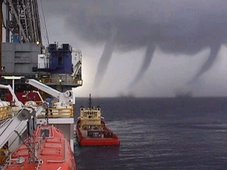
Waterspouts seen over Lake Erie

Published: June 19. 2008 11:53AM


Shipping firm to sue Philippine weather agency for mishap

Manila, June 27 (Xinhua) The owner of a Philippine ferry that sank in the devastating Typhoon Fengshen with more than 800 people on board said Friday he would sue the country’s weather agency for not giving timely information about the typhoon. According to Philippine TV network GMA News, shipping company Sulpicio Lines, which owned the sunken ship MV Princess of the Stars, said it would charge the Philippine Atmospheric, Geophysical and Astronomical Services Administration (Pagasa) next week for failing to update the ship’s crew about the movement of Typhoon Fengshen.

At least 70 passengers were confirmed killed when the MV Princess of the Stars sank off Sibuyan Island, 300 km south of Manila. More than 740 people are still missing and feared dead, while 48 have survived the accident - the worst in the past two decades.

Sulpicio Lines’ lawyer Arthur Lim said the shipping company will charge Pagasa with gross incompetence and negligence, saying that the ferry could have averted the tragedy had Pagasa issued an additional warning on the typhoon’s movement.

Lim said the ship’s route from Manila to Cebu was not completely reflected in the Pagasa bulletin they received before sailing.

At the Board of Marine Inquiry investigation earlier Friday, Nestor Ponteres, Sulpicio’s port captain in Cebu, claimed that the company was informed six hours late by Pagasa regarding typhoon Fengshen’s changing course.

Ponteres also claimed he was in constant communication with the ferry’s captain, Florencio Marimon Sr, before the ship sank. Marimon is still missing.

Ponteres added that there were alternate routes that the ship could have taken had the warning been relayed earlier.

But Pagasa director Prisco Nilo said that they always make sure to release weather updates to the public even though predicting the behavior of a typhoon cannot always be precise.

“Anywhere you go, the warnings and the bulletins are updated a number of times in a day, usually four times a day taking into consideration that (weather) forecasting is not an exact science,” Nilo said, adding that shipping companies also have the responsibility to closely monitor the weather condition to ensure its vessels’ safety.

Sulpicio Lines had earlier blamed the Philippine Coast Guard for the tragedy, saying Wednesday that it was the Coast Guard’s task to plot routes for vessels during inclement weather.

The Board of Marine Inquiry, however, said the 1998 memorandum circular on which Sulpicio Lines based its arguments had been replaced with an updated June 2007 memorandum circular that places responsibility on the ship’s owner and captain.


RS