Thursday, October 11, 2007

Satellite Data Used To Warn Oil Industry Of Potentially Dangerous Eddy

Satellite Data Used To Warn Oil Industry Of Potentially Dangerous Eddy

Science Daily — Ocean FOCUS began issuing forecasts on 16 February 2006 – just in time to warn oil production operators of a new warm eddy that has formed in the oil and gas-producing region of the Gulf of Mexico.


The model forecast shows the jet along the western edge of the Loop Current weakening, and an intense jet forming along the north eastern Loop front. (Credit: Ocean Numerics 2006)

These eddies, similar to underwater hurricanes, spin off the Loop Current – an intrusion of warm surface water that flows northward from the Caribbean Sea through the Yucatan Strait – from the Gulf Stream and can cause extensive and costly damage to underwater equipment due to the extensive deep water oil production activities in the region.

The Ocean FOCUS service is a unique service that provides ocean current forecasts to the offshore oil production industry to give prior warning of the arrival of eddies. The service is based on a combination of state-of-the-art ocean models and satellite measurements.

Oil companies require early warning of these eddies in order to minimise loss of production, optimise deep water drilling activities and prevent damage to critical equipment.

The Loop Current and eddies shedding from it pose two types of problems for underwater production systems: direct force and induced vibrations, which create more stress than direct force and results in higher levels of fatigue and structural failure.

The impact of these eddies can be very costly in terms of downtime in production and exploration and damage to sub sea components.

Information provided by Ocean FOCUS gives industrial operators an accurate and up-to-date analysis of the present situation to support production management decisions.

In addition, Ocean FOCUS forecasts will be used by oil and gas companies planning major operations such as installing new equipment – which are very sensitive to local conditions and may require prolonged ‘windows’ of low current speed to achieve successful completion.

The Loop Current is presently to the north of its average position, sparking concerns that more eddies could be generated over the next few weeks. The current eddy, dubbed ‘Walker’, was detected breaking away from the Loop Current in mid February.

Ocean FOCUS was developed by Ocean Numerics and is partially supported by the ESA’s Earth Observation Market Development (EOMD) programme. Ocean Numerics and the Ocean FOCUS operators will continue their monitoring to ensure early and reliable detection of further eddies.

Ocean Numerics is a joint venture between France’s Collecte Localisation Satellites (CLS), the UK’s Fugro GEOS and Norway’s Nansen Environmental and Remote Sensing Centre (NERSC).

Maritime Notes:
Up coming conferences...

08-Oct-07 Maritime Reconnaissance & Surveillance 2007
09-Oct-07 Safer Seas 2007
09-Oct-07 National Maritime Salvage Conference and Expo
10-Oct-07 19th annual Deep Offshore Technology International Conference & Exhibition (DOT)
10-Oct-07 ShipRepair & Conversion 2007
17-Oct-07 Baltic RO-RO & Ferry Conference 2007
18-Oct-07 5th Charting the Course in Welding: US Shipyards
18-Oct-07 2nd Southern Asia Ports, Logistics and Shipping 2007
21-Oct-07 Ocean Innovation 2007: Rise of Maritime Simulation
21-Oct-07 CSCMP's 2007 Annual Conference
22-Oct-07 Networked Public Safety
25-Oct-07 Turkish Shipping Summit 2007
26-Oct-07 CONECT Northeast Cargo Symposium 2007
30-Oct-07 India Shipping Summit 2007

Around the World Today

IAEM Discussion Group:
UN Day of Disaster Reduction
IAEM President addresses IDER Conference and opens 1st IAEM Europa AGM.


USA: SAN DIEGO – Gov. Arnold Schwarzenegger declared a state of emergency in San Diego Monday in the wake of a landslide on La Jolla's Mount Soledad that caused $48 million in damage.

The proclamation allows the state Office of Emergency Services to deploy personnel and equipment and to provide other assistance, according to the governor's office. It also clears the way for Caltrans to request an emergency declaration from the federal Highway Administration. Last Wednesday's landslide, which occurred in the 5700 block of Soledad Mountain Road, caused $26 million in public works damages and $22 million in property damage, city officials said over the weekend. Seven homes remain “red-tagged,” which means they have been declared uninhabitable by the city.

AUSTRALIA: Hail storms stretch emergency crews to limit
Hail storms have left a trail of destruction through parts of northern New South Wales today and emergency service workers are struggling to keep up with the damage. The Bureau of Meteorology says hail stones the size of tennis balls have smashed homes and cars during two storms which have since moved off shore but are forecast to return. The city of Lismore, home to about 45,000 people and close to the NSW/Queensland border has been hardest hit. SES spokesman Phil Campbell says they've had some 300 calls for assistance and they're still coming in. A school at Lismore has asked for SES assistance after the storms smashed more than 100 windows at the facility. Churches, police stations and hospitals have also been damaged by the storms. The first and most severe storm hit Lismore about two o'clock (AEST) this afternoon and was followed about an hour later by another wave of large hail stones. Volunteers are expected to work through until about 11 o'clock tonight securing property and will start back at sunrise tomorrow weather permitting.

SUMATRA ISLAND: An earthquake with a magnitude of 6.0 hit off west coast of Indonesia's Sumatra Island. There were no immediate reports of deaths, injuries or damage. The epicenter of the quake was located about 129 kilometers southwest of the city of Padang, at a depth of 20 kilometers. So far no tsunami warning has been issued.

VIETNAM: The Vietnamese villages are under muddy water that reeks with the stench of dead animals. The worst floods in decades that followed last week's typhoon have left hundreds of homes submerged and rice fields under water. Food shortages and water-borne diseases were major concerns. Families are forced to cower on higher floors and rooftops, surviving on the little water and food they have. 34,000 soldiers have been deployed in order to distribute instant noodles, drinking water, medicines and other emergency supplies by helicopter and boat. Authorities and relief agencies struggle to deliver aid.

UGANDA: Flooding in Uganda, a country that has been worst hit by torrential rains and flash floods, makes the thousands of its inhabitants face severe food shortages and malnutrition. The risk of a cholera epidemic is also very serious because of reduced access to clean water. Rescue agencies say 1 million people are affected, and 20 people have died but with more rain expected the toll might climb.

USA: Cleveland, Ohio, student goes on gun rampage
A 14-year-old student has shot himself dead after going on a shooting spree at his school in the US city of Cleveland, Ohio, the city's mayor has said. Mayor Frank Jackson said five people were wounded when the teenager entered the SuccessTech Academy and walked down a corridor on the fourth floor firing. Two teenage boys and two adults were shot while a teenage girl injured her knee while fleeing, Mr Jackson said.

NIGERIA: Vaccine-linked polio hits Nigeria
Nigeria is fighting a rare outbreak of a vaccine-derived form of polio, says the UN's World Health Organization. It says 69 children in the north have caught the paralysing disease from others who had already been immunised. The WHO says such rare outbreaks have occurred where immunisation campaigns did not reach enough of the population.

RS

Wednesday, October 10, 2007

UPDATED! NTSB Investigator Takes Issue With RPI Ethan Allen Report

UPDATED

I am just continually amazed. I have had a banter of emails from Ms. June Maxam the publisher of the North County Gazette
. Even insulting ones about my simple little blog. As Ms Maxam writes, "Considering your Blog has generated less than 250 views since its inception, obviously no one pays much attention to you" Kicks!

I guess my "no attenton blog" got hers! Ms. Maxam I follow the fair use clause in all my postings and have bowed to your requests though I should not have. So here is what I am going to do. I am going to take a very hard professional look into your report and publish my findings in both a major maritime journal and major local newspaper in your area. I am sure I will be able to get a little OPED space.

I am one who is very much concerned about maritime safety and I believe that this might be a very good case to take a look at and see what the actual facts are and how they have been reported. Moreover, the last communications with Ms. Maxam a so-called professional journalist was that she has blocked any further emails from me.

Just amazing.... I will keep you posted!

NTSB Investigator Takes Issue With RPI Ethan Allen Report

EXCLUSIVE

By June Maxam

Using data provided and generated by the National Transportation Safety Board, a professor and his students at Rensselaer Polytechnic Institute have predictably endorsed the findings of the NTSB that instability, overloading and that alleged “rogue” wave caused the Ethan Allen to capsize on Lake George two years ago this month.

Read the rest of the report here without due threat of a law suit, NTSB Investigator Takes Issue With RPI Ethan Allen Report

NOTE:

I originally posted the entire article and linked to the writers site, thinking that my readers would be interested in this report. Let me be very clear here. This website is actually a hobby and I make no money on it what so ever. Its for educational purposes only. Its because of my love for the subject matter and nothing more than that. If I wanted to I could very well make this site a professional site. Not my style nor my wants. Nor do I really have the time.

Today I got a email from the author who seems to think she is some top flight investigative reporter and has a real attitude problem. It reads;

Mr. Storm:

Obviously you either failed to read the copyright notice on the bottom of my exclusive article which you lifted or else intentionally ignored it. You have engaged in copyright infringement and theft of my intellectual property, an exclusive no less, which is absolutely unacceptable and unlawful. My work is not yours for the taking. Please remove my work from your blog immediately or I will submit this to my attorney. The article was clearly marked copyright protected and exclusive. You did not ask for permission to reprint and it certainly was not granted nor did you compensate me for stealing my work and using it for your own purposes. You DO NOT have permission to use ANY of my work for your own purposes. Please advise when my work has been removed from your blog or you'll have a storm that you didn't forecast.

June Maxam
Publisher
North Country Gazette

Well now first of all the copyright to this article is not even part of the article and yes I did miss it. But saying that, I am not a competitor and again all of the articles I post are for educational purposed only. I posted without comment since I wanted to leave it to my readers to come to their own conclusions. But since Ms. Maxam insists, so be it and of course I have a reaction.

Since I am a Master Salvor ( look it up Ms. Maxam) and Marine Engineer I have decided to take a serious look at Ms. Maxam's report. For accuracies sake.
If I do an investigative piece as I did with the s.v Sean Seamour II, of course I would be in direct contact with the people involved. Now I am getting involved in this report and will be checking with all parties.

I do not know what I will find and if I find in support of her report I will post such. I already have some concerns with her report and I will be checking with NTSB and the USCG for their side of the story.

Moreover if i find different, the Storm that Ms. Maxam will feel, will make a Typhoon look like a gentle sailing breeze.

I just dislike people with attitudes... Simply put Ms. Maxam, you get more with honey than threats...

Stay Tuned!

Maritime Note

Hijacking of the cruise ship ACHILLE LAURO On October 7, 1985, four terrorists associated with the Palestine Liberation Front took control of the Italian cruise ship ACHILLE LAURO in the Mediterranean Sea off the coast of Egypt. The terrorists, headed by Abu Abbas, demanded that Israel release 50 detained Palestinians. After the Israelis refused, the terrorists shot American passenger Leon Klinghoffer, who was disabled and wheelchair-bound, and then threw him and his wheelchair into the water. Egypt eventually agreed to give the terrorists safe conduct to Tunisia. US Navy fighter jets intercepted the flight and forced it to land in Italy. Nine years later (November 30, 1994) the ship was destroyed and then sank following a fire off the coast of Somalia.


RS

Tuesday, October 9, 2007

Freak Waves and Rogues

Freak Waves and Rogues
Jerry Dennis & Glenn Wolff

Waves generate much sound and fury, impressing us greatly, so we can probably be forgiven for exaggerating their size. I once spent a miserable day tossed around in a small cod boat off the southern coast of Iceland by waves I was certain were at least twelve feet high. They came at us like they were attacking, rising out of the choppy chaos of smaller waves until they crested above the height of the cabin roof and seemed about to come down like giant fists. It was humbling and a little disappointing to learn later from the weather service that the waves had been mere six-footers. I've taken some comfort since watching anglers on Lake Michigan motor into harbors for protection from waves measuring barely three feet from trough to crest.

Even in the open ocean the immense waves of popular imagination are rarely encountered. At least three-quarters of all sea waves have a height less than 12 feet, and only very powerful storms produce mountainous seas of more than 30 feet. Nonetheless, some parts of the oceans have earned notoriety from producing larger-than- average waves, some of them very large indeed. Many of the biggest waves that reach the shores of Europe and eastern North America originate in the middle of the North Atlantic, especially in the stormy regions south of Iceland and Greenland. The long rollers that frequently strike the southwest corner of England can begin as far south as the Cape of Good Hope, South Africa -- some 6,000 miles away. In the Pacific, swells washing on the shores of California and even Alaska have been traced to the Antarctic Ocean. The winds south of Cape Horn, at the southern tip of South America, follow the "Screaming Sixties" all the way around the world without interruption by continents. This endless fetch produces long, powerful waves known as "graybeards" or "Cape Horn Rollers" by mariners who claim they have seen them measure a mile from crest to crest and reach heights of 200 feet.

Such figures were once discounted as the result of fancy and fear by oceanographers convinced that no wave could surpass 60 feet in height without collapsing. But this "60-foot rule" has been challenged recently by computer models that seem to prove that powerful storms are capable of creating waves as high as 219 feet.

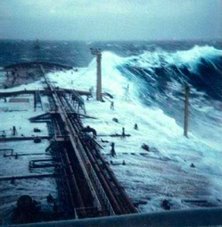
The big waves of computer models, of course, are an exercise in theory divorced from practice. In nature, waves are not nearly as predictable and orderly as they are in laboratories, computers, and mathematical equations. While features such as velocity, period, and length are easy to measure in controlled circumstances, in the open ocean they can be hopelessly confused. Swells the size of small hills come at you from several directions at once, each rising and descending unpredictably, the slopes hacked by wind waves and covered with a perplexity of tiny capillary waves. One moment a breaking curler rushes down the slope of a large swell, then a trough fills with the crest of a wave coming from the side or falls away into yet a deeper trough. The random and disorderly nature of waves in the oceans almost guarantees that they will occasionally produce waves of a higher order. Such "rogue," "freak," or "episodic" waves are known as Extreme Storm Waves (or ESW) when they develop within a storm, and often rise in groups of three that have earned the quasi-mythical designation "Three Sisters Waves." Most reports of ESWs note that they look like "walls of water," that they're accompanied by steep-sided and unusually deep troughs (deep enough to occasionally swallow a ship), and that they spill forward and break simultaneously and with equal energy the entire lengths of their crests. An enormous freak wave with those characteristics struck the Queen Mary amidships south of Newfoundland while ferrying U.S. soldiers home at the end of World War II, rolling her to within a degree or two of capsizing.

Rogue waves can occur on relatively calm seas with no storms for hundreds of miles. Trains of swells traveling in the same direction but at different speeds will pass through one another; when their crests, troughs, and lengths happen to coincide they reinforce each other, combining their energies to form unusually large waves that tower mountainously for a few minutes then subside. Such giants can suddenly reach several times the height of most of the waves around them, forming mid-ocean breakers that are probably responsible for at least some mysterious disappearances of ships. When such anomalous waves occur near shore, roaring down without warning on piers and rocky ledges, they sometimes sweep people to their deaths.

When waves meet opposition in an oncoming current the wavelength is shortened and the wave is forced to become steeper and as much as two to four times higher. Examples can be seen on a relatively small scale at the mouths of rivers or estuaries, where the outflowing current creates high choppy waves that can be dangerous for small craft. When a current exceeding about four miles per hour is spread over a large area and involves massive amounts of water the danger is magnified. Regions notorious for such hazardous juxtaposition of waves and current include the Agulhas Current off the east coast of South Africa, the Kuroshio Current southeast of Japan, and the Straits of Florida and elsewhere along the Gulf Stream, where 30-foot waves blown up by nor'easters sometimes reach 40 to 60 feet in height.

Reports of rogue waves a hundred or more feet in height are no doubt often exaggerated, but careful measurements by coolheaded observers have left little doubt that waves of that size sometimes occur. One fairly reliable way sailors have measured such waves is to climb the rigging until they reach the point, while the ship is in the bottom of a trough, at which the crest of the wave lines up with the horizon. The height climbed then equals the height of the wave. This technique, or variations on it, have been used to measure some waves of terrifying dimensions.

One of the largest waves ever measured was reported by Navy Lieutenant Commander R. P. Whitemarsh in a famous paper titled "Great Sea Waves," published in the U.S. Naval Institute Proceedings in August 1934. Whitemarsh encountered a storm on February 7, 1933, while crossing the Pacific in the navy tanker the U.S.S. Ramapo. During this storm, west winds had a fetch across thousands of miles of unobstructed ocean and had already blown at gale force for days. With the wind at 60 to 66 knots (69 to 76 miles per hour) directly from the stern and the waves consistent, without cross seas, Whitemarsh and his crew were able to estimate (based on the 478-foot length of the ship) that the length of the waves was 1,000 to 1,500 feet. Using a stopwatch they timed wave periods up to 14.8 seconds. Crew members standing on the ship's bridge could measure the height of a wave by lining up its crest with the horizon and a point on the ship's mast (making the line of sight approximately horizontal) while the stern of the ship was at the bottom of a trough. By triangulating from the line of sight to the bottom of the ship's stern (or the trough of the wave) they were able to determine the height of each wave. The largest they measured was 112 feet.

Other notable waves have been measured against stationary objects, especially lighthouses. In the winter of 1861, for example, the Bishop Lighthouse in the Isles of Scilly was struck by a wave high enough to smash a fog bell hanging 100 feet above the ground (eyewitnesses insisted the crest of the wave came down on the bell), breaking a metal support bracket four inches thick and tossing the bell to the rocks below where it smashed to pieces. Waves have occasionally passed over the top of the 75-foot-high lighthouse on Minots Ledge, Massachusetts, and have flung rocks through the glass of Oregon's Tillamook Rock Lighthouse, 133 feet above the water.

Weather Story

From IAEM supported IDER Conference in London, England.

VIETNAM: Homes of hundreds of thousands of Vietnamese villagers are still under water after days of some of the worst flooding in decades, caused by the typhoon Lekima. Up to 67 people were killed and 14 were missing. The provinces Thanh Hoa and Nghe An were worst hit by floods and landslides and its two million inhabitants are affected. Maintaining sanitary conditions and the threat of water-borne diseases is becoming real. The disasters damaged over 100,000 houses, closed roads, submerged hundreds of thousands of hectares of subsidiary crops, and disrupted electricity and telecommunications system, isolating villages in several mountainous areas. Preliminary reports said nearly 58,000 houses were damaged or destroyed.

CHINA: Typhoon Krosa caused landfall in the southern China, lashing with heavy rain and high winds up to 126 km/h. It has been downgraded to tropical storm today. No casualties were reported although over 5 million people in east China's Zhejiang Province were affected. The storm prompted evacuation of more than 1.41 million people. Transportation services were paralyzed, power supplies cut off, schooling and tourist businesses suspended, and ship services halted on Saturday.

Chicago - On Sunday October 6, 2007, we broke the record of 86 set in 1947 by one degree - 88. Unfortunately we also broke the Chicago Marathon. One died and some 300 needed medical attention. The race was called half way through... However fall has arrived so we will be moving from Construction Season to Winter.... Good Morning Chicago!

That time of year again! Water Buoys to be removed in 10 days (Oct 5, 2007)

Funny side story here as told to me by a port captain for a major tug and barge company here in Chicago a while back ago.

Every winter as the lakes freeze over the USCG has to remove buoys and get the ole icebreaker ready. Though one of the local maritime companies has a tug that is ice capable. Seems that the local Indians who snow mobile over the lakes between Michigan and Wisconsin will mark the trail with small trees so that they can follow the path back home. One Captain of the ice-tug seemed to love to target and "break ice" directly in between the path of the trees so that the trail ..eh...ends... abruptly.

Water Buoys to be removed in 10 days (Oct 5, 2007)

Warning buoys upstream of seven Grand River Conservation Area dams along the Grand River will be removed the week of Oct. 15 to prepare for winter.

The buoys will be put back in place in May 2008 after the spring runoff.

Boaters using the river after the buoys are removed should exercise extra caution around the dams.

Buoy removal schedule:

*Oct. 15 - Dunnville Dam;

*Oct. 16 - Caledonia Dam, Wilkes Dam (Brantford);

*Oct. 17 - Parkhill Dam (Cambridge), New Hamburg Dam, Drimmie Dam (Elora), Bissell Dam (Elora).

The schedule is subject to change depending on weather conditions.

The buoys are installed each May to warn canoeists and kayakers about the danger of approaching these dams, which are all known as "run of the river" or "low head" dams.

The water upstream of the dams can be still and placid, but the area downstream can be dangerous.

Strong currents at the base of the dam can capsize a canoe or kayak and trap the occupant underwater.

Just a note from me

Recently I wrote a OPED which appeared in the Forth Worth Star Telegram on the mis-placement of six nuclear ACM 129 Cruise Missiles. I really shy away from politics but this incident is a very grave and serious matter not just to me but many of my peers. I sincerely hope that the USAF completes its investigation and the truth comes out. I wish to thank Paul Harral, Editor of the Editorial Page of the Forth Worth Star Telegram for taking the subject matter seriously and giving me the opportunity to go to print. His editorial skills and patience with me was just outstanding.

I cannot take full credit for the entire article, many of my peers and maritime friends coached and helped with support and questions. It was a team effort and I wish to thank them as well. I also wish to thank Susan H and Larry Johnson of No Quarter for re-printing the article. Their blog is one all must keep in their bookmarks. I also wish to thank Fred Fry of Fred Fry International and my shipmate Captain John Konrad at gCaptain for re-posting the article. Both blog's are also truly amazing like the men who write them.

RS


Monday, October 8, 2007

Busy Pacific Storms

While its been extremely quiet in the Atlantic the Pacific is entirely another story.

To date there have been some 15 named storms and another three weather systems of interest harrassing the area. Unlike the Atlantic Hurricane season typhoons can run year round in the Pacific.


Tropical Cyclone Krosa now a tropical storm is now tracking toward China. At the last observation, on 2007/10/07 6:00 UTC, tropical cyclone KROSA is a Tropical Storm with maximum sustained wind speeds of 25 m/s (92 km/h, 50 knots) according to the Joint Typhoon Warning Center.
Meanwhile, another system Typhoon Lekima, triggered floods and landslides which battered Vietnam's central coast earlier this week and killed up to 34 people and left 19 others missing. Thousands of homes were destroyed in two central provinces of Ha Tinh and Quang Binh, Vietnamees officials reported on Sunday. Lekima was the fifth typhoon to hit Vietnam this season. Tug boats were stabilizing the M/V Aladdin Dream which ran aground during the storm.

Freak Waves?

Here is a interesting story from New Zealand on a reported "freak wave" in one of New Zealand's worse maritime accidents.

Sinking just a 'freak accident'
5:00AM Sunday October 07, 2007
By Michelle Coursey
An official report into one of New Zealand's worst maritime tragedies, the sinking of the Kotuku fishing boat in Foveaux Strait last year, attempts to lay blame where it shouldn't, say family members of the victims.

The 17-metre trawler capsized on May 13 last year, reportedly after being hit by two large waves, on its way back to Bluff from the Titi Islands, near Stewart Island.

Six people died in the incident - including members of three generations of one family - while three others narrowly escaped with their lives by swimming to a nearby island.

On board were members of the Topi family, a well-known clan in Bluff - Leslie Topi (known as Peter), 78, his daughter Tania Topi, 41, and his two grandsons Shain Topi-Tairi and Sailor Trow-Topi, both aged nine, all died; while Paul Topi and Dylan Topi both survived the accident.

Skipper John Edminstin also survived, but his friend Ian "Shorty" Hayward, 52, and crew member Clinton Woods, 34, perished.

Last week, the first preliminary report was released on the tragedy by the Transport Accident Investigation Commission, but those close to the victims are unhappy about its contents, and plan to tell the TAIC what they have got wrong.

Those who have seen it have had it "drummed" into them that they are not allowed to discuss its findings until after a meeting to be held this Thursday. The closed hearing will be held in Invercargill, where the three-member Commission will hear submissions from those affected.

All of those who spoke to the Herald on Sunday yesterday intended to be at the hearing, or make submissions via email on the content of the report.

But at least one family member, who did not wish to be named, said the conclusion of the findings was the part they found most objectionable, as it tried to "find something wrong" with various factors, including people's actions and the boat, to explain the incident.

"They've tried to find something to blame but it was a freak accident. They can't seem to accept there were two waves, and that's what did it."

While previous reports have speculated the boat may have been overloaded - it was carrying around 60 buckets of muttonbird on deck when it left the Titi Islands - the TAIC findings apparently do not say that was the cause.

Neither do they apportion blame to alcohol being consumed; however, they do make suggestions as to what might have been done by those onboard to survive.

"That just seems pointless. I guess they have to do it, because they said this report is meant to tell other people what not to do, but it's a bit late now."

The report includes much technical detail, including stability testing on the boat, and a close analysis of its seaworthiness. Some of the information in it has come as a surprise to family members, but then "we weren't on the boat" they say. And neither were the writers of this report, they add.

Edminstin did not wish to speak at length to the Herald on Sunday yesterday, preferring to save his comments on the tragedy for after the government reports were finalised.

TAIC hopes to release its final findings by the end of the year, but that will "depend on the extent of further work required following next week's hearing", chief commissioner Bill Jeffries said in a press release.

However, after that, another report will be put together by Maritime New Zealand, and Southland coroner Trevor Savage is waiting for both before deciding if an inquest into the deaths would be held.

Judy Hayward, who lost her husband Ian in the sinking, and who has since relocated to Melbourne, said every time someone mentioned the name of the boat to her "it brings it all up again", and she was looking forward to when "all of it has finished".

After reading the report, she would make her submission to the commission via email, but agreed that it was simply an accident.

"At the end of the day you can't change the sea. No amount of preparation can change the strength of the sea and no amount of reporting will make it [the accident] go away."

Another widow, Joyce Topi, who lost husband Peter, said she had not read the report because she didn't believe it needed to be written in the first place. "It's nobody's fault, it was an accident."

The Kotuku itself continues to sit rusting in the backyard of an old timber mill outside of Invercargill.

Edminstin still plans to burn the boat when it is returned to him - he has no use for it now.

"It should never have been lifted up," said Judy Hayward. "It was already a graveyard."


My favorite subject, USCG Rescue Teams.
2006 AIRSTA SAV rescue clips to music.


Weather Note

Chicago Weather for October? 88 degrees? Unheard of ! And what did the heat do the Chicago Marathon?

One dead, 250 hospitalized after heat-shortened Chicago Marathon Associated Press - October 7, 2007 5:43 PM ET

CHICAGO (AP) - A Michigan man died while running the Chicago Marathon as stifling heat and humidity forced race organizers to shut down the course midway through the race. Authorities say the 35-year-old man collapsed while running on the city's South Side and was pronounced dead at a Veteran's Affairs hospital.Some 250 people were taken to hospitals because of heat-related ailments.

The decision to turn runners around effectively ended the race for many thousands midway through the course. Organizers closed the second half of the course just before noon, four hours after the annual race started with temperatures already touching 73 degrees with 86% humidity. By 10 a.m., temperatures had already reached a race-record of 88 degrees.

The men's race was won by Kenya's Patrick Ivuti (eh-VOO'-tee). Ethiopia's Berhane Adere (buhr-HAYN' ah-DAHR') rallied to successfully defend her women's title.

Copyright 2007 The Associated Press. All rights reserved. This material may not be published, broadcast, rewritten or redistributed

RS

Friday, October 5, 2007

U. S. Coast Guard Rescue Swimmer Program

I cannot say enough about these guys, so let me have LCDR Wright give you the skinny! RS

U. S. Coast Guard
Rescue Swimmer Program By LCDR Richard M. Wright, USCG (Ret.)
On the evening of 10 February 1983, the M/V MARINE ELECTRIC sailed out of Norfolk,VA, enroute to Brayton Point, MA, with a 25,000 ton cargo of pulverized coal. Seas were rough, the skies were laden with a heavy overcast and the wind was cold and blowing in excess of 40 knots. The crew of 34 officers and men were experienced and had sailed in such weather on numerous occasions. As the ship proceeded on course, operations seemed normal. However, as the ship cruised off Virginia's east shore, the weather intensified. By the following morning, the seas were between 20 and 40 feet, with winds blowing at 60 knots. The MARINE ELECTRIC strained under the growing seas, as each successive wave crashed green water heavily over the decks. By midnight on 11 February, the ship seemed sluggish through the seas, and the Captain instinctively sensed that the ship was not recovering normally through the swells. He directed that the holds be inspected to ensure the cargo was secure. A frantic report returned that the holds were filling with sea water.

Severely weakened over time with rust, weak spots in the hatch covers were allowing the sea to pour into the holds. With the storm still intensifying, the Captain knew the ship was doomed. At approximately 0400 on Saturday, 12 February, a distress call was sent and acknowledged by the Coast Guard. An HH-3F helicopter from Coast Guard Air Station Elizabeth City, NC, piloted by LT Scott Olin, was immediately dispatched by Rescue Coordination Center Portsmouth. By the time the helicopter arrived, however, the ship had sunk, and 34 people were now desperately fighting for their lives in the frigid waters. As theH-3 hovered overhead, a rescue basket was prepared and lowered to the people in the water. Numbed by severe hypothermia, the men were unable to grab the basket and floundered helplessly. LT Olin quickly recognized that these victims could not be rescued with the capabilities at hand and asked RCC Portsmouth to make an immediate call to NAS Oceana to inquire if a Navy helicopter and rescue swimmer might be available to assist.

Not normally maintaining a ready helicopter on weekends, the Navy recalled LCDR William Sontag, who quickly rounded up a crew including rescue swimmer Petty Officer James McCann. The Navy H-3 helicopter arrived on scene at 0605, and for over an hour, both aircraft positioned themselves to receive survivors. Petty Officer McCann swam to the point of exhaustion in 40 foot seas in his effort to save as many as he could. Conditions were so severe and the temperatures so cold that sea water on his facemask froze. Although only three persons were recovered alive, Petty Officer McCann was awarded the Navy and Marine Corps Medal for his heroic efforts. Tragically, a total of 31 crewmen perished.


The Congressional Merchant Marine and Fisheries Committee convened hearings to question why the worlds premier maritime rescue service was unable to assist people in the water. It became apparent during testimony the existing techniques and equipment were inadequate for rescue in such extreme circumstances as occurred with the MARINE ELECTRIC. Congress, therefore, mandated in the Coast Guard Authorization Act of 1984 that "The Commandant of the Coast Guard shall use such sums as are necessary, from amounts appropriated for the operational maintenance of the Coast Guard, to establish a helicopter rescue swimmer program for the purpose of training selected Coast Guard personnel in rescue swimming skills."


With this mandate from Congress, the Coast Guard immediately turned attention to developing rescue specialists who could assist incapacitated people in the water. The Aviation Division (G-OAV) at Coast Guard Headquarters was tasked with researching alternatives and recommending a plan. LCDR Dana Goward, of the Aviation Plans and Programs Branch, was tasked to develop the Planning Proposal that would incorporate the outlines of the Helicopter Rescue Swimmer Program and determine its funding. LCDR Ken Coffland, Chief of the Aviation Life Support Branch, was named Program Manager. To assist them was ASMCM Larry Farmer, the Aviation Survivalman (ASM) Rating Subject Matter Specialist at the Coast Guard Institute in Oklahoma City, OK.

A photo of the rescue swimmer insignia.

The Coast Guard Rescue Swimmer insignia.


The main question arose as to who would become Coast Guard helicopter rescue swimmers? Should the program be open to volunteers from any aviation rating; should a new and separate rating be established; or should one rating be transformed to provide rescue swimmers? Each option had significant implications to the existing enlisted force structure. The duties and training required of rescue swimmers would preclude most aviation ratings from performing their highly specialized maintenance duties while also maintaining demanding rescue swimmer qualifications. It was decided that the rating most easily transformed and one already identified with sea survival was Aviation Survivalman. Transition of the ASM rating, however, raised concerns for those individuals within that rating who were: in mid-career or had no interest or ability to become rescue swimmers.

However, the Coast Guard was faced with a Congressional mandate that a rescue swimmer program be established. LCDR Coffland and ASMCM Farmer recommended that the fairest way to transition the ASM rating would be to exempt individuals who were E-7 or above and to offer all others who did not want to become rescue swimmers lenient conditions for changing to a different rating. In June 1984, with many details of the plan still to be refined, the Commandant authorized a five year period to implement the program throughout Coast Guard aviation. On 25 February 1985, an ALDIST message was disseminated announcing the requirement for all ASMs below the rate of E-7 to become rescue swimmer qualified. ASMs were given until 30June 1990 to either become a rescue swimmer, be promoted to E-7, begin school to change to another rating, retire or resign. Recognizing the unquestioned demand for dramatic change but also in fairness to those who elected to make the difficult transition to rescue swimmer, the Commandant stated that virtually no waivers to these options would be given. The extraordinary physical demands required of rescue swimmers also raised the question as to whether the program would be open to females. Considerable thought was given to the physical standards required to perform the duties of rescue swimmer, and no other service allows females in such programs. The Coast Guard decided that physical fitness standards would be 'mission specific' and gender blind. If otherwise qualified, females who possessed the strength and stamina were as eligible as men to become rescue swimmers.


On 21 May 1984, LCDR Goward visited the Navy's Rescue Swimmer School at NAS Pensacola, FL, to discuss the Navy's program, looking particularly at its training, mission and equipment. Recognizing that the Coast Guard program would ultimately be a maritime rescue resource similar to the Navy's, the Coast Guard and Navy entered an agreement by which Coast Guard helicopter rescue swimmers would be trained at the U. S. Navy Rescue Swimmer School at NAS Pensacola, FL. Commencing training on 10 September 1984, ASM2 Steve Ober and ASM3 Kelly Gordon became the first Coast Guard personnel to complete the four-week course, graduating on 5 October 1984.

A photo of a Coast Guard rescue swimmer.In addition to having the distinction of being one of the first Coast Guard rescue swimmers, ASM2 Ober graduated as the Honor Graduate of his class, one of only four out of 282 graduates up to that time to be so honored. Petty Officers Ober and Gordon were joined shortly thereafter by more graduates of Rescue Swimmer School. ASM1 Richard Woolford, ASM3 Matt Fithian, and ASM3 Butch Flythe were qualified by the end of 1984. These five individuals were to become the first operational rescue swimmers when Air Station Elizabeth City reported operational on 5 March 1985. Air Station Elizabeth City recorded the first life saved by a Coast Guard rescue swimmer on 4 May 1985 when a severely hypothermic man was saved after clinging to the bow of his capsized boat. With the survivor unable to climb into a rescue basket, ASM1 Richard Woolford was deployed into the water and pulled the person to safety. Training for the Aviation Survivalman rating became extraordinarily intense. As of 1 January 1986, individuals have been required first to pass a physical fitness screening test and then attend sixteen weeks of Aviation Survivalman "A" School at ATTC Elizabeth City. This is followed by four weeks of training at Rescue Swimmer School. With weight and space limitations aboard HH-65A and HH-60J helicopters, there was concern regarding the ability to provide medical treatment to survivors once recovered. To eliminate the need for hospital corpsmen in the aircrew, it was decided that Coast Guard helicopter rescue swimmers should also be qualified to administer first aid.

Therefore, in addition to their other training, rescue swimmers are required to attend three weeks of training at EMT School at Coast Guard Training Center Petaluma, CA. Only the most dedicated men and women complete this rigorous regimen of courses to earn the coveted title of Helicopter Rescue Swimmer. Since the program's inception, however, the idea of placing these individuals above their contemporaries as elite has been spurned. At every instance, rescue swimmers are reminded that they are merely part of a team. When not conducting rescues, it is expected that ASMs will perform their other duties as Aviation Survivalmen, maintaining the survival equipment depended upon by pilots and other aircrew. The concept of "The Quiet Professional" is ingrained from the beginning of their training and reinforced throughout their careers.

In January 1985, an inter-service conference was held at NAS Pensacola to determine the operating procedures for the Coast Guard Helicopter Rescue Swimmer Program. At the time, helicopter rescue specialists were utilized by the U.S. Navy and Air Force, the Canadian Forces, the Royal Navy and the Royal Air Force. These services were invited to demonstrate their deployment procedures and techniques. Following the demonstration exercises, the Coast Guard team recognized that their primary mission would to assist people in distress in a maritime region in a peacetime environment. The focus, therefore, was concentrated on the U.S. Navy's Rescue Swimmer program, as modification of the Navy procedures could be more easily adapted to Coast Guard requirements. It was decided that Coast Guard Rescue Swimmers would not utilize scuba, parachutes, or utilize procedures for combat SAR, tree extraction, or mountain rescue.

Once the decision was made to establish a program similar to the Navy's, ASMCM Farmer developed the Coast Guard Helicopter Rescue Swimmer Manual to delineate policies and operating procedures. The concept of operations stated that the rescue swimmer would either free fall from the helicopter or deploy via the hoist cable and, equipped with mask, fins, snorkel, and appropriate anti-exposure garments, would swim freely to assist the survivor. Master Chief Farmer himself began training to become a rescue swimmer, and following graduation on 29 March 85, he was selected to lead the Rescue Swimmer Standardization Team at Air Station Elizabeth City, established in September 1984 by ASM1 Woolford. Master Chief Farmer and Petty Officer Woolford continued to test and evaluate rescue swimmer equipment, operational concepts, and aircrew training. The Rescue Swimmer Standardization Team remained at Elizabeth City until August 1988, when it was transferred to ATC Mobile and joined by ASM1 Jeffery Tunks, ASM1 Jim Sherman and ASM2 Scott Dyer.


LCDR Coffland, meanwhile, developed a comprehensive schedule for implementation of the program throughout Coast Guard aviation. Every air station tasked to maintain operationally ready helicopters for search and rescue would be required to implement rescue swimmers. By the end of 1986, LCDR Coffland had implemented rescue swimmers at six air stations. Elizabeth City reported operational on 5 March 1985, with San Francisco following on 1 November 1985; Astoria on 31 January 1986; Clearwater on 11 August 1986; Sitka on 20 November 1986; and Cape Cod on 1 December 1986. By August 1987, when CDR Hugh O'Doherty relieved LCDR Coffland as Program Manager, there was still significant resistance and apprehension within Coast Guard aviation regarding the need for rescue swimmers. The MARINE ELECTRIC incident that precipitated the Congressional mandate for rescue swimmers involved severe hypothermia. Many persons in warmer regions were skeptical of the need deploying rescue swimmers into water where hypothermia was not perceived to be a problem. Others were concerned about the impact of additional training requirements to maintain flight proficiency for all pilots and aircrews in rescue swimmer operations. CDR O'Doherty's greatest challenge was to overcome these apprehensions and ensure that the Helicopter Rescue Swimmer Program was implemented at every station.

A photo of a Coast Guard rescue swimmer.

An HH-60J helicopter demonstrates procedures used to pickup a rescue swimmer after a rescue for the Joint Civilian Orientation Conference attendees at Reserve Training Center Yorktown.


When the program first became operational, there was considerable reluctance to deploy rescue swimmers except under generally favorable conditions. It soon became apparent, however, that Coast Guard rescue swimmers would frequently be utilized in extreme weather conditions. On 10 December 1987, Air Station Sitka, Alaska, received a distress call from a 26 foot fishing vessel taking on water about 10 miles southwest of Sitka. An HH-3F was quickly launched to search for the vessel, but the weather conditions were terrible. Visibility was down to 1/4 in a severe snow storm, the seas were running at about 25 to 30 feet and the wind was blowing at 35 knots with gusts up to 70 knots. Aboard the vessel were a 33 year-old man and his 6 year-old son, both of whom were wearing survival suits. In the heavy seas, the tall rigging of the sinking boat swayed violently from side to side, with the stern already awash. Despite numerous attempts, the pilot and hoist operator were unable to get the rescue basket to the two people on the boat.

The pilot, after considerable persuasion, convinced the father and boy that their only chance at rescue was to enter the water where they could then get into the rescue basket. With the son strapped to his chest, the father jumped over the side into the turbulent water. However, the man's survival suit leaked, and immediately filled with water. After several attempts to get into the basket, it became apparent that they could not. The pilot turned to ASM1 Jeffery Tunks, the rescue swimmer, and directed him to prepare for deployment. In a few short moments, Petty Officer Tunks was in the turbulent water and swimming to assist the two individuals. Fighting heavy seas and winds, Petty Officer Tunks struggled to get the two survivors into the rescue basket. Once secured, they were hoisted to the hovering H-3. With the aircraft being buffeted by extremely gusty winds during the subsequent effort to recover the rescue swimmer, Petty Officer Tunks was dragged through an enormous sea swell, causing him to lose his mask and snorkel and sustain a minor back injury. He was ultimately recovered, and with the two survivors safely aboard, the H-3 returned to Sitka. For his courage and presence of mind in deploying into conditions as yet not previously encountered during previous rescue swimmer operations, ASM1 Jeffery Tunks became the first rescue swimmer to earn the Distinguished Flying Cross.


Operations such as this became almost routine. As more people grew aware of the significant enhancement that rescue swimmers give to the capabilities of the SAR team, people wondered how the Coast Guard had operated so long without them. Questions still remained, however, particularly concerning the suitability of women as rescue swimmers. On 23 May, 1986, ASM3 Kelly M. Mogk became the first female to graduate from Navy Rescue Swimmer School.

A photo of a Coast Guard rescue swimmer.

The insignia on the wall of the Rescue Swimmers Office at Air Station Traverse City, Michigan.


On 3 January 1989, the pilot and weapons officer of an Oregon National Guard F-4 fighter jet bailed out 35 miles west of Tillamook Bay, OR. The Coast Guard responded by dispatching an HH-65A helicopter from Air Station Astoria, piloted by LCDR Bill Peterson and LTJG Bill Harper. Also aboard were Petty Officer Reese as flight mechanic and ASM3 Mogk as rescue swimmer. On-scene conditions were 100 foot ceilings, one-quarter mile visibility and 20 foot seas. Being mid-winter, it was also extremely cold. After a brief search, the pilots spotted two rafts, but only one person was seen clinging to one of the rafts. With the helicopter in a hover and after completing the appropriate checklists, ASM3 Mogk jumped from the aircraft into the frigid waters and swam to the survivor. The pilot was entangled in his parachute, had several broken bones, was suffering from hypothermia and was barely able to keep his head above the water. Despite the real danger of herself becoming entangled, ASM3 Mogk worked for twenty minutes to free the pilot from his parachute.

Finally cut free, he was hoisted to the aircraft, but due to his size, it took two men aboard the aircraft to pull him inside. Meanwhile, Petty Officer Mogk was also suffering from severe hypothermia, as her own dry suit had leaked, allowing cold water to enter. Her fingers and hands were severely numb. A second aircraft arrived on scene and futilely attempted to locate the missing weapons officer. Unable to find the man, ASM3 Mogk was hoisted aboard, and the aircraft returned to Air Station Astoria. After refueling, LCDR Peterson returned to scene accompanied by an Air Force H-3 helicopter with two PJs aboard. The missing crewman eventually was found tangled in his parachute about twelve feet beneath the raft. Efforts to revive him were unsuccessful. For her exceptional skill and determined effort during her rescue, Petty Officer Mogk was awarded the Air Medal, becoming the first female rescue swimmer to receive an award for heroism.


Having overcome most resistance to the program, CDR O'Doherty faced other obstacles, primarily budget battles. Due to a lack of funding, implementation was temporarily halted during 1987 and much of 1988. In the Coast Guard's Authorization Act of 1988, funding for the program was restored, and implementation was rescheduled for the remaining air stations. Four air stations went operational in 1988, with six more in 1989. Due to recurring budget constraints, only three air stations went operational in 1990.

In July 1990, LCDR Richard M. Wright became Rescue Swimmer Program Manager, and between February and July 1991, he implemented the final five air stations and two air facilities. With Air Facility Charleston, SC, reporting operational on 24 October 1991, the program was completely implemented at all twenty-four Coast Guard helicopter air stations and two air facilities. During the six years of implementation, the helicopter rescue swimmer program gained national recognition and acclaim as an extraordinarily successful enhancement to Coast Guard search and rescue operations. Over 250 lives were saved by rescue swimmers during this period.


As operational commanders learned more of their capabilities, rescue swimmers were utilized in an increasing variety of situations. With the concept of "Risk versus Gain" continually stressed to both commanders and rescue swimmers, few restrictions were placed on how rescue swimmers could be utilized. As the original mission of the program was intended to assist incapacitated people in the water, the Coast Guard elected not to train its rescue swimmers for mountain rescues or tree extractions, which required highly specialized training and equipment. In practice, however, it became evident that the Coast Guard was indeed responding to persons in distress along rugged coastlines as well as further inland. Reviewing the increasing number of deployment messages, LCDR Wright perceived that there were numerous instances where rescue swimmers were being deployed to the rocky surf, caves and steep cliffs of the Pacific coast, on the winter ice of the Great Lakes and to a variety of other hazardous situations elsewhere. He expressed concern within the Aviation Division that the training received by rescue swimmers and flight crews might not adequately prepare them for such conditions.


The requirement for additional training and procedures gained a greater sense of urgency in February 1991, when a rescue swimmer was nearly killed along the rugged coastline of Oregon. In an attempt to rescue a stranded hiker from a steep cliff near Lincoln Beach, an HH-65A from Air Station North Bend deployed ASM3 Patrick Chick to a steep cliff to assist the hiker. Following normal procedures, he detached from the hoist cable to await delivery of the rescue basket. While attempting to put the hiker into the basket, however, Petty Officer Chick lost his footing and fell 120 feet to the beach below. Fortunately, his outstanding physical condition, helmet and anti-exposure clothing protected him, and he suffered only minor injuries. The hiker, meanwhile, was able to retain his grip on the rescue basket and was lowered to the beach. This incident highlighted the need for additional procedures appropriate for operating in this and other similar environments where rescue swimmers routinely operate. This rescue and Petty Officer Chick's fall fortunately were captured on video camera, providing dramatic evidence of the dangers involved. Senior officials at Headquarters reviewed the film and quickly approved a study into new procedures.

LCDR Wright contacted ASMCM Darell Gelakoska, now Chief of the Rescue Swimmer Training Branch, to discuss techniques whereby the rescue swimmer could remain attached to the hoist cable and deployed directly to a survivor. This would provide for a faster delivery of the rescue swimmer to a survivor and allow the pilot to quickly recover the swimmer and survivor if particular hazards existed. Remaining connected to the hoist cable on vertical surfaces would also provide a lifeline should the rescue swimmer fall. ATC Mobile was tasked to test, evaluate and develop appropriate procedures and equipment to enhance rescue swimmer capabilities. In August 1992, LCDR Wright, Master Chief Gelakoska, ASM1 Sherman and flight crews from ATC Mobile met for three weeks at Air Station San Francisco, under the command of CDR Kevin Scheid, and Air Station Astoria, under the command of CAPT Charles Leiand, to test and evaluate procedures and equipment for the direct deployment of rescue swimmers to cliffs, wet rocks and heavy surf. Wind conditions, terrain clearance, engine power and obstacles were crucial considerations, as were protective clothing and harness gear for the rescue swimmer. In April 1993, following these intense trials, CAPT Pete Poerschke, Commander, ATC Mobile, forwarded a complete package of recommendations regarding new rescue swimmer direct deployment procedures for HH-60J and HH-65A aircraft. These proposals were reviewed by the Aviation Division and approved by the Commandant.

LCDR Wright then developed a plan to implement the direct deployment procedure at all air stations. During June and July 1993, ATC Mobile instructors trained designated pilots and aircrews from every air station in the new procedures on the steep cliffs of Darrell' s Ledge and to the heavy surf at Zimmerman Beach below the Presidio in San Francisco for HH-60J aircrews and at Cape Disappointment, WA, for HH-65A aircrews. Demonstrating the effectiveness of the procedure, Master Chief Gelakoska and ASM1 Dyer deployed to 200 foot cliffs, wave swept rocks and heavy surf with ease, recovering simulated survivors from otherwise inaccessible places. The aircrews under training quickly recognized the enhanced operating capabilities the procedure provided. They, in turn, returned to their units to conduct additional training until all pilots and aircrew were qualified. The direct deployment procedure gave operational commanders significantly more flexibility, allowing safe rescue swimmer operations where previously infeasible.


During the "Storm of the Century" that raced up the Atlantic coast in March 1993, the Coast Guard responded to numerous distress calls from Miami to Cape Cod. Coast Guard helicopters operated in the most extreme conditions imaginable, with winds in excess of 80 knots and seas up to 60 feet. Although numerous rescues were conducted effectively, in several instances rescue swimmers declined deployment. Although the rescue swimmer has authority to decline deployment if conditions are beyond his or her capabilities, some swimmers were distressed later that they had not deployed.

ASMCM Gelakoska contacted ASMs at every air station to survey them as to what they regarded as conditions too severe in which to deploy. It was discovered that there was a great disparity in perception as to what was deemed too severe. Some rescue swimmers admitted considerable peer pressure to deploy under circumstances they believed might be beyond their abilities. Master Chief Gelakoska proposed that a training program be developed to expose rescue swimmers to high sea conditions. With such training, rescue swimmers would be better able to judge their abilities in extreme situations. From his standardization training trips around the country, Master Chief Gelakoska indicated that the units best situated for the most ideal conditions for high seas training would be Air Station Astoria, OR and Air Station Humboldt Bay, CA. With approval from CAPT Gary McGuffin, Chief of the Aviation Division, LCDR Wright coordinated with Commander, Pacific Area and these units to provide helicopter support for the Rescue Swimmer Training Branch to develop an appropriate course of istruction. In April 1994, ASMCM Gelakoska and ASMI Ted Finney conducted training to test and evaluate effective procedures for rescue swimmer operations in rough sea conditions.

A photo of a Coast Guard rescue swimmer.

Coast Guard rescue swimmer David Moore (right) prepares three Coast Guardsmen from the cutter Tamaroa to be hoisted into the helicopter following the rescue of people from the sailing vessel Satori. The three crewmen were forced to abandon their small boat after it was damaged in rough seas during an earlier rescue attempt.


During this high seas training, consideration was also given to yet another environment in which rescue swimmers had occasionally been called upon to assist individuals in distress. On 1 April 1991, Air Station San Francisco received notification that two boys were trapped inside a coastal cave. An HH-3F was launched to assist. Arriving on scene, it was readily apparent that the youths could not be recovered directly by the helicopter and could be reached only by the rescue swimmer.

With the helicopter hovering at the mouth of the cave, ASM1 Steve Frye jumped from the aircraft into the water and swam into the cave. He found the boys perched on a ledge that was imminently in danger of being submerged by the rising tide. Petty Officer Frye's only option was to take hold of the boys one at a time and swim out of the cave. The strong swells repeatedly pushed him back into the cave and against the rocks. Due to his superior physical condition, stamina and determination, after several attempts Petty Officer Frye was finally able to escape the cave with the first survivor. Although fatigued, he re-entered the cave for the second boy. Again battling the heavy swells and protecting both himself and the survivor from beating against the rocks, ASM1 Frye reached the relative safety beyond the incoming surf. The two boys were hoisted aboard the aircraft and transported to a hospital for evaluation. Other than exhaustion and a broken finger, ASM1 Frye was in good condition. For his extraordinary heroism, ASM1 Frye received the Coast Guard Medal. Although this case ended successfully, it dramatically highlighted that cave rescues presented yet another situation wherein rescue swimmers were called upon to operate without guidance or hazard awareness. In conjunction with high seas training, therefore, Master Chief Gelakoska and Petty Officer-Finney evaluated different techniques for entering caves under various sea conditions.


By 1994, the Rescue Swimmer Program had evolved dramatically from its initial concept of open ocean operations, with numerous changes in policies, operating procedures and equipment being developed. The direct deployment was a significant enhancement, as were procedures for ice operations and deployments in other hazardous situations. Always striving to improve the program, like a quilt maker attempting to connect many pieces into one, ASMCM Gelakoska recommended in early 1995 that advanced training be provided in hazard awareness and the various new procedures, techniques and equipment that rescue swimmers do not receive in Rescue Swimmer School or normally encounter during operations at their air stations.

A formal proposal to establish an Advanced Rescue Swimmer School in Astoria was submitted by ATC Mobile in March 1995 and approved by CAPT McGuffin. Astoria was determined to be the best location for such a school, as the rugged coastline, demanding surf and prevailing high seas provided ideal training conditions. Within three months of its inception, the plan to renovate a building at Tongue Point in Astoria was designed by Coast Guard Pacific Area civil engineers and approved by Vice Admiral Richard Herr, Commander, Pacific Area. He directed that a $200,000 project be undertaken to make the facility suitable for the proposed school. On 9 April, 1996 Vice Admiral Herr dedicated the building to establish the Coast Guard Advanced Rescue Swimmer School. Twice a year for one month periods, HH-65A, HH-60J and Rescue Swimmer Training Branches from ATC Mobile host advanced rescue swimmer training for pilots, hoist operators, flight mechanics and rescue swimmers from all Coast Guard air stations. Although the mission of the school is to conduct training in advanced rescue swimmer operations, the focus is upon integrating the pilots and aircrew into an entire team to enhance the Coast Guard's ability to conduct helicopter rescue safely and efficiently.

A photo of a Coast Guard rescue swimmer.

A rescue swimmer from Air Station Elizabeth City, NC, deploys to the cruise ship Sea Breeze I in December, 2000. Two Coast Guard HH-60 helicopters and two C-130 Hercules aircraft rescued 34 crewmembers off the distressed 600-foot Panamanian-flagged passenger vessel Sea Breeze I after their vessel began taking on water and later sank approximately 290 nautical miles east of Cape Charles, VA.


In just twelve years the Coast Guard Helicopter Rescue Swimmer Program progressed from mere concept into a nationally acclaimed program. It evolved from its initial mission of open ocean rescue to its now extensive capability to assist people in distress in virtually any environment in which the Coast Guard operates. In the program's first ten years of operations, over 400 lives were saved through rescue swimmer deployment.

Rescue swimmer operations remain team efforts. Despite operating in the most severe weather conditions imaginable and deploying into extremely hostile environments, there have been no serious injuries to rescue swimmers. The program's record of success speaks highly of the training, fitness and courage not only of the rescue swimmers but also of the aircrews who deploy them. Although the Helicopter Rescue Swimmer Program has taken enormous strides to achieve its current abilities, it remains a dynamic resource able to change and adapt as conditions warrant. Looking to the future, strong consideration is being given to establishing a Coast Guard Rescue Swimmer School at ATTC Elizabeth City. Coast Guard rescue swimmer operations have progressed to the point that with its own school, the Coast Guard could tailor its curricullum to provide training more specific to Coast Guard operations. Where the program stands in 1996 on the 80th anniversary of Coast Guard aviation attests to the vision, leadership, professionalism and determination of all individuals who directly participated in the program's development.

For those who had the privilege of participating in this program's evolution, it was a distinct honor to serve with the "Quiet Professionals" who so routinely demonstrate that courage is a common trait. There are few titles within the military profession that are as hard earned and respected as that of Coast Guard Helicopter Rescue Swimmer.


U S Coast Guard VIDEO: Since 1790, The Coast Guard has rescued thousands of mariners in distress. This is the Top Ten Rescue videos of all-time. These videos were rated both on the significance of each particular case, as well as the dramatic footage of the rescues.

Maritime Notes
Below is the link to the Notice to Mariners Web Page: http://www.nga.mil/maritime/
RS

Wednesday, October 3, 2007

Cargo Ship Sinks During Storm

Search for survivors Cebu Daily News Last updated 02:17pm (Mla time) 10/03/2007

CEBU CITY, Philippines - Four survivors of an ill-fated cargo ship from Cebu that sank off Palawan are still in shock.

They could still hear their co-workers shouting for help while being eaten alive by sharks, a police official in Palawan said.

“Sabi nung mga survivors narinig pa nilang sumisigaw yung iba habang humihingi ng tulong. Nakita daw nila na kinakain na ng mga pating yung mga kasamahan nila. Pero wala silang magawa (The survivors said they heard the others screaming while asking for help. They said they saw their fellow seamen being eaten by the sharks but there was nothing they could do),” said Senior Superintendent Dennis Peña, Palawan police director.

The four were identified as chief mate Roulette Sapallida, seaman Rey Cabuhay, oiler Marlon Tiguman and apprentice Richard Abrigona, who were rescued by passing fishing boat Alister.

The survivors are now confined at the Cuyo District Hospital in Cuyo town, Palawan.

Because of this account of the survivors, Peña said most of the 14 missing crew members of M/V Mia of JPS Shipping Lines in Cebu could already be dead.

But, he added, they have not given up hope.

Divers and rescue swimmers of the Philippine Coast Guard continued their search in the hope of finding more survivors.

The Maritime Industry Authority in Central Visayas (Marina-7) has started its investigation into the sinking of the cargo vessel about 28 nautical miles southwest off Cagayancillo, Palawan.

Mardon Martin, Marina-7 safety engineer, said the probe would determine if the shipping corporation could be liable for the incident or there was negligence on the part of the crew members.

The M/V Mia, loaded with 880 metric tons of cement, left San Fernando town in southern Cebu about 5 a.m. of September 27. It was expected to arrive in Brooke's Point, Palawan on September 29.

Based on the marine protest filed by JPS general manager Gallagher Gallarde to Marina-7, the vessel sank about 11 p.m. on September 28.

Report from the Philippine Coast Guard (PCG) in Manila, however, said M/V Mia went under about 4 p.m. on September 29 reportedly due to bad weather.

But according to the Palawan police, the vessel overturned after the enormous waves spawned by typhoon Hanna damaged its body while it was crossing the sea off Cagayancillo about 2:40 p.m. on Sunday.

The vessel tilted to its side and the overturned, the report from the Palawan police said.

According to Gallarde in his marine protest, the JPS shipping personnel received a radio message from the M/V Mia crew members about 1 p.m. on September 28 that the cargo vessel was already 20 miles off Tubbataha Reef, off Puerto Princesa City, Palawan.

The crew members also told the shipping lines that their estimated time of arrival in Brooke's Point would be delayed by seven hours — from 6 a.m. to 1 p.m. on September 29 — due to rough seas.

“This was the last radio communication from the crew of M/V Mia; hence, there was neither radio contact nor cellular phone communication from September 29, 30 and October 1 except from the fishing boat Alister at 8:10 a.m. on October 1,” according to the marine protest.

Gallarde said in the marine protest that representatives from the fishing boat informed JPS Shipping through radio on October 1 that they were able to rescue four of the 18 crew members.

The fishing boat happened to pass by and saw what happened.

The crew men of F/B Allister daringly plucked the four survivors from the rough seas, according to Peña of the Palawan police.

Peña said the Palawan police were also conducting an investigation to check into the possibility that the sunken cargo ship might be overloaded.

The sinking of M/V Mia was the second sea tragedy in Palawan in September.

Martin of Marina-7 said the Philippine Coast Guard would convene the Special Board of Marine Inquiry to look into the cause of the sinking.

Marina would also check if the vessel was seaworthy when it sailed to Brooke's Point, he added.

Martin said they would also verify if the vessel had proper life-saving equipment on board such as life-jackets and that all crew members had the proper papers.

To determine these, he said Marina officials would interview the survivors.

But Martin said there was no reason to ground the two other vessels of JPS Shipping Corp.

“If there are administrative lapses, we can impose a fine or suspend the certificate of public convenience of the shipping company”, he said.

In the meantime, the Coast Guard continues its search for missing crewmen.

Lieutenant Armand Balilo, PCG spokesperson, said the rescue team's operations were hampered by the incessant rains brought about by tropical storm “Ineng.”

“But rest assured that our search and rescue operations will not cease until we find the missing persons,” he said. /Correspondent Jhunnex Napallacan and Inquirer

Note: I have to tell you how disguested I am with the reporting of this event. 90% of the copy on this story is conflicting or just badly reported. To you reporters out there. What was the name of the storm that did the damage to this ship? Come on sheesh .....
Additional Stories...
Cebu Daily News
Inquirer.net, Philippines - 13 hours ago
CEBU CITY, Philippines - Four survivors of an ill-fated cargo ship from Cebu that sank off Palawan are still in shock. They could still hear their ...
Crew of sunken ship feared eaten by sharks
China Daily, China - 13 hours ago
Manila -- Fourteen crew members of a cargo ship which sank in waters off western Philippines' Palawan Island last weekend were believed to have been eaten ...
Four missing sailors eaten by sharks in Palawan
ABS CBN News, Philippines - 14 hours ago
Four of fourteen missing sailors were eaten by sharks after their cargo vessel sank off waters in Palawan over the weekend, the Philippine Coast Guard said ...
Sharks mangled crewmen of sunken ship off Palawan--survivors
Inquirer.net, Philippines - Oct 2, 2007
By Marlon Ramos CAMP VICENTE LIM, Laguna, Philippines -- Four of the rescued crewmembers of a cargo ship which sank off the coast of Cagayancillo, ...
14 missing after Philippine ship sinks in stormy waters
International Herald Tribune, France - Oct 2, 2007
AP MANILA, Philippines: A cargo ship sank in stormy waters in the southwestern Philippines, leaving 14 crew members missing, the coast guard said Tuesday. ...
14 crew missing after cargo vessel sinks off Palawan
Inquirer.net, Philippines - Oct 1, 2007
MANILA, Philippines -- Four of the 18 crew of a cargo vessel were rescued after their ship sank off the coast of Palawan province last Sept. ...
14 missing seamen now feared dead in Palawan
Manila Times, Philippines - 5 hours ago
PUERTO PRINCESA CITY: The 14 missing officers and crew of a Cebu-based cargo vessel that sank off Palawan waters over the weekend are feared dead. ...
Fourteen crew missing after cargo ship sinks in Philippines
Monsters and Critics.com, UK - Oct 2, 2007
Manila - Fourteen crew members are missing after a cargo ship carrying cement sank in stormy seas on the weekend in the western Philippines, the coast guard ...
Cargo ship sinks in the Philippines Gulf News, United Arab Emirates - Oct 2, 2007 Manila: At least 14 crew members were missing after a Philippine ship carrying 800 tonnes of cement sank off a western island, the coast guard said on ...


Special Notes Of The Day!

October 4th is the Feast Day of St. Francis of Assisi!

Saint Francis of Assisi (September 26, 1181 - October 3, 1226) was a Roman Catholic friar and the founder of the Order of Friars Minor, more commonly known as the Franciscans.

He is known as the patron saint of animals, birds, and the environment, and it is customary for Catholic churches, rescues and shelters, and animal community organizations to hold ceremonies honoring animals around his feast day of October 4.


RS