Showing posts with label sv/ sean seamour II. Show all posts

Monday, October 13, 2008

DEATH’S DOOR

DEATH'S DOOR

(The full story, with related interviews and full-color photos are in the article in Soundings Magazine November 2008 issue..
)

The Crew of a 44-foot cutter narrowly survive a knockdown, a 360-degree roll and, ultimately, the loss of their boat in a fierce Atlantic storm..


By Douglas A. Campbell Senior Writer

There was no conversation in the saloon of the 44-foot cutter Sean Seamour II, where the crew had retreated to ride out the huge storm waves one spring night in 2007. A drogue had been deployed on more than 500 feet of line, and a reefed storm jib was keeping the bow pointing downwind.

Outside, the storm howled, and mountains of water loomed 70 feet above the stern. Inside, only Rudy Snel’s voice occasionally broke through the roar, which had become background noise. Wind speeds were consistently reading above 70 knots. The 62-year-old Snel sat at the chart table and let his new friends know whenever there was a gust of more than 80 knots.

Ben Tye, 31, was sitting in the curved settee behind the oval table to port. Jean Pierre de Lutz, 56, the skipper, a citizen of the united States and France who owned the center cockpit Beneteau, was in one of the cushioned seats to starboard. As seas pounded the port bow with frightening frequency, Snel, a retired school teacher, remained at the nav station long enough to announce a high gust of 85.5 knots. Then he went back to the aft stateroom to nap. His rest would be short-lived; the following near-death experience would be anything but.

Sean Seamour II was caught in Tropical Storm Andrea may 6, 2007, off North Carolina. In the next 12 hours, two other yachts – one with a professional crew of three, the other sailed by a 75-year-old couple and their 45-year-old daughter – would be abandoned in the storm. And the 54-foot yacht Flying Colours would, after it’s EPIRB had transmitted two erratic signals, disappear without a track with it’s professional crew of four.

Although the search for Flying Colours was futile, Coast Guard helicopter crews saved nine sailors, including Snel, Tye and de Lutz, as they flew rescue sorties in this powerful storm, which at its peak generated 70-foot seas and produced winds as strong as 100 mph. Without exaggeration, the trio of sailors aboard Sean Seamour II are lucky to be alive today.

In hindsight, professional weather forecasters and yacht routers would agree there had been sufficient warning of the looming storm. Regardless, the severity of the conditions on board Sean Seamour II went far beyond what the three sailors had anticipated when they left Jacksonville, Fla., five days earlier for the start of a trans-Atlantic voyage.

The destination was France, with stops in the Azores and Gibraltar. Snel and Tye were volunteer crewmembers. They had never met de Lutz, a European management consultant and former hotelier in France, before he picked them up at the airport in Jacksonville when they arrived for the voyage. Each had signed aboard to acquire offshore sailing experience. Snel, from Ottawa had sailed a 27-footer on the Great lakes. Tye, a professional chef who had quit the hot kitchen to become a professional sailor, lives in the United Kingdom and had taught sailing around the world, though typically on lakes or coastal waters and within sight of land.

WELL PREPARED

Both were impressed with de Lutz when they saw his exhaustive preparations for heading offshore. Sean Seamour II, aboard which de Lutz had previously completed one of his two Atlantic crossings, had been stripped of its equipment following its last voyage. The gear was stored in an air-conditioned warehouse.

In preparation for the 2007 Atlantic crossing, de Lutz had the marina where he kept his 44-footer send out his life raft and GPIRB for recertification, which included checking the device’s battery. (A GPIRB is an electronic position-indicating radio beacon, or EPIRB, that incorporates a GPS and is able to send a precise location to rescuers.) De Lutz says the Georgia-based company reported that the emergency transmitter was in good condition and that its battery was good until the following November, but could last another five years.

Sean Seamour ii also had two drogues, once a Seabrake model de Lutz says he had used five or six times in a heavy mistral in the Mediterranean and three times in “critical conditions” at the tail end of Hurricane Bertha in 1996. He had bought a 500-meter reel of line, cut into four sections, for the drogue rode, as well as new chain segments and swivels. He says he trained Snel and Tye on the use of the drogue before departing.

Preparations for the voyage also included installation of a new wind sensor, autopilot hydraulic pump, stuffing box seal, house battery bank, fuel filter system, sail-handling sheets, rudder bearings, auxiliary tiller, and all life vests, flares and other safety equipment. In addition, de Lutz had examined the entire rig and the running lights, serviced the engine, polished the fuel, and sent the life raft and GPIRB for recertification.

For navigation and communications, Sean Seamour II had paper charts as well as two computers programmed with navigation and satellite telephone software, for sure in receiving weather information. The crew tried the electronics before they left, the skipper says.

De Lutz says he also briefed the crew on the boat’s equipment and tools, and discussed such safety contingencies as closing seacocks and companionway doors, executing proper lashings, and a discussion on how to use the electronics, drogues and more. Moreover, beginning a week before departure, the seven-day weather GPRIB files (computer generated weather forecasts) were downloaded and studied regularly. These shows two high- and two low-pressure systems “fairly balanced” over the western Atlantic, De Lutz says.

EPIRBs

Early on the morning of May 2, 2007, Sea Seamour II headed down Florida’s St. Johns River. In the afternoon, de Lutz stopped to top off his fuel tanks, and then the three men entered the Atlantic. Tye hoped for some adventure.

“Being outside one’s comfort zone is what it is all about for me,” says Tye. “Only then can you truly perform at your maximum level.” But no one on board expected the maelstrom they would encounter in just four days.

Sean Seamour II had two EPIRBs on board. The GPIRB, with its state-of-the-art technology, was mounted in a bracket in the cabin. The second EPIRB, an older 406 MHz model registered to de Lutz’s old boat, Lou Pantai, was mounted on the hard dodger. The emergency beacons certainly provided some sense of security for a boat headed offshore. Tye, for instance, says he wouldn’t have boarded de Lutz’s boat had there been no EPIRB.

But in the end, even they provided no guarantee of rescue. When the sailors were in desperate straits, confusion over the registration of the GPIRB actually caused rescue authorities to dismiss its emergency signal as a false alert (see accompanying story). What ultimately summoned rescue forces and saved the trio was the signal transmitted by the older backup device.

DeLutz steered for the Gulf Stream to take advantage of the current as long as the winds were favorable. On the first night out, Snel, taking the early watch, marveled at a large pod of dolphins.

There were squalls and some rough water in the Gulf Stream, and at one point, because the boat was taking on water from an unidentified leak, there was talk of heading for Norfolk, Va., to make repairs. But de Lutz determined that the leak was from the recently replaced rudder bearings. He packed in more grease and continued the northeasterly course.

When winds shifted to the northwest early May 5, de Lutz steered to the east on a route that would pass 300 miles north of Bermuda, on track for the Azores. At about 6;20 the following morning, the crew spotted an aircraft carrier heading to Newport News, Va. They were sailing in 30-knot winds, gusting to 35 knots.

HERE COMES ANDREA

“About 2 in the afternoon,” Snel says, “Ben and I were on the back of the cockpit, and off on the horizon we see these different-looking, wispy clouds, yellowish-brown on the top. I said it looks like fog. He said no, it’s rain.”

In fact, it was the leading edge of the low de Lutz now knew was coming. The GPRIB files and weather-fax indicated the storm was about eight hours away, de Lutz says. In about a half-hour, the crew of Sean Seamour Ii would find themselves in growing seas and increasing winds. De Lutz held the easterly course, hoping the weather would pass by. But at 4 o’clock in the afternoon may 6, in deteriorating conditions 217 miles east of Cape Hatteras, N.C., he turned to starboard to run with the north-northeast winds. Despite the sailors’ access to a variety of weather information, de Lutz apparently didn’t have enough data to fully grasp with the complex, converging weather systems would ultimately produce – an extremely powerful storm with hurricane-force winds and crippling seas.

With the storm jib reefed to one quarter on the roller furling of the inner forestay, the crew set the Seabrake drogue off the stern, the line passing through the aft starboard cleat and led to the main port-side winch so more line could be let out if needed. The drogues drifted back about 110 yards, to the second following wave. Then the crew wrapped the line with chafing tape and slathered it with grease. It was tiring work. The wind already was blowing hard from the north, and the seas had built to 20 feet or more.

The drogue set the boat on a slight angle to the following seas, on a starboard tack. Snel recalls climbing the companionway ladder a couple times and taking videos of the building seas, with waves riding above the stern, block the view aft.

Just before dark, de Lutz decided the drogue needed more line, and the crew joined him to add another 60 yards, bringing the total length to more than 500 feet.

“The boat handled very nicely throughout the storm, with very little rudder adjustment required,” de Lutz recalls. Now seas were 25 feet and the boat was heading south at 6 knots. Over the next several hours, the wind strengthened, and waves grew to 40 feet and higher.

With the extra line added to the drogue, the crew had retreated to the cabin for the night, riding alone in their thoughts, save for Snel’s occasional announcement of the wind speed. Outside, intermittent crossing waves hammered the port side of a hull, jarring Snel’s confidence. The noise, he thought, was like that of a truck running into the bow, again and again. When Snel announced that the wind instrument was at 85.5 knots 00 the maximum the unit could read – Tye said “That’s something to tell my chums back home.”

About 2:30 on the morning of may 7, Snel decided to try to get comfortable on the birth in the after cabin. De Lutz took over the watch at the nav station; Rye remained on the port settee.

KNOCKDOWNS

Not 10 minutes later, Snel found himself hurled across the aft cabin, slamming into the starboard furniture and straining his back. In the saloon, Tye became and projectile, flying through the air, reaching out, trying to grab something. De Lutz tried to break his fall; Tye hit the starboard side of cabin.

Sean Seamour II suddenly was on its side. As the yacht righted itself, de Lutz told his crew to remain on the starboard side, hoping that would eliminate further chance of injury. The crew didn’t know it at the time, but they now believe that during the knockdown, the line to the drogue parted. Without the tension of the drogue keeping the boat on course, disaster was imminent. It was just a matter of time. Moreover, there was water in the bilge, which apparently entered through engine room vents as waves washed across the boat’s stern. The crew ran the bilge pumps continuously.

Then the skipper looked out the companionway. The hard dodger had been sheered off in the knockdown and was gone, along with the 406 EPIRB, which did not have a hydrostatic release. De Lutz assumed the EPIRB had sunk with the dodger, preventing it was transmitting a signal.

Also, the helm was damaged so that the boat could not be steered. The hell seemed intact, and it was too early to assess the rig. But sending he had lost control of the vessel, de Lutz returned to the cabin, took the GPIRB out of its cradle on the wall beside the companionway, and activated it. The strobe on the unit began flashing, an indicator that it was performing properly. He put the unit back in its cradle and joined the crew in securing and assessing the conditions below deck.

FATAL BLOW

A crippling assault on the 44 foot cutter came about 15 minutes later, when an enormous wave hit the port side, rolling the boat. Water flooded in through vents in the cabin top around the mast. Rather than rolling completely over, however, the boat stabilized with its keep pointing to the night sky.

Snel had been in the galley, and de Lutz had been sitting on the cabin sole, his feet braced under the chart table. When the knockdown occurred, Snel heard the skipper yell and turned to see de Lutz pinned under the heavy saloon table, which had not been secured to the floor. As water flooded in through vents now positioned beneath the inverted hell, Snel sloshed across what had been the overhead and heaved the table off the skipper, who got to his feet in the rising water. Several of his ribs were broken.

There still was little discussion. De Lutz thinks he told the crew he planned to get outside to check the life raft. He was worried the boat might not right itself, and he wanted to make sure the raft was secure.

Snel made the first move to get out of the boat, but de Lutz gently pulled him back. Kneeling in a foot of water, the skipper reached down for the dogs securing a hatch now in the bottom of the capsized vessel. Showing remarkable courage, he opened the hatch, took what breath he could with several broken ribs, and made his way through the opening and into the dark sea.

The follow sequence of events happened very quickly. De Lutz swam after, under the cockpit, and toward the rear deck where the life raft was supposed to be mounted. In the darkness, he couldn’t locate the raft.

Meanwhile, in the cabin Tye was confused. He had seen the skipper leave without an explanation. How, Tye wondered, could de Lutz possibly survive out there? Feeling claustrophobic as the water level rose, Tye believed he was going to die.

Snel was worried, too. He didn’t know whether de Lutz had made it out or was stuck. After a few moments, Snel again prepared himself to follow de Lutz out the same hatch. Just then, the boat began to right itself.

SAVE THE LIFE RAFT

Outside, the skipper had his hands full. “I needed some air, so I swam to the port side,” de Lutz says. Just then, the boat resumed its roll, the starboard side rising out of the water just as he got his hands on the port rail. Like a sailor on a capsized dinghy, de Lutz allowed the turn of the boat to pull him back aboard. Clambering down into the cabin, he told the men to get the pumps going. The crew was incredibly calm, according to the accounts of all three. Tye still believed he was going to die; but he was right-side up again and, for the moment anyway, things appeared to be a bit more under control.

De Lutz returned to the deck to survey the damage and find the life raft. There was some moonlight filtering through clouds, and his eyes adapted quickly in the dark. The two forestays and the starboard shrouds had parted, and the most was bent and nearly severed three inches above the cabin top.

Standing on the heaving deck in seas that had reached 70 feet, de Lutz saw that the life raft was inflated and trapped upside down in the water beneath the mast. Its ballast bags and canopy lines were tangled in the spreaders and the rigging. De Lutz realized he had to somehow cut the raft free to keep it from being punctured. Adrenaline over-came pain from the broken ribs as he struggled to life the mast off the raft.

“I had to squeeze under the mast to lift it, keeping a leg free to push the raft forward,” de Lutz recalls. “Several times, the wave movement… compressed me against the deck and arch pole.”

To untangle the raft, De Lutz had had to cut off it’s ballast bags and then the canopy. He eventually was able to work the raft to the leeward, or starboard, side of the boat, where he tethered it. Tye and Snel, meanwhile, had cut open a plastic water jug and were bailing in 18-inch deep water, heaving it out the open companionway because the pumps were falling behind.

De Lutz wanted to lighten the bow by jettisoning anchors and 140 yard of chain. He also wanted to reroute the bilge pumps through the cabin top vents so he could close the companionway. But when he looked into the cabin and saw the green light on the GPIRB starting to fade, he says his plans suddenly were “uprooted.”

“I was absolutely panicked that if this EPIRB doesn’t work, nobody knows our predicament,” de Lutz says.

De Lutz concentrated on trying to revive the GPIRB and on sending a mayday by radio. Both efforts were unsuccessful. The single sideband radio was of little use with the backstay-mounted antenna missing. And with the rig on deck, the mast-head antenna for the VHF also was useless. The satellite telephone was out of commission, too.

ABANDON SHIP

All the while, waves that washed across the stern and broke over the boat slopped through the open companionway and down around the mast. Sean Seamour II began to wallow. Near first light at around 5:20, a large wave crashed on the boat. The bow was already riding low. De Lutz, who earlier had dismissed Snel’s suggestion that they take to the life raft, gave the order to abandon ship.

All three men were wearing foul weather gear and inflatable life vests on safety harnesses with tethers. As he climbed out of the cabin, Snel stuffed some flares in his pockets, where he also carried a knife and the GPIRB. But in their haste to get into the raft, they left the ditch bag with all it’s survival gear on board.

The noise was incredible, and the spray stung the men’s faces.

Tye says they got into the raft as quickly as possible but then realized it was still tethered to the boat. Fearful of puncturing the raft, Snel had dropped his knife into the sea. “Fortunately, I had a knife in my jacket, “ Tye says. He passed it to Snel, who cut the tether, and the raft went over the crest of the first wave. When it climbed When it climbed from the trough to the next crest, Sean Seamour II had vanished. They had gotten off just in time.

In some ways, their new vessel seemed little better than the one now headed for the bottom. When de Lutz had slashed away the canopy to free the raft from the rigging, the survival gear packed in the raft was lost. And without a canopy or ballast bags to keep it upright, the raft was pray to each towering, breaking wave and every 70-mph gust that got under the edge of the raft. Their tethers attached to webbing on the raft floor were the only things that kept them from being separated.

Things looked bad. “It didn’t take long to think, Here we are with a GPIRB that’s not working,” Snel remembers. “Nobody knows where we are. The three of us are dead.”

After a while, Snel says he decided to make the best of it by looking around and trying to “enjoy the scenery. I tried to estimate wave heights.” His conservative estimate – later verified by the Coast Guard – was 70 feet.

The waves came from different directions, and on several occasions they’d collide in spectacular fashion. “You’d see a pillar of water shoot up 15 feet across, just straight up,” Snel remembers. “Amazing!”

RESCUE

The hours in the raft were an ordeal. The men struggled with righting the raft every time it got knocked over and with helping the injured de Lutz back aboard. The skipper was not in good shape. “J.P. went through two episodes of shaking, lying with his head in my lap,” Snel remembers. “He was just waiting for that peaceful feeling of hypothermia coming over him so he could just fade away.”

De Lutz agrees that he was in serious trouble. “Hypothermia was gaining on me, and my strength was depleting with the very difficult tasks of attempting [to] upright the raft [and] climb on,” de Lutz says. “At one point, the pain… was so acute I hoped for relief in drowning and almost did. I was resigned to that fate.

“I had tied myself to the raft so my body might be found. The tether was short, and Rudy reached down and pulled me to the surface, and somehow they managed to pull me aboard. From there on, I was slipping in and out of consciousness, quite oblivious to what was happening.” De Lutz wound up with 10 broken ribs.

After two hours in the raft and with hope fading, the sailors spotted a C-130 aircraft. “J.P. gave a weak little cheer,” Snel says. “It flew by three or four times. I was busy trying to light hand-held flares.” Snel says he had practiced lighting flares before, but now the “stupid things wouldn’t strike. Finally, I got a parachute flare out, pointed it into the wind. It went up 50 feet and blew horizontally into the wave.”

Up in the C-130, a crewmember looking back saw the flare. The aircraft immediately dropped a big, floating flare to mark the location. It was 7:11 a.m. May 7.

A half-hour later, a helicopter was launched from Elizabeth City, N.C., assigned to rescue the crew of a boat identified as the Lou Pantai, which was the name of the same yacht the C-130 had been assigned to find. That’s the boat name that de Lutz’s older 406 EPIRB – the one that was lost when the boat rolled the first time – was still registered under. Unbeknownst to the men, the emergency beacon had activated when the boat capsized, and its signal had been received.

Not quite two hours later, a scene unfolded that Snel remembers as surreal. Without warning, a helicopter appeared, hovering above the huge waves, flying into wind that had by now subsided to 50 mph. “Awhile later, I see the rescue swimmer coming swimming up to the raft,” remembers Snel, who a year later was being treated for post-traumatic stress. “[He] puts his elbow over the raft and says, ‘How you all doing.’”

De Lutz was the first to ride up in Drew Dazzo’s basket. “Then there was a bit of a wait” Snel says. “Ben said, ‘They’re not coming back for the rest of us.’ “ But Dazzo returned and loaded Snel in the basket. The rescue swimmer waiting with Tye until the basket returned to the surface. The Dazzo retrieved the GPIRB, punctured the raft to deflate it, and rode up to the helicopter with Tye.

(The full story, with related interviews and full-color photos are in the article in Soundings Magazine November 2008 issue..)


Robin Storm previous s/v Sean Seamour II posts:

Summary of Action for CG6014 for the S/V SEAN SEAMOUR II- REDUX - Plus
WebExclusive EPIRBs and the s/v Sean Seamour II - Part III

WebExclusive EPIRBs and the s/v Sean Seamour II - Part II
EPIRBs and the s/v Sean Seamour II
NHC Report on Subtropical Storm Andrea
Cheating Death On The High Seas
The s/v Sean Seamour II & The Hatteras Trench
High Sea's Update On Sean Seamour II
The Story of the Sailing Vessel Sean Seamour II

gCaptain previous s/v Sean Seamour II posts:
gCaptain Exclusive - Sailing in Severe Weather
Lessons Learned

RS

Thursday, February 28, 2008

High Tech Cowboys of the Deep Seas: The Race to Save the Cougar Ace

I post this article because it presents a interesting backgrounder on people in the marine salvage community.

A industry that many have either never heard of or do not understanding what marine salvage companies actually do or go through to get the job done.

They are truly first responders and sometimes the only responders.


High Tech Cowboys of the Deep Seas: The Race to Save the Cougar Ace

Latitude 48° 14 North. Longitude 174° 26 West.

Almost midnight on the North Pacific, about 230 miles south of Alaska's Aleutian Islands. A heavy fog blankets the sea. There's nothing but the wind spinning eddies through the mist.

( Pix: The Cougar Ace lists at a precarious angle in Wide Bay, Alaska. Photo: Courtesy of US Coast Guard )

Out of the darkness, a rumble grows. The water begins to vibrate. Suddenly, the prow of a massive ship splits the fog. Its steel hull rises seven stories above the water and stretches two football fields back into the night. A 15,683-horsepower engine roars through the holds, pushing 55,328 tons of steel. Crisp white capital letters — COUGAR ACE — spell the ship's name above the ocean froth. A deep-sea car transport, its 14 decks are packed with 4,703 new Mazdas bound for North America. Estimated cargo value: $103 million.

Joshua Davis narrates this collection of photos and Coast Guard video taken during Titan Salvage's attempt to save the Cougar Ace.

(Video produced and edited by Wired's Annaliza Savage and Michael Lennon. Clips and photos courtesy of US Coast Guard and Titan Salvage.)

On the bridge and belowdecks, the captain and crew begin the intricate process of releasing water from the ship's ballast tanks in preparation for entry into US territorial waters. They took on the water in Japan to keep the ship steady, but US rules require that it be dumped here to prevent contaminating American marine environments. It's a tricky procedure. To maintain stability and equilibrium, the ballast tanks need to be drained of foreign water and simultaneously refilled with local water. The bridge gives the go-ahead to commence the operation, and a ship engineer uses a hydraulic-powered system to open the starboard tank valves. Water gushes out one side of the ship and pours into the ocean. It's July 23, 2006.

In the crew's quarters below the bridge, Saw "Lucky" Kyin, the ship's 41-year-old Burmese steward, rinses off in the common shower. The ship rolls underneath his feet. He's been at sea for long stretches of the past six years. In his experience, when a ship rolls to one side, it generally rolls right back the other way.

This time it doesn't. Instead, the tilt increases. For some reason, the starboard ballast tanks have failed to refill properly, and the ship has abruptly lost its balance. At the worst possible moment, a large swell hits the Cougar Ace and rolls the ship even farther to port. Objects begin to slide across the deck. They pick up momentum and crash against the port-side walls as the ship dips farther. Wedged naked in the shower stall, Kyin is confronted by an undeniable fact: The Cougar Ace is capsizing.

He lunges for a towel and staggers into the hallway as the ship's windmill-sized propeller spins out of the water. Throughout the ship, the other 22 crew members begin to lose their footing as the decks rear up. There are shouts and screams. Kyin escapes through a door into the damp night air. He's barefoot and dripping wet, and the deck is now a slick metal ramp. In an instant, he's skidding down the slope toward the Pacific. He slams into the railings and his left leg snaps, bone puncturing skin. He's now draped naked and bleeding on the railing, which has dipped to within feet of the frigid ocean. The deck towers 105 feet above him like a giant wave about to break. Kyin starts to pray.

Jackson Hole, Wyoming, 4 am.
A phone rings. Rich Habib opens his eyes and blinks in the darkness. He reaches for the phone, disturbing a pair of dogs cuddled around him. He was going to take them to the river for a swim today. Now the sound of his phone means that somewhere, somehow, a ship is going down, and he's going to have to get out of bed and go save it.

It always starts like this. Last Christmas Day, an 835-foot container vessel ran aground in Ensenada, Mexico. The phone rang, he hopped on a plane, and was soon on a Jet Ski pounding his way through the Baja surf. The ship had run aground on a beach while loaded with approximately 1,800 containers. He had to rustle up a Sikorsky Skycrane — one of the world's most powerful helicopters — to offload the cargo.

Rich Habib, Senior Salvage Master
Photo: Andrew Hetherington

Ship captains spend their careers trying to avoid a collision or grounding like this. But for Habib, nearly every month brings a welcome disaster. While people are shouting "Abandon ship!" Habib is scrambling aboard.

He's been at sea since he was 18, and now, at 51, his tanned face, square jaw, and don't even try bullshitting me stare convey a world-weary air of command. He holds an unlimited master's license, which means he's one of the select few who are qualified to pilot ships of any size, anywhere in the world. He spent his early years captaining hulking vessels that lifted other ships on board and hauled them across oceans. He helped the Navy transport a nuclear refueling facility from California to Hawaii. Now he's the senior salvage master — the guy who runs the show at sea — for Titan Salvage, a highly specialized outfit of men who race around the world saving ships.

(Full Story Wired Magazine)


MARTIME NOTES:

Messing About In Ships Podcast


Messing About In Ships Podcast #12 - Special Interview of US Coast Guard Rescue of Sailors Aboard the Yacht Sean Seymour II

February 25, 2008, 4:33 am
Filed under: podcast, shownotes

Here is the inspiring interview with the US Coast Guard helicopter rescue crew that saved the lives of three sailors aboard the yacht Sean Seymour II.

File Download:Messing About In Ships 12 - Special Interview

Interviewees:

  • Aviation Survival Technician Second Class Drew D. Dazzo, H-60 Rescue Swimmer
  • Lieutenant Commander Nevada A. Smith, H-60 Aircraft Commander
  • Lieutenant Junior Grade Aaron G. Nelson, H-60 Copilot
  • Aviation Maintenance Technician Second Class Scott D. Higgins, H-60 Flight Mechanic

Final log entry by Jean Pierre de Lutz, owner of Sean Seymour II

Robin Storm blog: Saved from the Angry Atlantic

Watch for future episodes with interviews with the C130 flight crew and the Sean Seymour II captain/owner.


RS

Thursday, February 14, 2008

Improving ship safety and efficiency with proactive use of Voyage Data Recorders

Todd Ripley, Maritime Administration, Washington, DC

Thomas King, Litton Marine Systems Inc., Charlottesville, VA., Henry Chen, Ocean Systems, Inc., Oakland, CA

INTRODUCTION

The use of Shipborne Voyage Data Recorder (VDR) in the commercial maritime industry can raise both safety and operation efficiency levels. Although it is late coming compared with aviation industries, the International Maritime Organization (IMO) has recently passed the resolution A.861(20) Performance Standards for Shipborne Voyage Data Recorders. The International Electrotechnical Commission (IEC) is currently finalizing the technical specification of the VDR for type approval. Carriage requirements are now under discussion at IMO and will become a reality in the near future.

While mandatory carriage requirement is still years away, some progressive shipping companies have already started to install VDR as part of an advanced Integrated Bridge System (IBS). Actual field experience shows that cost-effective VDRs can be built and maintained to meet reasonable performance requirements with today's technology. Although the primary purpose of the VDR is for accident investigation after the fact, innovative uses of the VDR by the operators both in real-time and post voyage modes have demonstrated VDRs can improve safety as well as efficiency of operations. The concept is similar to the use of flight recorder to store engine data for maintenance in the aircraft industry. This paper describes several areas of proactive use of VDRs for central alarm management, performance efficiency monitoring, heavy weather damage avoidance and seamanship skill training.

SAFETY

The safe operation of commercial ships is most important to ship operators, regulators and the private sector. Just as in other industries, the prudent operator strives for a high degree of safety in its transportation operations. Operating safely and efficiently is a basic business requirement, which must be met just to stay in business. Today's legal liabilities make it non-profitable to operate unsafely, and can soon put sub-standard operators out of business. The risk of fighting law suits and paying judgements and fine for loss of life, injuries, damage to property, and damage to the environment make it impractical and foolish to operate un-safely.

Tools that encourage and ensure that shipping operations are conducted safely must be a priority. The VDR and its potential for improving marine transportation safety are far reaching. The extensive recording of ship navigation equipment, propulsion system and bridge command as well as alarm status provides a comprehensive analysis database. The data could be used to aid investigators in identifying causes of the accident. More important, it can also be used to study trends and precursor events, which lead to an incident, thereby assist in formulating proper procedures to avoid future similar scenarios. Incident data could be used as a training tool to make operators aware of potential hazards and assist in the avoidance of incidents. Data could also be used in the evaluation of certain critical equipment, to ensure proper maintenance and operation or to install added redundancy to further improve safety.

Furthermore, in the real-time mode and without affecting the recording function of the VDR, data can be made available for viewing by the operator to prevent accidents. The following are a few examples of the real-time use of VDR data:

    Heavy Weather Damage Avoidance

    Containers are lost and ships are damaged in severe sea states. Monitoring of vessel motion and hull stress can alert the operator when the safe operating threshold is about to be exceeded. The real-time display and analysis coupled with analytical prediction of motion and sea load with observed or forecast sea and swell condition can reduce the risk of heavy weather damage. Using these tools, the operator will be able to answer many "what if" questions on changing ship speed and heading to reduce motion and stress before it is carried out. The sensors will further confirm the operator's actions.

    Central Alarm Management

    With the proliferation of alarm signals on each piece of equipment and sensors on a modern ship, the sound and light signals quickly become confusing and unmanageable. The crew may take days to become familiar with the alarms and how to turn them off. Since the VDR is already monitoring all the major alarms, a Central Alarm Management System can automatically monitor, record and display ship's alarm at a central location so that the crew can easily identify the alarm and manage the condition in a timely manner. The entire system is designed to assist the mariner in overcoming the uncontrolled proliferation of alarms and warning sounds on modern ships by displaying the alarm status so that:

    · Alarms are easily distinguishable

    · Alerts or informs which important actions are to be taken

    · Non-important action can be postponed or transferred

    · Responsibilities, procedures, and routines are easily understood through the use of check lists and graphic display including video

    · Records are kept for later investigation and training

    Directional Stability

    A large vessel with blunt hull form can sometimes exhibit directional instability in slow forward speeds. When ship's turning is not responding to the rudder action, it can lead to collision in congested waters and grounding in narrow waterways. Real time display of turn rate, rudder angle and other factors influencing the ship's maneuver can alert the operator of potential dangers.

    Incident Investigation

    As in other transportation incident investigations, the marine incident requires accurate data records in order to gauge system and personnel performance as well as operating status prior to an incident. In maritime industry, most of these incidents are not fatal, the actions taken by the crew after the incident is also important. The VDR can record and save the data so that analysis can be made when the ship arrives next port. The determination of factors, which caused, or contributed, to an incident is most important in the prevention of similar future incidents.

    Perhaps the most notable are maritime investigation involve passenger vessels and the loss of human life. It is critical to determine which regulations, equipment, and operational procedures require modification to prevent these incidents. Also incidents which damage the environment have a "high profile" with a lot of public demand to find ways to prevent future incidents. For the operator, all ship incidents are important if lessons can be learned to avert damage in a potentially dangerous situation. The second by second replay of important ship data recorded by the VDR could be a critical tool for the marine accident investigator in the determination of specific precursor events, sources causing incidents, and subsequent actions taken to avert the incident.

    Bridge Team Training

    Shipping companies spend a great deal of effort in bridge team resource management training to ensure safe operation. Playback of VDR recording of actual operation data can provide realistic scenario to improve bridge team effectiveness and evaluate procedures for accident prevention. Corrective measures can then be reinforced via training.

EFFICIENCY

Operating efficiency is another important element in the competitive commercial shipping industry. In the long run, only the safe and efficient operator will survive in business. Efficiency can be improved only when the management can compare performance to an established base line standard. Ship operators currently rely on the crew to make observations of time, ship position, speed, engine output and other pertinent voyage data, then record them on a sheet of paper or input them into a computer data base. Uncertainties in weather conditions, effect of current, averaging process used to determine SHP, speed etc on once or twice a day basis degrade the overall data integrity. Since there is no way to check the validity of each input, the data is often of little use in performance monitoring except for record keeping purpose.

The continuous monitoring of navigation and engine data by the VDR creates an ideal database for performance evaluation in an automated fashion. Passage reports can be generated from past time history records on any selected data fields. Inferences can be made regarding the hull, engine, and propeller efficiencies as well as fuel consumption. The results can assist the management in making optimum dry-docking schedules, choosing fuel types, as well as validating claims of energy saving devices. In the real-time mode the VDR can supply critical engine data to alert operator of abnormal operating conditions before they result in engine damage. The following are a few examples of the use of VDR data in enhancing operation efficiencies:

    Engine overload

    Ships with low sea margin design of fixed pitch propeller and low speed diesel engine combination can often lead to engine overload when encountering head sea conditions. Monitoring of Shaft horsepower and RPM and displaying them on an engine overload diagram can alert the operator when approaching such conditions. The engineers can then take appropriate actions to minimize the engine wear when operating in restricted zones.

    Hull and propeller roughness monitoring

    An increase in Hull and propeller roughness can result in a large increase in fuel consumption over time. In the worst scenario, the added resistance will also cause frequent engine overload even in favorable weather conditions resulting in reduction of operating speed. The detailed recording of engine SHP, propeller RPM, and ship speed just after dry-docking can be used as a baseline for comparison with current conditions. Savings in fuel cost can be traded-off between early dry-docking, using long lasting anti-fouling paint and underwater propeller polishing.

    Performance evaluation

    Ship performance evaluation has been an elusive target due to lack of detailed navigation and engine data. Uncertainties on the effect of weather and ship's loading on fuel consumption plus changes in schedule requirement makes the performance evaluation difficult if not impossible.

    With the VDR recording actual ship position, speed, engine RPM, SHP and wind speed, it is possible to compare the performance to a known based line standard. Charter party speed claims can now be based on actual recorded ship speed and wind measurements. For owner operated ships, management can compare performance of sister ships running on the same trade route and identify deficient operating practice to improve efficiency. Historical data can also help the company naval architect in specifying proper sea margin when building new ships.

BEYOND VDR BASICS: ADDED ECONOMIC BENEFITS

Although the primary purpose of VDR is to record data for accident investigation, many real-time applications of the VDR can lead to improved safety by identifying and warning of impending danger or organize the alarms. VDR data could prove valuable for the training and education of mariners. Real life data of unfolding events could be used to simulate actual problematic situations and the decision of the student could safely be evaluated and guidance provided. Data could be used and reviewed by crews who operate in a problematic area to improve their decisions. VDR data can play a key roll in the education and training of our mariners to enhance the safety of operations.

Companies trying to become more efficient could also use VDR's information. Data collected and analysis performed by companies could be used to increase their competitive advantage. Historical vessel operating efficiency data could be collected and monitored to determine the need for vessel maintenance or modification to reduce operating cost. Performance evaluation could be carried out to identify operating deficiency. By using the VDR data, companies can improve their operating efficiencies. Safer and more efficient operations can be directly translated into cost-saving and increased profitability of those shipping companies utilizing the VDR technology.

CONCLUSION

Carriage requirements for commercial vessels will happen. It is not a question of if there will be a VDR requirement, just when. IMO has passed resolution on Performance Standards of VDR and encourages member states to vote for mandatory carriage of VDR. Discussions are focusing on passenger vessels, which have potentially the greatest impact on human life; followed by vessels which have the potential for environment impacts, such as tankers and chemical carriers, then cargo vessels. Progressive IMO implementation of carriage requirements is expected in the near future.

Currently the IEC is completing the final draft of the technical standard for the VDR. The specifications will have to be consensus standards developed collaboratively by all parties with an interest. They must allow for the cost-effective production VDRs, which can be used by the majority of the commercial shipping industry. In addition, innovative use of VDR data in both real-time and archived mode should be encouraged to bring about added benefits for the owner and operators.

In conclusion, VDRs can positively impact the commercial maritime industry. Safety will be increased just by the awareness of their existence. The utilization of VDR's in the commercial shipping industry will be a plus for the maritime industry. Just through the awareness of their existence, they will heighten operator's diligence in operating their vessels safely and efficiently. With the carriage requirements for the maritime industry coming out in the near term, the industry must be prepared for their implementation. As ships are required to carry such recording equipment, operators should take advantage of the VDR hardware and derive added benefits in enhanced safety as well as efficiency.

Acknowledgements

The research and development effort of VDR described in this paper is partially funded by an ARPA/Maritech project. Opinion expressed in this paper however, may not necessarily reflect that of Maritime Administration.

References

Chen, H. Cardone, V. and Lacey, P. "Use of Operation Support Information Technology to Increase Ship Safety and Efficiency", Society of Naval Architect and Marine Engineers, Annual Meeting 1998.

Biographies

Todd Ripley is a Naval Architect at the Maritime Administration under the U.S. Department of Transportation. He is the Maritime Administrations representative for technology development programs involving shipboard information systems and shipboard bridge systems. He is a member of ASTM and ISO and is engaged in shipbuilding and maritime standards development both at the national and international level.

Tom King is the Director of Marketing and System Sales for Litton Marine Systems. Litton Marine Systems, headed in Charlottesville, Virginia is a trade name of Litton Industries, representing the three legacy companies of Sperry Marine, Decca Marine and C. Plath.

Henry Chen is the President of Ocean Systems Inc. of Oakland, California. He has actively participated in the development of VDR hardware and software during the last 5 years. He is a member of the IEC committee formulating the draft technical requirement of VDR. His background is in naval architecture and marine systems engineering. He has a Ph.D. from MIT.

WEATHER NOTES:

The History Channel and Rogue Waves

"Join us for the amazing story of one of nature's most terrifying forces. With striking visuals from ships in storm-tossed seas, the special presents dramatic tales of rogue wave disasters throughout history, and explores the astonishing scientific discoveries surrounding this deadly phenomenon. Aided by mind-blowing CGI footage from the motion picture Poseidon by Wolfgang Petersen, director of The Perfect Storm, we reveal the awesome power of this ocean menace as it really is--a monster rising from the deep!"

STORM SPOTTER BEAU DODSON


February 12, 2008: MAJOR ICE STORM DAMAGE - WESTERN KENTUCKY

FROM THE TULLAHOMA NEWS

Sirens working, but take extra precautions against tornadoes


MARITIME NOTES


Smaller ferries in Admiralty Inlet would be dangerous


A former NOAA officer, otherwise anonymous, has filed an interesting report about weather conditions in Admiralty Inlet, where the Port Townsend-Whidbey Island ferry route runs (when it does). His verdict: the state's plans to replace the current ferry with a smaller boat would risk lives, due to the mighty winds and waves prevalent in the area.

The blogger describes, with detailed records, how the wind comes around the Olympics and creates intense pressure and high waves. That calls for boats that are "large, powerful, and sturdy," he writes. Here's his scary weather report:
By David Brewster, Ferries
Posted on February 13, 2008, Printed on February 13, 2008
http://www.crosscut.com/ferries/11537/

A former NOAA officer, otherwise anonymous, has filed an interesting report about weather conditions in Admiralty Inlet, where the Port Townsend-Whidbey Island ferry route runs (when it does). His verdict: the state's plans to replace the current ferry with a smaller boat would risk lives, due to the mighty winds and waves prevalent in the area.

The blogger describes, with detailed records, how the wind comes around the Olympics and creates intense pressure and high waves. That calls for boats that are "large, powerful, and sturdy," he writes. Here's his scary weather report:

When Southwest storm winds off the Pacific are forced to divide around the Olympic Mts., the eastern branch of these winds blows up Hood Canal. Because the mountains have forced the moving air aside, it is compressed, and by a well-known principle of fluid dynamics called the Bernoulli Principle, a flowing fluid (in this case air) that is compressed and subjected to higher pressure by dividing around an object speeds up in the immediate vicinity of the object. This is why Hood Canal experienced 100 mph winds in 1979, winds which broke apart and sank the original bridge. When this eastern branch of the “fluid” reaches the northern end of Hood Canal at the NE corner of the Olympic Peninsula and north end of the Kitsap Peninsula, it spews forth into Admiralty Inlet like water out of a fire hose and slams into the southwest side of Whidbey Island.

In calling for bigger boats to replace the scrapped small Port Townsend ferry, the writer also says there will need to be an expanded terminal at Port Townsend and a new terminal outside the tiny Keystone Harbor on Whidbey. He stresses that the Inlet is "a wild and dangerous place," as some recent episodes demonstrate:

The experience of the Keystone-Port Townsend passenger-only ferry the other day is a case in point, with the entire bow going under dark green water for what seemed like an eternity, flooding water into the passenger cabin and striking terror among the passengers. They literally thought they were about to die, screaming and helplessly running “up hill” toward the back of the boat. Another case in point is the recent event that damaged cars on a much larger San Juan Islands ferry.

The comments appear on a blog called Bitter End, run by a rescue tug captain, Richard J. Rodriguez. It's an interesting source of detailed information about our ferries, from the helm, as it were.

FINALLY

We have been blogging about the rescue of the s/v Sean Seamour II by the United States Coast Guard for some time now. The crew that rescued the sailors of this stricken sailboat were recently decorated for heroism. ( See Saved from the Angry Atlantic )

Well we are pleased to announce that USCG Rescue Swimmer Drew Dazzo is up for another award from the Naval Helicopter Association. Here is the announcement;

AST2 DREW DAZZO: 2007 NAVAL HELICOPTER ASSOCIATION RESCUE SWIMMER OF THE YEAR, REGION FOUR* - Recognized for saving 3 lives on 7 May 2007 180NM east of MCAS Cherry Point, NC.

AIRCREW OF 6003 (LCDR ADAM KERR, LT ANDY SCHANNO, AET1 THOMAS ROMERO, AST2 MIKE ACKERMANN): 2007 NAVAL HELICOPTER ASSOCIATION AIRCREW OF THE YEAR (NON-DEPLOYED), REGION FOUR* - Recognized for saving 2 lives on morning of
20 Feb 2007 200NM east of Bermuda.

Banquet to be held at 1100 on Friday, 21 March at the Vista Point All HandsClub in Norfolk. RSVP NLT 13 March. See below for details. Uniform foraward winners, military/civilian guests TBD.

*Region 4 is the Mid-Atlantic Region of the United States.


Way To GO.. Drew Dazzo!

RS

Tuesday, October 9, 2007

Freak Waves and Rogues

Freak Waves and Rogues
Jerry Dennis & Glenn Wolff

Waves generate much sound and fury, impressing us greatly, so we can probably be forgiven for exaggerating their size. I once spent a miserable day tossed around in a small cod boat off the southern coast of Iceland by waves I was certain were at least twelve feet high. They came at us like they were attacking, rising out of the choppy chaos of smaller waves until they crested above the height of the cabin roof and seemed about to come down like giant fists. It was humbling and a little disappointing to learn later from the weather service that the waves had been mere six-footers. I've taken some comfort since watching anglers on Lake Michigan motor into harbors for protection from waves measuring barely three feet from trough to crest.

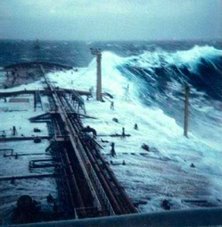
Even in the open ocean the immense waves of popular imagination are rarely encountered. At least three-quarters of all sea waves have a height less than 12 feet, and only very powerful storms produce mountainous seas of more than 30 feet. Nonetheless, some parts of the oceans have earned notoriety from producing larger-than- average waves, some of them very large indeed. Many of the biggest waves that reach the shores of Europe and eastern North America originate in the middle of the North Atlantic, especially in the stormy regions south of Iceland and Greenland. The long rollers that frequently strike the southwest corner of England can begin as far south as the Cape of Good Hope, South Africa -- some 6,000 miles away. In the Pacific, swells washing on the shores of California and even Alaska have been traced to the Antarctic Ocean. The winds south of Cape Horn, at the southern tip of South America, follow the "Screaming Sixties" all the way around the world without interruption by continents. This endless fetch produces long, powerful waves known as "graybeards" or "Cape Horn Rollers" by mariners who claim they have seen them measure a mile from crest to crest and reach heights of 200 feet.

Such figures were once discounted as the result of fancy and fear by oceanographers convinced that no wave could surpass 60 feet in height without collapsing. But this "60-foot rule" has been challenged recently by computer models that seem to prove that powerful storms are capable of creating waves as high as 219 feet.

The big waves of computer models, of course, are an exercise in theory divorced from practice. In nature, waves are not nearly as predictable and orderly as they are in laboratories, computers, and mathematical equations. While features such as velocity, period, and length are easy to measure in controlled circumstances, in the open ocean they can be hopelessly confused. Swells the size of small hills come at you from several directions at once, each rising and descending unpredictably, the slopes hacked by wind waves and covered with a perplexity of tiny capillary waves. One moment a breaking curler rushes down the slope of a large swell, then a trough fills with the crest of a wave coming from the side or falls away into yet a deeper trough. The random and disorderly nature of waves in the oceans almost guarantees that they will occasionally produce waves of a higher order. Such "rogue," "freak," or "episodic" waves are known as Extreme Storm Waves (or ESW) when they develop within a storm, and often rise in groups of three that have earned the quasi-mythical designation "Three Sisters Waves." Most reports of ESWs note that they look like "walls of water," that they're accompanied by steep-sided and unusually deep troughs (deep enough to occasionally swallow a ship), and that they spill forward and break simultaneously and with equal energy the entire lengths of their crests. An enormous freak wave with those characteristics struck the Queen Mary amidships south of Newfoundland while ferrying U.S. soldiers home at the end of World War II, rolling her to within a degree or two of capsizing.

Rogue waves can occur on relatively calm seas with no storms for hundreds of miles. Trains of swells traveling in the same direction but at different speeds will pass through one another; when their crests, troughs, and lengths happen to coincide they reinforce each other, combining their energies to form unusually large waves that tower mountainously for a few minutes then subside. Such giants can suddenly reach several times the height of most of the waves around them, forming mid-ocean breakers that are probably responsible for at least some mysterious disappearances of ships. When such anomalous waves occur near shore, roaring down without warning on piers and rocky ledges, they sometimes sweep people to their deaths.

When waves meet opposition in an oncoming current the wavelength is shortened and the wave is forced to become steeper and as much as two to four times higher. Examples can be seen on a relatively small scale at the mouths of rivers or estuaries, where the outflowing current creates high choppy waves that can be dangerous for small craft. When a current exceeding about four miles per hour is spread over a large area and involves massive amounts of water the danger is magnified. Regions notorious for such hazardous juxtaposition of waves and current include the Agulhas Current off the east coast of South Africa, the Kuroshio Current southeast of Japan, and the Straits of Florida and elsewhere along the Gulf Stream, where 30-foot waves blown up by nor'easters sometimes reach 40 to 60 feet in height.

Reports of rogue waves a hundred or more feet in height are no doubt often exaggerated, but careful measurements by coolheaded observers have left little doubt that waves of that size sometimes occur. One fairly reliable way sailors have measured such waves is to climb the rigging until they reach the point, while the ship is in the bottom of a trough, at which the crest of the wave lines up with the horizon. The height climbed then equals the height of the wave. This technique, or variations on it, have been used to measure some waves of terrifying dimensions.

One of the largest waves ever measured was reported by Navy Lieutenant Commander R. P. Whitemarsh in a famous paper titled "Great Sea Waves," published in the U.S. Naval Institute Proceedings in August 1934. Whitemarsh encountered a storm on February 7, 1933, while crossing the Pacific in the navy tanker the U.S.S. Ramapo. During this storm, west winds had a fetch across thousands of miles of unobstructed ocean and had already blown at gale force for days. With the wind at 60 to 66 knots (69 to 76 miles per hour) directly from the stern and the waves consistent, without cross seas, Whitemarsh and his crew were able to estimate (based on the 478-foot length of the ship) that the length of the waves was 1,000 to 1,500 feet. Using a stopwatch they timed wave periods up to 14.8 seconds. Crew members standing on the ship's bridge could measure the height of a wave by lining up its crest with the horizon and a point on the ship's mast (making the line of sight approximately horizontal) while the stern of the ship was at the bottom of a trough. By triangulating from the line of sight to the bottom of the ship's stern (or the trough of the wave) they were able to determine the height of each wave. The largest they measured was 112 feet.

Other notable waves have been measured against stationary objects, especially lighthouses. In the winter of 1861, for example, the Bishop Lighthouse in the Isles of Scilly was struck by a wave high enough to smash a fog bell hanging 100 feet above the ground (eyewitnesses insisted the crest of the wave came down on the bell), breaking a metal support bracket four inches thick and tossing the bell to the rocks below where it smashed to pieces. Waves have occasionally passed over the top of the 75-foot-high lighthouse on Minots Ledge, Massachusetts, and have flung rocks through the glass of Oregon's Tillamook Rock Lighthouse, 133 feet above the water.

Weather Story

From IAEM supported IDER Conference in London, England.

VIETNAM: Homes of hundreds of thousands of Vietnamese villagers are still under water after days of some of the worst flooding in decades, caused by the typhoon Lekima. Up to 67 people were killed and 14 were missing. The provinces Thanh Hoa and Nghe An were worst hit by floods and landslides and its two million inhabitants are affected. Maintaining sanitary conditions and the threat of water-borne diseases is becoming real. The disasters damaged over 100,000 houses, closed roads, submerged hundreds of thousands of hectares of subsidiary crops, and disrupted electricity and telecommunications system, isolating villages in several mountainous areas. Preliminary reports said nearly 58,000 houses were damaged or destroyed.

CHINA: Typhoon Krosa caused landfall in the southern China, lashing with heavy rain and high winds up to 126 km/h. It has been downgraded to tropical storm today. No casualties were reported although over 5 million people in east China's Zhejiang Province were affected. The storm prompted evacuation of more than 1.41 million people. Transportation services were paralyzed, power supplies cut off, schooling and tourist businesses suspended, and ship services halted on Saturday.

Chicago - On Sunday October 6, 2007, we broke the record of 86 set in 1947 by one degree - 88. Unfortunately we also broke the Chicago Marathon. One died and some 300 needed medical attention. The race was called half way through... However fall has arrived so we will be moving from Construction Season to Winter.... Good Morning Chicago!

That time of year again! Water Buoys to be removed in 10 days (Oct 5, 2007)

Funny side story here as told to me by a port captain for a major tug and barge company here in Chicago a while back ago.

Every winter as the lakes freeze over the USCG has to remove buoys and get the ole icebreaker ready. Though one of the local maritime companies has a tug that is ice capable. Seems that the local Indians who snow mobile over the lakes between Michigan and Wisconsin will mark the trail with small trees so that they can follow the path back home. One Captain of the ice-tug seemed to love to target and "break ice" directly in between the path of the trees so that the trail ..eh...ends... abruptly.

Water Buoys to be removed in 10 days (Oct 5, 2007)

Warning buoys upstream of seven Grand River Conservation Area dams along the Grand River will be removed the week of Oct. 15 to prepare for winter.

The buoys will be put back in place in May 2008 after the spring runoff.

Boaters using the river after the buoys are removed should exercise extra caution around the dams.

Buoy removal schedule:

*Oct. 15 - Dunnville Dam;

*Oct. 16 - Caledonia Dam, Wilkes Dam (Brantford);

*Oct. 17 - Parkhill Dam (Cambridge), New Hamburg Dam, Drimmie Dam (Elora), Bissell Dam (Elora).

The schedule is subject to change depending on weather conditions.

The buoys are installed each May to warn canoeists and kayakers about the danger of approaching these dams, which are all known as "run of the river" or "low head" dams.

The water upstream of the dams can be still and placid, but the area downstream can be dangerous.

Strong currents at the base of the dam can capsize a canoe or kayak and trap the occupant underwater.

Just a note from me

Recently I wrote a OPED which appeared in the Forth Worth Star Telegram on the mis-placement of six nuclear ACM 129 Cruise Missiles. I really shy away from politics but this incident is a very grave and serious matter not just to me but many of my peers. I sincerely hope that the USAF completes its investigation and the truth comes out. I wish to thank Paul Harral, Editor of the Editorial Page of the Forth Worth Star Telegram for taking the subject matter seriously and giving me the opportunity to go to print. His editorial skills and patience with me was just outstanding.

I cannot take full credit for the entire article, many of my peers and maritime friends coached and helped with support and questions. It was a team effort and I wish to thank them as well. I also wish to thank Susan H and Larry Johnson of No Quarter for re-printing the article. Their blog is one all must keep in their bookmarks. I also wish to thank Fred Fry of Fred Fry International and my shipmate Captain John Konrad at gCaptain for re-posting the article. Both blog's are also truly amazing like the men who write them.

RS


Friday, October 5, 2007

U. S. Coast Guard Rescue Swimmer Program

I cannot say enough about these guys, so let me have LCDR Wright give you the skinny! RS

U. S. Coast Guard
Rescue Swimmer Program By LCDR Richard M. Wright, USCG (Ret.)
On the evening of 10 February 1983, the M/V MARINE ELECTRIC sailed out of Norfolk,VA, enroute to Brayton Point, MA, with a 25,000 ton cargo of pulverized coal. Seas were rough, the skies were laden with a heavy overcast and the wind was cold and blowing in excess of 40 knots. The crew of 34 officers and men were experienced and had sailed in such weather on numerous occasions. As the ship proceeded on course, operations seemed normal. However, as the ship cruised off Virginia's east shore, the weather intensified. By the following morning, the seas were between 20 and 40 feet, with winds blowing at 60 knots. The MARINE ELECTRIC strained under the growing seas, as each successive wave crashed green water heavily over the decks. By midnight on 11 February, the ship seemed sluggish through the seas, and the Captain instinctively sensed that the ship was not recovering normally through the swells. He directed that the holds be inspected to ensure the cargo was secure. A frantic report returned that the holds were filling with sea water.

Severely weakened over time with rust, weak spots in the hatch covers were allowing the sea to pour into the holds. With the storm still intensifying, the Captain knew the ship was doomed. At approximately 0400 on Saturday, 12 February, a distress call was sent and acknowledged by the Coast Guard. An HH-3F helicopter from Coast Guard Air Station Elizabeth City, NC, piloted by LT Scott Olin, was immediately dispatched by Rescue Coordination Center Portsmouth. By the time the helicopter arrived, however, the ship had sunk, and 34 people were now desperately fighting for their lives in the frigid waters. As theH-3 hovered overhead, a rescue basket was prepared and lowered to the people in the water. Numbed by severe hypothermia, the men were unable to grab the basket and floundered helplessly. LT Olin quickly recognized that these victims could not be rescued with the capabilities at hand and asked RCC Portsmouth to make an immediate call to NAS Oceana to inquire if a Navy helicopter and rescue swimmer might be available to assist.

Not normally maintaining a ready helicopter on weekends, the Navy recalled LCDR William Sontag, who quickly rounded up a crew including rescue swimmer Petty Officer James McCann. The Navy H-3 helicopter arrived on scene at 0605, and for over an hour, both aircraft positioned themselves to receive survivors. Petty Officer McCann swam to the point of exhaustion in 40 foot seas in his effort to save as many as he could. Conditions were so severe and the temperatures so cold that sea water on his facemask froze. Although only three persons were recovered alive, Petty Officer McCann was awarded the Navy and Marine Corps Medal for his heroic efforts. Tragically, a total of 31 crewmen perished.


The Congressional Merchant Marine and Fisheries Committee convened hearings to question why the worlds premier maritime rescue service was unable to assist people in the water. It became apparent during testimony the existing techniques and equipment were inadequate for rescue in such extreme circumstances as occurred with the MARINE ELECTRIC. Congress, therefore, mandated in the Coast Guard Authorization Act of 1984 that "The Commandant of the Coast Guard shall use such sums as are necessary, from amounts appropriated for the operational maintenance of the Coast Guard, to establish a helicopter rescue swimmer program for the purpose of training selected Coast Guard personnel in rescue swimming skills."


With this mandate from Congress, the Coast Guard immediately turned attention to developing rescue specialists who could assist incapacitated people in the water. The Aviation Division (G-OAV) at Coast Guard Headquarters was tasked with researching alternatives and recommending a plan. LCDR Dana Goward, of the Aviation Plans and Programs Branch, was tasked to develop the Planning Proposal that would incorporate the outlines of the Helicopter Rescue Swimmer Program and determine its funding. LCDR Ken Coffland, Chief of the Aviation Life Support Branch, was named Program Manager. To assist them was ASMCM Larry Farmer, the Aviation Survivalman (ASM) Rating Subject Matter Specialist at the Coast Guard Institute in Oklahoma City, OK.

A photo of the rescue swimmer insignia.

The Coast Guard Rescue Swimmer insignia.


The main question arose as to who would become Coast Guard helicopter rescue swimmers? Should the program be open to volunteers from any aviation rating; should a new and separate rating be established; or should one rating be transformed to provide rescue swimmers? Each option had significant implications to the existing enlisted force structure. The duties and training required of rescue swimmers would preclude most aviation ratings from performing their highly specialized maintenance duties while also maintaining demanding rescue swimmer qualifications. It was decided that the rating most easily transformed and one already identified with sea survival was Aviation Survivalman. Transition of the ASM rating, however, raised concerns for those individuals within that rating who were: in mid-career or had no interest or ability to become rescue swimmers.

However, the Coast Guard was faced with a Congressional mandate that a rescue swimmer program be established. LCDR Coffland and ASMCM Farmer recommended that the fairest way to transition the ASM rating would be to exempt individuals who were E-7 or above and to offer all others who did not want to become rescue swimmers lenient conditions for changing to a different rating. In June 1984, with many details of the plan still to be refined, the Commandant authorized a five year period to implement the program throughout Coast Guard aviation. On 25 February 1985, an ALDIST message was disseminated announcing the requirement for all ASMs below the rate of E-7 to become rescue swimmer qualified. ASMs were given until 30June 1990 to either become a rescue swimmer, be promoted to E-7, begin school to change to another rating, retire or resign. Recognizing the unquestioned demand for dramatic change but also in fairness to those who elected to make the difficult transition to rescue swimmer, the Commandant stated that virtually no waivers to these options would be given. The extraordinary physical demands required of rescue swimmers also raised the question as to whether the program would be open to females. Considerable thought was given to the physical standards required to perform the duties of rescue swimmer, and no other service allows females in such programs. The Coast Guard decided that physical fitness standards would be 'mission specific' and gender blind. If otherwise qualified, females who possessed the strength and stamina were as eligible as men to become rescue swimmers.


On 21 May 1984, LCDR Goward visited the Navy's Rescue Swimmer School at NAS Pensacola, FL, to discuss the Navy's program, looking particularly at its training, mission and equipment. Recognizing that the Coast Guard program would ultimately be a maritime rescue resource similar to the Navy's, the Coast Guard and Navy entered an agreement by which Coast Guard helicopter rescue swimmers would be trained at the U. S. Navy Rescue Swimmer School at NAS Pensacola, FL. Commencing training on 10 September 1984, ASM2 Steve Ober and ASM3 Kelly Gordon became the first Coast Guard personnel to complete the four-week course, graduating on 5 October 1984.

A photo of a Coast Guard rescue swimmer.In addition to having the distinction of being one of the first Coast Guard rescue swimmers, ASM2 Ober graduated as the Honor Graduate of his class, one of only four out of 282 graduates up to that time to be so honored. Petty Officers Ober and Gordon were joined shortly thereafter by more graduates of Rescue Swimmer School. ASM1 Richard Woolford, ASM3 Matt Fithian, and ASM3 Butch Flythe were qualified by the end of 1984. These five individuals were to become the first operational rescue swimmers when Air Station Elizabeth City reported operational on 5 March 1985. Air Station Elizabeth City recorded the first life saved by a Coast Guard rescue swimmer on 4 May 1985 when a severely hypothermic man was saved after clinging to the bow of his capsized boat. With the survivor unable to climb into a rescue basket, ASM1 Richard Woolford was deployed into the water and pulled the person to safety. Training for the Aviation Survivalman rating became extraordinarily intense. As of 1 January 1986, individuals have been required first to pass a physical fitness screening test and then attend sixteen weeks of Aviation Survivalman "A" School at ATTC Elizabeth City. This is followed by four weeks of training at Rescue Swimmer School. With weight and space limitations aboard HH-65A and HH-60J helicopters, there was concern regarding the ability to provide medical treatment to survivors once recovered. To eliminate the need for hospital corpsmen in the aircrew, it was decided that Coast Guard helicopter rescue swimmers should also be qualified to administer first aid.

Therefore, in addition to their other training, rescue swimmers are required to attend three weeks of training at EMT School at Coast Guard Training Center Petaluma, CA. Only the most dedicated men and women complete this rigorous regimen of courses to earn the coveted title of Helicopter Rescue Swimmer. Since the program's inception, however, the idea of placing these individuals above their contemporaries as elite has been spurned. At every instance, rescue swimmers are reminded that they are merely part of a team. When not conducting rescues, it is expected that ASMs will perform their other duties as Aviation Survivalmen, maintaining the survival equipment depended upon by pilots and other aircrew. The concept of "The Quiet Professional" is ingrained from the beginning of their training and reinforced throughout their careers.

In January 1985, an inter-service conference was held at NAS Pensacola to determine the operating procedures for the Coast Guard Helicopter Rescue Swimmer Program. At the time, helicopter rescue specialists were utilized by the U.S. Navy and Air Force, the Canadian Forces, the Royal Navy and the Royal Air Force. These services were invited to demonstrate their deployment procedures and techniques. Following the demonstration exercises, the Coast Guard team recognized that their primary mission would to assist people in distress in a maritime region in a peacetime environment. The focus, therefore, was concentrated on the U.S. Navy's Rescue Swimmer program, as modification of the Navy procedures could be more easily adapted to Coast Guard requirements. It was decided that Coast Guard Rescue Swimmers would not utilize scuba, parachutes, or utilize procedures for combat SAR, tree extraction, or mountain rescue.

Once the decision was made to establish a program similar to the Navy's, ASMCM Farmer developed the Coast Guard Helicopter Rescue Swimmer Manual to delineate policies and operating procedures. The concept of operations stated that the rescue swimmer would either free fall from the helicopter or deploy via the hoist cable and, equipped with mask, fins, snorkel, and appropriate anti-exposure garments, would swim freely to assist the survivor. Master Chief Farmer himself began training to become a rescue swimmer, and following graduation on 29 March 85, he was selected to lead the Rescue Swimmer Standardization Team at Air Station Elizabeth City, established in September 1984 by ASM1 Woolford. Master Chief Farmer and Petty Officer Woolford continued to test and evaluate rescue swimmer equipment, operational concepts, and aircrew training. The Rescue Swimmer Standardization Team remained at Elizabeth City until August 1988, when it was transferred to ATC Mobile and joined by ASM1 Jeffery Tunks, ASM1 Jim Sherman and ASM2 Scott Dyer.


LCDR Coffland, meanwhile, developed a comprehensive schedule for implementation of the program throughout Coast Guard aviation. Every air station tasked to maintain operationally ready helicopters for search and rescue would be required to implement rescue swimmers. By the end of 1986, LCDR Coffland had implemented rescue swimmers at six air stations. Elizabeth City reported operational on 5 March 1985, with San Francisco following on 1 November 1985; Astoria on 31 January 1986; Clearwater on 11 August 1986; Sitka on 20 November 1986; and Cape Cod on 1 December 1986. By August 1987, when CDR Hugh O'Doherty relieved LCDR Coffland as Program Manager, there was still significant resistance and apprehension within Coast Guard aviation regarding the need for rescue swimmers. The MARINE ELECTRIC incident that precipitated the Congressional mandate for rescue swimmers involved severe hypothermia. Many persons in warmer regions were skeptical of the need deploying rescue swimmers into water where hypothermia was not perceived to be a problem. Others were concerned about the impact of additional training requirements to maintain flight proficiency for all pilots and aircrews in rescue swimmer operations. CDR O'Doherty's greatest challenge was to overcome these apprehensions and ensure that the Helicopter Rescue Swimmer Program was implemented at every station.

A photo of a Coast Guard rescue swimmer.

An HH-60J helicopter demonstrates procedures used to pickup a rescue swimmer after a rescue for the Joint Civilian Orientation Conference attendees at Reserve Training Center Yorktown.


When the program first became operational, there was considerable reluctance to deploy rescue swimmers except under generally favorable conditions. It soon became apparent, however, that Coast Guard rescue swimmers would frequently be utilized in extreme weather conditions. On 10 December 1987, Air Station Sitka, Alaska, received a distress call from a 26 foot fishing vessel taking on water about 10 miles southwest of Sitka. An HH-3F was quickly launched to search for the vessel, but the weather conditions were terrible. Visibility was down to 1/4 in a severe snow storm, the seas were running at about 25 to 30 feet and the wind was blowing at 35 knots with gusts up to 70 knots. Aboard the vessel were a 33 year-old man and his 6 year-old son, both of whom were wearing survival suits. In the heavy seas, the tall rigging of the sinking boat swayed violently from side to side, with the stern already awash. Despite numerous attempts, the pilot and hoist operator were unable to get the rescue basket to the two people on the boat.

The pilot, after considerable persuasion, convinced the father and boy that their only chance at rescue was to enter the water where they could then get into the rescue basket. With the son strapped to his chest, the father jumped over the side into the turbulent water. However, the man's survival suit leaked, and immediately filled with water. After several attempts to get into the basket, it became apparent that they could not. The pilot turned to ASM1 Jeffery Tunks, the rescue swimmer, and directed him to prepare for deployment. In a few short moments, Petty Officer Tunks was in the turbulent water and swimming to assist the two individuals. Fighting heavy seas and winds, Petty Officer Tunks struggled to get the two survivors into the rescue basket. Once secured, they were hoisted to the hovering H-3. With the aircraft being buffeted by extremely gusty winds during the subsequent effort to recover the rescue swimmer, Petty Officer Tunks was dragged through an enormous sea swell, causing him to lose his mask and snorkel and sustain a minor back injury. He was ultimately recovered, and with the two survivors safely aboard, the H-3 returned to Sitka. For his courage and presence of mind in deploying into conditions as yet not previously encountered during previous rescue swimmer operations, ASM1 Jeffery Tunks became the first rescue swimmer to earn the Distinguished Flying Cross.


Operations such as this became almost routine. As more people grew aware of the significant enhancement that rescue swimmers give to the capabilities of the SAR team, people wondered how the Coast Guard had operated so long without them. Questions still remained, however, particularly concerning the suitability of women as rescue swimmers. On 23 May, 1986, ASM3 Kelly M. Mogk became the first female to graduate from Navy Rescue Swimmer School.

A photo of a Coast Guard rescue swimmer.

The insignia on the wall of the Rescue Swimmers Office at Air Station Traverse City, Michigan.


On 3 January 1989, the pilot and weapons officer of an Oregon National Guard F-4 fighter jet bailed out 35 miles west of Tillamook Bay, OR. The Coast Guard responded by dispatching an HH-65A helicopter from Air Station Astoria, piloted by LCDR Bill Peterson and LTJG Bill Harper. Also aboard were Petty Officer Reese as flight mechanic and ASM3 Mogk as rescue swimmer. On-scene conditions were 100 foot ceilings, one-quarter mile visibility and 20 foot seas. Being mid-winter, it was also extremely cold. After a brief search, the pilots spotted two rafts, but only one person was seen clinging to one of the rafts. With the helicopter in a hover and after completing the appropriate checklists, ASM3 Mogk jumped from the aircraft into the frigid waters and swam to the survivor. The pilot was entangled in his parachute, had several broken bones, was suffering from hypothermia and was barely able to keep his head above the water. Despite the real danger of herself becoming entangled, ASM3 Mogk worked for twenty minutes to free the pilot from his parachute.

Finally cut free, he was hoisted to the aircraft, but due to his size, it took two men aboard the aircraft to pull him inside. Meanwhile, Petty Officer Mogk was also suffering from severe hypothermia, as her own dry suit had leaked, allowing cold water to enter. Her fingers and hands were severely numb. A second aircraft arrived on scene and futilely attempted to locate the missing weapons officer. Unable to find the man, ASM3 Mogk was hoisted aboard, and the aircraft returned to Air Station Astoria. After refueling, LCDR Peterson returned to scene accompanied by an Air Force H-3 helicopter with two PJs aboard. The missing crewman eventually was found tangled in his parachute about twelve feet beneath the raft. Efforts to revive him were unsuccessful. For her exceptional skill and determined effort during her rescue, Petty Officer Mogk was awarded the Air Medal, becoming the first female rescue swimmer to receive an award for heroism.


Having overcome most resistance to the program, CDR O'Doherty faced other obstacles, primarily budget battles. Due to a lack of funding, implementation was temporarily halted during 1987 and much of 1988. In the Coast Guard's Authorization Act of 1988, funding for the program was restored, and implementation was rescheduled for the remaining air stations. Four air stations went operational in 1988, with six more in 1989. Due to recurring budget constraints, only three air stations went operational in 1990.

In July 1990, LCDR Richard M. Wright became Rescue Swimmer Program Manager, and between February and July 1991, he implemented the final five air stations and two air facilities. With Air Facility Charleston, SC, reporting operational on 24 October 1991, the program was completely implemented at all twenty-four Coast Guard helicopter air stations and two air facilities. During the six years of implementation, the helicopter rescue swimmer program gained national recognition and acclaim as an extraordinarily successful enhancement to Coast Guard search and rescue operations. Over 250 lives were saved by rescue swimmers during this period.


As operational commanders learned more of their capabilities, rescue swimmers were utilized in an increasing variety of situations. With the concept of "Risk versus Gain" continually stressed to both commanders and rescue swimmers, few restrictions were placed on how rescue swimmers could be utilized. As the original mission of the program was intended to assist incapacitated people in the water, the Coast Guard elected not to train its rescue swimmers for mountain rescues or tree extractions, which required highly specialized training and equipment. In practice, however, it became evident that the Coast Guard was indeed responding to persons in distress along rugged coastlines as well as further inland. Reviewing the increasing number of deployment messages, LCDR Wright perceived that there were numerous instances where rescue swimmers were being deployed to the rocky surf, caves and steep cliffs of the Pacific coast, on the winter ice of the Great Lakes and to a variety of other hazardous situations elsewhere. He expressed concern within the Aviation Division that the training received by rescue swimmers and flight crews might not adequately prepare them for such conditions.


The requirement for additional training and procedures gained a greater sense of urgency in February 1991, when a rescue swimmer was nearly killed along the rugged coastline of Oregon. In an attempt to rescue a stranded hiker from a steep cliff near Lincoln Beach, an HH-65A from Air Station North Bend deployed ASM3 Patrick Chick to a steep cliff to assist the hiker. Following normal procedures, he detached from the hoist cable to await delivery of the rescue basket. While attempting to put the hiker into the basket, however, Petty Officer Chick lost his footing and fell 120 feet to the beach below. Fortunately, his outstanding physical condition, helmet and anti-exposure clothing protected him, and he suffered only minor injuries. The hiker, meanwhile, was able to retain his grip on the rescue basket and was lowered to the beach. This incident highlighted the need for additional procedures appropriate for operating in this and other similar environments where rescue swimmers routinely operate. This rescue and Petty Officer Chick's fall fortunately were captured on video camera, providing dramatic evidence of the dangers involved. Senior officials at Headquarters reviewed the film and quickly approved a study into new procedures.

LCDR Wright contacted ASMCM Darell Gelakoska, now Chief of the Rescue Swimmer Training Branch, to discuss techniques whereby the rescue swimmer could remain attached to the hoist cable and deployed directly to a survivor. This would provide for a faster delivery of the rescue swimmer to a survivor and allow the pilot to quickly recover the swimmer and survivor if particular hazards existed. Remaining connected to the hoist cable on vertical surfaces would also provide a lifeline should the rescue swimmer fall. ATC Mobile was tasked to test, evaluate and develop appropriate procedures and equipment to enhance rescue swimmer capabilities. In August 1992, LCDR Wright, Master Chief Gelakoska, ASM1 Sherman and flight crews from ATC Mobile met for three weeks at Air Station San Francisco, under the command of CDR Kevin Scheid, and Air Station Astoria, under the command of CAPT Charles Leiand, to test and evaluate procedures and equipment for the direct deployment of rescue swimmers to cliffs, wet rocks and heavy surf. Wind conditions, terrain clearance, engine power and obstacles were crucial considerations, as were protective clothing and harness gear for the rescue swimmer. In April 1993, following these intense trials, CAPT Pete Poerschke, Commander, ATC Mobile, forwarded a complete package of recommendations regarding new rescue swimmer direct deployment procedures for HH-60J and HH-65A aircraft. These proposals were reviewed by the Aviation Division and approved by the Commandant.

LCDR Wright then developed a plan to implement the direct deployment procedure at all air stations. During June and July 1993, ATC Mobile instructors trained designated pilots and aircrews from every air station in the new procedures on the steep cliffs of Darrell' s Ledge and to the heavy surf at Zimmerman Beach below the Presidio in San Francisco for HH-60J aircrews and at Cape Disappointment, WA, for HH-65A aircrews. Demonstrating the effectiveness of the procedure, Master Chief Gelakoska and ASM1 Dyer deployed to 200 foot cliffs, wave swept rocks and heavy surf with ease, recovering simulated survivors from otherwise inaccessible places. The aircrews under training quickly recognized the enhanced operating capabilities the procedure provided. They, in turn, returned to their units to conduct additional training until all pilots and aircrew were qualified. The direct deployment procedure gave operational commanders significantly more flexibility, allowing safe rescue swimmer operations where previously infeasible.


During the "Storm of the Century" that raced up the Atlantic coast in March 1993, the Coast Guard responded to numerous distress calls from Miami to Cape Cod. Coast Guard helicopters operated in the most extreme conditions imaginable, with winds in excess of 80 knots and seas up to 60 feet. Although numerous rescues were conducted effectively, in several instances rescue swimmers declined deployment. Although the rescue swimmer has authority to decline deployment if conditions are beyond his or her capabilities, some swimmers were distressed later that they had not deployed.

ASMCM Gelakoska contacted ASMs at every air station to survey them as to what they regarded as conditions too severe in which to deploy. It was discovered that there was a great disparity in perception as to what was deemed too severe. Some rescue swimmers admitted considerable peer pressure to deploy under circumstances they believed might be beyond their abilities. Master Chief Gelakoska proposed that a training program be developed to expose rescue swimmers to high sea conditions. With such training, rescue swimmers would be better able to judge their abilities in extreme situations. From his standardization training trips around the country, Master Chief Gelakoska indicated that the units best situated for the most ideal conditions for high seas training would be Air Station Astoria, OR and Air Station Humboldt Bay, CA. With approval from CAPT Gary McGuffin, Chief of the Aviation Division, LCDR Wright coordinated with Commander, Pacific Area and these units to provide helicopter support for the Rescue Swimmer Training Branch to develop an appropriate course of istruction. In April 1994, ASMCM Gelakoska and ASMI Ted Finney conducted training to test and evaluate effective procedures for rescue swimmer operations in rough sea conditions.

A photo of a Coast Guard rescue swimmer.

Coast Guard rescue swimmer David Moore (right) prepares three Coast Guardsmen from the cutter Tamaroa to be hoisted into the helicopter following the rescue of people from the sailing vessel Satori. The three crewmen were forced to abandon their small boat after it was damaged in rough seas during an earlier rescue attempt.


During this high seas training, consideration was also given to yet another environment in which rescue swimmers had occasionally been called upon to assist individuals in distress. On 1 April 1991, Air Station San Francisco received notification that two boys were trapped inside a coastal cave. An HH-3F was launched to assist. Arriving on scene, it was readily apparent that the youths could not be recovered directly by the helicopter and could be reached only by the rescue swimmer.

With the helicopter hovering at the mouth of the cave, ASM1 Steve Frye jumped from the aircraft into the water and swam into the cave. He found the boys perched on a ledge that was imminently in danger of being submerged by the rising tide. Petty Officer Frye's only option was to take hold of the boys one at a time and swim out of the cave. The strong swells repeatedly pushed him back into the cave and against the rocks. Due to his superior physical condition, stamina and determination, after several attempts Petty Officer Frye was finally able to escape the cave with the first survivor. Although fatigued, he re-entered the cave for the second boy. Again battling the heavy swells and protecting both himself and the survivor from beating against the rocks, ASM1 Frye reached the relative safety beyond the incoming surf. The two boys were hoisted aboard the aircraft and transported to a hospital for evaluation. Other than exhaustion and a broken finger, ASM1 Frye was in good condition. For his extraordinary heroism, ASM1 Frye received the Coast Guard Medal. Although this case ended successfully, it dramatically highlighted that cave rescues presented yet another situation wherein rescue swimmers were called upon to operate without guidance or hazard awareness. In conjunction with high seas training, therefore, Master Chief Gelakoska and Petty Officer-Finney evaluated different techniques for entering caves under various sea conditions.


By 1994, the Rescue Swimmer Program had evolved dramatically from its initial concept of open ocean operations, with numerous changes in policies, operating procedures and equipment being developed. The direct deployment was a significant enhancement, as were procedures for ice operations and deployments in other hazardous situations. Always striving to improve the program, like a quilt maker attempting to connect many pieces into one, ASMCM Gelakoska recommended in early 1995 that advanced training be provided in hazard awareness and the various new procedures, techniques and equipment that rescue swimmers do not receive in Rescue Swimmer School or normally encounter during operations at their air stations.

A formal proposal to establish an Advanced Rescue Swimmer School in Astoria was submitted by ATC Mobile in March 1995 and approved by CAPT McGuffin. Astoria was determined to be the best location for such a school, as the rugged coastline, demanding surf and prevailing high seas provided ideal training conditions. Within three months of its inception, the plan to renovate a building at Tongue Point in Astoria was designed by Coast Guard Pacific Area civil engineers and approved by Vice Admiral Richard Herr, Commander, Pacific Area. He directed that a $200,000 project be undertaken to make the facility suitable for the proposed school. On 9 April, 1996 Vice Admiral Herr dedicated the building to establish the Coast Guard Advanced Rescue Swimmer School. Twice a year for one month periods, HH-65A, HH-60J and Rescue Swimmer Training Branches from ATC Mobile host advanced rescue swimmer training for pilots, hoist operators, flight mechanics and rescue swimmers from all Coast Guard air stations. Although the mission of the school is to conduct training in advanced rescue swimmer operations, the focus is upon integrating the pilots and aircrew into an entire team to enhance the Coast Guard's ability to conduct helicopter rescue safely and efficiently.

A photo of a Coast Guard rescue swimmer.

A rescue swimmer from Air Station Elizabeth City, NC, deploys to the cruise ship Sea Breeze I in December, 2000. Two Coast Guard HH-60 helicopters and two C-130 Hercules aircraft rescued 34 crewmembers off the distressed 600-foot Panamanian-flagged passenger vessel Sea Breeze I after their vessel began taking on water and later sank approximately 290 nautical miles east of Cape Charles, VA.


In just twelve years the Coast Guard Helicopter Rescue Swimmer Program progressed from mere concept into a nationally acclaimed program. It evolved from its initial mission of open ocean rescue to its now extensive capability to assist people in distress in virtually any environment in which the Coast Guard operates. In the program's first ten years of operations, over 400 lives were saved through rescue swimmer deployment.

Rescue swimmer operations remain team efforts. Despite operating in the most severe weather conditions imaginable and deploying into extremely hostile environments, there have been no serious injuries to rescue swimmers. The program's record of success speaks highly of the training, fitness and courage not only of the rescue swimmers but also of the aircrews who deploy them. Although the Helicopter Rescue Swimmer Program has taken enormous strides to achieve its current abilities, it remains a dynamic resource able to change and adapt as conditions warrant. Looking to the future, strong consideration is being given to establishing a Coast Guard Rescue Swimmer School at ATTC Elizabeth City. Coast Guard rescue swimmer operations have progressed to the point that with its own school, the Coast Guard could tailor its curricullum to provide training more specific to Coast Guard operations. Where the program stands in 1996 on the 80th anniversary of Coast Guard aviation attests to the vision, leadership, professionalism and determination of all individuals who directly participated in the program's development.

For those who had the privilege of participating in this program's evolution, it was a distinct honor to serve with the "Quiet Professionals" who so routinely demonstrate that courage is a common trait. There are few titles within the military profession that are as hard earned and respected as that of Coast Guard Helicopter Rescue Swimmer.


U S Coast Guard VIDEO: Since 1790, The Coast Guard has rescued thousands of mariners in distress. This is the Top Ten Rescue videos of all-time. These videos were rated both on the significance of each particular case, as well as the dramatic footage of the rescues.

Maritime Notes
Below is the link to the Notice to Mariners Web Page: http://www.nga.mil/maritime/
RS