Showing posts with label Typhoon. Show all posts

Tuesday, October 16, 2007

Time-frequency Study of Nearshore Wind and Wave Processes

Thought I post a wonderful study by my good friend and naval peer, Paul C. Liu..

Paul Liu

Surface wind- gravity waves represent a primary driving force for dynamic processes in the oceans and lakes. As long as wind waves are ubiquitous features on the surfaces of the oceans and lakes, so too are the breaking waves appearing in the form of whitecaps woven in the midst of the wind waves. These waves induce intermittent temporally and spatially energetic mixing events at the sediment-water boundary which affect the redistribution of sediment, heat, and biogeochemical substances (such as nutrients and pollutants). While the importance of surface waves is well recognized, the study of the processes of the surface wind-generated gravity waves appears to have stagnated. At present there seems to be uncertainty as to how to proceed.

We think the there is a need to rethink the basic research approach to wind wave studies. Conventional wind waves studies such as the stationary Gaussian random process, the frequency energy spectrum, and the significant wave height are all based on conceptual frameworks devised over 4 decades ago. These approaches worked quite well for many years in practical applications but they may now be on the verge of obsolescence. Any casual observer looking at the ocean or at lake surfaces cannot possibly conclude that the processes they are seeing are "stationary" by any stretch of imagination. We see it as our challenge to address the non-stationary aspect of the ocean and lake surfaces, and to re-think the earlier approach of relying on frequency spectrum. We seek a fresh and novel new approach and ideas for surface wind wave studies.

Collaborators
Alexander V. Babanin, Swinburne University of Technology,
Australia (Swineburne University web site)
Chen H. Tsai, National Taiwan Ocean University, Keelung, Taiwan (National Taiwan Ocean University web site)

2006 Plans

In spite of the fact that breaking waves are integral components of the wind wave system, they have been largely ignored in wave modeling development and general studies. Most of the vast amounts of the available time series data of wind waves undoubtedly contain breaking waves, nevertheless most of the conventional study of wave modeling and wave data analysis based on theses time series recordings were performed as if the breaking waves were entirely absent. An early attempt (Liu in Annales Geophysicae, 1993) used continuous wavelet transform and the complex valued Morlet wavelet to estimate local surface acceleration and thereby detect wave breaking events through a given limiting fraction of gravitational acceleration. The approach remained idle until we meet Alex Babanin who has just the kind of breaking wave field measurements that can be used to test and substantiate our 1993 proposition. This collaborative work has been making encouraging progress. Additionally, we recently were able to acquire 5 GB of continuously recorded high quality time series wave data from western Pacific Ocean northeast of Taiwan from Prof. C. H. Tsai of National Taiwan Ocean University. We wish to continue these collaborations on breaking wave field measurements.

Program Accomplishments

We have been involved in wind wave studies since 1998. We have experimented with a number of different research approaches and worked with data from a variety of instrumentation deployed in Lake Michigan over this timeframe including Acoustic Doppler Current ProfilersADCP's), waveriders, tripods equipped with: pressure sensor, current meter, thermistor, and a transmissometercurrent meters. Beginning in summer of 2003 we shifted our research effort externally available wave data. We are now studying the detection of breaking waves in the time series using Wavelet Transform in collaboration with Alex Babanin. Additionally, are collaborating with C. H. Tsai studying continuously recorded high quality time series wave data from western Pacific Ocean northeast of Taiwan. (

In 2003 started by analyzing the new wave data recorded by the two bottomed-mounted, upward-looking Acoustic Doppler Current Profiler (ADCP) deployed in eastern Lake Michigan in the late autumn of 2002. The two gages were deployed at depths of 20 m and 12 m. From the middle of October to the beginning of December, over 40 days of continuous, non-intermittent wave measurements were collected. As ADCP's are well known for current measurements, wave measurement is their developed function. While the wave measurements have been quite successful, we found, at some unknown and difficult to trace frequencies the surface recording tends to become noisy. So while it provides reasonable general wave conditions we are not yet able to work with its time series data. In the later part of the year we shifted our effort to study the detection of breaking waves in the time series using Wavelet Transform in collaboration with Alex Babanin of the University of Adelaide of Australia who has breaking wave measurements from Lake George and Black Sea.

Prior to 2003 we focused on an analysis of the data collected from this instrumentation during the field seasons of 1998-2000. The effort concentrated on determining the differences between the wave parameters derived from the observations and those calculated by the GLERL-Donelan wave model. The wave model tends to under estimate the wave periods, so the bottom stresses calculated from the model results are usually less than those derived from the observations. This may be important when analyzing the results at a specific site, but for lake-wide models other sources of error are probably more important. The present sediment resuspension model is being modified to calculate the shear stress in order to model the measured results from the 18 deployments in Lake Michigan conducted over the last few years. No more sediment resuspension study will be done in this program.

deployment of   wave rider buoy

Deployment of Waverider buoy

The Waverider and two other moorings were deployed near Muskegon in the spring of 2000 to collect simultaneous surface measurements and water pressure measurements of wave heights. Analysis of the 1998-1999 data has proceeded continuously. The data show that the occurrence of waves with periods greater than 8 seconds is more frequent than previously thought, and that the present wave model does not accurately calculate the wave periods. Further analysis on applying the time-frequency wavelet spectrum analysis leads to new approach of identifying wave groups in each of the measured time series and defining relevant empirical wave group dimensional parameters. The results led to two normalized non-dimensional wave group parameters through classic dimensional analysis that provided new perspectives on wave grouping characteristics.

In 1998-99 an essentially complete time series records of wave parameters were obtained from the moorings at Michigan City, Benton Harbor, and Milwaukee. A complete time series record of water transparency was collected at the Milwaukee mooring and a partial one from Michigan City. In addition, measurements of water transparency and water temperature were obtained from 8 water intake plants. .

In 1998, an instrumented NDBC buoy 45011 was deployed in 1997 in the eastern Lake Michigan nearshore area near Grand Haven, Michigan at 43.02N and 86.27W. A number of interesting wave growth episodes were recorded. Besides research use of the measured data, the availability of lake meteorological information in the nearshore area has also received appreciative and favorable comments from nearshore lake users. In 1998, however, because of funding shortage the NDBC buoy measurement had been discontinued. Instead we chose to explore making underwater pressure sensor measurements of surface waves during the winter season.

In preparation of the instrument deployment, one tripod was modified to collect time series wave data and deployed in June and July of 1998. The test development was successful and three other tripods were modified prior to deployment in October.

Five moorings were deployed in October and November of 1998. Four of these (located near Milwaukee, Muskegon, Benton Harbor, and Michigan City) are tripods equipped with a pressure sensor, a current meter, a thermistor, and a transmissometer. The 5th mooring is an acoustic current meter, located near Muskegon to provide observations of the near bottom wave orbital velocities.

Milestone Reports

FY 2001 Q3 Milestone Report Complete the preliminary assessment of the wave grouping effects in nearshore Lake Michigan.

FY 1997 Q4 Milestone Report Completion of the Lake Michigan near shore hydrodynamic study of the Milwaukee area and reporting on wind and wave time series data analysis.

Products

Liu, P.C., D.J. Schwab, and J.R. Bennett. 2005. Some perspectives of the GLERL/DonelanDonelan Wave Symposium, University of Miami monograph. (In press) wave model, in

Lin, A. B. and P. C. Liu, 2004. Wavelet based comparison of infrared and water vapor images. Far East Journal of Applied Mathematics. 17(3), 309-326.

Liu, P. C., and B. V. Babanin. Using wavelet spectrum analysis to resolve breaking events in the wind wave time series. Annales Geophysicae 22:3335-3345 (2004). http://www.glerl.noaa.gov/pubs/fulltext/2004/20040024.pdf

Liu, P.C. and N. Hawley. 2002. Wave grouping characteristics in nearshore Great Lakes, Part II, Ocean Engineering, 29, 1415-1425.

Liu, P.C., editor, 1997. Nearshore Hydrodynamics Studies in Western Lake Michigan. NOAAGLERL-103, Great Lakes Environmental Research Laboratory, (NTIS# PB97-211031INZ) 40 pp. Technical Memorandum ERL

Maritime Notes

From Cargolaw

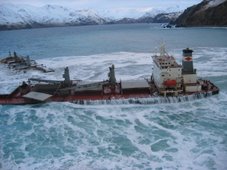
On June 22 2007 the 24 crew of M/V Denden began a 20 hour ordeal off the Thannirbhavi coast, about 13 km from Managalore, India. The vessel had departed New Mangalore Port, making for Dubai with a cargo of furnace oil slag when her engines failed off Panambur Beach. High velocity winds from Cyclone Gonu pushed M/V Denden towards the land.

Cyclone Gonu was the strongest tropical cyclone on record in the Arabian Sea, and tied for the strongest tropical cyclone on record in the northern Indian Ocean.

This would be the first casualty experience during the distinguished 40-years career at sea for Capt. Abraham Kwaw.

The entire crew would be tested. All would be heroes. Some would be lost in the wake of Cyclone Gonu. Cyclone Gonu.

Michael S. McDaniel - Your Editor

Flag from the Bridge

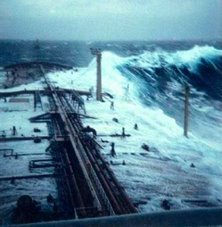
This dramatic photo of the M/V Denden is just incredible from a seaman's point of view. The vessel itself was a total loss due to the Cyclone. Mother nature can be a witch when she wants to. 2 died 14 rescued.

RS


Monday, October 15, 2007

Underwater Weather Watchers

One of my favorite subjects! Underwater Weather! This is a 2005 article from the American Institute of Physics and DBIS.

We have spoken about how we humans view things on a one-plane thought process, notably what we see. While much of what effects our planet and our weather are conditions, atmospheres and environments we either do not see or in some cases cannot see, yet.

The fact is that weather is a complex science with many variables. Science is on the path to try and understand these unseen but critical factors. RS

Underwater Weather Watchers


Oceanographers, Physicists Design Submersible Floats For Eyeing Ocean Weather
January 1, 2005

Researchers are now collecting valuable information about ocean weather from a fleet of cost-effective instruments called Argo floats. Using hydraulic fluid in internal and external sacs, each float sinks about a mile and a half underwater.

Every ten days, the float rises to the surface and transmits information on the ocean temperature and salt content. Researchers hope Argo will improve the ability to forecast the paths of hurricanes and where they will make their landfall.

Why do some objects float and others sink?

Legend has it that around 200 B.C., the Greek philosopher Archimedes took the first step to determine why objects float. Archimedes noticed as he was getting into his bath that when he sat down, water flowed over the sides of the tub. His weight had moved, or "displaced," it. He concluded that water pushes upward with a force equal to the object's weight.

When an object is floating, part of it is under the water; how much of it is underwater depends its weight. For instance, if a boat weighs 1,000 pounds, it will sink into the water until it has displaced 1,000 pounds of water. The object will float unless it is too heavy to push away enough water equal to its own weight and still have part of itself above the water.

But weight is not the primary factor in determining whether something will float. After all, big ships are very heavy, yet they stay afloat. It all comes down to an object's density: Objects with lower density will float more easily than objects of higher density. The density of the liquid is also a factor.

A boat may weigh 1,000 pounds, but it is not solid steel throughout: Much of its interior is air. So the average density of a boat is very light compared to the average density of water. Filling the boat with heavy rocks will increase its density, and eventually the boat will sink when its density becomes greater than that of the water.

The American Geophysical Union contributed to the TV portion of this report.

Additional information on Argo: Underwater Weather.

Maritime Note


Another amazing USCG Rescue was brought to my attention. This also includes another reported EPIRB malfunction as both gCaptain and myself have been reporting on with regards to the s/v Sean Seamour II. I am taking a look into the
fishing vessel Illusion's report to see if there was any USCG findings..

Aleutian rescue a close call for Coast Guardsmen AWARD: Helicopter crew saved fishermen in February sinking.

The Associated Press

(Published: October 14, 2007)

KODIAK -- When rescue swimmer Wil Milam pulled into Dutch Harbor aboard the cutter Mellon on a stormy February morning for a patrol break, his task was to brief some third-graders about his life in the U.S. Coast Guard.

It was 7:30 a.m. Feb. 19 when he gathered with the kids and told them he never had used the strobe light attached to his shoulder.

He would have to eat his words later that night when he saved the lives of four fishermen at sea.

The fishing vessel Illusion and its crew of four, longlining for cod, sank by the time the rescue helicopter arrived. Milam ended up in the hospital attached to an IV, wrapped like a cocoon in blankets beneath heat lamps until he was able to recover hours later.

Milam recently returned from Washington, D.C., where on Sept. 29 he received the Capt. Frank Erickson Rotary Wing Rescue of the Year award.

The award recognized the entire crew: Milam, pilot Lt. Devin Townsend, co-pilot Lt. Cmdr. Joe Carroll and flight mechanic John Maghupoy.

POWER OUTAGE

Dressed in a Coast Guard jumpsuit, Milam told his story last week to the Kodiak Rotary.

It was about 11:30 p.m. when he and his crew finished dinner. Milam was headed back to the Mellon when he was told the HH-65 Dolphin helicopter might have to launch.

The Mellon is a cutter fitted with a helicopter pad.

He arrived at the Mellon only to find there were no lights on board the ship because there was no power. He drove to the hangar, where there also was no power, meaning the doors could not be opened. The helicopter was parked behind other aircraft. He seemed stuck.

Milam said the flight mechanic luckily was able to get the hangar doors open. The helicopter was rolled out.

Winds were blowing from 40 mph to 55 mph and the visibility ceiling was only 150 feet. Finally off the ground, the chopper had to fly low and headed west about 50 miles to the location of a signaling emergency beacon near Makushin Bay.

The seas were swelling with 15-foot waves.

Milam had done rescues before. He didn't see why this one would be different, but like the other small obstacles that day, there would be more and more that would seem to pile higher and higher.

RACE AGAINST TIME

Milam that night was the only swimmer onboard the helicopter, a standard procedure on a mission.

As the chopper hovered above the sea, Milam spotted four people in a raft. None had survival suits on; they were all in street clothes.

He was lowering four survival suits to the stranded fishermen when two of the suits were lost in the rough water.

"I had to go back in the water after the suits. Then my own suit started filling with water because the T-handle had accidentally opened," Milam said. "I was trying to get into the raft, but I could not get my lower body in. My suit was full of water. It was very cold."

Milam then tried to get hold of the basket. One hand was holding the basket; the other was stretched to the raft. The raft got away.

"It was then I pulled out my strobe light. I was thinking what I had told the students -- that I had never, ever used my strobe light before," he said.

There were five in the raft, including Milam. The survivors did not speak English; two were Hispanic and two were Russian.

There was only 15 minutes of fuel left in the chopper. Milam got back to the chopper and climbed up and down repeatedly to pluck victims out of the basket to get them aboard.

"Now nauseous, I vomited. I went down again, this time in the basket instead of the hoist," Milam said.

But the ordeal wasn't over. One of the survivors jumped to the basket, but the basket flipped over, upside down.

As if that weren't enough, the cable tangled.

"One of the guys was swimming on his stomach. Another wave broke. He gets away and the cable is looped around his neck.

"Finally, I got him into the basket. I was ready to go. Everyone was safe. But I was shivering violently when the helo scooped me into the basket.

"In the end, our crew had saved the lives of four people," Milam said.

One of the victims was suffering from hypothermia.

"Then there was me," Milm said. "The two pilots and flight mechanic saved me. Had the crew not been able to scoop me out of the water, I might not have been able to make it back. The fuel was short and I am not sure I could have survived if I would have been left on my own."

"I don't remember the flight back. Coming into Dutch, the chopper had difficulty finding the airport lights. The pilot and a paramedic walked me to the ambulance. Except for the hospital, it was over."

ALL IN A DAY'S WORK

Milam, 41, a demure man, has lived in Kodiak since 1997. He told the rescue story without fanfare, as if it was just one of those things he does in the course of his Coast Guard duties as a petty officer first class.

Milam has been on numerous rescues. He was plucking people and dogs out of the water in the aftermath of Hurricane Katrina in New Orleans. Shortly after the hurricane, Milam was on the cover of Time magazine with a dog he had rescued.

Milam is quick to point out that it takes the entire crew to save lives, not just a rescue swimmer, as portrayed in the recent movie "The Guardian." He said the movie did not focus enough on the team and the support it takes in efforts to save lives.

Milam's next stop is New York City, where Thursday he will receive the U.S. Coast Guard Foundation Award for Heroism.

ASA elects new leaders

John A. Witte, Jr., Executive Vice President of Donjon Marine Co., Inc, Hillside, N.J. has been elected President of the American Salvage Association (ASA). Mauricio Garrido, Managing Director of Salvage for the Americas for Titan, a Crowley Company, Fort Lauderdale, Fla,. has been elected ASA's Vice President, and Tim Beaver, President of Global Diving & Salvage, Inc. ,Seattle, has been elected Secretary/Treasurer.

Flag From the Bridge

Since the printing of my OPED I have received a ton of email. Some supportive, some not and some just plainly hostile. I also have received some very hostile emails because of my posting of the Ethan Allan incident. I posted that article in full because it was a very important topic to the maritime community at large, or so I thought. Since then the only thing I have not been accused of is heresy and I am sure that is coming.

This blog is a hobby to highlight storms, storms at sea and maritime incidents caused by extreme conditions, rather than just on-shore storm and damage reports. I purposely avoid politics when blogging here and even my OPED is not posted on this site. While I get nothing in return for blogging...

I am not a reporter or journalist in the professional sense and really a novice at blogging. Nor do I believe that all blogger's are reporters or journalist just because they blog. I understand copyright issues. Though many times I do try to seek permission or at least notify that i am linking pr posting a story. I do at least link to the story or note the source, if it is not mine, or make sure my readers understand that the story is sourced out. Moreover, it does not take a rocket scientist to read my blog to understand this. While some of the comments I have received lately and anonymously are plainly stupid and down right insulting.

Other than that, its simple with me if you don't like my blog don't read it. But we all have the Constitutional right to free speech with out being intimidated. If you want to leave a comment that's fine but personal attacks are what we call "Bravo Sierra" and uncalled for, besides they just get deleted and I will not reply...

RS


Monday, October 8, 2007

Busy Pacific Storms

While its been extremely quiet in the Atlantic the Pacific is entirely another story.

To date there have been some 15 named storms and another three weather systems of interest harrassing the area. Unlike the Atlantic Hurricane season typhoons can run year round in the Pacific.


Tropical Cyclone Krosa now a tropical storm is now tracking toward China. At the last observation, on 2007/10/07 6:00 UTC, tropical cyclone KROSA is a Tropical Storm with maximum sustained wind speeds of 25 m/s (92 km/h, 50 knots) according to the Joint Typhoon Warning Center.
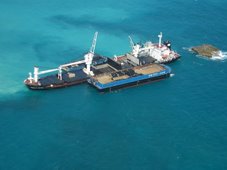
Meanwhile, another system Typhoon Lekima, triggered floods and landslides which battered Vietnam's central coast earlier this week and killed up to 34 people and left 19 others missing. Thousands of homes were destroyed in two central provinces of Ha Tinh and Quang Binh, Vietnamees officials reported on Sunday. Lekima was the fifth typhoon to hit Vietnam this season. Tug boats were stabilizing the M/V Aladdin Dream which ran aground during the storm.

Freak Waves?

Here is a interesting story from New Zealand on a reported "freak wave" in one of New Zealand's worse maritime accidents.

Sinking just a 'freak accident'
5:00AM Sunday October 07, 2007
By Michelle Coursey
An official report into one of New Zealand's worst maritime tragedies, the sinking of the Kotuku fishing boat in Foveaux Strait last year, attempts to lay blame where it shouldn't, say family members of the victims.

The 17-metre trawler capsized on May 13 last year, reportedly after being hit by two large waves, on its way back to Bluff from the Titi Islands, near Stewart Island.

Six people died in the incident - including members of three generations of one family - while three others narrowly escaped with their lives by swimming to a nearby island.

On board were members of the Topi family, a well-known clan in Bluff - Leslie Topi (known as Peter), 78, his daughter Tania Topi, 41, and his two grandsons Shain Topi-Tairi and Sailor Trow-Topi, both aged nine, all died; while Paul Topi and Dylan Topi both survived the accident.

Skipper John Edminstin also survived, but his friend Ian "Shorty" Hayward, 52, and crew member Clinton Woods, 34, perished.

Last week, the first preliminary report was released on the tragedy by the Transport Accident Investigation Commission, but those close to the victims are unhappy about its contents, and plan to tell the TAIC what they have got wrong.

Those who have seen it have had it "drummed" into them that they are not allowed to discuss its findings until after a meeting to be held this Thursday. The closed hearing will be held in Invercargill, where the three-member Commission will hear submissions from those affected.

All of those who spoke to the Herald on Sunday yesterday intended to be at the hearing, or make submissions via email on the content of the report.

But at least one family member, who did not wish to be named, said the conclusion of the findings was the part they found most objectionable, as it tried to "find something wrong" with various factors, including people's actions and the boat, to explain the incident.

"They've tried to find something to blame but it was a freak accident. They can't seem to accept there were two waves, and that's what did it."

While previous reports have speculated the boat may have been overloaded - it was carrying around 60 buckets of muttonbird on deck when it left the Titi Islands - the TAIC findings apparently do not say that was the cause.

Neither do they apportion blame to alcohol being consumed; however, they do make suggestions as to what might have been done by those onboard to survive.

"That just seems pointless. I guess they have to do it, because they said this report is meant to tell other people what not to do, but it's a bit late now."

The report includes much technical detail, including stability testing on the boat, and a close analysis of its seaworthiness. Some of the information in it has come as a surprise to family members, but then "we weren't on the boat" they say. And neither were the writers of this report, they add.

Edminstin did not wish to speak at length to the Herald on Sunday yesterday, preferring to save his comments on the tragedy for after the government reports were finalised.

TAIC hopes to release its final findings by the end of the year, but that will "depend on the extent of further work required following next week's hearing", chief commissioner Bill Jeffries said in a press release.

However, after that, another report will be put together by Maritime New Zealand, and Southland coroner Trevor Savage is waiting for both before deciding if an inquest into the deaths would be held.

Judy Hayward, who lost her husband Ian in the sinking, and who has since relocated to Melbourne, said every time someone mentioned the name of the boat to her "it brings it all up again", and she was looking forward to when "all of it has finished".

After reading the report, she would make her submission to the commission via email, but agreed that it was simply an accident.

"At the end of the day you can't change the sea. No amount of preparation can change the strength of the sea and no amount of reporting will make it [the accident] go away."

Another widow, Joyce Topi, who lost husband Peter, said she had not read the report because she didn't believe it needed to be written in the first place. "It's nobody's fault, it was an accident."

The Kotuku itself continues to sit rusting in the backyard of an old timber mill outside of Invercargill.

Edminstin still plans to burn the boat when it is returned to him - he has no use for it now.

"It should never have been lifted up," said Judy Hayward. "It was already a graveyard."


My favorite subject, USCG Rescue Teams.
2006 AIRSTA SAV rescue clips to music.


Weather Note

Chicago Weather for October? 88 degrees? Unheard of ! And what did the heat do the Chicago Marathon?

One dead, 250 hospitalized after heat-shortened Chicago Marathon Associated Press - October 7, 2007 5:43 PM ET

CHICAGO (AP) - A Michigan man died while running the Chicago Marathon as stifling heat and humidity forced race organizers to shut down the course midway through the race. Authorities say the 35-year-old man collapsed while running on the city's South Side and was pronounced dead at a Veteran's Affairs hospital.Some 250 people were taken to hospitals because of heat-related ailments.

The decision to turn runners around effectively ended the race for many thousands midway through the course. Organizers closed the second half of the course just before noon, four hours after the annual race started with temperatures already touching 73 degrees with 86% humidity. By 10 a.m., temperatures had already reached a race-record of 88 degrees.

The men's race was won by Kenya's Patrick Ivuti (eh-VOO'-tee). Ethiopia's Berhane Adere (buhr-HAYN' ah-DAHR') rallied to successfully defend her women's title.

Copyright 2007 The Associated Press. All rights reserved. This material may not be published, broadcast, rewritten or redistributed

RS

Wednesday, October 3, 2007

Cargo Ship Sinks During Storm

Search for survivors Cebu Daily News Last updated 02:17pm (Mla time) 10/03/2007

CEBU CITY, Philippines - Four survivors of an ill-fated cargo ship from Cebu that sank off Palawan are still in shock.

They could still hear their co-workers shouting for help while being eaten alive by sharks, a police official in Palawan said.

“Sabi nung mga survivors narinig pa nilang sumisigaw yung iba habang humihingi ng tulong. Nakita daw nila na kinakain na ng mga pating yung mga kasamahan nila. Pero wala silang magawa (The survivors said they heard the others screaming while asking for help. They said they saw their fellow seamen being eaten by the sharks but there was nothing they could do),” said Senior Superintendent Dennis Peña, Palawan police director.

The four were identified as chief mate Roulette Sapallida, seaman Rey Cabuhay, oiler Marlon Tiguman and apprentice Richard Abrigona, who were rescued by passing fishing boat Alister.

The survivors are now confined at the Cuyo District Hospital in Cuyo town, Palawan.

Because of this account of the survivors, Peña said most of the 14 missing crew members of M/V Mia of JPS Shipping Lines in Cebu could already be dead.

But, he added, they have not given up hope.

Divers and rescue swimmers of the Philippine Coast Guard continued their search in the hope of finding more survivors.

The Maritime Industry Authority in Central Visayas (Marina-7) has started its investigation into the sinking of the cargo vessel about 28 nautical miles southwest off Cagayancillo, Palawan.

Mardon Martin, Marina-7 safety engineer, said the probe would determine if the shipping corporation could be liable for the incident or there was negligence on the part of the crew members.

The M/V Mia, loaded with 880 metric tons of cement, left San Fernando town in southern Cebu about 5 a.m. of September 27. It was expected to arrive in Brooke's Point, Palawan on September 29.

Based on the marine protest filed by JPS general manager Gallagher Gallarde to Marina-7, the vessel sank about 11 p.m. on September 28.

Report from the Philippine Coast Guard (PCG) in Manila, however, said M/V Mia went under about 4 p.m. on September 29 reportedly due to bad weather.

But according to the Palawan police, the vessel overturned after the enormous waves spawned by typhoon Hanna damaged its body while it was crossing the sea off Cagayancillo about 2:40 p.m. on Sunday.

The vessel tilted to its side and the overturned, the report from the Palawan police said.

According to Gallarde in his marine protest, the JPS shipping personnel received a radio message from the M/V Mia crew members about 1 p.m. on September 28 that the cargo vessel was already 20 miles off Tubbataha Reef, off Puerto Princesa City, Palawan.

The crew members also told the shipping lines that their estimated time of arrival in Brooke's Point would be delayed by seven hours — from 6 a.m. to 1 p.m. on September 29 — due to rough seas.

“This was the last radio communication from the crew of M/V Mia; hence, there was neither radio contact nor cellular phone communication from September 29, 30 and October 1 except from the fishing boat Alister at 8:10 a.m. on October 1,” according to the marine protest.

Gallarde said in the marine protest that representatives from the fishing boat informed JPS Shipping through radio on October 1 that they were able to rescue four of the 18 crew members.

The fishing boat happened to pass by and saw what happened.

The crew men of F/B Allister daringly plucked the four survivors from the rough seas, according to Peña of the Palawan police.

Peña said the Palawan police were also conducting an investigation to check into the possibility that the sunken cargo ship might be overloaded.

The sinking of M/V Mia was the second sea tragedy in Palawan in September.

Martin of Marina-7 said the Philippine Coast Guard would convene the Special Board of Marine Inquiry to look into the cause of the sinking.

Marina would also check if the vessel was seaworthy when it sailed to Brooke's Point, he added.

Martin said they would also verify if the vessel had proper life-saving equipment on board such as life-jackets and that all crew members had the proper papers.

To determine these, he said Marina officials would interview the survivors.

But Martin said there was no reason to ground the two other vessels of JPS Shipping Corp.

“If there are administrative lapses, we can impose a fine or suspend the certificate of public convenience of the shipping company”, he said.

In the meantime, the Coast Guard continues its search for missing crewmen.

Lieutenant Armand Balilo, PCG spokesperson, said the rescue team's operations were hampered by the incessant rains brought about by tropical storm “Ineng.”

“But rest assured that our search and rescue operations will not cease until we find the missing persons,” he said. /Correspondent Jhunnex Napallacan and Inquirer

Note: I have to tell you how disguested I am with the reporting of this event. 90% of the copy on this story is conflicting or just badly reported. To you reporters out there. What was the name of the storm that did the damage to this ship? Come on sheesh .....
Additional Stories...
Cebu Daily News
Inquirer.net, Philippines - 13 hours ago
CEBU CITY, Philippines - Four survivors of an ill-fated cargo ship from Cebu that sank off Palawan are still in shock. They could still hear their ...
Crew of sunken ship feared eaten by sharks
China Daily, China - 13 hours ago
Manila -- Fourteen crew members of a cargo ship which sank in waters off western Philippines' Palawan Island last weekend were believed to have been eaten ...
Four missing sailors eaten by sharks in Palawan
ABS CBN News, Philippines - 14 hours ago
Four of fourteen missing sailors were eaten by sharks after their cargo vessel sank off waters in Palawan over the weekend, the Philippine Coast Guard said ...
Sharks mangled crewmen of sunken ship off Palawan--survivors
Inquirer.net, Philippines - Oct 2, 2007
By Marlon Ramos CAMP VICENTE LIM, Laguna, Philippines -- Four of the rescued crewmembers of a cargo ship which sank off the coast of Cagayancillo, ...
14 missing after Philippine ship sinks in stormy waters
International Herald Tribune, France - Oct 2, 2007
AP MANILA, Philippines: A cargo ship sank in stormy waters in the southwestern Philippines, leaving 14 crew members missing, the coast guard said Tuesday. ...
14 crew missing after cargo vessel sinks off Palawan
Inquirer.net, Philippines - Oct 1, 2007
MANILA, Philippines -- Four of the 18 crew of a cargo vessel were rescued after their ship sank off the coast of Palawan province last Sept. ...
14 missing seamen now feared dead in Palawan
Manila Times, Philippines - 5 hours ago
PUERTO PRINCESA CITY: The 14 missing officers and crew of a Cebu-based cargo vessel that sank off Palawan waters over the weekend are feared dead. ...
Fourteen crew missing after cargo ship sinks in Philippines
Monsters and Critics.com, UK - Oct 2, 2007
Manila - Fourteen crew members are missing after a cargo ship carrying cement sank in stormy seas on the weekend in the western Philippines, the coast guard ...
Cargo ship sinks in the Philippines Gulf News, United Arab Emirates - Oct 2, 2007 Manila: At least 14 crew members were missing after a Philippine ship carrying 800 tonnes of cement sank off a western island, the coast guard said on ...


Special Notes Of The Day!

October 4th is the Feast Day of St. Francis of Assisi!

Saint Francis of Assisi (September 26, 1181 - October 3, 1226) was a Roman Catholic friar and the founder of the Order of Friars Minor, more commonly known as the Franciscans.

He is known as the patron saint of animals, birds, and the environment, and it is customary for Catholic churches, rescues and shelters, and animal community organizations to hold ceremonies honoring animals around his feast day of October 4.


RS

Wednesday, September 26, 2007

New technology helps Coast Guard pin point emergency signals


Office of Public Affairs
U.S. Coast Guard First District

BOSTON - Recent radio upgrades on a falcon jet at Air Station Cape Cod Mass., enable crews to rapidly locate the exact source of emergency signals, as seen during a recent search.

(Coast Guard Petty Officer 1st Class Michael O'Neal inspects the new 430 Direction Finding system aboard a Falcon jet at Air Station Cape Cod here Friday, Sept. 21, 2007. The new technology enables crews to rapidly locate the exact sources of emergency signals. U.S. Coast Guard photo.)

The HU-25 falcon jet equipped with the new gear launched Sept. 7 after the air station was notified of an Emergency Position Indicating Radio Beacon (EPIRB) emitting a distress signal from a boat near Jonesport, Maine. Coast Guard aircraft respond to EPIRB distress signals by following instrument guidance towards the radio beacon provided by direction finding equipment.

During the air station's first operational test of the new 430 Direction Finding (DF) system, the aircraft locked onto the EPIRB's signal from 72 miles away and obtained its location.

A 25-foot response boat from Station Jonesport determined that the boat was safely moored and the EPIRB was sending a false alarm.

"This new system saves us valuable response time, allowing us to receive more accurate guidance and acquire weaker signals," said Lt. j.g. Adam Young, a pilot at Air Station Cape Cod.

The HU-25 Falcon jet is one of only three aircraft in the Coast Guard with the new 430 DF system.

There are two types of EPIRB's, the original model that supplies only azimuth guidance and a newer device, a 406 EPIRB, that is registered to a specific user and can provide coordinates for the activated device's position.

When a boater's 406 EPIRB emits a distress signal, the beacon's position is transmitted via satellite to the U.S. Mission Control Center in Maryland where it is then passed to the appropriate rescue coordination center. The rescue coordination center in turn passes the position to the aircraft.

"The notification process usually only takes a few minutes, but those few minutes can be vital when factors such as cold water or injuries come into play," said Lt. Michael Nalli, a search and rescue coordinator at the First Coast Guard District.

With the new system, the Falcon not only obtains real-time data for a quicker response, it also obtains a more exact location.

The position the EPIRB passes to the satellite may be off by as much as three miles. But when the Falcon picks up the EPIRB's signal, it can usually pin-point the location.

"Mariners' widespread use of the 406 EPIRB has significantly reduced search time and unnecessary asset use," said Young. "Now if all mariners use a 406 EPIRB with the capabilities of the 430 DF system, we have the potential to take the search out of search and rescue."

Weather Story

Tropical Storm Karen and Jerry

MIAMI (AP) — Tropical Storm Karen strengthened from the twelfth tropical depression of the season early Tuesday in the open Atlantic Ocean but posed no immediate threat to land.

[full basin map of tropical cyclone activity] Tropical Storm Karen is about 1,355 miles east of the Windward Islands, and the 13th tropical depression of the hurricane season is about 165 miles east of Tampico, Mexico, the National Hurricane Center reported late Tuesday.

An area of cloudiness and a few thunderstorms is associated with a broad area of low pressure near the Virgin Islands in the Lesser Antilles, but the system is poorly organized and unlikely to develop, the NHC reported.

Another area of disturbed weather over South Florida, western Cuba and the western Bahamas is associated with a mid- to upper-level trough that could bring heavy rains to South Florida and the Florida Keys in the next several days, the NHC reported.

Additional information to expand on the West African flooding. . .

"Following torrential rains recorded in West Africa, floods have affected over 500,000 people in 12 countries: in Ghana (+270,000), Nigeria (50,000), Burkina Faso (+40,600), Togo (+100,000), Mali (25145), The Gambia (298), Niger (16,700), Senegal (3100), Côte d’Ivoire (2000), Liberia (17,000), Mauritania (30,000) and Sierra Leone (4500). Floods have caused the destruction of houses, food stocks, goods, farms and polluted most of the water sources (wells and canals). This has resulted in the displacement of thousands of people."

Maritime Notes

Long Beach – counter-terrorism exercise

The US Coast Guard issued a press release stating that members of the Los Angeles-Long Beach Area Maritime Security Committee will conduct a command post counter-terrorism exercise in Long Beach on September 27. (9/24/07).


RS


Tuesday, September 18, 2007

NATO assets used in survey of sunken Russian submarine

ROVs are not just used in commercial applications. As we will learn in the article below they are used in military applications.

NATO
assets used in survey of sunken Russian submarine

20 July 2007 – NATO Research Vessel ALLIANCE was recently engaged in a task to survey the wreck of a sunken nuclear submarine, 21 June to 7 July. This was part of an international effort led by the UK Ministry of Defence’s (MOD) Defence Equipment and Support Salvage and Marine Operations Team (SALMO) at the specific request of the Russian Federation (RF). The UK MOD requested the use of NRV ALLIANCE, managed by NURC, a NATO research centre in Italy, due to the unique capabilities of the ship to perform oceanographic research and surveying. NRV ALLIANCE was used, in this operation, as the host ship for the NATO Submarine Rescue System (NSRS) Intervention Remotely Operated Vehicle (IROV), owned jointly by the UK, France and Norway.

The decommissioned Russian submarine, B-159, was being towed to a breakers yard in 2003 when it broke loose and sank in rough weather in the Barents Sea at the entrance of the Murmansk River, resulting in the loss of nine Russian sailors. Two nuclear reactors were onboard the submarine when it sank, although the reactors were shut down and in a safe state. This survey was the first stage of a recovery effort and was carried out through the Arctic Military Environment Co-operation (AMEC), with the UK and Russia as active members and Norway and the US as observing members.

Upon arrival at the wreck site under the escort of a RF naval vessel, the survey team was officially welcomed by Vice Admiral Maksimov, Deputy Commander in Chief of the Northern Fleet. The location and position of the submarine was quickly found using sensors on NRV ALLIANCE. Environmental sampling was conducted by sonar surveyors from St. Andrews University, while the IROV removed debris from the vicinity of the wreck. This was the IROV’s first operational deployment, and the vehicle stood up to the challenge. With the IROV pilots working 24/7 over the wreck site, a considerable amount of seabed work was completed. Radiation monitoring indicated no radiation hazard from the submarine.

A highlight of the operation was the recovery of a small Russian ROV that had become entangled in the wreck a few years ago, as well as the RF naval flag that had been flying on the B159 when she sank. The ROV was returned to the surface and presented back to Admiral Maksimov, along with the flag.

The operation was a great success, meeting all its objectives: SALMO was particularly pleased with the performance and capability of NRV ALLIANCE. In addition, it was noteworthy to see the NATO flag flying alongside that of the Russian Federation, with international teams working collaboratively on such a worthwhile project. Prior to its departure from the area of operations, NRV ALLIANCE participated in a wreath laying ceremony with the RF Navy Destroyer ADMIRAL LEVCHENKO.

Credits: Photos courtesy of the UK MOD

Weather Story

tornado.jpg

Saturday (September 15, 2007) evening at approximately 7:00 p.m. a weather cell confirmed to be a tornado ripped through the Palo Verde, California region and heavy damage occurred. It is anticipated that the total damage will exceed $10,000,000.00. Palo Verde, California is located at the northeast corner of Imperial County, just within the county limit that is shared with Riverside County.

The initial site survey reports conducted by the Imperial County Planning Department estimated that 80% of the community’s structures incurred major damage. 13 Condemnation notices have already been posted and it is estimated that 30% of the structures will be condemned once the damage assessment surveys are completed. The water has been deemed safe to drink, and shelters have been established at the Colorado Fairgrounds in Palo Verde. It is estimated that power will not be fully restored for a few days. Responders to the scene included but were not limited to; Imperial County Sheriff Ray Lorea, Imperial County Supervisor Wally Leimgruber, ICFD Battalion Chief Tony Rohoutas, Fire Chief Bill Zimmerman, Imperial Valley Red Cross Volunteers Ramon Barron & Roland Pritchard.

Imperial County CEO Roberta Burns has been working with the Governors Office to have this emergency classified a State Disaster. Imperial County Supervisor Joe Maruca signed the Imperial County Disaster Proclamation at 3:45pm today. This weather cell also downed eight Power Lines in the City of Calexico and two in Holtville, power was restored this afternoon to all of Calexico and Holtville. Note: Palo Verde has a population of 279 people with 225 Residential structures mostly mobile homes.

Damage level: Heavy

Update Typhoon NARI

SOUTH KOREA: Typhoon kills at least one, strands 15,000 in South Korea

A powerful typhoon killed at least one person in South Korea on Sunday, grounded 280 flights and stranded 15,000 passengers on its southern resort island of Jeju, officials said. The anti-disaster agency reported one dead and two missing on Jeju. South Korea's Yonhap news agency put the total typhoon death toll at six -- on Jeju and elsewhere.The agency said Typhoon Nari, expected to hit the mainland late Sunday, moved faster than the country's weather office had expected, flooding scores of houses and leaving more than 100 people homeless. The powerful storm also cut power to some 150,000 homes on Jeju and parts of southwestern South Jolla province for hours.

RS

Thursday, August 9, 2007

Crazy Weather


Where do we start? Chicago had tornado warnings with 3.50 " of rain per hour and Brooklyn got hit with a EF2 Tornado. But thats not all. While its quiet in the Atlantic there have been some 12 Typhoons in the Pacific, with another four tropical depressions under watch. Flood's? Try China and Britain are competing for the worlds largest ark contest. Lets not forget New York City! Extreme weather has raged in Bulgaria, Pakistan and even Romania and two tornado's in the Philippines.

So whats in store for us today in Chicagoland? More of the same, so let's sit and watch the sky's and the radar for another day..


Stay cool, stay dry and stay safe...
RS