Thursday, May 15, 2008

Burmese officials selling emergency aid supplies in local markets

Burmese officials selling emergency aid supplies in local markets

Officials in Burma's cyclone-hit Irrawaddy delta area are appropriating emergency aid supplies and selling them in local markets, it was claimed on Monday.

Burmese volunteers who are operating their own private aid missions to the area have said that they are having to hide from local apparatchiks in order to prevent them commandeering their aid and selling it on at markets.

The Telegraph learned of the alleged scam from a Burmese businessman from Rangoon, who was leading one of dozens of private relief missions distributing supplies of rice, biscuits and clothing around the flood-hit delta area on Monday.

The volunteers had covered the back of their pick up truck with a tarpaulin so that local officials could not see what they were doing.

"If they see our relief supplies, they will come over and say 'don’t worry, give that to us, we will distribute it for you',” he said.

"But we know that for every ten sacks of rice we give them, only four will reach the people.

"The other six will end up being sold by that official on a market in some local town. Rice prices are very high right now and that official will then make a good profit.

On the outskirts of the more storm-damaged regions, checkpoints had sprung up overnight, where police and immigration officials were banning any foreigners - including aid workers - from entering the area.

"We have orders to turn all foreigners around," said one official.

"That includes even workers from the ICRC [the International Committee of the Red Cross]."

The secretive junta has already been condemned for refusing to allow in foreign aid experts to oversee the distribution of the massive aid effort, claiming that it alone is best equipped to deal to do so.

But on Monday, during a three-hour drive through the water-logged delta area, not a single village had received government aid.

The first American military aid flight was among a handful allowed to land in Rangoon yesterday. It was met with an ambiguous pledge by Burma’s leaders to deliver its cargo of water, mosquito nets and blankets “as soon as possible”.

The US intensified pressure on the regime on Monday, sending three naval ships towards the Burmese coast.

Admiral Timothy Keating, the head of the US Pacific Command, arrived in Rangoon on the aid flight to urge the Burmese leadership to allow a "long, continuous train of flights".

A French warship is also expected to arrive this week, carrying 1,500 tons of rice that France said it wants to distribute directly to survivors.

The United Nations confirmed a US estimate that more than 100,000 people had perished when Cyclone Nargis crashed into Burma 10 days ago, adding that more than 200,000 people were still unaccounted for.

The Burmese leader General Than Shwe would not accept a telephone call from Ban Ki-moon, the UN Secretary-General.

Mr Ban expressed "immense frustration" at the "unacceptably slow" response by Burma and demanded immediate action as the threat of starvation and disease threaten the delta region, where heavy rains are forecast this week.

Gordon Brown urged the Burmese authorities to give "unfettered access" to humanitarian agencies. He said that HMS Westminster was heading for Burma to help humanitarian operations.

"We now estimate that two million people face famine or disease as a result of the lack of co-operation of the Burmese authorities. This is completely unacceptable," he said.

Britain has pledged £5 million in assistance and aid agencies have raised another £5 million.

A British Government official said the UK was ready to at least match an Australian pledge of about £10.5 million in aid funds.


Most Cyclone Victims 'Children


BURMA UPDATE

Situation Update No. 45

Myanmar (Burma) - Tropical Storm on 2008-05-02 at 16:52:43

Ref.no.: TC-20080502-16580-MMR

Situation Update No. 45

On 2008-05-14 at 03:44:29 [UTC]

Event:
Tropical Storm
Location:
Myanmar (Burma) Southern area

Situation


A total of 34,273 people have been killed in Myanmar's Cyclone Nargis, the worst natural disaster to hit the region since the 2004 tsunami, the country's state television announced on Tuesday. Cyclone Nargis hit Myanmar on May 3 devastating large parts of the country with over 27,000 people still unaccounted for. The UN under-secretary for humanitarian affairs and emergency relief, John Holmes, however, said up to 2 million people have been 'severely' affected and put the death toll at "between 63,000 and 100,000, or possibly even higher." A state of emergency has been introduced in the five worst-hit areas - the Irrawaddy delta, the cities of Yangon and Pegu, and the states of Karen and Mon. Most of the deaths have been in the low-lying Irrawaddy delta region. The UN, governments and international relief agencies said aid has begun to trickle through to the disaster-hit country, but many organizations have reported that distribution is being delayed by the military authorities, who are reluctant to permit foreigners into the worst-hit areas. British aid group, Oxfam said the death toll could hit 1.5 million if disease broke out and people did not get access to clean water. The situation in the disaster-stricken country is extremely dangerous and the risk of epidemic is very high due to unsanitary conditions caused by rotting carcasses and corpses across the region.

Number of Deads:
34273 persons
Number of Injured persons:
1383 persons
Number of Missing persons:
42119 persons
Number of Evacuated persons:
1500000 persons

WEATHER NOTE

Eyeing Hot Weather, Hurricanes, Gas Prices Could Test Records

U.S. natural gas prices could move closer toward record highs this summer if gas inventories don't grow substantially over the next several weeks.

As in past years, gas prices will take their cue this summer from the weather, particularly the length and intensity of heat in key consuming areas of the U.S. Midwest and East and whether one or more tropical storms or hurricanes do any damage in the energy producing U.S. Gulf of Mexico.

"A lot of people are looking at natural gas to take out the all-time high this summer or early fall," said Mario Chavez, a broker at UBS Securities in New York. The looming hurricane season, a recent loss of supply from the U.S. Gulf and a drop in LNG imports have been keeping gas prices near $11/MMBtu, he said, still well off a record high north of $15.

Supply also matters. Late winter weather and strong gas demand this year, along with supply constraints, a drop in overseas imports and overall strength across commodities markets have helped push up natural gas prices 51% in the year to date.

Rising prices for crude oil in particular have pressured gas prices higher. Natural gas at times trades in step with oil and refined products, both because it can sometimes be used as a substitute for oil and as weakness in the dollar or in the equities market spurs overall demand for commodities.

Gas price spikes mean higher electricity prices, which would hit businesses and consumers still grappling with record gasoline prices.

Natural gas futures for June delivery on the New York Mercantile Exchange were trading Thursday at about $10.52 a million British thermal units, down 32 cents, after government data were released showing a larger-than-expected build in U.S. gas stocks last week of 86 billion cubic feet.

Private weather forecasters Earthsat MDA and Planalytics are predicting normal summer temperatures in the Midwest, Northeast and much of the U.S., with cooler weather than the last few summers. The National Weather Service forecasts above-normal temperatures for part of the Northeast, the southern Rockies and the desert Southwest, but hasn't predicted summer weather in the Midwest, Texas and other regions.

While gas market participants see the normal-weather forecasts as an indication that demand for gas-fired generation for cooling could be lackluster, they're also watching inventory levels, which are slightly below average and well below the surplus at this time last year.

Hurricane Quotient

Forecasters at the University of Colorado and elsewhere are calling for an active Atlantic hurricane season this year, with more tropical storms than average and a better-than-average chance they'll make landfall in the U.S. Hurricane season, between early June and late November, peaks between early August and late October.

The most recent active season was in 2005, when Hurricanes Katrina and Rita ripped through the Gulf of Mexico. Nymex front-month gas futures reached their all-time high settlement price of $15.378/MMBtu that December. Gas prices are seen returning to that level in the event of a destructive tropical storm or a lengthy heat wave in the Midwest and East.

A weather condition called the "Bermuda High" expected this summer could nudge one or more Atlantic hurricanes to U.S. shores, said Jim Rouiller, senior energy meteorologist at Planalytics in Philadelphia.

The Bermuda High is a large group of storms near Bermuda and the Azores in the Atlantic Ocean. It could also bring a longer summer to the Northeast, keeping hot, humid weather in the region through early September, Rouiller predicted.

"Along with that hot, humid weather comes the threat of hurricanes," Rouiller said.

Strong cooling demand that extends into fall would cut into the amount of gas in storage available for use next winter. At 1.37 trillion cubic feet, U.S. gas inventories are slightly below the five-year average and 15.7% below a year ago, thanks to late-winter weather, according to the U.S. Energy Information Administration.

Substantial builds over the coming weeks will be needed to avoid spiraling prices going into the summer, analysts and brokers said.

"If we don't start seeing average builds of plus-65 (billion cubic feet), and do it for a good eight weeks, that's definitely going to provide a floor for the market," said Gene McGillian, a broker and analyst with TFS Energy Futures in Stamford, Conn.

Need For Storage

Entering the summer with lower-than-normal gas inventories could leave little wiggle room as air conditioners ramp up, boosting demand for gas-fired electricity. Gas consumption by power generators has jumped by nearly a third since the start of the decade, and by more than 10% in 2007 from the previous year, according to the U.S. Energy Information Administration.

In the event of normal weather, an uneventful hurricane season, increased domestic gas production and an economic slowdown, companies would be able to beef up stocks before winter, and gas prices would likely fall.

"If all goes well, and we don't have out-of-control heat, or a hurricane, we can do it," said George Hopley, analyst at Barclays Capital. However, "if we're going into a summer where we have a withdrawal...you really have to do your yeoman's work (building stocks) in May and early June."

The gas market is also monitoring domestic production for price cues. U.S. gas output is expected to rise, on average, by more than 1.5 billion cubic feet a day from last year, with new supplies coming from the Barnett Shale and other areas of Texas, and from Wyoming, said Ed Kelly, vice president of North America Gas & Power at Wood Mackenzie. However, gas production has been down the last three weeks due to an outage at the Independence Hub, a major U.S. Gulf gas platform that produces up to 10% of the region's gas.

Volunteer firefighter dies of injuries sustained in storms

yler Casey, 21, did not survive to be congratulated for his heroism.

The Seneca Area Fire Protection District volunteer firefighter died at 2 p.m. Monday due to injuries he received while trying to warn Newton County residents of the devastating tornado he saw coming right for them.

Casey is now the 14th person killed in Newton County by the storm that hit the Midwest Saturday night.

Casey was storm spotting Saturday evening at the intersection of Highway 43 and Iris Road, according to Andy Nimmo, Redings Mill fire chief, the spokesman for the Seneca Area Fire Protection District in this matter.

As the storm worsened, Nimmo said Casey was officially dispatched to watch for tornadoes at that intersection. When he saw the tornado coming, Casey warned at least three people to seek shelter — someone changing their tire along the side of the road, as well as two other people in a nearby home.

Casey went back to his car to get out of the storm’s path, but it was too late. His car was hit by the tornado while he was inside.

He was transported to Freeman West and put on life support Saturday.

Casey has a two-year-old daughter and his fiancé is expecting another child. He served as a volunteer firefighter with the Seneca Area Fire Protection District for the last three years. There are about 20 other volunteer firefighters with that district office.

Nimmo said Casey’s death is considered as an officer in the line of duty.

MARITIME NOTE

The Guardian's do it again!


RS

Wednesday, May 14, 2008

Experts: Twisters Getting Larger, Deadlier

Experts: Twisters Getting Larger, Deadlier

No End in Sight for Tornado-Ravaged Nation

By ASHLEY PHILLIPS

May 12, 2008 —

As communities rebuild after deadly tornadoes bulldozed their way from Oklahoma to Georgia and North Carolina over the weekend, experts say that this tornado season is bigger and deadlier than last year's, with little relief in sight.

Seventy-seven tornadoes tore through the country the past few days, according to preliminary reports at the National Oceanic and Atmospheric Administration Storm Prediction Center. In Georgia, more than 180,000 people were left without power, while 15 fatalities were reported in Missouri.

This year's count is already twice the number of tornadoes logged during last year's U.S. tornado season, which generally runs from mid-spring to early summer.

"So far, in terms of the number of tornadoes, this is one of the most active years to date," said Harold Bloom, a meteorologist at the National Severe Storms Laboratory in Norman, Okla.

Tornadoes develop from large, powerful thunderstorms known as super cell thunderstorms.

"One super cell thunderstorm can move many miles and can produce several tornadoes, a family of tornadoes," said Henry Margusity, a meteorologist at Accuweather.

"These thunderstorms will produce one tornado. It will develop, mature and dissipate and another will fall right behind it. & You're getting a lot of these very large thunderstorms developing."

The larger thunderstorms are producing more families of tornadoes earlier than before and the tornadoes themselves are staying on the ground longer than ever before in regions outside of "tornado alley," Margusity said.

Kansas, Oklahoma and parts of Texas officially make up this area, although the southeastern United States experiences its fair share of tornadoes during the season.

With more tornadoes have come more deaths. So far, 96 people have died this year. Last year, the entire tornado season end with 81 fatalities.

"This year everything's been shifted to the east, & which is why we've seen a higher death toll," he said. "They're happening in very highly populated areas of our country."

"The damage that you see is just incredible," he added.

And some people are at greater risk than others.

"If people didn't live in mobile homes or if they had a more permanent shelter to get into you could cut the deaths in half," said Paul Markowski, a Penn State meteorologist and a veteran storm chaser.

Of the 81 people who died in tornadoes in 2007, 52 were killed in a mobile home, according to National Oceanic and Atmospheric Administration statistics. Markowski and other scientists suggest creating permanent underground shelters in areas like mobile home parks that are more vulnerable to tornado damage.

"That's what's frustrating as scientists. &The reality is for a lot less money than the millions spent on science research, for a much smaller investment, you could probably have a much bigger impact," he said.

Different meteorologists offer different possible reasons for the tornado increase, from the jet stream pattern to changing water temperatures.

"There are several things going on the atmosphere: a progressive pattern in jet stream. & There's also plenty of fuel for these storms in the form of a sharp temperature contrast in the United States," said Jay Searles, a meteorologist at Pennsylvania State University. "There's been record heat and record cold over the month of April and the first part of May. Last year & everyone got warm in the same time. The temperature difference wasn't as strong."

Those extremes may be attributable to La Nina, a cooling of the Pacific Ocean, that has happened in the past year, Searles said.

"It's a normal phase," he said. "There may be a connection."

There may also be a connection to a warming Gulf of Mexico, which in the winter had temperatures that were a bit warmer than normal, Penn State's Markowski said. "The warmer that the ocean is the more water evaporates to its surface," Markowski said. Moisture is a key ingredient of tornado development.

"Years when the Gulf of Mexico is really warm, we tend to have more tornadoes."

Despite this, Markowski stressed that there is no proven connection between global warming and tornado development.

"People have bent over backwards to try to come up with generalizations about tornado activity," he said. "That's one of the biggest areas of uncertainly in the climate change community. There's no doubt that the earth is warmer than it has been. There's extremely high confidence that humans have contributed to warming. & What that warming means and how it translates in tornadoes and hurricanes, especially tornadoes, we don't know." What meteorologists do know, however, is that for now, there's no end in sight.

Severe thunderstorms, like those that produced the weekend's tornadoes are expected in Texas, Mississippi, Illinois and Iowa, according to Joe Schaeffer, a meteorologist at the Storm Prediction Center. On Wednesday, NOAA is predicting severe storms over central Alabama.

Although several meteorologists said that the tumultuous storm season could continue even through the end of summer, accurately predicting the outcome of a tornado season is near impossible.

"Anything beyond day three is a flip of the quarter," Penn State meteorologist Searles said.

Coast Guard Urges Mariners to Think Safety During Severe Weather

Coast Guard Urges Mariners to Think Safety During Severe Weather

PORTSMOUTH, Va., - The Coast Guard urges mariners to exercise extreme caution when transiting coastal and inland waterways as severe weather passes through the mid-Atlantic region today.

A gale warning is currently in effect for the inland and coastal waters of Virginia and North Carolina with northeastern winds forecasted to reach 30-35 m.p.h.

The Coast Guard has saved or assisted 17 people since the severe weather system entered the mid-Atlantic region earlier this weekend.

To prepare for severe weather, the Coast Guard urges to always:

-Wear their life jackets on the water.
-Check their current and expected weather and water conditions before heading out.
-File a float plan with friends, family members and their local marina before heading out. The list should include the number of passengers onboard the vessel, their destination and expected time of return.
-Always have a working radio onboard their vessel as cell phone coverage varies from region to region.
-Carry marine flares onboard their vessels to signal rescuers in distress and emergency situations.
-Boat owners are encouraged to check their mooring lines to insure their vessels do not break free during the sever weather.

Mariners are reminded that drawbridges along the coast may deviate from normal operating procedures and are generally authorized to remain closed up to eight hours prior to the approach of gale force winds of 34 knots or greater.

The gale warning is in effect until tuesday.

For current and detailed weather information in your area, consult the National Oceanagraphic and Atmospheric Administration website. http://www.noaa.gov/

MARAD – National Maritime Day events

On May 22, the United States celebrates National Maritime Day. In Washington, DC, a Eucharistic liturgy will be celebrated at St. Joseph’s Roman Catholic Church; a seminar will be conducted at the Rayburn House Office Building on environmental issues; and an observance ceremony will be conducted at the Roosevelt Memorial. (5/11/08).

RS

Tuesday, May 13, 2008

A New Forecast of California Earthquakes

A New Forecast of California Earthquakes

The 2007 Working Group on California Earthquake Probabilities (WGCEP 2007), a multi-disciplinary collaboration of scientists and engineers, has released the Uniform California Earthquake Rupture Forecast (UCERF)—the first comprehensive framework for comparing earthquake likelihoods throughout all of California. It provides important new information for improving seismic safety engineering, revising building codes, setting insurance rates, and helping communities prepare for inevitable future earthquakes.

In developing the UCERF, the 2007 Working Group revised earlier forecasts for Southern California (WGCEP 1995) and the San Francisco Bay Area (WGCEP 2003) by incorporating new data on active faults and an improved scientific understanding of how faults rupture to produce large earthquakes. It extended the forecast across the entire state using a uniform methodology, allowing for the first time meaningful comparisons of earthquake probabilities in urbanized areas such as Los Angeles and San Francisco Bay Area, as well as comparisons among the large faults in different parts of the state.

The study was organized by the Southern California Earthquake Center, the U.S. Geological Survey, and the California Geological Survey, and it received major support from the California Earthquake Authority, which is responsible for setting earthquake insurance rates statewide. During the three-year study, advice and comment was sought from the broader community of earthquake scientists and engineers through open meetings and workshops. Where experts disagreed on aspects of the forecast, alternative options were accounted for in calculations to reflect these uncertainties. The final forecast is a sophisticated integration of scientific data and expert opinion.

UCERF Earthquake Probabilities

Figure 1

Figure 2

According to the new forecast, California has a 99.7% chance of having a magnitude 6.7 or larger earthquake during the next 30 years (see Figure 1). The likelihood of an even more powerful quake of magnitude 7.5 or greater in the next 30 years is 46%. Such a quake is more likely to occur in the southern half of the state (37% chance in 30 years) than in the northern half (15% chance in 30 years) (see Figure 2).

Figure 3

Figure 4

The probability of a magnitude 6.7 or larger earthquake over the next 30 years striking the greater Los Angeles area is 67%, and in the San Francisco Bay Area it is 63%, similar to previous WGCEP estimates (see Figure 3). For the entire California region, the fault with the highest probability of generating at least one magnitude 6.7 quake or larger is the southern San Andreas (59% in the next 30 years; see Figure 4). For northern California, the most likely source of such earthquakes is the Hayward-Rodgers Creek Fault (31% in the next 30 years). Events of this size can be deadly, as shown by the 1989 Loma Prieta earthquake (magnitude 6.9) and 1994 Northridge earthquake (magnitude 6.7).

Earthquake probabilities for many parts of the state are similar to those in previous studies, but the new probabilities calculated for the Elsinore and San Jacinto Faults in southern California are about half those previously determined. For the far northwestern part of the State, a major source of earthquakes is the offshore 750-mile-long Cascadia Subduction Zone, the southern part of which extends about 150 miles into California. For the next 30 years there is a 10% probability of a magnitude 8 to 9 quake somewhere along that zone. Such quakes occur about once every 500 years on average.

Figure 5

The UCERF model includes the concept that earthquake likelihoods change with time. A fault that has ruptured in a recent large earthquake is less likely to produce another quake in the near future, because tectonic stress has not had time to build back up. Likewise, a fault that last ruptured a long time ago is more likely to produce an earthquake, because the stress on the fault has had time to re-accumulate. The faults with elevated probabilities for an earthquake include the southern San Andreas and Hayward-Rodgers Creek Faults (see Figure 5), although major quakes on these faults may still be decades away.

Earthquake Forecasting, Hazard, and Risk

Californians know that their state is subject to frequent—and sometimes very destructive—earthquakes. Accurate forecasts of the likelihood of earthquakes can help people prepare for these inevitable events. Because scientists cannot yet make precise predictions of the date, time, and place of future quakes, forecasts must be in the form of the probabilities of quakes of certain sizes occurring during specified periods of time.

In daily living, people are used to making decisions based on probabilities—from the flip of a coin (50% probability of heads) to weather forecasts (such as a 30% chance of rain) to the annual chance of being killed by lightning (about 0.0003%). In comparison, the probability of a magnitude 7.5 or greater earthquake striking somewhere in California is about 2% per year.

Earthquake probabilities derived by scientists can help people plan and prepare for future quakes. When an earthquake occurs, two things happen. The first is a fault rupture—a crack in the Earth’s crust—gives way and slips under tectonic stress. The second is the radiation of seismic waves caused by this sudden fault motion, which spread out like ripples from a pebble tossed into a pond. The ground shaking that occurs as these seismic waves pass by causes most of the damage. The strength of the waves at a particular site depends on the earthquake’s magnitude, which measures the size of the fault rupture, the distance of the site from the rupture, and the local geological conditions at the site.

The UCERF study has determined the probabilities that different parts of California will experience earthquake ruptures of various magnitudes (“earthquake rupture forecast”) but not the likelihood of shaking that will be caused by these quakes (“seismic hazard”). This is an important distinction, because even areas with a low probability of fault rupture can experience shaking and damage from distant, powerful quakes.

The U.S. Geological Survey is incorporating the UCERF into its official estimate of California's seismic hazard, which in turn will be used to update building codes. Other subsequent studies will add information on the vulnerability of manmade structures to estimate expected losses, which is called “seismic risk.” In these ways, UCERF will help to increase public safety and community resilience to earthquake hazards.

The results of the UCERF study serve as a reminder that all Californians live in earthquake country and should therefore be prepared (see Putting Down Roots in Earthquake Country). Although earthquakes cannot be prevented, the damage they do can be greatly reduced through prudent planning and preparedness. The ongoing work of the Southern California Earthquake Center, U.S. Geological Survey, California Geological Survey, and other scientists in evaluating earthquake probabilities is part of the National Earthquake Hazard Reduction Program’s efforts to safeguard lives and property from the future quakes that are certain to strike in California and elsewhere in the United States.

WEATHER NOTE

China hit with 7.8 earthquake

Update at 7:55 a.m. PDT: The status of Intel's plant and the figure for the estimated death toll have been updated.

A massive earthquake struck Western China on Monday, killing up to 5,000 people and trapping more than 900 students in a high school, according to press reports.

The 7.8 magnitude earthquake was centered in a mountainous region of the country in the Sichuan Province, according to The New York Times.

The epicenter was in Xinhua, about 55 miles northwest of Chengdu, the capital of Sichuan--one of the country's most populated provinces, The Wall Street Journal reported, noting the earthquake struck about 2:30 p.m. local time Monday in China--or 11:28 p.m. PDT Sunday.

Sichuan has attracted tech companies to the province, as has China as a whole for outsourcing domestic tech work and as a growing and viable market for technology companies such as Dell to sell into.

Intel, for example, announced in 2003 its investment of $200 million in a chip test-and-assembling center in Chengdu.

On Monday, Intel spokesman Chuck Mulloy said none of its employees in Chengdu were injured, nor was its facility damaged.

The chip giant immediately evacuated its roughly 2,000 workers from the plant when the earthquake struck, Mulloy said.

The plant has no power or water and is currently running on back-up power. Intel hopes to have the test-and-assembly center running again by Wednesday.

"We are geographically diverse, so there is no near-term impact to the business," Mulloy said.

He added that no product is exclusively tested and assembled at the Chengdu plant. The site focuses on microprocessors, chipsets, and communications chips.

Chengdu is also set to host the World Cyber Games' grand finale in 2009. The World Cyber Games is one of the largest global video game tournaments--if not the largest.

OpenTV, which provides software for digital set-top boxes, announced in 2001 it would team up with a system integration company, Sichuan NTC, to launch interactive TV via cable in the Henan province.

Accounts of the earthquake came fast and furious. Graham Webster, a member of the CNET Blog Network, twittered: "13 seismic events above 4.9 measured since the first quake, reports USGS"

The U.S. Geological Survey (USGS), which tracks earthquakes around the world, reported the 7.8 earthquake had a depth of 6.2 miles.

Other bloggers, such as Rory Cellan-Jones of the BBC news blog offered commentary on whether news of the earthquake via Twitter marks its coming of age as the platform for truly real-time news.

Beijing, which is approximately 950 miles from the epicenter, also felt the effects of the earthquake, but it was a "quiet rolling sensation," according to a CNN report. The news agency also noted that the earthquake was also felt in Hong Kong, Shanghai, and Taiwan--and as far as Vietnam and Bangkok.

Sina.com, one of China's most popular sites, featured photos that appear to be related to Monday's earthquake.

U.S. officials say at least 22 killed by tornadoes

A flag flies over the wreckage of a destroyed home near Racine, Mo., on Sunday, May 11, 2008. (AP / Mark Schiefelbein)

A flag flies over the wreckage of a destroyed home near Racine, Mo., on Sunday, May 11, 2008. (AP / Mark Schiefelbein)

Chris Bryant stands by the damage to a sign on Harrison Road and Eisenhower Parkway in Macon, Ga. on Sunday, May 11, 2008. (AP / Woody Marshall)

Chris Bryant stands by the damage to a sign on Harrison Road and Eisenhower Parkway in Macon, Ga. on Sunday, May 11, 2008. (AP / Woody Marshall)

Michael Richardson, center, and his mother, Betty Lawson, right, carry a crib from Richardson's home in Picher, Oklahoma on Sunday, May 11, 2008. (AP / Sue Ogrocki)

Michael Richardson, center, and his mother, Betty Lawson, right, carry a crib from Richardson's home in Picher, Oklahoma on Sunday, May 11, 2008. (AP / Sue Ogrocki)

CTV.ca News Staff
Updated: Sun. May. 11 2008 10:39 PM ET

Survivors of a series of tornado strikes in the U.S. struggled to come to terms with the destruction Sunday, as officials raised the death toll to 22.

Susan Roberts, a 61-year-old resident of Seneca, Missouri, was left with a heavily damaged 1985 Cadillac in her living room. A woman who had sought shelter in the car had died.

Roberts had warned the woman to flee, minutes before a tornado hit the area. The victim had been trying to change a tire.

"That is what is tearing me up," Roberts told The Associated Press.

At least 15 people died in southwestern Missouri. Officials said another death has been confirmed in Georgia, after the storms made their way there on Sunday.

And at least six people died in Picher, a mining town in Oklahoma, when a tornado tore up a 20-block swath on Saturday.

"We've seen homes that were completely levelled to the foundation," said state Highway Patrol Lt. George Brown of the damage in Picher. "In a few of these homes you would have had to be subterranean to survive."

One of Picher's dead includes an infant, he said. At least three others have been confirmed missing. Crews and search dogs are hunting for survivors or bodies in the piles of debris.

"Trees are toppled over, ripped apart," said Ottawa County emergency manager Frank Geasland. "There are cars thrown everywhere. It looks like a bomb went off, pretty much."

About 150 Picher residents were injured during the storm. Thirty-two people had been taken to hospital, with 26 already released, Geasland said.

Picher is a town of 800 and is heavily polluted by lead from nearby mines. It sits in the state's extreme northeast near the border with Kansas and Missouri.

Ten died when a twister hit near Seneca, Mo., about 32 kilometres southeast of Picher.

American Red Cross disaster relief officials have set up a command post in the area and are providing shelter, food and water to those sifting through what remains of their homes. The agency's Joann Moore told CTV Newsnet on Sunday that the weather has been good for the relief efforts.

Oklahoma's Gov. Brad Henry planned to visit the area Sunday afternoon.

"Our thoughts and prayers are with the people of Picher and all of the other Oklahoma communities that have been impacted by the latest wave of severe weather," he said.

A newspaper in Joplin, Mo. said more than 90 people were being treated in local hospitals following the storm.

A tornado also struck in Arkansas as the storm system swept eastward through the night.

President George Bush has pledged government support in helping communities recover from the massive wreckage.

"The federal government will be moving hard to help," he said. "I'll be in touch with the governors and offer all of the federal assistance we can."

Another storm heading for Burma

HE United Nations today warned another storm was headed in the direction of Burma, which could complicate the slow-moving relief efforts from deadly Cyclone Nargis.

An estimated 1.5 million people have been left homeless by the disaster, which has killed tens of thousands, and the storm could pose serious risks to those battling disease, said Richard Horsey, a UN relief spokesman.

"Our meteorological people tell us there's likely to be fairly strong rainfall in the next seven days,'' he said.

"That's going to be a big issue with unpaved roads. Heavy rainfall could complicate things for all those people going without shelter,'' Horsey said.

"If there's an epidemic of water-borne disease and a lack of shelter when a storm comes in ... if we have another storm coming into the delta, that's going to be a significant concern for all those people without shelter.''

The country's military, which has run Burma with an iron fist for almost half a century, said earlier that it welcomed shipments of supplies but was "not ready'' to let in foreign aid workers, including disaster experts.

"If we don't get this relief effort up to full scale quickly, there's significant risk of a second round of this disaster which could potentially kill as many people as the initial cyclone,'' Mr Horsey said.

10 provinces are warned of hazardous weather

The Meteorological Department reported at 4 AM today (May 12th) reported that a trough of low pressure cells lies across central and eastern Thailand, and the southwest monsoon over the Andaman Sea, southern Thailand and the Gulf of Thailand is strengthening. More thundershowers with isolated heavy rainfall are likely over the areas. People in the provinces of Tak, Kamphaeng Phet, Phichit, Nakhon Sawan, Prachin Buri, Chachoengsao, Chumphon, Ranong, Phangnga and Phuket should beware of hazardous weather during this period.

High waves above two meters are present in the Andaman Sea and the Gulf of Thailand. All ships should proceed with caution, and small boats should stay ashore during until May 15th.

Bangkok metropolis and vicinity can expect fairly widespread thundershowers with isolated heavy rain. The daily temperature would range from 25 to 33 degrees Celsius. The speed of southwesterly winds would be around 15 to 30 kilometers per hour.

MARITIME NOTE

Coast Guard Issues Safety Alert


WASHINGTON - The office of Investigations and Analysis at Coast Guard Headquarters, here, issued a marine safety alert May 9, advising vessel owners and operators to examine their vessels' watertight integrity and the placement of high-level bilge alarms within their vessels.

The alert was issued in light of information revealed during the ongoing marine board of investigation for the sinking of the Alaska Ranger March 28, that resulted in the loss of five lives, as well as other accident investigations that identified similar issues.

The Coast Guard advised vessel owners and operators to implement a watertight door inspection program that will help ensure all watertight decks and bulkheads are inspected periodically. The inspections should ensure the watertight doors will function properly to prevent progressive flooding in the event of an accident or other incident that causes flooding. The Coast Guard also recommended that all vessel crewmembers be familiar with the locations of watertight doors and weather tight closures throughout their vessels.

The safety alert further urged vessel owners and operators to ensure high-level bilge alarms are arranged to provide the earliest warnings of the abnormal accumulation of water. These alarms should be set as low as possible to the deck or bilge-well along the center-most area of the bilge.

The complete marine safety alert is available online at http://marineinvestigations.us and then by selecting safety alert and most current.

The U.S. Coast Guard typically conducts approximately 14,000 marine casualty investigations to identify the causal factors of reportable maritime accidents. The findings and lessons learned from these investigations are used to develop new standards to prevent future accidents.

Panama Canal – transit of HMS BOUNTY

The Panama Canal Authority issued a press release stating that the H.M.S. BOUNTY transited the Panama Canal en route from St. Petersburg, Florida to the US West Coast. Some people, myself included, had assumed that the ship was wrecked at Pitcairn Island after the mutiny led by Fletcher Christian (or Marlon Brando, whichever). (5/8/08).


RS

Monday, May 12, 2008

Exercise Auger!

EMERGENCY SERVICES EXERCISE FIRE ON SHIP WITH BRITTANY FERRIES

An exercise, named Exercise Auger, will test the emergency services response to a fire at sea between Cherbourg and Poole on Wednesday, 14 May. The exercise will involve the Brittany Ferries ship, MV Cotentin, which will report a fire via a distress call on marine band radio. The ships captain will request firefighting assistance.

This exercise is designed to deploy the Maritime Incident Response Group (MIRG) by Coastguard helicopter to a seagoing vessel. Other organisations involved will include the Maritime and Coastguard Agency (MCA), Hampshire, Dorset and East Sussex Fire and Rescue Services, Poole Harbour Commissioners and Brittany Ferries.

There are fifteen MIRG teams who provide cover for the United Kingdoms coastline for incidents involving fires, hazardous materials and industrial accidents. After initial alerting by the MCA, MIRG personnel respond to pager messages and ensure they are equipped and ready to fly within 60 minutes. The MIRG are all volunteers who, in addition to learning practical ship firefighting are trained in water sea survival, helicopter underwater escape, helicopter operations, winching and use of the extensive equipment provided by the MCA and Fire Service specifically for the MIRG.

Lee Fisher, Rescue Co-ordination Centre Manager at HM Coastguard, Lee-on-Solent says: We are delighted that Brittany Ferries have once again offered their vessel MV Cotentin as a platform to enable a multi-agency exercise to test our local MIRG call out procedures. The MIRG now forms an integral part of the United Kingdoms search and rescue response. Exercise Auger will ensure the local MIRG teams gain valuable experience and information regarding areas for improvement.

Group Manager Mick Johns of Hampshires MIRG team says: Regular exercises with other fire and rescue services, shipping companies, and emergency services allow us to test our training and offshore procedures. This gives us a better understanding of each others roles, which ultimately makes sea travel safer.

Thanks to the various agencies taking part in UK MIRG and exercises like this, the UK has the worlds most advanced procedures and plans for firefighting at sea. The Sea of Change project was formed to set up 15 MIRG teams to provide this response from strategic locations, one of these being Hampshire. Our thanks go to Brittany Ferries for allowing us to exercise onboard their ship.

MARITIME NOTE

Coast Guard to Hold “In Commission Special” Ceremony for First National Security Cutter

The image “http://www.perspectx.com/store/prodimages/LP0141.jpg” cannot be displayed, because it contains errors.

Coast Guard to Hold “In Commission Special” Ceremony for First National Security Cutter

WASHINGTON, D .C. - The Coast Guard will hold a ceremony this Thursday, May 8, 2008 at 1:00 pm in Pascagoula, Miss., to acknowledge preliminary acceptance (delivery) and “In-Commission Special” status of its first National Security Cutter, BERTHOLF (WMSL 750). Not to be confused with a Commissioning, Thursday’s event is meant to recognize the importance of reaching this milestone and to formally transfer the cutter to a Coast Guard crew. “In Commission Special” status begins when the Coast Guard crew takes possession of the vessel. It then enters a post-delivery period of approximately 22-24 months, during which crew training, operational evaluation and certification, and regularly scheduled maintenance availabilities will occur to ensure it meets all performance and operational requirements.

Preliminary acceptance is a major milestone in BERTHOLF’s transition to full operational status in the Coast Guard’s fleet and represents transfer of ownership of the National Security Cutter to the Coast Guard.

The 418-foot BERTHOLF, lead ship in the new Legend-class of cutters, is designed to be the flagship of the U.S. Coast Guard’s modern fleet. Capable of executing the most challenging maritime safety and security missions around the globe, BERTHOLF is the first of eight NSCs planned to be built by the Coast Guard. A formal commissioning ceremony will take place on Coast Guard Day, August 4, 2008 in Alameda, Calif.


STCW Review - A Matter of Competency
May 7th, 2008 by bobcouttie


This week sees the International; Maritime Organisation’s Maritime Safety Committee,MSC, meet to oversee the most extensive review of the Standard of Training, Certification and Watchkeeping, STCW, convention for a dozen years. Much has changed in those dozen years and the review will focus on manpower, training and development, and more generally the human resource issues affecting the industry, but will it reach on meaningful global standards and, most importantly, seafarer competency?

It is the last of those that will prove a difficult nut to crack in a organisation that must operate through consensus. Imperfect though it may be, the IMO has done much good in it’s 60 year existence but seafarer competency may be beyond its reach.

The MSC included competency standards in its mandated reviews to be carried out by the STW subcommittee headed by the Jamaica Maritime Authority’s Admiral Peter Brady, but what does it actually mean? And how do manning agents and shipowners avoid liability for lack of competence?

As with other STCW requirements, competency standards will be interpreted at the local level by national administrations who decide what the ’standards’ mean, which makes ’standards’ a sort of Tweedledum-Tweedledee word that means what one wants it to mean.

Competency is the ability to carry out a set task to a set standard safely. It isn’t whether or not one can successfully pass a written or oral examination, but on whether one can do the job safely.

Possession of a certificate does not imply competency – the ability to carry out a task to a set standard safely. Even if one is competent at the moment one receives the certificate, it doesn’t mean one is still competent six months or a year later. And completing a refresher course onshore doesn’t mean one is competent onboard ship. Even those firms in the business of providing training at onshore facilities and various training products agree as much.

What matters is competency assessment, and that can only be done in the place of work, where the task is being carried out. One only has to consider The Case Of The Silent Assassin in which the officers, and the men who died, were appropriately certificated but incompetent when it came to enclosed space entry and rescue procedures. It was a pretty harsh form of informal assessment and fatal to two seafarers. Therein lies the problem for the industry. If a seafarer is assessed on board for a task he is already carrying out, and found to be less than competent, then there is a liability issue if that seafarer is killed or injured or if the ship comes to grief. Anyone familiar with maritime accident reports knows that most fatalities occur because either the victim, or someone else onboard, is not competent to do the task they are set and the truth is that too many companies simply don’t want to know whether or not those who man their ships are competent or not because then they might become legally liable for knowingly putting incompetent seafarers in way of danger. Until that issue is resolved it is unlikely that workplace competency assessment will gain much of a foothold in the maritime industry. The MSC review will cover a lot of territory: ECDIS familiarisation and other relatively recent technologies, the special circumstances of short sea shipping and the offshore industry, LNG training and the introduction of mandatory alcohol limits during watchkeeping and other shipboard duties, all of which is much needed and welcome. It implicitly recognises the danger of already questionable ’standards’ being further corroded as a result of the current manning shortages and says one of the aims of the review is to “ ensure that existing standards are not down?scaled and do not amend the articles of the Convention”.

Underlying all those fine efforts, of course, is a notional level of competency. Is the IMO’s MSC up to the challenge of introducing effective, onboard, assessment of competency? We’ll have to wait and see, but holding your breath is not recommended.


RS

Friday, May 9, 2008

FIRE! Transocean's Discover Deep Seas

What a time for this casualty to happen!

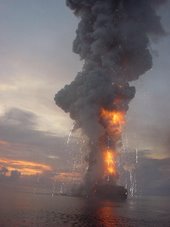
The Discoverer Deep Seas is the largest exploration drill ship in the world. Matter of fact there is a shortage of these type of Enterprise Class Drillships. There primary mission is to explore and find oil. Once they do then the oil company moves in a production platform.

The Deep Seas , call sign (V7HC6) was the ship responsible for finding the Chevron Jack Well Field in 2006. One of the largest recent finds. That field according to Chevron has a reserve of 500 million barrels of oil with a revenue expectation of 3 Billion. The Deep Seas was drilling in the Outer Continental Shelf in the Walker ridge area when the fire occured.

According to source in the salvage community the fire started in the port engine room and the vessel lost 4 of its six engine generators which drive the ships dynamic positioning system, which keeps the ship stabilized on station and acts as its primary propulsion system. The Deep Seas was able to continue some operations on its remaining two generators. Fortunately there were no injuries during the incident.

Not a good time for this to happen.....

Fire idles Transocean drillship


An engine room fire will sideline Transocean drillship Discoverer Deep Seas for around 50 days, the US-based drilling contractor said today.

Earlier this month, a fire broke out on the rig while it was drilling for Chevron at the supermajor’s St Malo discovery in the Walker Ridge area of the US Gulf.

A Transocean spokesman said no one was hurt and the company is in the midst of determining the extent of damage to the vessel.

An investigation into the cause of the blaze is ongoing.

The rig has been moved off location and will be brought into a Gulf coast shipyard for repairs. Transocean has also elected to carry out a scheduled 14-day underwater survey of the unit while it is idle.

The Discoverer Deep Seas is under a long-term contract with Chevron in the US Gulf. The unit’s current day rate is $335,000. The rate jumps to $485,000 per day in March 2009.

Additional Casualty Reports
Transocean investigating drillship fire

Discoverer Deep Seas History
Peak oil theorists don't know Jack
Chevron Well Tests Deeper Gulf of Mexico Oil Deposits (Update7)
Rig Shortage Slows Chevron Bid to Tap Offshore Fields
SHOW ME THE BUBBLE!

Chevron Thinks It Might Have Found As Much As 15 Billion Barrels

WEATHER NOTE

This report made the rounds on the top weather list serves yesterday morning. Brian Barnes is a professional storm chaser and has the experience to guide tours through some dangerous weather systems. What happened here is really an unknown but by the sounds of this it appears that the sheriffs officer ..eh... the son-in-law of the Sheriff. may have over reacted.

Though this is an important issue for all chaser. Professionalism must be maintained at all times but law enforcement personnel must also understand that not all storm chasers are cowboy's and they do provide a valuable service to the public.

Storm Chaser Arrested
by Victor Lopez

CRANE COUNTY--Chasing storms is what Brian Barnes does for a living. And it was while he was doing just that, that he says he found himself in a difficult and strange situation involving a Crane County Sheriff's Deputy. Barnes was out on Tuesday in Crane County as severe weather moved across the region. Crane County was under a tornado warning for about an hour Tuesday night.

"I told him that I was helping out the National Weather Service in San Angelo, and they were relaying my reports to Midland. He told me he didn't care, and that I needed to go."

Barnes thought it was his obligation to stay put and follow the storms, a decision that landed him in jail.

"He jumped out and put me in handcuffs. I turned around and I remember him slamming me up against his vehicle, and then it all got kind of scary."

Among the witnesses was Dennis Greer, who had a similar run-in, with the same deputy, just minutes earlier while he was shooting pictures of the same storm for the local newspaper.

"His first words to me were, 'are you a blankety-blank idiot?' He told me if I didn't leave, I was going to jail, flat out," Greer said. Barnes was arrested at a road side park on Highway 385 and charged with obstruction of a highway or other passage way. According to witnesses, there is plenty of room on on the road in front of the park for a vehicle to get by. That's why they are questioning the validity of the charge. Dennis Greer says, "The guy wasn't blocking anything. He was able to drive a full size truck by with no problem." In addition to the charges, people were taken aback by the deputy's attitude. "He came down there, and was just very abusive in his language. Never once did he state to me why he would arrest me, or why he was doing anything", Greer says.

Barnes adds, "He continued to say that I was the example why people were stopping and that I was putting those other people at risk, because they were stopping behind me." Barnes says that during his years of storm chasing, this is the first time anything like this has ever happened to him. And despite this one incident, he has good things to say, about West Texas. "I have to say that everytime I come to West Texas, the people here are outstanding. They are the most friendly people I've ever met," he said. Barnes was released on a $2,000 bond. He plans to hire a Dallas attorney to handle his case.

Calls to the Crane County Sheriff's Office for comment were not returned.
MARITIME NOTE

A public consultation process has been launched to decide on the future registration of ships in Ireland.

The Minister for Transport and Marine, Noel Dempsey, has called on vessel owners and the public to become involved in the process.

It is intended to create a new ship register in Ireland that will enforce legislation on safety and living conditions aboard and help improve maritime safety.

Advertisement

New arrangements are being considered by the Department under which vessels not previously required to be registered will have to do so in the future.

The public consultation process will be used to prepare the legislation, which will result in a centralised electronic register to be used to enforce legislation on safety, security, living, working and environmental conditions.

There are 41 ships on the Irish register at present. Its numbers were reduced when Irish Ferries flagged out to other countries.

Arklow Shipping is now the biggest shipping company in the country.


In the following video we discus the various types of Position Indicating Radio Beacons. We explore the diffrences between an EPIRB, GPIRB, ELT and the increasingly less expensive PLB’s . We will also be taking a look at the new $149 Spot Satellite Messenger and ask if it’s the right solution for your emergency locator redundancy needs.

...
previewImg
.. ..
icon for podpress GPIRB vs EPIRB vs PLB: Hide Player | Play in Popup | Download

Messingaboutinships Podcast


Messing About In Ships Podcast


Have A Great Weekend!

RS