Friday, October 17, 2008

Cloud Radar: Predicting The Weather More Accurately

Cloud Radar: Predicting The Weather More Accurately

ScienceDaily (Oct. 1, 2008) The weather. It’s the one topic of conversation that unites Britain – umbrella or sun cream? Now scientists at the Science and Technology Facilities Council have developed a system that measures the individual layers of cloud above us which will make answering the all-important weather questions much easier in future.

The Cloud Radar will not only allow forecasters to predict the weather more precisely, the information gathered will also enable aircraft pilots to judge more accurately whether it is safe to take off and land in diverse weather conditions, offering a powerful safety capability for civil airports and military air bases.

Developed over 10 years by researchers and engineers at the STFC Rutherford Appleton Laboratory, in collaboration with the Met Office, the Cloud Radar can take a complete and accurate profile of cloud or fog up to 5 miles overhead. Operating at 94 GHz, 50 times higher in frequency than most mobile phones, the radar measures the cloud base height, its thickness, density and internal structure as well as providing similar information on cloud layers at higher altitudes.

The earliest version of the cloud radar was built to demonstrate that a low power system operating at high frequency could compete with more common radar types. It was built from the spare components of a radar altimeter designed to operate on a satellite, so that it used small, low-power components in contrast to previous cloud radars that use expensive pulsed sources which consume many times more power and have limited lifetimes.

Brian Moyna, Senior Systems Engineer at STFC said: “In a nutshell, our Cloud Radar takes a slice of cloud and provides a complete and accurate vertical profile. Compared to conventional pulsed radar instruments, this radar is a low power, high sensitivity, portable instrument that uses all solid state components for lower cost and increased reliability.”

The Met Office has just purchased a Cloud Radar which is being trialled at sites around Britain. Additionally, a Cloud Radar has also been acquired by the University of Marburg in Germany.

The radar consists of a millimetre-wave frequency source that continuously emits a low power signal in the vertical direction that is frequency modulated. A signal is returned, mainly due to what is known as ‘back-scattering’ from water droplets and ice crystals in the atmosphere. This signal is picked up by a receiver and converted to a microwave signal, which is then digitised, analysed and a real-time image of the returned signal intensity versus altitude is displayed for the user.

The new Cloud Radar is the result of several hundred thousands of pounds of investment into the Space Science & Technology Department at STFC with proof of concept funding from CLIK, STFC’s wholly-owned technology exploitation company, along with the Met Office.

WEATHER NOTE

Global Warming Will Have Significant Economic Impacts On Florida Coasts, Reports State

ScienceDaily (Oct. 1, 2008) Leading Florida-based scientific researchers released two new studies today, including a Florida State University report finding that climate change will cause significant impacts on Florida's coastlines and economy due to increased sea level rise.

A second study by researchers at Florida Atlantic University recommends that the state of Florida adopt a series of policy programs aimed at adapting to these large coastal and other impacts as a result of climate change. Key findings of the FAU report were included just this week by Florida Gov. Charlie Crist's Climate and Energy Action Team when it adopted the "Adaptation" section of its final report.

"The impacts of climate change on Florida's coasts and on our economy will be substantial, persistent and long-term, even under our conservative estimates," said Julie Harrington, director of the Center for Economic Forecasting and Analysis at FSU. "Should, as many models predict, sea level rise, and hurricane strength and other factors become more extreme, much greater economic impacts will occur along many parts of Florida's coast in this century."

The second new study, by researchers at FAU, focused on state adaptation policies needed as Florida faces the impacts of climate change.

"The goal of our study is to help the state of Florida adapt, in the most effective way possible, to climate change impacts that are now inevitable," said Jim Murley, director of Florida Atlantic University's Center for Urban and Environmental Solutions and leader of the study. "These approaches must be comprehensive and strategic, not piecemeal and episodic. Governor Crist and other leaders have rightly identified adapting to climate change as one of the state's greatest challenges -- we look forward to working with the state to protect our people, natural splendor, and economic livelihood. There is real work to be done."

This research was supported by a grant from the National Commission on Energy Policy, a project of the Bipartisan Policy Center.

About the FSU study

This study uses current estimates of sea level rise from Florida State University's Beaches and Shores Resource Center and 2001 estimates from the Intergovernmental Panel on Climate Change to evaluate the effect of sea level rise on the six coastal counties. The results show projected trends in storm-surge flood return periods associated with hurricanes, damage costs associated with flooding from major storm events, and the value and area of land at risk.

Under the FSU study's estimates for sea level in Dade County, the value of land at risk totals $6.7 billion in 2080 (in 2005 dollars). (By comparison, using International Panel on Climate Change sea level estimates, the value of land at risk in Dade County ranges from $1 billion to $12.3 billion in 2080). The study also calculated the effect of storm surge and sea level rise on future damage costs, finding that if a storm like Hurricane Wilma from 2005 occurred in 2080, the cost to Dade alone would be from 12 percent to 31 percent higher (in 2005 constant dollars). While these findings do not account for adaptive strategies or potential future increases in property values, they still provide valuable information about potential impacts and resources that are put at risk from sea level rise.

About the FAU study

Key findings of the report have been included by Gov. Crist's Climate and Energy Action Team as it adopted the "Adaptation" section of its final report this week in Tallahassee. Important findings from the FAU study call for major state environmental, growth management and public infrastructure decision-making processes to be adjusted so they are responsive to future climate change impacts.

"FAU will continue to research how Florida can be a leader in providing guidance to other states on how best to put in place workable solutions that will help communities adapt to future climate change impacts," Murley said.

"Storm events associated with certain levels of storm surge could increase in frequency in the future, due to sea level rise," Harrington said.

"As sea level rises, damage costs associated with extreme storm events increases significantly for the Florida counties examined in this study," she said.

MARITIME NOTE

Navy Confirms Sunken Submarine Is Grunion

ScienceDaily (Oct. 4, 2008) Commander, Submarine Forces Pacific Fleet (COMSUBPAC), Rear Adm. Douglas McAneny announced October 2 that a sunken vessel off the coast of the Aleutian Islands is in fact the World War II submarine USS Grunion (SS 216).

The submarine Grunion arrived at Pearl Harbor on June 20, 1942. The vessel completed pre-patrol training before departing on its first war patrol June 30. Grunion's commanding officer, Lt. Cmdr. Abele, was ordered to proceed to the Aleutian Islands and patrol westward from Attu on routes between the Aleutians and the Japanese Empire. On July 10, Grunion was reassigned to the area north of Kiska. Over the next 20 days, the submarine reported firing on an enemy destroyer, sinking three destroyer-type vessels, and attacking unidentified enemy ships near Kiska.

Grunion's last transmission was received on July 30, 1942. The submarine reported heavy antisubmarine activity at the entrance to Kiska, and that it had 10 torpedoes remaining forward. On the same day, Grunion was directed to return to Dutch Harbor Naval Operating Base. There was no contact or sighting of the submarine after July 30, and on August 16, Grunion was reported lost.

"I am honored to announce that, with records and information provided by the Abele family and assistance from the Naval Historical Center, USS Grunion has been located," said McAneny. "We are very grateful to the family of Grunion's Commanding Officer Lt. Cmdr. Mannert L. Abele for providing the underwater video footage and pictures that allowed us to make this determination. We also appreciate the efforts of the USS Cod Submarine Memorial for their assistance in this matter. We hope this announcement will help to give closure to the families of the 70 crewmen of Grunion."

Abele was posthumously awarded the Navy Cross for heroism. A destroyer, USS Mannert L. Abele (DD 733), was commissioned in his honor, and was later lost in action off Okinawa in 1945. Japanese anti-submarine attack data recorded no attack in the Aleutian area at the time of Grunion's disappearance, so the submarine's fate remained an unsolved mystery for more than 60 years.

After discovering information on the internet in 2002 that helped pinpoint USS Grunion's possible location, the sons of Grunion's commanding officer, Bruce, Brad, and John Abele, began working on a plan to find the submarine. In August 2006, a team of side scan sonar experts hired by the brothers located a target near Kiska almost a mile below the ocean's surface. A second expedition in August 2007 using a high definition camera on a remotely operated vehicle (ROV) yielded video footage and high resolution photos of the wreckage of a U.S. fleet submarine.

"This discovery has come about through a stream of seemingly improbable events; it's like we won the lottery 10 times in a row," said Bruce Abele, eldest son of Grunion's commanding officer. "It is so dramatic to see the underwater photo and be certain it was in fact Grunion; not only is this announcement important for the families of the crew members, it's also important for the Navy and the country."

The Abele brothers then contacted the USS Cod Submarine Memorial for assistance in identifying the wreckage. The vessel is lying at a depth of about 3,200 feet. Very cold water and lack of significant currents has preserved much of the wreckage.

Dr. John Fakan, director of the USS Cod Submarine Memorial, remarked about the importance of having an unmodified example in USS Cod, a fellow Gato-class submarine, in identifying the wreckage of USS Grunion.

"USS Grunion and USS Cod shared the same blueprints," he said. "It is very gratifying for me and my crew to help with the identification of the submarine."

With the information provided by the Abele family and the USS Cod Submarine Memorial, COMSUBPAC and the Naval Historical Center examined the evidence and historical records and determined that the submarine found at the reported position could only be USS Grunion.

"The synergy of our group working together with the Navy for the common cause has been a wonderful group effort," Bruce Abele said. "The teamwork combined with everyone's compassion and wisdom has resulted in our success."

According to Bruce's brother John Abele, those responsible for contributing to this discovery included historians and engineers from the United States, Australia, Israel and Japan. Of particular note was the involvement of Japanese naval architect Yutaka Iwasaki, who provided information critical to pinpointing the location of the submarine.

Bruce and John's brother, retired Lt. Brad Abele, who recently passed away, also played a significant role in the find. As his brother John explained, "Brad's experience as a Naval aviator helped a great deal by helping us to plot the strategy for the discovery."

Unfortunately, the cause of Grunion's sinking remains a mystery. No matter what the cause, the end result was the loss of all hands. As the Naval Historical Center noted, "no amount of analysis or speculation will change or alter the fact that families lost fathers, husbands, uncles and brothers… the Navy and the nation will always be grateful for their service and their sacrifice."

Former Commander-in-Chief of the U.S. Pacific Fleet Admiral Chester Nimitz once said, "When I assumed command of the Pacific Fleet on 31 December 1941 our submarines were already operating against the enemy, the only units of the Fleet that could come to grips with the Japanese for months to come. It was to the Submarine Force that I looked to carry the load until our great industrial activity could produce the weapons we so sorely needed to carry the war to the enemy. It is to the everlasting honor and glory of our submarine personnel that they never failed us in our days of great peril."

By the end of World War II, submarines had made more than 1,600 war patrols. Pacific Fleet submarines like Grunion accounted for more than half of all enemy shipping sunk during the war. The cost of this success was heavy: 52 U.S. Pacific Fleet submarines were lost, and more than 3,500 submariners remain on "eternal patrol."

A representative of the submarine force will speak on behalf of the U.S. Navy at a memorial service in Cleveland, Ohio, Oct. 11. The service, hosted by the USS Cod Memorial, will honor the 70 crewmembers killed when USS Grunion was sunk near the Aleutian Islands on or about July 30, 1942.

"To provide ourselves and the families this closure, it's icing on the cake," said John Abele. "The memorial service is a symbolic event; we've discovered family we didn't know we had. Not only is this an honor for all of us, it increases the feeling of community we've been able to achieve."


Messing About In Ships Podcast

HAVE A SAFE AND GREAT WEEKEND!
RS

Thursday, October 16, 2008

Why Hurricane Ike's "Certain Death" Warning Failed

Why Hurricane Ike's "Certain Death" Warning Failed

As residents of Galveston, Texas, were allowed to return to the devastated island this week, experts puzzled over why tens of thousands of others had remained during Hurricane Ike—despite the National Weather Service's "certain death" warning.

Among the possible explanations: memories of a chaotic 2005 evacuation, an anti-government attitude, and a false sense of security fueled by TV news and the abundance of hurricane data on the Web.

(See full Hurricane Ike coverage: photos, stories, and videos.)

Avoiding Chaos

Gene Hafele, director of the Houston-Galveston National Weather Service office, said about 500,000 people in and around Galveston were in a mandatory evacuation zone, and only about 300,000 left.

Bill Read, director of the National Hurricane Center in Miami, estimated there were about 140,000 people in the smaller, "certain death" zone. About 70 percent of those residents evacuated. That left nearly 40,000 people to contend with the worst of the storm surge.

There is "no one answer" why so many Texas residents ignored the evacuation order, Read said.

Some probably refused to leave because they'd been caught in the chaotic evacuation for Hurricane Rita in 2005, he said.

During that event, roads out of Houston became gridlocked. Officials later estimated that about 90 people died during the 2005 evacuation because of heatstroke, dehydration, and other causes.

Read also said that some of those who refused to leave during Hurricane Ike stayed because they have an intense anti-government attitude. "They think, No one tells me what to do," Read said.

The National Weather Service's Hafele said officials decided to issue the "certain death" evacuation warning because the storm surge from Hurricane Ike would be unlike anything seen on the Texas coast since an unnamed hurricane in 1915.

"People who were living in the storm surge zone had never experienced a surge like this and had no way of knowing how severe this could be," Hafele said.

Hafele said he was puzzled by why some residents of Bolivar Peninsula—a low-lying, more rural community just north of Galveston—defied the evacuation order.

The peninsula took the worst of Ike's storm surge, and dozens of homes and other buildings there simply disappeared after the hurricane (photo: the peninsula before and after Hurricane Ike).

"The people who live on Bolivar understand their vulnerability," Hafele said. "Some have lived out there an unusually long time, and they've experienced a lot of storms. Why some of those people decided not to leave really is beyond me."

False Sense of Security

Jay Baker, a professor of geography at Florida State University in Gainesville, has studied how people respond to hurricane warnings.

The main reason people don't comply with evacuation orders is because they think they will be safe despite the warning to leave, Baker said.

"They think the storm will miss them, or they think they will be safe in their homes even if the storm does hit," Baker said.

There's also the fact that evacuating can be an expensive and very difficult task, and that can prompt people to decide not to leave, Baker said.

In addition, the National Hurricane Center's Read added, live news reports from the ground in Galveston may have given some viewers a false sense of security. "Viewers think, It's OK for the cameraman to stay there, why not me?"

Florida State's Baker said, "I'm not convinced that there's any kind of deep-seated psychological reason. People just make poor judgments. They don't know how bad it can get if they stay."

Billy Wagner is the chief emergency management specialist for Early Alert, a private hurricane warning and emergency management consulting service based in Tampa, Florida.

The availability of so much hurricane information on the Internet may be another reason why some people decide to ignore evacuation orders, Wagner said.

Amateur forecasters don't have the skill and training to evaluate hurricane data and make sound decisions about whether they should evacuate, he added.

The National Hurricane Center, on the other hand, has the "overall picture" of the approaching storm and also is communicating with local officials about whether to issue evacuation orders, he said.

"They need to listen to public officials," Wagner said. "I'm always concerned that too many people think they're tropical meteorologists now and are second-guessing what's taking place."

Read, the National Hurricane Center director, said forecasters will be taking a "cold, hard" look after the hurricane season at hurricane warnings and how people responded to them. The review could prompt changes in how the center issues warnings, he said.

Willie Drye is author of Storm of the Century: the Labor Day Hurricane of 1935, published by National Geographic Books.

HURRICANE BASICS


WEATHER NOTE

Arctic Sea Ice Hits Second-lowest Recorded Extent, Likely Lowest Volume

ScienceDaily (Oct. 3, 2008) — Arctic sea ice extent during the 2008 melt season dropped to the second-lowest level since satellite measurements began in 1979, reaching the lowest point in its annual cycle of melt and growth on Sept. 14, according to researchers at the University of Colorado at Boulder's National Snow and Ice Data Center.

Preliminary data also indicate 2008 may represent the lowest volume of Arctic sea ice on record, according to the researchers. The declining Arctic sea ice is due to rising concentrations of greenhouse gases that have elevated temperatures across the Arctic and strong natural variability in Arctic sea ice, according to scientists.

Average sea ice extent during September, a benchmark measurement in the scientific study of Arctic sea ice, was 1.8 million square miles. The record monthly low, set in 2007, was 1.65 million square miles. The third lowest monthly low was 2.15 square miles in 2005, according researchers at the center.

The 2008 low strongly reinforces the 30-year downward trend in Arctic sea ice extent, said CU-Boulder Research Professor Mark Serreze, an NSIDC senior scientist. The 2008 September low was 34 percent below the long-term average from 1979 to 2000 and only 9 percent greater than the 2007 record. Because the 2008 low was so far below the September average, the negative trend in the September extent has been pulled downward, from a minus 10.7 percent per decade to a minus 11.7 percent per decade, he said.

"When you look at the sharp decline we have seen over the past 30 years, a recovery from lowest to second lowest is no recovery at all," Serreze said. "Both within and beyond the Arctic, the implications of the decline are enormous."

Conditions in the spring, at the end of the growth season, played an important role in the outcome of this year's melt, the researchers said. In March 2008, thin first-year ice covered a record high 73 percent of the Arctic basin. While it may appear to be a recovery of the sea ice, the large extent masked an important aspect of sea ice health since thin ice is more prone to melting during the summer. The widespread thin ice in spring 2008 set the stage for extensive ice loss during the melt season, according to the NSIDC researchers.

Through the 2008 melt season, a race developed between the melting of thin ice and gradually waning sunlight, said CU-Boulder Research Associate Walt Meier, a research scientist at NSIDC. Summer ice losses allowed significant solar energy to enter the ocean and heat up the water, melting even more ice from the bottom and sides. Warm oceans store heat longer than the atmosphere does, contributing to melt long after the sunlight has begun to wane, Meier said. In August 2008, the Arctic Ocean lost more ice than any previous August on record.

"Warm ocean waters helped contribute to ice losses this year, pushing the already thin ice pack over the edge," said Meier. "In fact, preliminary data indicate that 2008 probably represents the lowest volume of Arctic sea ice on record, partly because less multiyear ice is surviving now and the remaining ice is so thin."

In 2008, summer conditions worked together to save some first-year ice from melting and to "cushion" the thin ice pack from the effects of sunlight and warm ocean waters, preventing the "perfect storm" for ice loss seen in 2007, according to the researchers. Temperatures in 2008 were cooler than in 2007, although still warmer than average.

Cloudier skies also protected the ice from some melt, and wind patterns spread the ice pack out, leading to higher extent numbers, according to CU-Boulder Research Associate Julienne Stroeve, an NSIDC research scientist. The end result was the natural variability of short-term weather patterns provided enough of a "brake" to prevent a new record-low ice extent from occurring, she said.

"I find it incredible that we came so close to beating the 2007 record, without the especially warm and clear conditions we saw last summer," said Stroeve. "I hate to think what 2008 might have looked like if the weather patterns had set up in a more extreme way."

The melt season of 2008 reinforces the decline of Arctic sea ice documented over the past 30 years, said CU-Boulder Senior Research Associate Ted Scambos, NSIDC lead scientist. "The trend of decline in the Arctic continues, despite this year's slightly greater extent of sea ice," said Scambos. "The Arctic is more vulnerable than ever."


MARITIME NOTE

Maritime Casualties and Homeland Security


Shortly after 1:30 A.M. of July 23, 2008, two vessels were transiting the Mississippi River. The Motor Tanker TINTOMARA, a 600-foot tanker was heading down river on a transit that seemed perfect for the early morning sail. The sky was clear with a three-quarter moon, 82 degrees with a light wind and ten-mile visibility. Lighting from the New Orleans Riverfront and two separate spans of the Crescent City Connection Bridges lit the waterway. The transit should have been enjoyable; the type of sail that sailors reminisce about years later.

Yet, another vessel, the MEL OLIVER, a Towboat pushing a loaded barge with over 400,000 gallons of No. 6 oil was heading upriver in the path of the tanker. The bridge crew on the TINTOMARA called out a warning via the radio to the smaller vessel. The MEL OLIVER seemed to ignore the call and continued into a deadly path. The U.S. Coast Guard Vessel Traffic Service (VTS) tasked as the traffic controller of the busy waterway also called out to the Towboat, “Mel Oliver, Come in, cap! You’re crossing the bottom of a ship coming at you!” The towboat once again ignored the call and took aim at the larger ship.

The TINTOMARA had few options given the location of this unfortunate meeting on the water. Given the strong current at that location and two bridges ahead, there were two choices: run the vessel aground to avoid the towboat and bridges, or stay on track and wish for the best. The vessel characteristics of the TINTOMARA show the ship operates on a single shaft and propeller. If the Pilot of the larger ship opted to slow down, they would lose bare steerageway, the needed force against the rudder to allow controllability. Putting the engines into reverse with a single screw ship risked loss of control, a grounding or an allision with one of the two bridge spans ahead. The Master continued ahead. Moments later, the TINTOMARA called the Coast Guard VTS, “This ain’t good, man! … We just took his tow. The barge is right in front of us and we’re running it over!”


The tanker hit the loaded barge and literally cut it in half. As the oil was quickly spread by the rapid current, the two oily hulks of steel rested near the first span of bridges. The investigation shows the TINTOMARA was in good mechanical and electrical condition. There were no competency issues with the crew. In the case of the MEL OLIVER, the Pilot of the towboat was unlicensed.

Another maritime tragedy occurred 15-years earlier when the pilot of the towboat MAUVILLA hit a rail bridge separating the tracks near Mobile, Alabama. Shortly after the strike, the Amtrak “Sunset Limited” plunged into water below killing 47 people. The towboat pilot was unfamiliar with the waterway and became disoriented in the fog. Rather than turn right, he went left. The bridge was seen on the radar; unfortunately, the pilot was untrained and couldn’t discern the radar image on the scope. The loss of life and the economic cost of diverting rail systems, response and recovery cost the U.S. economy millions. It took eight years for the enactment of regulation requiring training and record keeping for towboat pilots.

The MEL OLIVER case shows that there are existing holes in the regulations; in fact, sometimes they are ignored. As it turns out, the same company that operated the MEL OLIVER, DRD Towing had another incident just ten days earlier when the pilot of the RUBY E was also unqualified. In that case, the towboat sunk, again requiring response and a diversion of U.S. Coast Guard assets. Now is the time to amend the existing regulations requiring towboats to “check-in” with the Coast Guard prior to sailing. The Coast Guard operates the Maritime Information for Safety and Law Enforcement (MISLE) database. This information resource provides a detailed listing of mariners and their qualification status. Prior to moving barges with potentially hazardous cargoes on navigable waterways, operators should be held responsible to prove they have a qualified crew.

Hundreds of barges move along our waterways and nearby populated areas each day. As I describe in my book, “Terrorism and the Maritime Transportation System” many times these large vessels carry dangerous caustic chemicals that could kill thousands. The same chemical mixture that killed in 20,000 people in Bhopal, India is moved along our waterways. It’s best to have qualified crews capable of safely handling these vessels.

Whenever there is a significant marine casualty, vital assets normally available to respond to a serious homeland security situation or terror attack are diverted leaving gaps in our national security. According to the Coast Guard, in the case of the MEL OLIVER, there were over 2,000 personnel involved in the operation including the USCG Gulf Strike Team from Mobile, Alabama; USCG District Eight Response Teams; the Coast Guard Cutter Razorbill; multiple 41-foot patrol boats; regular HH-65 helicopter flights; Unified Command Personnel and State and Local response units.

The incident closed 97-miles of the Mississippi River to maritime shipping for six days. When I asked the Coast Guard for an estimated cost to our national economy, I was told the New Orleans Port Authority assessed a national cost of $275 million per day. Over the six-day period, the cost to maritime commerce and response totaled over $1.6 billion; all because one person opted to ignore maritime safety regulations. Let’s put this amount into perspective. Comparing against the 2008 Department of Homeland Security budget, the cost of this one maritime casualty exceeds the following budgets:

  • All US Customs and Border Protection Air and Marine Interdiction operations ($528M).
  • The entire U.S. Coast Guard Marine Safety program ($728M), and
  • The entire Federal Law Enforcement Training Center ($274M - effectively trained 60,458 law enforcement agents in 2007)

Our nation cannot afford to relinquish vital resources to protect our national security. Rather than pursue earmarks to support local economies, our elected leaders should come together in a bi-partisan effort and amend 46 Code of Federal Regulations, parts 10 and 12 requiring that mariners acting in Bridge crew positions of commercial vessels check in with Coast Guard or appropriate local port authorities prior to sailing. Will this prevent maritime accidents from happening? No, but it will severely hamper the attempts by unqualified mariners to operate vessels. When local budgets are not lost and resources expended unnecessarily, they are available for homeland security issues.

In the case of the MEL OLIVER, the entire incident was (literally) on the radar of the USCG VTS. While the Coast Guard attempted to intervene and avert a casualty, the towboat pilot ignored the call. Coast Guard and marine patrols cannot be everywhere at every time. Looking back at this case, what if a terrorist group knowing quick intervention is unlikely attempted to duplicate this incident? If the target was a vital bridge or the intent to shut down a navigable waterway, it impacts maritime commerce and our national homeland security posture. Look at the cost. As we’ve seen in recent days, people are nervous about the economy. If a terror incident can shake the economic front, it would also shake the confidence of citizens.

Smoldering containers removed from APL Peru

SEATTLE - Four containers that were putting off alarmingly high heat since Sunday were removed from the APL Peru Saturday.

Members of the Seattle Fire Department cut holes into the containers and sprayed water inside in order to extinguish the smoldering contents of what is believed to be clothing, shoes, and appliances. No other source of heat or smoke has been detected aboard the vessel and the remaining containers will be offloaded according to schedule.

The cause of the fire is under investigation.


RS

Wednesday, October 15, 2008

Apocalypse: Earthquakes, Archaeology, and the Wrath of God

Apocalypse: Earthquakes, Archaeology, and the Wrath of God

By Amos Nur With Dawn Burgess

What if Troy was not destroyed in the epic battle immortalized by Homer? What if many legendary cities of the ancient world did not meet their ends through war and conquest as archaeologists and historians believe, but in fact were laid waste by a force of nature so catastrophic that religions and legends describe it as the wrath of god?

Apocalypse brings the latest scientific evidence to bear on biblical accounts, mythology, and the archaeological record to explore how ancient and modern earthquakes have shaped history--and, for some civilizations, seemingly heralded the end of the world.

Archaeologists are trained to seek human causes behind the ruins they study. Because of this, the subtle clues that indicate earthquake damage are often overlooked or even ignored. Amos Nur bridges the gap that for too long has separated archaeology and seismology. He examines tantalizing evidence of earthquakes at some of the world's most famous archaeological sites in the Mediterranean and elsewhere, including Troy, Jericho, Knossos, Mycenae, Armageddon, Teotihuacán, and Petra. He reveals what the Bible, the Iliad, and other writings can tell us about the seismic calamities that may have rocked the ancient world. He even explores how earthquakes may have helped preserve the Dead Sea Scrolls. As Nur shows, recognizing earthquake damage in the shifted foundations and toppled arches of historic ruins is vital today because the scientific record of world earthquake risks is still incomplete. Apocalypse explains where and why ancient earthquakes struck--and could strike again.

Amos Nur is the Wayne Loel Professor of Earth Sciences and professor of geophysics at Stanford University. Dawn Burgess is a writer and editor based in Bar Harbor, Maine. She earned a PhD in geophysics from Stanford.

Reviews:

"[Amos Nur] posits seismicity--rather than invaders or social forces--as the prime dynamic behind the fall of ancient civilizations. Nur engages in what we might call archaeological detective work--looking at the positions of human remains, for instance, to determine cause of death--his book is focused and intense."--David Ulin, Los Angeles Times Book Review

"[A] deeply researched and compellingly written book. Apocalypse is a winning combination of cautious interdisciplinary investigation and interpretation, writing suitable for a general readership, and excellent illustrations. Although it will deliberately irritate many archaeologists, it should also provoke a serious reconsideration of the archaeological record. [T]he evidence for earthquakes in prehistorical change may be staring archaeologists in the face."--Andrew Robinson, Nature

"The theory that earthquakes may have caused the destruction of many ancient cities is unpopular and controversial. Amos Nur's book illustrated these ideas with convincing prose and meticulous research. Nur introduces the reader to a relatively new science...called Archaeoseismology. The reader will dosciver that the earthquakes that have occurred in the more recent times...have parallels to the remnants of destruction left from earthquakes in the distant past. Apocalypse is a result of [Nur's] determined effort to expell the fallacies in archaeology with the hard science of geophysics."--Lee Gooden, ForeWord Magazine

"In Apocalypse...Amos Nur compellingly proposes seismic sources for civilizational collapses that the Bible and the Classics attribute to other causes."--Anneli Rufus, East Bay Express

Continue

WEATHER NOTE

Flooding in Interior Alaska declared a major disaster

FAIRBANKS -- Federal disaster aid has been granted to Alaska to supplement state and local recovery efforts in the areas struck by severe storms, flooding, landslides and mudslides between July 27 and Aug. 6, according a news release from the Federal Emergency Management Agency.

FEMA Administrator David Paulison said federal funding is available for emergency work and the repair or replacement of facilities damaged in the Denali Borough, Fairbanks North Star Borough, North Slope Borough and the Yukon-Koyukuk Regional Educational Attendance Area.

Douglas G. Mayne is the federal coordinating officer for operations in the affected area.

12th Annual High Plains Conference

The 12th Annual High Plains Conference was held September 4-5, 2008 in Hays, KS. Thanks to everyone who attended the conference! With over 30 presenters on a wide array of topics, keynote speakers included Dr. Eve Gruntfest, Greg Carbin, Dr. Mary Ann Cooper, and Dr. Patrick Market.

Presentations from the conference are now available for online viewing (PDF and PPT formats).


MARITIME NOTE

Mysterious Disappearances On Cruise Ships

HungZai.com
October 6, 2008

The cruise industry says that more than 30 passengers have disappeared from ships in the past five years - and these figures exclude those known to have been suicides or drunken accidents.

When the QE2 docked at Southampton on January 2, the liner was one passenger short: a 62-year-old German woman was missing. She is just one of a growing list of people who have disappeared from cruise ships in mysterious circumstances. Some of these deaths may be suicides, writes Gwyn Topham, but others appear more sinister. And of course there are no police out on the ocean . . .

In the last days of the Vietnam war, Hue Pham and his wife Hue Tran spent two perilous weeks on a cramped container ship, adrift with no food and little water in the South China Sea. The couple survived this desperate flight from Vietnam, built a new life in America, and then, three decades later, decided to take a Caribbean cruise on a ship called the Carnival Destiny. This was the boat journey that they would not survive.

The facts of the couple's disappearance, as the Destiny sailed between Barbados and Aruba on May 12 2005, are few. After a fruitless on-board search, the ship eventually retraced its path, joined by the US coastguard. No trace of their bodies was ever found.

For the relatives, the deaths left a terrible, insoluble puzzle. Their son, Son Michael Pham, maintained that his parents had no reason to take their own lives and were in fact planning a trip back to Vietnam, and were looking forward to meeting relatives again. "Two American citizens with no personal or financial problems, no serious health problems, living the happiest time of their lives, both vanished without a trace or witness," he later told an inquiry.

The cruise had been a Mother's Day gift to the couple, and they were on board ship with their daughter and granddaughter. "I immediately flew down to California, went through their home, and tried to find one clue, something unusual. I could not," Son Michael says now.

Since then, with the help of two other bereaved families, Son Michael has helped establish a group called the International Cruise Victims. In the past weeks, he has been offering his help to yet another family, after the QE2 sailed into Southampton on January 2 this year one passenger short.

Officially, Hampshire police are still investigating how a 62-year-old German woman, so far identified only as Sabine L, disappeared from a new-year cruise aboard the QE2 somewhere off Madeira. Her family has launched its own website appealing for help (www.qe2missing.de). But the full truth of Sabine L's last moments on the luxury Cunard liner is unlikely ever to be firmly established - beyond the cold fact that she joins more than 30 passengers who, in the past four years, have mysteriously disappeared from cruise ships worldwide.

Last year the cruise industry reported that 24 passengers had disappeared between 2003 and last March. The information emerged after a US Congressional subcommittee found itself with an unlikely task: to examine the threat posed to citizens by booking a cruise holiday. Since then, at least 10 more passengers and two crew have been reported missing or overboard, including one Scottish pensioner lost in the Atlantic last November. These figures do not include known suicides and those who, for one or reason or another - a drunken argument, perhaps, or misplaced bravado - are known to have deliberately jumped. Of those who have gone mysteriously missing, some may have killed themselves; other incidents may be alcohol-related mishaps; but in at least one case, the death of a 52-year-old woman on the Island Escape in Italy, something more sinister may have gone on. The FBI is still investigating that case.

After hearing details of those who had gone missing on board ships, subcommittee chairman, Christopher Shays, a Republican congressman, warned of a "growing manifest of unexplained disappearances, unsolved crimes and brazen acts of lawlessness on the high seas". Like small cities, he said, cruise ships experienced crimes. "But city dwellers know the risks of urban life - and no one falls off a city never to be heard of again." Going on a cruise was, he said, perhaps "the perfect way to commit the perfect crime".

There was no evidence of foul play in the disappearance of "M", a 40-year-old woman, from Celebrity Cruise Line's Mercury. But then, there was precious little evidence at all - and what did emerge was largely due to the persistence of her father, Kendall Carver, a former company CEO, who spent tens of thousands of dollars on legal fees and private investigators in an attempt to discover the truth about her disappearance. (Carver has asked the Guardian not to use his daughter's name, to protect the privacy of other family members.) Carver says it was on the second day of the Mercury's cruise to Alaska in August 2004 that a cabin steward realised that M's room had not been slept in and reported her absence to his boss, who told him he would deal with it. Throughout the cruise, the steward continued to place chocolates on the pillow of the unused bed, as he was ordered to do, but no one saw M again. At the end of the cruise, when the ship docked in Vancouver and all passengers disembarked, M's belongings were packed away. No one notified the police or her family. It was only after her father filed a missing person's report that police discovered that she had disappeared from a cruise ship.

Kendall Carver's loss was, he says, made worse by a lack of cooperation from the cruise line. At one point, Celebrity Cruise Line issued a statement in which it called the death a horrible tragedy, and added that "regrettably, there is very little a cruise line, a resort or a hotel can do to prevent someone from committing suicide". As Carver points out, the case is still open and his daughter has not been declared dead by the family or the FBI - in his belief, suicide is neither the only nor the most likely explanation.

Celebrity Cruise Line, however, now says: "There is probably nothing we or any company could do that would make the parents feel the company had acted sensitively enough." Today, all the company's passengers pass a computerised checkout at the end of a cruise.

Whatever the truth of what happened, M's case starkly underlines a fact that cruise passengers, potentially thousands of miles from home, should be well aware of: out at sea, there are no police.

It is extremely difficult for any detective to piece together a murder case without a body, and chances of finding a passenger dumped into the ocean are slim indeed. And while all cruise ships employ security officers, they do not always seal off crime scenes, detain suspects and interview witnesses in the manner that might be expected of them.

Two cases in particular have gripped the US and Australia respectively: the disappearance of honeymooner George Smith [see below] and the death of mother of three Dianne Brimble. The story of Smith, presumed to have gone overboard from the superliner Brilliance of the Seas less than 10 days into his married life, was lapped up by US television networks. First there was the young, well-connected victim and his telegenic, grieving widow opening up on talkshows; then family rifts and media-friendly forensic investigators added to the drama. The details of Brimble's end, left drugged and naked to die on P&O Australia's Pacific Sky, emerged in the more low-key surroundings of a New South Wales coroner's court. But both cases have been marked by questions over how well initial investigations were handled, by angry allegations from families and rebuttals from cruise lines, and an increased public perception that something was seriously amiss.

Unlike many in the grim litany of victims' tales, Dianne Brimble did not disappear. Brimble, 42, from Brisbane, had saved for two years to go on a cruise with her sister and their daughters. But by the end of the first night of her holiday in September 2002, she was lying naked, drugged and dying on the floor of a cabin, ignored and ridiculed by the men who had left her there.

A toxicology report would later show that Brimble had died of an overdose of gamma-hydroxybutyrate, a party drug also known as fantasy, GHB, GBH or liquid ecstasy, and often described as a date-rape drug. Brimble, her family told Australian TV, didn't even like to take Panadol.

By the time police met the boat in the South Pacific island of Noumea to investigate, the male passengers had been back in to the cabin to tidy up. No one has been charged in relation to her death, and it took more than three years for the details of her story to emerge at the coroner's inquest, which reopens next month in Australia.

Eight men were identified as "persons of interest" in the investigation. Photographs retrieved from a digital camera would reveal that before her death at least one man had sex with Brimble; photographs were taken even when she was passed out naked on the floor.

The Brimble inquest highlighted a cruise culture far from old-fashioned ideas of shuffle-board, after-dinner dances and G&Ts at the captain's table. At one point an advert for P&O cruises was produced in court: a postcard showing a line of sunbathing women and bearing the slogan, "Seamen wanted". P&O's lawyers protested that the cruise line was not on trial. But the coroner ruled it was admiss- ible evidence; Brimble, she said, did not die in a vacuum.

If the behaviour of eight "persons of interest" had attracted complaints - a photo of one showed him running naked through the ship on the night of Brimble's death - ship security officers would reveal that finding drunk, naked people on deck was a relatively common occurrence.

It is just not deaths and disappearances that are a problem on cruise ships. According to crime statistics supplied to the Congressional hearings by 15 of the biggest lines, covering around 85% of cruise holidays worldwide, there were 178 reports of sexual assault on cruise ships between 2003 and 2005. FBI representatives testified to their belief that the figures were under-reported - and further documents recently obtained under court order by a Miami lawyer, James Walker, show that Royal Caribbean alone, which carries around 25% of cruise passengers, recorded more than 100 complaints of sexual assault and sexual battery within that time span.

Some British and American security officers claim that the real picture is even worse. Geoff Furlong, an ex-detective from Liverpool who worked for six years as a security officer for two cruise lines, says: "It doesn't matter what the class of ship is. Young women are particularly susceptible - particularly from crew members. They hunt in packs."

He claims often to have discovered crew targeting young female passengers. "Say I came across the situation: the guy would be up before the captain at the next port of call and thrown off the ship at his own expense, to repatriate him to Costa Rica, or wherever," he says. "That was all that happened - there was never any police involvement." If passengers complained, they were bought off, he says, "given champagne, free holidays, told about the consequences of going to court, how it would bring shame on their families". Such complaints, he says, would frequently not even be logged.

"The cruise companies just want it to go away," says Randy Jaques, an American security officer. He claims personally to have dealt with more than 50 complaints, and says hundreds of women have signed "Jane Doe agreements" - meaning they have reached an out-of-court settlement with the cruise lines and signed a confidentiality clause.

Passengers can find themselves in a complex legal situation, potentially under numerous jurisdictions when sailing abroad. With many cruise ships registered under flags of convenience with relatively slack tax and labour regimes, the relevant laws might be those of Panama, the Bahamas or Bermuda. Prosecuting, say, a sacked crew member who has returned to his own country brings a whole new dimension of complexity. Charles Lipcon, a Miami lawyer who has built a 30-year career on suing cruise lines, says his firm does not normally take on cases without a clear jurisdiction. "What I've seen over the years is that it's a hot potato for everyone, and nothing much gets done," he says.

In the US, Son Michael Pham's victim-support organisation has persuaded two members of congress to sponsor a bill, the Cruise Line Accurate Safety Statistics Act, to put more of an onus on cruise lines to prevent and report crimes at sea. James Walker believes that many are unreported, and points out that crew members are far more at risk than passengers. "You don't have young Filipino women who have been sexually abused calling in to the guest claims department," he says. In fact, convictions of either employees or passengers are virtually unheard of. "People call and say they are confident that the FBI can solve their crime," he says. "We say, 'Well, if it happens with this cruise line, it will be the first time in their history.'"

Cruise lines, meanwhile, have been at pains to stress that ships are inherently safe, self- contained environments. In the context of millions of passengers each year, the number of missing people and reported sexual assaults compares well with statistics on land, they say; crimes such as robbery are negligible.

William Giddons, director of the UK's Passenger Shipping Association, representing the cruise industry, says: "The occurrence is so rare, anything that happens on a cruise ship is news. Because we're such a high-profile industry, it's something we have to live with. Compare us with a resort or a hotel, where there is virtually no security at all.

"I can't sit here and tell you that all crimes are reported - but the rules are very strict that they should be. They certainly will be now, if [they weren't] in the past."

Changes are indeed being made. Drug- and terror-related concerns have seen airport-style security introduced at ports, complete with x-ray machines and sniffer dogs. The on-board culture on "fun ships" may be changing, too: in Australia, a beleaguered P&O has increased CCTV, stopped 24-hour drinking, and scrapped its notorious "schoolies cruises", which often saw unruly passengers expelled on South Pacific islands. Its ill-fated ship, the Pacific Sky - now linked to four premature passenger deaths through accidents and illness in as many years - has been sold off.

The industry still has some PR work to do, though: disappearances and assaults aside, it has been beset by a roll-call of blights in recent years. Last year one man died when fire swept through cabins on a Caribbean cruise, and passengers feared for their lives as another cruise ship blazed in the English Channel. Cunard's Queen Mary 2 was recently the scene of a very public passenger mutiny after propeller troubles cut every stop from the cruise itinerary. Other cruises have been hit by the norovirus: a highly contagious sickness with symptoms including diarrhoea, stomach cramps and violent projectile vomiting. Some older British people had to be stretchered off one ship when it returned to Hull, and at one point successive outbreaks of the virus confined the world's newest, biggest megaliner, the Freedom of the Seas, to port. In late 2005, the luxurious Seabourn Spirit even found itself having to face down pirates with rocket launchers.

The industry has also run into problems on environmental grounds. In Alaska, where only ships with advanced waste purification systems are allowed to sail, a referendum has led to the tightening of controls and a rise in taxes on cruise ships. Meanwhile, Californian ports, under the newly green leadership of Arnold Schwarzenegger, are forcing ships to reduce their fuel smoke emissions. More large fines have been levied on cruise ships for dumping untreated waste.

But despite it all, passengers continue to flock to the ships. The Passenger Shipping Association estimates that there was a 17% rise in Britons taking cruises last year - with 1.25m of us taking a trip - and predicts that 1.55m will be on board by 2008. Worldwide, the figure is expected to pass 15m people going on a cruise annually. Bigger ships with astonishing facilities are intermittently unveiled - and monster ships to dwarf today's megaliners are under construction. With these huge ships boasting theatres and shopping malls larger than those found in many towns, passengers need hardly know they are at sea at all. So long, of course, as they don't go overboard

Profile: George Smith, a young man who went missing on honeymoon

Young, handsome and wealthy, George Allen Smith IV, a 26-year-old from Connecticut, went missing on a honeymoon cruise in the Mediterranean with his new wife, Jennifer Hagel Smith.

After a lavish wedding in Rhode Island, the couple had fl own to Europe, and in Barcelona boarded Royal Caribbean's Brilliance of the Seas, a large resort ship that caters for the younger and more active end of the market.

On the seventh day of the cruise, July 5 2005, Smith was reported missing. The newlyweds had spent the previous evening in the bar and casino with acquaintances from the cruise, drinking heavily. Hagel Smith said she remembered nothing after leaving the bar, allegedly after rowing with her husband. At around 3.30am, Smith, intoxicated, was helped back to his cabin. His wife was not there.

The next morning, a passenger noticed a large bloodstain on a canopy below the Smiths' cabin, and called security. Jennifer was tracked down to the ship's spa, where she was having a massage. George was missing without a trace.

Turkish forensic investigators were called in, as was an FBI agent holidaying in the area. By evening, the bloodstain was cleaned away and the ship continued on its voyage. If anyone had been responsible for Smith's death, that person was on the cruise: in the words of the dead man's sister, Bree Smith, who is convinced that there was foul play, "the Brilliance of the Seas sailed off into the sunset with the murderers on board".

In June 2006, Smith's family filed a lawsuit against the cruise line. Hours later, Royal Caribbean announced that the widow, Jennifer Hagel Smith, separately from the family, had agreed to a settlement.

Hagel Smith told the press: "As many great peace and spiritual teachers have said, through great suffering comes great awareness." Details of the settlement were revealed last week: Hagel Smith received a payment worth one million dollars.

Profile: Annette Mizener, a mother who disappeared on a cruise she won as a prize

Annette Mizener, 37, from Wisconsin, was reported missing on the last night of a nine-day cruise to the Mexican Riviera on the Carnival Pride.

Both her parents and daughter were accompanying her on the cruise, which she had won as a prize in a competition. On the evening of her disappearance on December 4 2004, Mizener performed Britney Spears' Baby One More Time at a karaoke night with her daughter, then went to the casino. Later than evening she was due to meet her parents again for bingo. But she never made it.

Her parents, Wally and Heidi Knerler, were immediately concerned. When an announcement came over the Tannoy that her purse had been found, they rushed to find cruise staff . The damaged purse had been discovered near a railing on the lower deck.

The local coastguard led a fruitless search of more than 800km2 of water well into the next day. The FBI later investigated, but no explanation was ever forthcoming. A CCTV camera nearby had been obscured - covered up by a map of the ship.

Finally a judge declared Mizener offi cially dead, but the family - who rule out suicide and suspect foul play - still have no answers. Carnival have since agreed an out-of-court, confidential settlement with Mizener's husband, John.

Boat hit by barge, sinks in Ohio River

The Enquirer

A boat partially sank in the Ohio River last night after it was clipped by a barge, according to the Cincinnati Police Department.

The accident took place around 10 p.m. near the public landing.

Neither the barge operator nor the boat operator was injured. The damaged boat was towed to shore and impounded by the Ohio Department of Natural Resources.


Coast Guard Rescues Two Men from Disabled Sailboat


Coast Guard Rescues Two Men from Disabled Sailboat - Click here for another funny movie.

RS

Monday, October 13, 2008

DEATH’S DOOR

DEATH'S DOOR
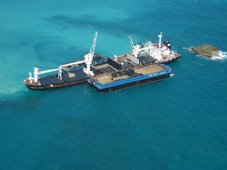
(The full story, with related interviews and full-color photos are in the article in Soundings Magazine November 2008 issue..
)

The Crew of a 44-foot cutter narrowly survive a knockdown, a 360-degree roll and, ultimately, the loss of their boat in a fierce Atlantic storm..


By Douglas A. Campbell Senior Writer

There was no conversation in the saloon of the 44-foot cutter Sean Seamour II, where the crew had retreated to ride out the huge storm waves one spring night in 2007. A drogue had been deployed on more than 500 feet of line, and a reefed storm jib was keeping the bow pointing downwind.

Outside, the storm howled, and mountains of water loomed 70 feet above the stern. Inside, only Rudy Snel’s voice occasionally broke through the roar, which had become background noise. Wind speeds were consistently reading above 70 knots. The 62-year-old Snel sat at the chart table and let his new friends know whenever there was a gust of more than 80 knots.

Ben Tye, 31, was sitting in the curved settee behind the oval table to port. Jean Pierre de Lutz, 56, the skipper, a citizen of the united States and France who owned the center cockpit Beneteau, was in one of the cushioned seats to starboard. As seas pounded the port bow with frightening frequency, Snel, a retired school teacher, remained at the nav station long enough to announce a high gust of 85.5 knots. Then he went back to the aft stateroom to nap. His rest would be short-lived; the following near-death experience would be anything but.

Sean Seamour II was caught in Tropical Storm Andrea may 6, 2007, off North Carolina. In the next 12 hours, two other yachts – one with a professional crew of three, the other sailed by a 75-year-old couple and their 45-year-old daughter – would be abandoned in the storm. And the 54-foot yacht Flying Colours would, after it’s EPIRB had transmitted two erratic signals, disappear without a track with it’s professional crew of four.

Although the search for Flying Colours was futile, Coast Guard helicopter crews saved nine sailors, including Snel, Tye and de Lutz, as they flew rescue sorties in this powerful storm, which at its peak generated 70-foot seas and produced winds as strong as 100 mph. Without exaggeration, the trio of sailors aboard Sean Seamour II are lucky to be alive today.

In hindsight, professional weather forecasters and yacht routers would agree there had been sufficient warning of the looming storm. Regardless, the severity of the conditions on board Sean Seamour II went far beyond what the three sailors had anticipated when they left Jacksonville, Fla., five days earlier for the start of a trans-Atlantic voyage.

The destination was France, with stops in the Azores and Gibraltar. Snel and Tye were volunteer crewmembers. They had never met de Lutz, a European management consultant and former hotelier in France, before he picked them up at the airport in Jacksonville when they arrived for the voyage. Each had signed aboard to acquire offshore sailing experience. Snel, from Ottawa had sailed a 27-footer on the Great lakes. Tye, a professional chef who had quit the hot kitchen to become a professional sailor, lives in the United Kingdom and had taught sailing around the world, though typically on lakes or coastal waters and within sight of land.

WELL PREPARED

Both were impressed with de Lutz when they saw his exhaustive preparations for heading offshore. Sean Seamour II, aboard which de Lutz had previously completed one of his two Atlantic crossings, had been stripped of its equipment following its last voyage. The gear was stored in an air-conditioned warehouse.

In preparation for the 2007 Atlantic crossing, de Lutz had the marina where he kept his 44-footer send out his life raft and GPIRB for recertification, which included checking the device’s battery. (A GPIRB is an electronic position-indicating radio beacon, or EPIRB, that incorporates a GPS and is able to send a precise location to rescuers.) De Lutz says the Georgia-based company reported that the emergency transmitter was in good condition and that its battery was good until the following November, but could last another five years.

Sean Seamour ii also had two drogues, once a Seabrake model de Lutz says he had used five or six times in a heavy mistral in the Mediterranean and three times in “critical conditions” at the tail end of Hurricane Bertha in 1996. He had bought a 500-meter reel of line, cut into four sections, for the drogue rode, as well as new chain segments and swivels. He says he trained Snel and Tye on the use of the drogue before departing.

Preparations for the voyage also included installation of a new wind sensor, autopilot hydraulic pump, stuffing box seal, house battery bank, fuel filter system, sail-handling sheets, rudder bearings, auxiliary tiller, and all life vests, flares and other safety equipment. In addition, de Lutz had examined the entire rig and the running lights, serviced the engine, polished the fuel, and sent the life raft and GPIRB for recertification.

For navigation and communications, Sean Seamour II had paper charts as well as two computers programmed with navigation and satellite telephone software, for sure in receiving weather information. The crew tried the electronics before they left, the skipper says.

De Lutz says he also briefed the crew on the boat’s equipment and tools, and discussed such safety contingencies as closing seacocks and companionway doors, executing proper lashings, and a discussion on how to use the electronics, drogues and more. Moreover, beginning a week before departure, the seven-day weather GPRIB files (computer generated weather forecasts) were downloaded and studied regularly. These shows two high- and two low-pressure systems “fairly balanced” over the western Atlantic, De Lutz says.

EPIRBs

Early on the morning of May 2, 2007, Sea Seamour II headed down Florida’s St. Johns River. In the afternoon, de Lutz stopped to top off his fuel tanks, and then the three men entered the Atlantic. Tye hoped for some adventure.

“Being outside one’s comfort zone is what it is all about for me,” says Tye. “Only then can you truly perform at your maximum level.” But no one on board expected the maelstrom they would encounter in just four days.

Sean Seamour II had two EPIRBs on board. The GPIRB, with its state-of-the-art technology, was mounted in a bracket in the cabin. The second EPIRB, an older 406 MHz model registered to de Lutz’s old boat, Lou Pantai, was mounted on the hard dodger. The emergency beacons certainly provided some sense of security for a boat headed offshore. Tye, for instance, says he wouldn’t have boarded de Lutz’s boat had there been no EPIRB.

But in the end, even they provided no guarantee of rescue. When the sailors were in desperate straits, confusion over the registration of the GPIRB actually caused rescue authorities to dismiss its emergency signal as a false alert (see accompanying story). What ultimately summoned rescue forces and saved the trio was the signal transmitted by the older backup device.

DeLutz steered for the Gulf Stream to take advantage of the current as long as the winds were favorable. On the first night out, Snel, taking the early watch, marveled at a large pod of dolphins.

There were squalls and some rough water in the Gulf Stream, and at one point, because the boat was taking on water from an unidentified leak, there was talk of heading for Norfolk, Va., to make repairs. But de Lutz determined that the leak was from the recently replaced rudder bearings. He packed in more grease and continued the northeasterly course.

When winds shifted to the northwest early May 5, de Lutz steered to the east on a route that would pass 300 miles north of Bermuda, on track for the Azores. At about 6;20 the following morning, the crew spotted an aircraft carrier heading to Newport News, Va. They were sailing in 30-knot winds, gusting to 35 knots.

HERE COMES ANDREA

“About 2 in the afternoon,” Snel says, “Ben and I were on the back of the cockpit, and off on the horizon we see these different-looking, wispy clouds, yellowish-brown on the top. I said it looks like fog. He said no, it’s rain.”

In fact, it was the leading edge of the low de Lutz now knew was coming. The GPRIB files and weather-fax indicated the storm was about eight hours away, de Lutz says. In about a half-hour, the crew of Sean Seamour Ii would find themselves in growing seas and increasing winds. De Lutz held the easterly course, hoping the weather would pass by. But at 4 o’clock in the afternoon may 6, in deteriorating conditions 217 miles east of Cape Hatteras, N.C., he turned to starboard to run with the north-northeast winds. Despite the sailors’ access to a variety of weather information, de Lutz apparently didn’t have enough data to fully grasp with the complex, converging weather systems would ultimately produce – an extremely powerful storm with hurricane-force winds and crippling seas.

With the storm jib reefed to one quarter on the roller furling of the inner forestay, the crew set the Seabrake drogue off the stern, the line passing through the aft starboard cleat and led to the main port-side winch so more line could be let out if needed. The drogues drifted back about 110 yards, to the second following wave. Then the crew wrapped the line with chafing tape and slathered it with grease. It was tiring work. The wind already was blowing hard from the north, and the seas had built to 20 feet or more.

The drogue set the boat on a slight angle to the following seas, on a starboard tack. Snel recalls climbing the companionway ladder a couple times and taking videos of the building seas, with waves riding above the stern, block the view aft.

Just before dark, de Lutz decided the drogue needed more line, and the crew joined him to add another 60 yards, bringing the total length to more than 500 feet.

“The boat handled very nicely throughout the storm, with very little rudder adjustment required,” de Lutz recalls. Now seas were 25 feet and the boat was heading south at 6 knots. Over the next several hours, the wind strengthened, and waves grew to 40 feet and higher.

With the extra line added to the drogue, the crew had retreated to the cabin for the night, riding alone in their thoughts, save for Snel’s occasional announcement of the wind speed. Outside, intermittent crossing waves hammered the port side of a hull, jarring Snel’s confidence. The noise, he thought, was like that of a truck running into the bow, again and again. When Snel announced that the wind instrument was at 85.5 knots 00 the maximum the unit could read – Tye said “That’s something to tell my chums back home.”

About 2:30 on the morning of may 7, Snel decided to try to get comfortable on the birth in the after cabin. De Lutz took over the watch at the nav station; Rye remained on the port settee.

KNOCKDOWNS

Not 10 minutes later, Snel found himself hurled across the aft cabin, slamming into the starboard furniture and straining his back. In the saloon, Tye became and projectile, flying through the air, reaching out, trying to grab something. De Lutz tried to break his fall; Tye hit the starboard side of cabin.

Sean Seamour II suddenly was on its side. As the yacht righted itself, de Lutz told his crew to remain on the starboard side, hoping that would eliminate further chance of injury. The crew didn’t know it at the time, but they now believe that during the knockdown, the line to the drogue parted. Without the tension of the drogue keeping the boat on course, disaster was imminent. It was just a matter of time. Moreover, there was water in the bilge, which apparently entered through engine room vents as waves washed across the boat’s stern. The crew ran the bilge pumps continuously.

Then the skipper looked out the companionway. The hard dodger had been sheered off in the knockdown and was gone, along with the 406 EPIRB, which did not have a hydrostatic release. De Lutz assumed the EPIRB had sunk with the dodger, preventing it was transmitting a signal.

Also, the helm was damaged so that the boat could not be steered. The hell seemed intact, and it was too early to assess the rig. But sending he had lost control of the vessel, de Lutz returned to the cabin, took the GPIRB out of its cradle on the wall beside the companionway, and activated it. The strobe on the unit began flashing, an indicator that it was performing properly. He put the unit back in its cradle and joined the crew in securing and assessing the conditions below deck.

FATAL BLOW

A crippling assault on the 44 foot cutter came about 15 minutes later, when an enormous wave hit the port side, rolling the boat. Water flooded in through vents in the cabin top around the mast. Rather than rolling completely over, however, the boat stabilized with its keep pointing to the night sky.

Snel had been in the galley, and de Lutz had been sitting on the cabin sole, his feet braced under the chart table. When the knockdown occurred, Snel heard the skipper yell and turned to see de Lutz pinned under the heavy saloon table, which had not been secured to the floor. As water flooded in through vents now positioned beneath the inverted hell, Snel sloshed across what had been the overhead and heaved the table off the skipper, who got to his feet in the rising water. Several of his ribs were broken.

There still was little discussion. De Lutz thinks he told the crew he planned to get outside to check the life raft. He was worried the boat might not right itself, and he wanted to make sure the raft was secure.

Snel made the first move to get out of the boat, but de Lutz gently pulled him back. Kneeling in a foot of water, the skipper reached down for the dogs securing a hatch now in the bottom of the capsized vessel. Showing remarkable courage, he opened the hatch, took what breath he could with several broken ribs, and made his way through the opening and into the dark sea.

The follow sequence of events happened very quickly. De Lutz swam after, under the cockpit, and toward the rear deck where the life raft was supposed to be mounted. In the darkness, he couldn’t locate the raft.

Meanwhile, in the cabin Tye was confused. He had seen the skipper leave without an explanation. How, Tye wondered, could de Lutz possibly survive out there? Feeling claustrophobic as the water level rose, Tye believed he was going to die.

Snel was worried, too. He didn’t know whether de Lutz had made it out or was stuck. After a few moments, Snel again prepared himself to follow de Lutz out the same hatch. Just then, the boat began to right itself.

SAVE THE LIFE RAFT

Outside, the skipper had his hands full. “I needed some air, so I swam to the port side,” de Lutz says. Just then, the boat resumed its roll, the starboard side rising out of the water just as he got his hands on the port rail. Like a sailor on a capsized dinghy, de Lutz allowed the turn of the boat to pull him back aboard. Clambering down into the cabin, he told the men to get the pumps going. The crew was incredibly calm, according to the accounts of all three. Tye still believed he was going to die; but he was right-side up again and, for the moment anyway, things appeared to be a bit more under control.

De Lutz returned to the deck to survey the damage and find the life raft. There was some moonlight filtering through clouds, and his eyes adapted quickly in the dark. The two forestays and the starboard shrouds had parted, and the most was bent and nearly severed three inches above the cabin top.

Standing on the heaving deck in seas that had reached 70 feet, de Lutz saw that the life raft was inflated and trapped upside down in the water beneath the mast. Its ballast bags and canopy lines were tangled in the spreaders and the rigging. De Lutz realized he had to somehow cut the raft free to keep it from being punctured. Adrenaline over-came pain from the broken ribs as he struggled to life the mast off the raft.

“I had to squeeze under the mast to lift it, keeping a leg free to push the raft forward,” de Lutz recalls. “Several times, the wave movement… compressed me against the deck and arch pole.”

To untangle the raft, De Lutz had had to cut off it’s ballast bags and then the canopy. He eventually was able to work the raft to the leeward, or starboard, side of the boat, where he tethered it. Tye and Snel, meanwhile, had cut open a plastic water jug and were bailing in 18-inch deep water, heaving it out the open companionway because the pumps were falling behind.

De Lutz wanted to lighten the bow by jettisoning anchors and 140 yard of chain. He also wanted to reroute the bilge pumps through the cabin top vents so he could close the companionway. But when he looked into the cabin and saw the green light on the GPIRB starting to fade, he says his plans suddenly were “uprooted.”

“I was absolutely panicked that if this EPIRB doesn’t work, nobody knows our predicament,” de Lutz says.

De Lutz concentrated on trying to revive the GPIRB and on sending a mayday by radio. Both efforts were unsuccessful. The single sideband radio was of little use with the backstay-mounted antenna missing. And with the rig on deck, the mast-head antenna for the VHF also was useless. The satellite telephone was out of commission, too.

ABANDON SHIP

All the while, waves that washed across the stern and broke over the boat slopped through the open companionway and down around the mast. Sean Seamour II began to wallow. Near first light at around 5:20, a large wave crashed on the boat. The bow was already riding low. De Lutz, who earlier had dismissed Snel’s suggestion that they take to the life raft, gave the order to abandon ship.

All three men were wearing foul weather gear and inflatable life vests on safety harnesses with tethers. As he climbed out of the cabin, Snel stuffed some flares in his pockets, where he also carried a knife and the GPIRB. But in their haste to get into the raft, they left the ditch bag with all it’s survival gear on board.

The noise was incredible, and the spray stung the men’s faces.

Tye says they got into the raft as quickly as possible but then realized it was still tethered to the boat. Fearful of puncturing the raft, Snel had dropped his knife into the sea. “Fortunately, I had a knife in my jacket, “ Tye says. He passed it to Snel, who cut the tether, and the raft went over the crest of the first wave. When it climbed When it climbed from the trough to the next crest, Sean Seamour II had vanished. They had gotten off just in time.

In some ways, their new vessel seemed little better than the one now headed for the bottom. When de Lutz had slashed away the canopy to free the raft from the rigging, the survival gear packed in the raft was lost. And without a canopy or ballast bags to keep it upright, the raft was pray to each towering, breaking wave and every 70-mph gust that got under the edge of the raft. Their tethers attached to webbing on the raft floor were the only things that kept them from being separated.

Things looked bad. “It didn’t take long to think, Here we are with a GPIRB that’s not working,” Snel remembers. “Nobody knows where we are. The three of us are dead.”

After a while, Snel says he decided to make the best of it by looking around and trying to “enjoy the scenery. I tried to estimate wave heights.” His conservative estimate – later verified by the Coast Guard – was 70 feet.

The waves came from different directions, and on several occasions they’d collide in spectacular fashion. “You’d see a pillar of water shoot up 15 feet across, just straight up,” Snel remembers. “Amazing!”

RESCUE

The hours in the raft were an ordeal. The men struggled with righting the raft every time it got knocked over and with helping the injured de Lutz back aboard. The skipper was not in good shape. “J.P. went through two episodes of shaking, lying with his head in my lap,” Snel remembers. “He was just waiting for that peaceful feeling of hypothermia coming over him so he could just fade away.”

De Lutz agrees that he was in serious trouble. “Hypothermia was gaining on me, and my strength was depleting with the very difficult tasks of attempting [to] upright the raft [and] climb on,” de Lutz says. “At one point, the pain… was so acute I hoped for relief in drowning and almost did. I was resigned to that fate.

“I had tied myself to the raft so my body might be found. The tether was short, and Rudy reached down and pulled me to the surface, and somehow they managed to pull me aboard. From there on, I was slipping in and out of consciousness, quite oblivious to what was happening.” De Lutz wound up with 10 broken ribs.

After two hours in the raft and with hope fading, the sailors spotted a C-130 aircraft. “J.P. gave a weak little cheer,” Snel says. “It flew by three or four times. I was busy trying to light hand-held flares.” Snel says he had practiced lighting flares before, but now the “stupid things wouldn’t strike. Finally, I got a parachute flare out, pointed it into the wind. It went up 50 feet and blew horizontally into the wave.”

Up in the C-130, a crewmember looking back saw the flare. The aircraft immediately dropped a big, floating flare to mark the location. It was 7:11 a.m. May 7.

A half-hour later, a helicopter was launched from Elizabeth City, N.C., assigned to rescue the crew of a boat identified as the Lou Pantai, which was the name of the same yacht the C-130 had been assigned to find. That’s the boat name that de Lutz’s older 406 EPIRB – the one that was lost when the boat rolled the first time – was still registered under. Unbeknownst to the men, the emergency beacon had activated when the boat capsized, and its signal had been received.

Not quite two hours later, a scene unfolded that Snel remembers as surreal. Without warning, a helicopter appeared, hovering above the huge waves, flying into wind that had by now subsided to 50 mph. “Awhile later, I see the rescue swimmer coming swimming up to the raft,” remembers Snel, who a year later was being treated for post-traumatic stress. “[He] puts his elbow over the raft and says, ‘How you all doing.’”

De Lutz was the first to ride up in Drew Dazzo’s basket. “Then there was a bit of a wait” Snel says. “Ben said, ‘They’re not coming back for the rest of us.’ “ But Dazzo returned and loaded Snel in the basket. The rescue swimmer waiting with Tye until the basket returned to the surface. The Dazzo retrieved the GPIRB, punctured the raft to deflate it, and rode up to the helicopter with Tye.

(The full story, with related interviews and full-color photos are in the article in Soundings Magazine November 2008 issue..)


Robin Storm previous s/v Sean Seamour II posts:

Summary of Action for CG6014 for the S/V SEAN SEAMOUR II- REDUX - Plus
WebExclusive EPIRBs and the s/v Sean Seamour II - Part III

WebExclusive EPIRBs and the s/v Sean Seamour II - Part II
EPIRBs and the s/v Sean Seamour II
NHC Report on Subtropical Storm Andrea
Cheating Death On The High Seas
The s/v Sean Seamour II & The Hatteras Trench
High Sea's Update On Sean Seamour II
The Story of the Sailing Vessel Sean Seamour II

gCaptain previous s/v Sean Seamour II posts:
gCaptain Exclusive - Sailing in Severe Weather
Lessons Learned

RS