Thursday, June 21, 2007

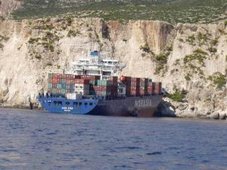
Rogue Wave traps four hikers

P.C. Lui of Freaque Waves, has a couple of good articles om rogue waves.

Rogue wave traps 4 hikers
When I first saw this title, I was a little puzzled. How does freaque wave got to do with hikers? Well, this article in the Seattle Times by Maureen O'Hagan tells what had happened to a group of hikers:

The group had set out Sunday for a weeklong hike on the West Coast Trail on Vancouver Island. The trail, about 47 miles long, is as beautiful as it is rugged. There is no road access. And with parts of the trail hugging the ocean, hikers must time their forays to avoid the dangers of high tide. No matter the time of day, the waves crash explosively. The area is known as the Graveyard of the Pacific because of the ships that have sunk there.

So with parts of the trail hugging the ocean, they carefully tried to avoid high tide, can freaque waves to be far behind? It almost sounds like an action movie script, but it's beyond most of the Hollywood script writers imagination:

The rest of Paul's post can be found here Rogue wave traps 4 hikers


RS

Wednesday, June 20, 2007

Tornado's Destruction From Space

Image : A tornado left this scar in a forested region of Wisconsin on June 7, 2007. Image Credit: NASA's MODIS Rapid Response.

A series of tornadoes ripped across central and northeast Wisconsin on the evening of June 7, 2007, leaving a path of destruction visible from space.

This image of the track of one of those tornadoes was captured on June 9, 2007, by the Moderate Resolution Imaging Spectroradiometer (MODIS) on NASA’s Terra satellite. The tornado track is the diagonal line running through the dark green, forested area, just left of the center of the image.

The path torn through this densely wooded area stands out quite clearly in the satellite image, as tens of thousands of trees were leveled by the devastating funnel cloud.

One of the tornadoes to strike the area was given an F-3 rating by the National Weather Service, classifying it as a “strong” tornado that causes severe damage and has wind speeds between 158 and 206 miles per hour.

For more information on the Wisconsin tornadoes:

Earth Observatory: Natural Hazards

For more information on NASA's MODIS Rapid Response:

http://modis.gsfc.nasa.gov/index.php


RS

Tuesday, June 19, 2007

The rescue of the M/V Pusha Bulker


Here is another recent story of a ship running aground off Nobbys Beach (near the extrance to Newcastle Harbour in Australia) after getting into trouble, during gale-forced winds on 8 June 2007.

The m/v Pusha Bulker, owned by Lauritzen Bulkers, is a 738 foot/ 225/m, 76,741 mt, Panama Flagged Bulkcarrier, hauling coal, built in 2006 by Sasebo Heavy Industries Co., Ltd. The Salvage operations is being conducted by s Svitzer Salvage, a division of A.P. Moller-Maersk. It was reported and determined that the ship's hull was breached by the continued pounding of the waves.

As of this writing, the vessel could be stranded until late June and until tides and seas are favorable. Salvage continues, with the 22 member salvage team, stabilizing the ship, preparing it for re-float and transfering fuel and oil to tanks that are higher and not impacted by the waves.

There are some 20 marine and environmental agencies involved in the operations.

As you can see in the video, people lined the beaches in heavy rain and gale-force winds as the rescue operations retrieved the 22 member Filipino crew. Now just imagine the force of this storm that caused this vessel onto the beach.

Here ia another amazing photo, ( Courtesy of Cargolaw ).


This town will never forget the m/v Pusha Bulker. We will keep you posted....

RS

Monday, June 18, 2007

Nine Rescue's In One Day


I have been writing about the s/v Sean Seamour II and its crew that were rescued on 7 May 2007 by the USCG. But this was not the only rescue for USCG Elizabeth City, where they had one C-130 and 3 HH-60 Jay Hawks operational. There were actually six other boaters all rescued on the same day. In total there were nine rescues on this day for Air Station Elizabeth City and its USCG HH-60 Jay Hawk helicopter crews.

The way Subtropical Storm Andrea came in and caught everyone off guard I am surprised that more boaters were not caught in the storm . However, the s/v Flying Colours and its crew are still missing.

This video (USCG Imagery) is of the rescue of the three crew members of s/v Seeker rescued at 0730hrs, 7 May 2007, in the vicinity of Diamond Shoals, N.C.

On the Illinois wether front, its been pretty boring. But the weather has been just great! You know that the weather has to be pretty boring when the main talk on the storm chaser list-serves is "food" ...

Though Storm Chaser Matt Ziebell got some great shots of a super cell and shelf cloud approaching his offiice. Shortly after this photo was taken the Automated Surface Observing System (ASOS) measured an outflow at 62MPH. No tornado though.... Great Shot Matt!


UPDATE 19 June 2007

Received an email from Matt Ziebell correcting my post on the 62mph outflow. Matt goes on to say the 62mph gust was inflow straight out of the east! When the shelf cloud passed, the outflow was around 70mph from the west. There were several large tree limbs that came down before the storm even hit.

NWS Glasgow MT

Best
RS

Friday, June 15, 2007

The Rescue of the s/v Sean Seamour II


I just can't get over the rescue operations that the US Coast Guard performed recovering the crew of the s/v Sean Seamout II. Just to recap, On or around 7 May 2007 the s/v Sean Seamour II was struck by a what is believed to be a "freak wave", during Subtropical Storm Andrea. The sailboat was broadsided by a wave that did an great deal of damage to the boat and sent the crew flying about the cabin doing 360's and causing its Master to break his ribs. The wave caused the sailboat to immediately list starboard.

After a harrowing time riding the waves a EPIRB signal was received by the USCG and a C-130 over fight located the wave riding crew. A J-Hawk Helicopter was dispatched to the area and launched a rescue swimmer, who injured his back during the insertion into the water, when a wave dropped from beneath him and he dropped some 50 to 70 feet. All of this done in 50 to 70 foot seas, with winds estimated at 80 knots.

This video was taken by the rescue helicopter of part of the rescue and though short its just amazing. Again the USCG Rescue Crew did an outstanding job!

I am adding a recent news article on the Gloucester-based dragger Grace Marie and its encounter with a rogue wave on 27 April 2007. Note the damage done to the steel hull by a wave. I have also added the latest reports (from cargolaw) on recent ships encountering rogue or freak waves. Again note the damage and injuries done to these vessels and crew by a wave.

  • Unidentified 32-foot fishing vessel, with crew of 3, was struck by wave causing damage to the vessel's bow and subsequent flooding approximately 45 miles east of Port Aransas, TX. A distress call was received by the crew of an offshore supply vessel who then relayed the message to the Coast Guard. A Coast Guard rescue swimmer and the boat's crew were able to pump water out of the vessel before it sank. A Coast Guard cutter escorted the vessel to Port Aransas for repairs. No injuries were reported. (Tues. June 5 2007)

  • High-speed 279-ton hydrofoil ferry Seven Island Ai , cruising 40 knots from Izu-Oshima Island to Kurihama Port with 207 passengers, struck by rogue wave off Kanagawa Prefecture, approximately 13 kilometers south of Jogashina Island in Miura, on May 19, causing smashed windows , significant flooding and 27 injuries. From our Sr. Correspondent Tim Schwabedissen (Sat. May 26 2007)

  • Passenger M/V Enez Sun, with 136 passengers & 7 crew -- struck by a massive wave off the coast of Brittany in western France May 19 -- 1 man & 1 woman swept off the bridge into the sea near Sein Island. The man broke his arm. They were fished alive out of the water by a trawler that had been alerted to the accident by the coast guard & airlifted to a hospital in the Brittany port of Brest. "We were on the deck, we were looking at the dolphins. We were very close to the island when a huge wave hit us from the side. The seats were ripped loose. I was very afraid," said a passenger. From our Sr. Correspondent Tim Schwabedissen (Mon. May 21 2007)


Previous Posts;
Cheating Death On The High Seas
The s/v Sean Seamour II & The Hatteras Trench
High Sea's Update On Sean Seamour II
The Story of the Sailing Vessel Sean Seamour II


RS

Thursday, June 14, 2007

QuikScat In Trouble?

The QuikScat Weather Satellite is reported to be running into problems and could fail at any moment. This would indeed have a major impact on reporting hurricanes, as recently reported by the Associated Press.

History

NASA's Quick Scatterometer (QuikSCAT) was lofted into space at 7:15 p.m. Pacific Daylight Time on Saturday, June 19, 1999 atop a U.S. Air Force Titan II launch vehicle from Space Launch Complex 4 West at California's Vandenberg Air Force Base. The satellite was launched in a south-southwesterly direction, soaring over the Pacific Ocean at sunset as it ascended into space to achieve an initial elliptical orbit with a maximum altitude of about 800 kilometers (500 miles) above Earth's surface.

Built in a record time of just 12 months, QuikScat provides climatologists, meteorologists and oceanographers with daily, detailed snapshots of the winds swirling above the world's oceans. Labeled as NASA's next "El NiƱo watcher," QuikSCAT is used to better understand global weather abnormalities and to generally improve weather forecasting.

QuikSCAT's predecessor, NSCAT (NASA Scatterometer), a microwave radar scatterometer, measured near-surface wind vectors (both speed and direction) over the global oceans starting in August 1996. The QuikSCAT mission is a "quick recovery" mission to fill the gap created by the loss of data from NSCAT, after the satellite it was flying on lost power in June 1997.

Winds play a major role in every aspect of weather on Earth. They directly affect the turbulent exchanges of heat, moisture and greenhouse gases between Earth's atmosphere and the ocean. To better understand their impact on oceans and improve weather forecasting, QuikSCAT carries a state-of-the-art radar instrument called a scatterometer for a two-year science mission. Known as "SeaWinds," this scatterometer operates by transmitting high-frequency microwave pulses to the ocean surface and measuring the "backscattered" or echoed radar pulses bounced back to the satellite. The instrument senses ripples caused by winds near the ocean's surface, from which scientists can compute the winds' speed and direction. The instruments can acquire hundreds of times more observations of surface wind velocity each day than can ships and buoys, and are the only remote-sensing systems able to provide continuous, accurate and high-resolution measurements of both wind speeds and direction regardless of weather conditions.

SeaWinds uses a rotating dish antenna with two spot beams that sweep in a circular pattern. The antenna radiates microwave pulses at a frequency of 13.4 gigahertz across broad regions on Earth's surface. The instrument is currently collecting data over ocean, land, and ice in a continuous, 1,800-kilometer-wide band, making approximately 400,000 measurements and covering 90% of Earth's surface each day.

The Problem

Last year, the satellite suffered a major set back with the failure of a primary transmitter used to send data to Earth about every 90 minutes. It appears that there was a software glitch that seems to happen more than NASA likes. Now QuikScat is operating on back up transmitters that could last for years or fail without warning. With the only back up being a European satellite with similar technology but with limited capabilities. There would be about a 16% loss of information. However, forecasters will still be able to predict a hurricane and its path, but it could mean evacuations over a wider area than the hurricane center normally orders when it has more precise forecasts.

But the problem does not end there. NASA is having it's semi monthly budget fights and of course we can't forget the never ending internal battles for a new design. Maybe by 2012 we will get a new bird. Maybe? Either that or if QuikScat fails like NSCAT failed and the next Cat 5 takes out another major city, we will have another satellite just as quick as we got QuikScat in the first place.


RS

Flying Through A Thunderstorm


Ever wonder what it feels like flying into a Thunderstorm in a armor-plated airplane? This is a great video (Complements of Storm Chaser Tom Warner) of a T-28 Storm Penetrating Aircraft. This T-28 was retired last year and now resides in a museum in Ashland NE,

Here is a little history on the T-28 Storm Penetrating Aircraft.

T-28 Flies Into History

T-28 History

The original concept of a meteorological research aircraft capable of penetrating hailstorms was developed and promoted by Dr. Paul MacCready in the late 1950s. At the time, this was widely regarded as not feasible because of potential danger to pilots and aircraft. The idea of developing a storm penetration aircraft persisted, however, and began to approach reality following Project Hailswath in 1966, when the National Science Foundation provided funds to support a detailed investigation. MacCready commissioned an associate, Robin Williamson, to do the aircraft feasibility study. Williamson considered all aircraft in the military and civilian fleet of the Vietnam War era. All aspects of aircraft operation including survivability, maintainability, costs, and performance were analyzed. Strictly on the basis of performance characteristics, he concluded that the best aircraft for hailstorm penetrations would be a Douglas “Dauntless” dive bomber, a World War II-era combat aircraft. His second choice was a T-28 military trainer, developed in the late 1940s as a high-performance, prop-driven, pre-jet trainer. When costs and maintainability were factored in, however, the T-28 was judged to be the overall top choice.

Using the results of Williamson's study, MacCready successfully presented his idea to the National Science Foundation (NSF) in 1967. MacCready's company, Meteorology Research, Incorporated, under contract to the South Dakota School of Mines and Technology Institute of Atmospheric Sciences’ NSF-funded Hailstorm Models Project, acquired and registered a T-28. Williamson Aircraft Co. (headed by Robin Williamson) contracted to outfit the aircraft for hailstorm penetrations. This work began in 1968 and was carried on through 1969.

After the modifications, the T-28 was capable of performing hailstorm penetrations to altitudes up to about 25,000 feet, and was able to withstand impacts of hailstones up to 7.5 cm in diameter at 100 m/s relative speed, with minimal damage. Meteorological instrumentation was installed, and the aircraft made test flights during the summer of 1969 at Rapid City, S.D., and Flagstaff, Ariz., to determine its capacity for carrying heavy loads of structural ice. It was found that the aircraft could handle up to an inch of ice with only a relatively small increase in speed to maintain controllability. Since the T-28 was to be used in summer thunderstorms where a layer of warm air would be present between icing zones and the ground, icing was not felt to be a major problem.

At this time, the T-28 resides with the Institute of Atmospheric Sciences at South Dakota School of Mines and Technology. The T-28 has participated in summer field programs almost every year from 1970 through 2004. This began with the National Hail Research Experiment in northeast Colorado and continued through projects across North America from Florida to Texas to Alberta, Canada. It even included one two-summer project in Switzerland. The T-28 has provided critical pieces to the puzzle of severe storm development and behavior.

Because of its contributions to science, the T-28 will be retired to a place where a national audience can view it, and be inspired by its work and by the ingenuity of those who developed and operated the aircraft for the past 34 years. The Strategic Air and Space Museum was chosen because of its specialized commitment to atmospheric related research.

Enjoy the ride!

Best
RS

Wednesday, June 13, 2007

The Missing Sail Boat Grendal

There are times in life when communications gets its wires crossed. This is something that happens even when you check with official regulatory agencies, information just gets miss communicated, wires get crossed. As we say in the biz, "Ship Happens". This unfortunately happened to me recently. I have redacted the names of some of the participants in this story that are not in the public domain, because of both privacy issues and lets just say, making the point I am going to make is not worth any more hassles. People just react differently for various reasons and some of them just get involved on a limited basis. I am not known for that. Once I get involved, I get involved, no holds barred, especially with a report of a missing sail boat.

As the story of the missing s/v Grendal first came to me from a sailing boat forum. The posting dated around 8 June 2007, was a strange and not a typical posting from someone searching for a missing boat and person. The party inquiring was asking for any information on the missing sail boat 'Grendal' and its owner Mr. Edward C. Judd, who was sailing from Fiji to Hawaii on or about 15 October 2006 and had not been heard from since. There was no other information posted. The poster requested anyone who knew anything about the Grendal and Mr. Judd to contact him.

We are talking about searching for someone or gathering information about someone in a span of time some eight months from the last known reported sighting in the general area between Fiji and Hawaii to when the post was published. There was no further details posted. Over the next few days the postings continued and were still limited in any details, though the forum moderator was requesting those details. The inquiry seemed very strange indeed. Why ask for assistance locating a missing boat and its owner and not provide more accurate details? So becoming peaked and after a web search and finding nothing noteworthy, I emailed the person inquiring and asked for more details. After a web search I found the company address and contact data for the person making the inquiry. Noted the companies location and assumed that this was the location or the general area where the missing boater either came from or had family. That was the correct part.

So I contacted that area's USCG Operations Office and made an inquiry with the limited details I had. After searching their data base and speaking with their own area command. They informed me that both the Grendal and Mr. Judd were located a while ago. Knowing that there were privacy issues involved and that I not being next of kin, would not receive any further information asto his exact location or well being, I dropped the issue and reported back to the forum moderator that the boat and owner were indeed located and that the posting was a false report.

Well guess who was wrong? I later received a email from the original inquiring party with much more detail than what was posted including the USCG case number. At the same time the forum moderator without even contacting me decided, I was off my rocker and revoked my entrance to the forum. Got to love people who have the same questions as you do, the same thoughts or concerns about the post in question, as you do, and then just assume your off your rocker and don't even bother to have the common decency to ask you before they react. Especially on a report of a missing sail boat, of which I take very seriously.

Well it did get my attention to say the least and I am not one to drop an issue like this, once I get involved. If I am wrong then I have to admit my mistake and take corrective action. So armed with much more details, I decided to go find out what the real story here was. I made direct contact with the USCG Area Command and also call the company where the original inquirer worked and who had contacted me by email and leaving a message to contact me.

Here are the real known facts of the missing sail boat Grendal.

As it was told to me by the United States Coast Guard this time. The Grendal was located half sunken off the Kura Atoll, North West of Midway Atoll or Midway Island. Mr. Judd was not located. When I asked if an air search had been conducted, the USCG said no, because they received the missing boat report some six or seven months after the last reported known sighting of the Grendal and Mr. Judd in Fiji. However they did launch a search party on the Kura Atoll and found nothing. Mr. Judd's personal processions, what was left of them, were on board the half sunken Grendal at the time.

I asked if there were any GPIRB or EBIRB signals sent or received or any may-days calls. The answer was very a surprising, no. A man with 40 years of sailing history in the South Pacific and no may-day calls or GPIRB signals? How very strange. Well I later found out why. Mr. Judd did not have any form of communications or electronics on his 33 foot sail boat. Nor was any found on his boat by the USCG. Not even a simple VHF radio.

Because of this and the fact that the missing boat report was transmitted so very late to the USCG, they could not even define an air search area. Forget about trying to find someone, some seven or eight months afterwards, sailing between Fiji and Hawaii. Once again even though with limited information the USCG did manage to locate the Grendal and sent a search party to the Atoll, finding nothing, they made contact with as many customs and regulatory offices in countries as they could that Mr. Judd was known to have visited. With no sign of Mr. Judd and no further information provided they closed the case.

As I was finishing my call with the USCG I received a call from the inquiring party who I had left a message for. Yes as I was informed, Mr. Judd did not have any communications or electronics equipment on board. Mr. Judd a 80 year old gentleman with some 40 years of sailing history in the South Pacific was something of a mavrick and someone who just was just care free. Mr. Judd was known to keep in touch with his family and so the lack of communications was unusual.

That did strike me as strange. If Judd had a habit of communicating why did his family wait so long? The gentleman on the line could not answer that and was surprised to find out that the report to the USCG was filed so late himself. Matter of fact according to this person. Mr. Judd had indeed communicated his sailing intentions. He originally sent a lady friend of his a post card in September of 2006 telling her that he would be departing Fiji on October 15 of 06, bound for Helo, Hawaii and was not sure how long it would take. She was asked to give this information to his brother and so she did.

Moreover, during this time there were some five or six named tropical cyclones raging havoc in the South Pacific at varying times during the period when the Grendal was sailing. Without any type of even basic electronics or communications, advanced warning would have never happened.


Tropical Cyclone Arthur - NASA


So Mr. Judd, would have had to rely on visual atmospheric and ocean sightings to determine weather. That did not work to well back in the days of Wooden Tall Ships and many ships and sailors were lost and that does not work well today either. For anyone especially a 80 year old person sailing in any ocean or even offshore without basic communications is unfortunately foolish. No matter how experienced someone is. The odds have a nasty habit of catching up on you. The likelihood of finding Mr. Judd at this time is about, well? Lets say almost impossible. Unless Mr. Judd one day makes contact. That too it seems unlikely.

As of this writing I have sent an email to a contact of mine at Fiji asking them to inquire about the Grendal and Mr. Judd at marinas he was known to harbor at.

If anyone has any information or history about Mr. Judd and his travels starting from September 2006 to May 2007, please contact me here. Just answer this post and I will receive an email.

To my mates at the sailing forum. Communications get crossed all the time and it was not hard in this very unusual case either. It was a strange tail and as I said before, "Ship Happens". You do have my apologies, but jumping without knowing any facts or just assuming someone is wrong without knowing any facts is making the same mistake I made. Next time at least make contact and find out what the facts really are before you react.

My condolences and prayers to Mr. Judd's family. I will do my best to find out anything I can.

Best
RS

Monday, June 11, 2007

Cheating Death On The High Seas

When we talk about the fury of mother nature, no matter if its a flood, tornado, hurricane, or a rogue wave, the mechanics of the event are normally a story in itself. But there is always, the other side of the story.

That story is the story of the rescue operations and the compelling story of the survivors.

This photograph was taken of the rescue of the crew of the s/v Sean Seamour II from the USCG J-Hawk Rescue Helicopter. It again gives us another plane of view of the monstrous sea states at the time of rescue. And this may have been the smaller of the waves that caused the sinking of the 44 foot, s/v Sean Seamour II.

At this view its difficult to estimate the size of the wave in this photograph, but monstrous maybe a understatement. There are just no words to express or define this picture. It's just an incredible and frightening picture! Note the height of the wave peak at the top in comparison to the life raft below. The waves heights were estimated by UCSG Command Pilot Lt.CMDR Nevada C. Smith ( named after the famed wild west cowboy in the 1937 movie the "carpetbaggers") piloting the USCG J-Hawk Rescue Helicopter, to be between 50 to 70 feet.

Also take note of the distance between the waves. and how close they are to each other. Just an amazing photo and a amazing tail of survival and rescue. The Hatteras Trench is definitely living up to its violent reputation here. Not just is it amazing that the crew of the s/v Sean Seamour II, who suffered from a severe case of hypothermia and injury, survived to be rescued. But the rescue itself was indeed most difficult and amazing. Hovering a helicopter in winds estimated between 60 to 80 MPH and with waves of 50 to 70 feet, was no small feat for Lt.CMDR Smith his Co-Pilot LTJG Aaron G. Nelson and Flight Mechanic Petty Officer Scott Higgens.


While deciding to launch and monitor a rescue swimmer and survivors in these conditions is entirely another difficult and painful command decision. For any rescue swimmer not just to stabilize himself in these waters, but to stabilize the rescue basket with a survivor in these types of waters, that rescue swimmer needed to be super-human, and in the case of USCG Chief Petty Officer Drew Dazzo, super-human maybe also a understatement. These USCG rescue swimmers are unsung hero's and in this case, the rescue was just not difficult, but it resulted in injury to
rescue swimmer, PO Drew Dazzo.

PO Dazzo himself had a very difficult time stabilizing himself in the water, since the steep pitch of these monstrous waves had PO Dazzo, who was tethered to a safety wire from the helicopters hoist, feeling like he was in the, spin cycle of a washer machine. PO Dazzo was hanging either very taught or very slack on his safety wire as he pitched and rolled with these waves. During his initial insertion into the stormy seas and while he was stabilizing, it is believed that one of the waves dropped from under him as he crested the wave and then suddenly dropped some 50 to 70 feet, over the other side
causing painful injury to PO Dazzo's back. .

Though injured and hurting, PO Dazzo continued with the rescue operations, saving the rest of the s/v Sean Seamour crew. The final rescue of the last crew member of the s/v Sean Seamour II became very laborious for the injured PO Dazzo and after a failed attempt in using a rescue sling, he once again called for the rescue basket. PO Dazzo then reentered the water to retrieve the
GPIRB. Once back on board the J-Hawk Helicopter, PO Dazzo laid on the floor of the helicopter in pain and was hospitalized, along with the crew of the s/v/ Sean Seamour II.

On top of that prior to this harrowing period, the Master of the s/v Sean Seamour II, being tossed around like a rag doll by the waves, had broken his ribs. Anyone who has broken ribs before understands pain. The slightest jarring is very painful. Imagine riding this roller coaster of waves and wind with broken ribs for an extended period of time? The other two crew members were tossed violently around the cabin and one suffered some back trauma, while the brutality of the wave did not just flip them in a 360 about the cabin, but caused the s/v Sean Seamour II to immediately list to the starboard.

But as I am informed, that did not deter the Master from attaching the GPIRB and freeing the raft from his stricken sail boat and struggling to care for his crew, while his crew made sure they took care of him, knowing that he was injured and weaving
in and out of semi-consciousness . The Master of the s/v Sean Seamour II, lived up to the honorable code of a Ships Master by tending to the safety of his crew during the emergency. I cannot say enough about his two friends and crew mates. Knowing that their friend and Captain was injured, they made sure that he was first in the rescue basket.

They are truly a "band of brothers" today.

RS

Previous Posts;
The s/v Sean Seamour II & The Hatteras Trench
High Sea's Update On Sean Seamour II
The Story of the Sailing Vessel Sean Seamour II


Saturday, June 9, 2007

Bevent, WI Tornado Aftermath, June 7th 2007


Bevent, Wisconsin Tornado and its destruction near Hwy 153 and CTY J around 5pm on June 7th, 2007. (Footage Courtesy of Matt Kaskavitch and Matt Westlund)

While Chicago escaped the worst from a line of thunder storms, Thursday evening 7 June 2007, the Northern Suburbs took most of the punch. Rain totals varied from Villa at 1.38" to Grayslake at 3.60". Most of the damage was downed trees, power lines and flash floods.

Wisconsin was entirely a different story, Where five tornado's touched down. At Bear Paw in Langslade County, Wisconsin, the resort was struck by a tornado rated by NWS as a EF3 with winds estimated between 140 to 165 MPH. It lost 10 buildings with damage estimated at some $200,000.00. As of Friday AM NOAA reported a total of 292 reports of severe weather across the region. There were some minor injuries but no deaths reported in any of the Wisconsin storm reports.

Below is the summary from WCM Chicago Jim Allsopp of the storm damage in the Chicago area.

000
NWUS53 KLOT 081740
LSRLOT

PRELIMINARY LOCAL STORM REPORT...CORRECTED
NATIONAL WEATHER SERVICE CHICAGO/ROMEOVILLE IL
1240 PM CDT FRI JUN 08 2007

..TIME... ...EVENT... ...CITY LOCATION... ...LAT.LON...
..DATE... ....MAG.... ..COUNTY LOCATION..ST.. ...SOURCE....
..REMARKS..

0700 PM NON-TSTM WND DMG CHICAGO 41.88N 87.63W
06/07/2007 COOK IL DEPT OF HIGHWAYS

CHICAGO DEPT OF STREETS AND SANITATION REPORTED 884 TREES
DOWN OR DAMAGED...71 TRAFFIC SIGNALS OUT...45 LIGHT POLES
DAMAGED...76 DOWNED WIRES TO LIGHT POLES AND LIGHTS.
OFFICIAL WIND GUSTS TO 45 MPH ATMIDWAY...OHARE...WAUKEGAN
AND VALPARAISO. GUST TO 48 MPH AT ROMEOVILLE.

0955 PM TSTM WND DMG DIXON 41.85N 89.48W
06/07/2007 LEE IL EMERGENCY MNGR

TREE LIMBS AND POWER LINES DOWN.

1005 PM TSTM WND GST MOUNT MORRIS 42.05N 89.43W
06/07/2007 E60.00 MPH OGLE IL FIRE DEPT/RESCUE

TREE LIMBS DOWN.

1020 PM TSTM WND DMG BYRON 42.13N 89.26W
06/07/2007 OGLE IL DEPT OF HIGHWAYS

6 INCH TREE LIMBS DOWN.

1100 PM TSTM WND DMG DIXON 41.85N 89.48W
06/07/2007 LEE IL DEPT OF HIGHWAYS

TREES AND LIMBS DOWN.

1140 PM TSTM WND DMG KIRKLAND 42.09N 88.85W
06/07/2007 DE KALB IL DEPT OF HIGHWAYS

TREE LIMBS BLOWN DOWN IN NORTHWEST PART OF DEKALB COUNTY.


1156 PM TSTM WND GST WAUKEGAN 42.37N 87.87W
06/07/2007 M52.00 MPH LAKE IL OFFICIAL NWS OBS

WAUKEGAN AIRPORT.

1200 AM TSTM WND DMG CRYSTAL LAKE 42.23N 88.33W
06/08/2007 MCHENRY IL LAW ENFORCEMENT

TREE LIMBS DOWN. ESTIMATED 60 MPH WIND FROM SPOTTER.

1200 AM HAIL CRYSTAL LAKE 42.23N 88.33W
06/08/2007 M0.75 INCH MCHENRY IL TRAINED SPOTTER

1214 AM TSTM WND DMG WAUCONDA 42.27N 88.14W
06/08/2007 LAKE IL NEWSPAPER

LARGE TREE DOWN.

1216 AM TSTM WND DMG GRAYSLAKE 42.35N 88.04W
06/08/2007 LAKE IL NEWSPAPER

LARGE TREE FELL ON A HOUSE.

1218 AM TSTM WND DMG ROUND LAKE 42.35N 88.11W
06/08/2007 LAKE IL NEWSPAPER

ROOF TORN OFF LUMBERYARD.

1255 AM FLOOD 1 W BEACH PARK 42.42N 87.88W
06/08/2007 LAKE IL CO-OP OBSERVER

2.00 INCHES OF RAIN SO FAR WITH 1.46 IN PAST 60 MINUTES.

0100 AM TSTM WND GST WAUKEGAN 42.37N 87.87W
06/08/2007 M62.00 MPH LAKE IL OFFICIAL NWS OBS

WAUKEGAN HARBOR.

0207 AM FLOOD MCHENRY 42.34N 88.29W
06/08/2007 MCHENRY IL TRAINED SPOTTER

2.5 INCHES OF RAIN FROM 10 PM TO 2AM CDT.

0529 AM FLASH FLOOD 2 WNW ZION 42.47N 87.88W
06/08/2007 LAKE IL LAW ENFORCEMENT

ILLINOIS ROUTE 173 AND DELANY ROAD ARE CLOSED DUE TO
LOCAL FLOODING

0702 AM FLASH FLOOD 3 W ZION 42.46N 87.90W
06/08/2007 LAKE IL LAW ENFORCEMENT

THE WATER OVER ILLINOIS ROUTE 173 AND KILBOURNE IS SLOWLY
RECEDING


&&

$$

ALLSOPP

RS

Friday, June 8, 2007

Another Plane Of View


As I have mentioned before, many times we view things on one plane of thought as we see them, without considering or imagining another view point. For example, the two video's (lower bottom on left) of ship's encountering heavy sea's. It is one thing to try and understand what it looks and feels like from the ships point of view or from the air looking down. Its another thing to see it from shore side.

This video is of a passenger ferry departing its port in New Zealand. This vessel is approximately 600 feet long. Watch the waves effects on this vessel and how the ship interacts with the waves from a shore-based point of view.

Consider now, the mechanical stress factors that these waves are placing on this ship and the emotional stress on the crew and passengers.
I can tell you that it took a strong Master and Crew to pilot this vessel under these conditions. Of course the passengers, I am sure had one heck of a ride.

Now imagine a 44 foot sail boat encountering these waves!


On the weather front in the Northern Illinois region last night;

Chicago got spared from much of the T-Storm damage last night.Though wind gusts, three miles offshore were reported at 60+ MPH and downtoen at 53MPH. But north and west of the city did not fair so well. There were reports of a tornado, funnel clouds, hail, downed electrical wires, downed trees and flash floods stretching from Lake, DeKalb, Ogle, McHenry, Winnebago and Cook Counties in Illinois. However, Wisconsin took a beating. In Langlade, WI the Bear Paw Inn was hit by a tornado and was totally devastated. There are no reported injuries or deaths with all accounted for.

Today the probability for widespread hazardous weather is low.

RS

Thursday, June 7, 2007

LATEST INFORMATION - Northern Illinois

LATEST INFORMATION on significant severe weather expected tonight!

A squall line or solid line of thunderstorms is expected to develop over northern Illinois this evening. The greatest severe weather threat from these storms is damaging wind gusts of 60 to 70 mph. These storms will evolve from supercell thunderstorms that will move into northern Illinois from Iowa and Missouri this evening and then race east northeast.

Isolated tornadoes are possible with these storms as well...however the risk of tornadoes will diminsh as these storms come farther east across Illinois and as we get later through the evening.

These storms are being driven by an unusually strong storm system across the northern Plains. This storm system is winter-like in terms of its wind energy...with winds over 100 mph in the upper levels of the atmosphere. This wind energy combined with abundant moisture streaming north ahead of a cold front and high instability prompted by very warm air near the ground and colder air aloft will set the stage for explosive thunderstorms development.

SPECIAL WEATHER ALERT

SPECIAL WEATHER ALERT
Public Information Statement

Statement as of 8:35 am CDT on June 7, 2007

Live severe weather briefings to be held on NOAA weather today...

The National Weather Service in Chicago will be conducting live
severe weather briefings on NOAA Weather Radio today due to the
heightened threat of severe thunderstorms across northern Illinois
and Northwest Indiana tonight.

The first live briefing will take place around 11 am this
morning... with a second live briefing tentatively scheduled to take
place at 4 PM this afternoon. If severe weather develops near near
Illinois earlier than expected then the second severe weather
briefing may be cancelled.


Spotter Activation maybe necessary later tonight in the Northern Illinois region.

The s/v Sean Seamour II & The Hatteras Trench

This chart (my thanks to Jean) represents the last known positon of the s/v Sean Seamour II and what is believed to be the last known position of the s/v Flying Colours. As you will note the s/v Sean Seamour sank and the s/v Flying Colours is missing in what is known as the "Hatteras Trench" a part of the continental margin.

According to NOAA, the continental margin is the underwater portion of a continent that extends from the shoreline to water depths of nearly 5,000 m. Continental margins are typically comprised of three regions: the shelf, slope, and rise. Each region has distinctly different characteristics, because of its distance from shore, water depth, and steepness. In the Atlantic Ocean, continental margins have a shelf that is broad and flat and reaches a depth of 100 m. The slope is the steep transitional area between the shelf and rise, and it lies between depths of 100 and 2,500 m.


The continental margin off Cape Hatteras, North Carolina (at 35° North latitude) displays the typical Atlantic Ocean shelf-slope-rise sequence.
The continental margin off Cape Hatteras, North Carolina, is a classic shelf-slope-rise sequence, while most of the southeast U.S. continental margin is terrace-like, with prominent features such as the Blake Plateau, Blake Ridge, and Blake Escarpment, as well as the Charleston Bump.

Due to the depth of the trench salvage operations, unforunately is almost impossible.


The trench has a well known history for violent seas, especially during storms. The Outer Banks itself is known as the, "Graveyard of the Atlantic". Over the years, some 600 ships have met their faith in this section of the Atlantic. Much of this is due to the fact that the elbow of the Outer Banks of Cape Hatteras, lies in the path of any hurricane and or tropical storm. This elbow acts as a partition or barrier between two oceans ( the North Atlantic and the Gulf Stream), and even a deflector, causing greater storm surges and waves.


Noted ships that have sunk off of Cape Hatteras include the Iron Clad Monitor, the USCGC Bedloe and Jackson, which sank in the Great Altantic Hurricane of 1944. This hurricane wreaked havoc on Hatteras Island actually causing residents to relocate entire villages.

As David Stick writes in his book,
Graveyard of the Atlantic Shipwrecks of the North Carolina Coast. "You can stand on Cape Point at Hatteras on a stormy day and watch two oceans come together in an awesome display of savage fury; for there at the Point the northbound Gulf Stream and the cold currents coming down from the Arctic run head-on into each other, tossing their spumy spray a hundred feet or better into the air and dropping sand and shells and sea life at the point of impact. Thus is formed the dreaded Diamond Shoals, its fang-like shifting sand bars pushing seaward to snare the unwary mariner. Seafaring men call it the Graveyard of the Atlantic."

For example on August 29 1999, along Cape Hatteras, the maxium wave hights caused by Category 2 Hurricane Dennis, as the storm, located approximately 150 miles offshore, battered the Cape Hatteras area for a week, where SWH's (Signifiant Wave Heights) were recorded by the US Army Corp of Engineers as high as 20.5 feet. Although the winds from Hurricane Dennis were not particularly strong, the duration of the effects of the storm on North Carolina's shoreline was remarkable.

Subtropical Storm Andrea had simular effects as she meandered offshore for a few days. But the duration of effects of the storm were felt along the southern coast. Very shortly the National Hurricane Center will be issuing a report of the damages caused by Subtropical Storm Andrea.

We await that report.

On a Illinois weather note;

There is going to be a CoCoRaHS training session held on Tuesday, June 26th at 7pm. The training session will be held at the University of Illinois Extension office in Grayslake. Here is more information about registering, etc on the CoCoRaHS Illinois page:

Tuesday, June 26, 2007 - 7:00 p.m.

University of Illinois Extension Office (Lake County)
100 South US Hwy 45
Grayslake, IL

Register in advance with the University of Illinois Extension-Rockford Center by calling 815-397-7714 or by email at churchj@uiuc.edu. Please register no later than June 22nd.


RS


Tuesday, June 5, 2007

Illinois Gustnado declared Tornado!

The National Weather Service has officially declared the reported Casey, Illinois "Gustnado" as a EF0 Tornado.

The tornado occurred during a chain of Memorial Day Weekend thunder storms. The tornado touched down on 25 May 2007 between the towns of Casey and Martinsville, Illinois. (photo by Curt Coffey).

NWS had received three different photographs of the tornado, along with a detailed account by a chaser who observed the twister for 10 minutes along its 2.5 mile path. The twister was estimated to be on the ground between 14:53hrs and 15:03hrs according to eyewitnesses. This twister was approximately 30 yards wide and stayed in open fields the whole time.

According to NWS, between eyewitness accounts, photos and radar data at the time, showed it was clearly a tornado. NWS said that, it looked like the outflow from a storm to the south was ingested in the parent cell, which increased the strength of the updraft and added aggregation of low level vorticity, which was already present because of synoptic front nearby.

RS

Monday, June 4, 2007

Automatic Triggering of Severe Weather Forecast

NCSA Enables Automatic Triggering of Severe Weather Forecast

The National Center for Supercomputing Applications (NCSA) has developed tools and is providing compute resources to enable atmospheric scientists to automatically produce high-resolution storm forecasts in response to real-world conditions. Hundreds of computer forecasts have been triggered by storm watches and weather discussions over the past several months.

"The idea is that when a critical need exists, we need to provide resources quickly," said Jay Alameda, leader of the middleware development team at NCSA.

The triggered forecasting capability is being rolled out as part of the 2007 Spring Experiment, hosted by the NOAA Hazardous Weather Testbed. The experiment, which runs during the storm-heavy season from mid-April through June, provides forecasters with a first look at the latest atmospheric science research and technology and familiarizes researchers with the needs and challenges of forecasters in the field.

As part of the spring experiment's effort to improve forecasting of severe weather, NCSA has demonstrated the capability to trigger computational simulations in response to real-world conditions. When the NOAA Storm Prediction Center in Norman, Oklahoma, issues a severe thunderstorm or tornado watch, or a discussion of current conditions points to the potential for storms to develop, this information automatically initiates computational forecasts using the WRF forecasting code on one of the compute systems (currently Tungsten or Mercury) that NCSA contributes to the TeraGrid.

"One of the things that's really unique about this is the unpredictability," said Brian Jewett, an atmospheric scientist at the University of Illinois at Urbana-Champaign who is working closely with NCSA on the development of advanced tools and technologies for weather forecasting. Jewett explained that watches can come at any time, and they often come in batches. So multiple simulations can be spawned around the clock.

NCSA's Ensemble Broker software is designed to manage multiple computational jobs. To support the triggered simulation capability, NCSA enhanced the Ensemble Broker so it can submit jobs to the Moab cluster workload management package. The Ensemble Broker also stores numerous aspects of workflow submission and execution, which Jewett said makes it easier for researchers to reproduce the steps they took to get their results and facilitates collaborating with others.

Currently, a single forecast is trigged for each watch or discussion; the forecast is carried out at two resolutions -- one with a grid spacing of 18 kilometers and the other at a high resolution of 2 kilometers. Details on the triggered forecasts are available online at http://rt.atmos.uiuc.edu/trigger/.

Because so many variables affect weather, forecasts are very sensitive to subtle changes in conditions. Atmospheric scientists often use ensemble forecasting to account for these uncertainties, carrying out multiple forecasts with slightly different conditions and configurations. Looking at the results of all of the simulations often provides forecasters with a best estimate for the ensuing weather conditions and gives a measure of the confidence in that forecast. The Ensemble Broker was designed to manage the thousands of jobs required for ensemble forecasting and other parameter studies.

"It's exciting for me to see the capabilities," Jewett said. "It's really general, it's not weather specific, and it's deceptively powerful."

For the spring experiment, all of the triggered simulations are being carried out on NCSA systems, but work has begun toward dynamic job deployment, meaning that once a forecast is submitted the best resource would be identified and the calculations would be carried out on whichever TeraGrid resource could complete the work most quickly. This type of dynamic deployment could be key during a national emergency -- whether it's a hurricane heading for the coast or an infectious disease spreading from person to person.

NCSA's work on tools to support advanced weather modeling and forecasting is supported by the National Science Foundation. NCSA is a partner in LEAD (Linked Environments for Atmospheric Discovery), an NSF-supported effort to create an integrated, scalable framework for identifying, accessing, preparing, predicting, managing, analyzing, and visualizing a broad array of meteorological data and model output independent of format and physical location and in a dynamically adaptive manner.

-----

Source: National Center for Supercomputing Applications

High Sea's & Update On Sean Seamour II


This is the Saga Cruise Line's, Saga Rose. The vessels characteristics include, Gross Tonnage: 24,474 gt. Length: 620 ft. / 189 m. Crew: 350. Full Capacity: 620.

The Saga Rose was built in 1965 for Norwegian American Lines and was later assigned to Cunard and then purchased by Saga Cruises, a subsidiary of Saga Travel. The ship was previously known as the Sagafjord , Gripsholm and Saga Ruby.

On
Nov. 24th, 2006 Sailing from Southampton to Madeir, she hit a storm with 50 + kt. winds for three days and the storm did quite a bite of damage. Let's not also mention the unscheduled and interesting wild ride it's passengers got. Though these waves are not officially reported as freak waves, it will give you an idea what heavy sea states are like. Remember this storm did a lot of damage to the Saga Rose. While your also watching the video (Lower Left Side - Saga Rose - Point and Click ) remember that this is a 620 foot/189 meter ship! Listen to the bridge crew. These are experienced sailors. Now just imagine what a wave such as this could do to a 44 foot sail boat!

I have also added a dramatic video clip of the Cruise Ship Voyager
(Lower Left Side - Voyager - Point and Click )with 776 on board who was enroute between Spain's Balearic Islands to the Italian island of Sardinia and ran into Force 11 Winds (100km/hr) on 2 February 2005 off the coast of France. There was a report of a "giant wave" smashing the bridge window and knocking out electronics. Once again imagine a 44 foot sail boat in these seas!

Running down any known facts in the case of the Sean Seamour II is rather difficult. I again appeal to anyone with any information to contact me here. I have communicated with Dr. Paul C. Liu of NOAA's Great Lakes Environmental Research Laboratory (GLERL) with regards to the Sean Seamour II. The first thing Dr. Liu said was, "thank God they were rescued." Dr. Lui
referring to my email then went on to explain that, "as there is no eyewitness and there is no measurement, it is just not possible to substantiate it one way or the other. The current state of freak/rogue waves research just can not be of any help beyond that." However he goes on to say, "this case clearly occurred during a storm. We know that in general freak/rogue waves can happen during calm or storm conditions."

We know that wave surges can travel thousands of miles in any direction from any storm. Forget the fact that the Sean Seamour II ran into its trouble directly in the middle of a subtropical storm. I am still waiting to see what the National Hurricane Center has to say.

Stay tuned.
RS

Friday, June 1, 2007

Rogue Waves & Latest on the Seamour II


I have been in contact with the National Hurricane Center with regards to the rouge wave theory as I posted yesterday, (The Story of the Sailing Vessel Sean Seamour II). This morning I received a reply. The NHC is assembling a report on the damages caused by Subtropical Storm Andrea which should be forthcoming shortly. The NHC is also taking a look at the rogue wave report and should be back to me in a couple of days.

I have also been in contact with scientists at the Great Lakes Environmental Research Laboratory (GLERL) who are studying rogue and freak waves and I expect to hear back from them shortly as well. The following paper was sent to me by Jamie Rhome of the National Hurricane Center. Its a must read for all mariners.

Maintaining Watch
RS

Expecting the Unexpected Wave: How the National Weather Service Marine Forecasts Compare to Observed Seas

Robbie Berg and Jamie R. Rhome, Tropical Analysis and Forecast Branch, NOAA/Tropical Prediction Center/National Hurricane Center

Introduction

Marine forecasts issued by the National Weather Service (NWS) provide the sea state in terms of the significant wave height (Hs). This value is defined as the average of the highest 1/3 of the waves observed in a wave field. In other words, if a mariner were to observe the passage of 100 individual waves past a given point, the significant wave height would be the average height of the highest 33 waves. The concept of significant wave height was derived during a project to forecast ocean wave heights and wave periods during World War II (Stewart 2005). The Scripps Institute of Oceanography has shown that observed wave heights correspond to the average of the highest 20-40% of the waves, and the significant wave height has evolved to become the highest 1/3 of the waves (Wiegel 1964).

The significant wave height tends to be the height of the waves that is most readily observed by the human eye (WMO 1998). But how does this value compare to the average height of all the observed waves, or the highest wave one might encounter? Unfortunately, misunderstanding of the meaning of significant wave height often leads to improper interpretation of the NWS marine forecasts. Additionally, confusion surrounding the proper measurement of significant wave height leads to subjective and widely varying wave height reports from ships since every mariner would most likely report different wave height values for a given sea state. This is often exacerbated by the fact that observations are dependent on the size of the vessel and the height at which the observation is taken. For example, observations of significant wave heights taken on the main deck of a large ship 80-100 feet above the water often cause the waves to appear smaller than reality. Similarly, a small vessel encountering rough seas may overestimate significant wave height or report only the highest individual waves (WMO 1998). This subjectivity results in vastly different reports of significant wave height from adjacent ships, forcing marine forecasters to speculate as to which report best represents the prevailing sea state. Accurate sea height estimates are critical to the accuracy of the NWS marine program. Accordingly, this paper seeks to provide additional insight into the term significant wave height and its relationship to other wave statistics.

Significant Wave Heights

If a NWS forecast calls for seas 12 to 14 feet, exactly how will the wave field look to a mariner? To better understand what the significant wave height is and what it means to the mariner, we need to turn to statistics and the concept of distributions. Most people are aware of statistical distributions and probably don't even know it. The most common distribution used in real life is the normal, or Gaussian distribution (Figure 1A), which is more commonly referred to as the bell curve because of its shape (Wilks 1995). This distribution is quite good at describing phenomena in which most elements in a group are clustered near an average value with an equal number of elements being greater and less than this average value. Examples include the high temperature in a city for a given day, the weight of babies born at a hospital, or the height of students in a college oceanography class.

Figure 1. Generalized normal  (a) and Rayleigh (b) distributions Figure 1. Generalized normal (a) and  Rayleigh (b) distributions

Figure 1. Generalized normal (a) and Rayleigh (b) distributions.

Wave heights in the ocean are usually modeled according to another statistical distribution called the Rayleigh distribution (Figure 1B). This distribution also has an average value, but in this case most elements are clustered toward lower values, with only a few exceptionally large values. The Rayleigh distribution does not exhibit symmetry like the normal distribution (Wilks 1995).

Several different wave statistics useful to the mariner can be inferred from the Rayleigh distribution. For example, the highest point of the distribution can be thought of as the most frequent wave height observed in the wave field. Roughly speaking, the most frequent wave height Hf is approximately half the value of the significant wave height (see Appendix). Similarly, the average wave height, which will be slightly larger than the most frequent wave, is estimated to be about 5/8 the value of the significant wave height (see Appendix).

Several recent marine incidents have highlighted the importance of knowing the height of the largest wave that can be expected for a given wave forecast. Since the Rayleigh distribution actually goes to infinity to the right of its peak, a wave is theoretically not bounded by a limiting height. This is where the Rayleigh assumption breaks down. Luckily, however, the highest waves can still be estimated through a combination of several methods. For example, it can be shown that 10% of the waves have a height greater than 1.074 times the significant wave height, and the average height of those highest 10% of the waves is approximately 1.272 times the significant wave height (see Appendix). Table 1 shows the relationship between the multiple wave statistics for several common significant wave height forecast values.

Significant Wave Height (Hs) Most Frequent Wave Height (Hf) Average Wave Height ( ) Average of Highest 10% of Waves ( )
4 2 2.5 5
8 4 5 10
10 5 6 13
12 6 7.5 15
15 7.5 9 19
20 10 13 25
Wave conditions at NDBC Buoy 42040 during Hurricane Ivan
52.4 26.1 32.8 66.7

Table 1. Relationship between selected National Weather Service forecast wave heights (significant wave height in feet) and other parameters such as most frequent wave height, average wave height, and average height of the highest 10% of waves (also in feet.) The most frequent wave height, average wave height, and average of the highest 10% of waves at Buoy 42040 during Hurricane Ivan are calculated from the theoretical Rayleigh distribution for the observed significant wave height of 52.4 feet.

In a somewhat tedious process, the above information can be combined with the parameters of the Rayleigh distribution to arrive at a relationship between the significant wave height and the highest expected waves (see Appendix). As an example, assume that the significant wave height in an area is 10 feet. One out of every 100 waves (or 1% of the waves) will have a height greater than about 16 feet. One out of every 1000 waves (or 0.1% of the waves) will have a height greater than about 19 feet. A common rule of thumb often utilized is that the highest expected wave is equal to twice the significant wave height. This kind of height would be observed in about 1 out of every 3000 waves. Incidentally, if an average wave period is known, the frequency of observing the highest expected wave can be obtained by multiplying 3000, or any other number of waves, by the wave period. If the average wave period is 10 seconds, then a wave two times as high as the significant wave height will be observed on average every 30,000 seconds, or about 8.3 hours. In reality, wave height is limited by wave steepness: deep water waves (those in an area where the ocean depth is greater than half the wavelength) begin to break when their height to length ratio exceeds 1/7 (see Appendix).

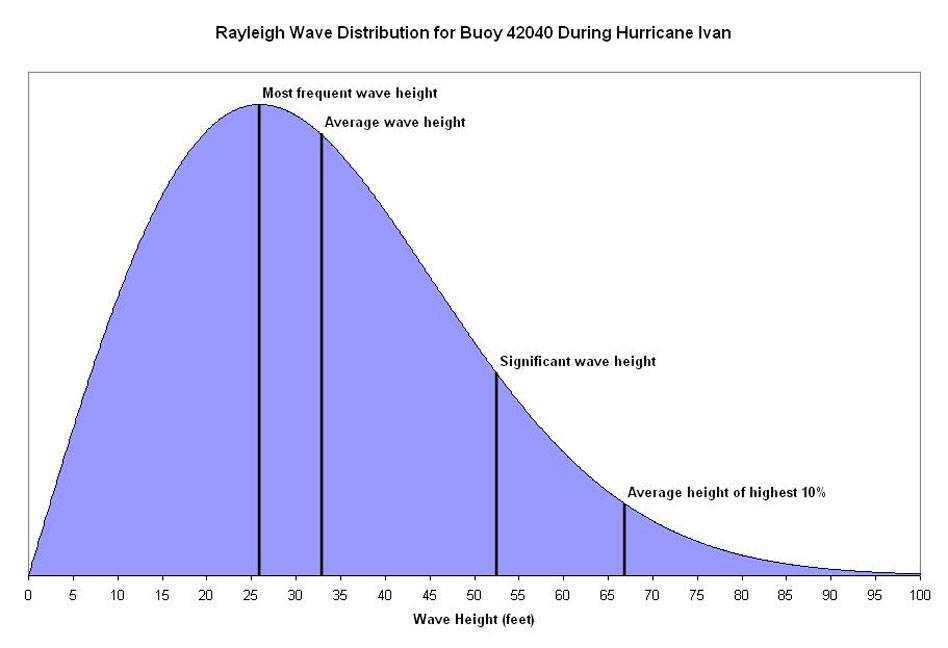
Here's an example to put all this into context. On September 15, 2004, Hurricane Ivan was racing northward across the Gulf of Mexico towards the Alabama and Florida coastline with strong 115 kts winds that were producing extremely large waves. The Tropical Analysis and Forecast Branch (TAFB) at the Tropical Prediction Center/National Hurricane Center predicted seas (significant wave heights) as high as 55 ft the morning before the hurricane moved into the northern Gulf of Mexico, and this forecast verified quite well with a significant wave height of 52.4 ft reported at NDBC buoy 42040 at 8:00 p.m. as the center of Ivan passed overhead. But not every wave that passed the buoy had a height of 52 feet, so what was the character of the actual wave field during the hurricane?

Figure 2. Rayleigh Wave Distribution for Buoy 42040 - Click to Enlarge

Figure 2. Theoretical Rayleigh distribution of the wave heights at Buoy 42040 at 8:00 p.m. September 15, 2004 as Hurricane Ivan was passing overhead.

A significant wave height of 52 feet seems quite large, but realistically a sizeable portion of the actual waves during the hurricane did not attain that height. The most frequent wave height, according to the Rayleigh distribution, was about 26 feet - still an imposing and dangerous wave for a mariner out at sea. A few waves did build higher than the significant wave height, with the average of the highest 10% of the waves being around 67 feet! Figure 2 shows the theoretical distribution of the wave heights at Buoy 42040 as Hurricane Ivan was passing overhead, and the last row in Table 1 gives the calculated values from the distribution.

There is a limit on the highest wave that would be expected. The average wave period reported by the buoy at the same time as the report of the maximum wave height was about 12 seconds. Therefore, a wave with a 12 second period (which incidentally would have a wavelength of 735 feet), would break when its wave height exceeded 105 feet. Individual waves with shorter periods would break at much shorter wave heights. Based on the rule of thumb for the highest expected wave, a significant wave height of 52 feet could yield a wave of about 104 feet, which lies within the possible range of wave heights given the breaking wave height.

Conclusion

The NWS marine forecasts provided by the Tropical Prediction Center, Ocean Prediction Center, and coastal Weather Forecast Offices convey important wave field information that goes beyond just the expected significant wave height. Other useful wave parameters, such as the most frequent wave and highest expected waves, can be derived that can go into making important decisions regarding safe marine operations. Estimations of the highest expected wave height are especially important in extreme weather events and can be beneficial when trying to avoid large and occasionally devastating storm-generated waves. So, don't be caught off guard by a 26 foot wave the next time the NWS marine forecast reads "SEAS 12 TO 15 FEET"!

References

Stewart, Robert H., 2005: Introduction to Physical Oceanography.
(Available at http://oceanworld.tamu.edu/resources/ocng_textbook/contents.html)

Wiegel, R. L., 1964: Oceanographical Engineering. Prentice Hall, Englewood, NJ.

Wilks, D. S., 1995: Statistical Methods in the Atmospheric Sciences. Academic Press, San Diego, CA, 467 pp.

WMO, 1998: Guide to Wave Analysis and Forecasting. WMO No.-702, Second Edition, 168 pp. (Available from http://www.wmo.ch/index-en.html).

Biography

Robbie Berg has worked as a forecaster in the Tropical Analysis and Forecast Branch of the Tropical Prediction Center/National Hurricane Center since June 2002. He received two B.S. degrees in meteorology and marine sciences from North Carolina State University and is currently pursuing a M.S. degree in meteorology from the University of Miami. Previous work experience includes hurricane research at the NOAA Environmental Technology Laboratory in Boulder, Colorado.

Jamie Rhome has worked as a forecaster in the Tropical Analysis and Forecast Branch of the Tropical Prediction Center/National Hurricane Center since September 1999. He received his B.S. and M.S. degrees in meteorology from North Carolina State University. Previous work experience includes the United States Environmental Protection Agency and the State Climate Office of North Carolina. In addition to his professional experience in marine meteorology, Jamie is an avid offshore fisherman.

Acknowledgments

The authors wish to thank Eric Holweg, Dr. Rick Knabb, Alison Krautkramer, and Daniel Brown for their constructive comments and suggestions on this paper.

Thursday, May 31, 2007

The Story of the Sailing Vessel Sean Seamour II

We see and hear of the destruction that Mother Nature can rain on homes and people shore-side. But little is blogged about what Mother Nature does to people, ships and boats ( for the record, the difference between a boat and a ship, is that a boat fits onto a ship.) where seeking cover is really very limited and in most cases non-existent. As in Hollywood's version of "The Prefect Storm". Of course most of the Perfect Storm is based on third party reports as well as NOAA/NWS and USCG reports.

Just maybe the story of the s/v Sean Seamour II compares with the story plot in the Perfect Storm.
Listed here is the log entry from the s/v Sean Seamour II Skipper. The crew was rescued by the United States Coast Guard during Sub-Tropical Storm Andrea. If you remember my posting of 12 May 2007 where the USCG was searching for the s/v Flying Colours. See Subtropical Storm Andrea .

Also running afoul of Andrea was the Hapag-Lloyd Paris Express and during the storm she lost some 21 containers as I also posted on 12 May 2007. Though not unusual for container ships to loose containers during a storm, since wave effects especially those associated with signifiant wave heights (SWH) can and do a lot of damage.

This is a copy of the USCG's Press Release of the days rescues; (Thanks Dennis!)

Portsmouth, VA

The Coast Guard rescued nine people today from three sailboats off the coast of North Carolina. A Coast Guard HH-60 Jayhawk helicopter crew based out of Air Station Elizabeth City, N.C., landed at Marine Corps Air Station Cherry Point with the latest survivors, who were plucked from their sailboat about 120 miles off shore. This was Air Station Elizabeth City's third rescue today. A rescue helicopter crew hoisted three people from the sailboat Seaker at approximately 7:30 a.m. in the vicinity of Diamond Shoals, N.C. The air crew transported the rescued to Air Station Elizabeth City where they were evaluated by medical crews and released.

In addition to the Seaker rescue, three people were rescued from a makeshift life raft about 160 nautical miles east of Cape Hatteras in 34-foot seas. They were aboard the sailboat Lou Pantai when rough seas and heavy winds forced the three sailors to abandon ship. A Coast Guard helicopter crew transported the rescued to Marine Corps Air Station Cherry Point. The sailors are suffering from hypothermia.

The story of the s/v Sean Seamour II is about not just how mother nature can spin a storm but its about the survivors and there experience. Fortunately the crew was rescued after a harrowing time at sea. To date the Flying Colours remains lost at sea.

Weather wise the log is a very interesting read and tells a tale of how mother nature can just as easily spring up at sea as she does on land. Remember Sub-Tropical Storm Andrea formed off our southern east coast not in the tropics as these storms normally do, but still had an impact on shore lines, ships and people.

One of the interesting weather phenomenon that is being explored in the case of the s/v Sean Seamour is what we in the maritime community know as the 'rogue wave" or "freak wave". These waves are relatively large and spontaneous ocean surface waves, which are a threat even to large ships.

T
hese waves are more precisely defined as waves that are more than double the significant wave height (SWH), which is itself defined as the average height (trough to crest) of the one-third highest wave valid for a 12 hour period. During the last 20 years more than 200 supertankers or ships over 200 meters (656 feet) long, have sunk beneath these waves. This is somtimes known as "submarining". Rogue waves are thought to have caused many of these incidents. A ladened vessel enters the wave never to been seen again or in some cases is sunk by shear flooding of massive volumes of water or is just broken in half by the shear stress and weight of the wave and its actions.

Most of these waves occur far out at sea. But Andrea was providing us with a very interesting wave actions along the coast. Sea States along Florida, Georgia North and South Carolina were fluxing between a Sea State of 4 to 8.
We are currently investigating the possibility that the s/v Sean Seamour II was struck by one of these rogue or freak waves. We are also investigating whether or not the Hapag-Lloyd Paris Express was also in the same general area that the s/v Sean Seamour II was sailing at eventful day and was struck by the same wave.

Anyone with any information please feel free to post here or contact me.


"ENTRY LOG

By
Jean Pierre de Lutz
The vessels particulars
s/v Sean Seamour II
Last known location n34.04 /w72.24

Cape Cod, May 12th 2007


This is the log of actions and events driven by the only-subsequently named Sub-tropical Storm Andrea, leading to the sinking of s/v Sean Seamour II and the successful rescue of its entire crew on the early morning of May 7th 2007. We departed from Green Cove Springs on the Saint Johns River in the early morning of May 2nd, 2007.

Gibraltar was our prime destination with a planned stopover in the Azores for commissioning and eventually fuel. The vessel, on its second crossing was fully prepared and some of the recent preparations done by Holland Marine and skipper with crew were as follows:
Full rig check, navigation lights, new wind sensor, sheet and line check / replacement new autopilot, stuffing box and shaft seal, house battery bank, racor fuel filtering system, bottom paint, new rudder bearing and check, new auxiliary tiller, full engine maintenance, recertification of life raft and check of GPIRB (good to November 2007), update and replacement of all security equipment (PFDs, flares, medical, etc). Although paper charts were available for all planned destinations, with increased dependence on electronic navigational aids, two computers were programmed to handle both the MaxSea navigation software (version 12.5) as well as the Iridium satphone for weather data (MaxSea Chopper and OCENS).

A full electronic systems checkout and burn trial was done during the days prior to departure.
For heavy weather and collision contingencies cutter rigged Sean Seamour II was equipped with two drogues (heavy and light), collision mat, auxiliary electric pump, as well as extensive power tools to enable repairs at sea with the 2.4kva inverter. Operational process and use of this equipment was discussed at length with the crew in anticipation. Other physical process contingencies such as lashing, closing seacocks, companionway doors, etc. were equally treated. The 7 day weather GRIBs downloaded almost daily from April 25th onwards showed no inconsistencies, with the two high and two low pressure systems fairly balanced over the western Atlantic.

Only the proximity of the two low pressure systems seemed to warrant surveillance as the May 5th GRIB would indicate with a flow increase from the N,NO from 20 to 35 knots focused towards coastal waters.
Already on a northerly course some 200 nautical miles out, I maintained our navigational plan with a N,NE heading until increased winds warranted a more easterly tack planned approximately 300 nautical miles north of Bermuda towards the Azores. Wind force increased about eight hours earlier than expected and later shifted to the NE reaching well into the 60 knots range by early afternoon, then well beyond as the winds shifted. Considering that we were confronted with a sustained weather system that was quite different from the gulf stream squall lines we had weathered previous days, by mid afternoon I decided to take appropriate protective measures.

From our last known position approximately 217 nautical miles east of Cape Hatteras I reversed course, laying my largest drogue off the starboard stern while maintaining a quarter of the storm jib on the inner roller furl. This was designed to balance the boat's natural windage due in large part to its hard dodger and center cockpit structure. By late afternoon the winds were sustained at well over 70 knots and seas were building fast. I estimate seas were well into 25 feet by dusk but after adding approximately 150 feet of drogue line the vessel handled smoothly over the next eight hours advancing with the seas at about 6 knots (SOG).

By late evening the winds were sustained above 74 kts and a crew member recorded a peak of 85.5 kts.
Growing and irregular seas were the primary concern as in the very early hours of the morning the boat was increasingly struck by intermittant waves to its port side. Crew had to be positioned against the starboard side as both were tossed violently across the boat. Water began to accumulate seemingly fed through the stern engine-room air cowls. I believe in retrospect the goosenecks were insufficient with the pitch of larger waves as they were breaking onto the stern. At approximately 02.45 hours we were violently knocked all the way down to starboard. It appears that the resulting angle and tension may have caused the drogue line to rupture (clean cut), perhaps as it rubbed against the same engine-room air-intake cowl positioned just below the cleat.

The line was attached to the port side main winch then fed through the cleat where it was covered with anti-chaffing tape and lubricant. Before abandoning ship I noticed the protected part of the line was intact and extended beyond the cleat some five inches. Its position in the cleat rather than retracted from it also supports this theory.
After the knockdown I knew there was already structural damage and that we had lost control of the vessel. I pulled the GPIRB (registered to USCG documented Sean Seamour II) but I suspect that the old EPIRB from 1996 (Registered to USCG documented Lou Pantai, but kept as the vessel was sold to an Italian national in 1998) might have been automatically launched first.

I kept this unit as a redundancy latched in its housing on the port side of the hard dodger; it may have been ejected upon the first knockdown as Coast Guard Authorities questioned relatives with this vessel name versus Sean Seamour II. Herein lies a question that needs to be answered, hopefully it will be in light of the USCG report.
The GPIRB initially functioned but the strobe stopped and the intensity of the light diminished rapidly to the extent that I do not know if the Coast Guard received that signal. At the time were worried the unit was not emitting and I reinitiated the unit twice.

The unit sent for recertification with the life raft a few weeks prior had been returned from River Services. They had responded to Holland Marine that the unit was good until this coming November, functioned appropriately, and that the battery had an extra five year life expectancy. I will await reception of the Coast Guard report to find out if one or both signals was processed as all POCs were questioned regarding Lou Pantai and not my current vessel Sean Seamour II (both vessels had been / in the case of Sean Seamour II is US Coast Guard documented).


Expecting worse to come I re-lashed and locked all openings and the companionway. At 02:53hours we were struck violently again and began a roll to 180 degrees. As the vessel appeared to stabilize in this position I unlocked the companionway roof to exit an see where the life raft was. It had disappeared from its poop deck cradle which I could directly access as the helm and pedestal had been torn away. When I emerged to the surface against the boat's starboard (in righted port position) it began its second 180 degree roll.

As it emerged the rig was almost longitudinal to the boat barely missing the stern arch. Spreaders were arrayed over cockpit and port side, mast cleanly bent at deck level, forestays apparently torn away.
I ordered the crew to start all pumps. By their own volition they also cut out 2.5 gallon water bottles to enable physical bailing while I continued to locate the liferaft. It finally appeared upside down under the rig.

As its sea anchors and canopy lines were entangled in the rig and partially torn by one of the spreaders I decided to cut them away in an effort to save time and effort. I needed the crew below and had to manage the rig entanglement alone. This done I managed to move the unit forward and use its windward position to blow it over the bow to starboard, attaching it still upside down.
Below, water was being stabilized above the knees. The new higher positioned house battery bank was not shorted by the water level but the engine bank was flooded not enabling us to start the engine and pump from the bilge instead of the seacock.

In retrospect this was not a loss as having to keep one of the companionway doors off for bailing and to route the Rule pump pipe, the water pouring in from here and the through-deck mast hole were no match for the impeller' volume. Plugging the mast passage was also not a solution as it was moving and hitting violently against the starboard head wall and was dangerous to try to cope with.
I knew the situation was desperate but it was still safer to stay aboard than to abandon ship, let alone in the dark any earlier than necessary. Estimating daylight at about 05:30 hours, we needed to hold on for at least another two hours.

As the boat shifted in the waves it became increasingly vulnerable to flooding from breaking waves. One such wave at about 05:20 added about 18 inches of water, as the bow was now barely emerged these two factors triggered my decision to abandon ship. I exited first knowing that the raft was still upside down. In addition, some of the canopy lines still needed to be cut from the rig entanglement. In the precipitation the grab bag containing Iridium phone, VHF, GPS and all our personal and ship documents was lost.
As we boarded the now upturned raft it immediately flooded with the breaking waves and once unprotected from the wind by the hull structure was prone to turn over (no sea anchors nor canopy to roll over on).

Hypothermia was already gaining upon one of my crew and myself and our efforts to right and re-enter the raft drained strength. Periods spent lying on the overturned raft exposed to the wind seemed to further weaken us."
Sean Seamour II sank a few minutes after we abandoned ship fully disappearing from view after the second wave crest. We became aware of fixed wing overflight sometime between 06:00 and 07:00 hours and estimate that the Coast Guard helicopter arrived some time around 08:30 hours. As seemingly the most affected by hypothermia and almost unconscious the crew had me lifted out first.

It was a perilous process during which Coast Guard AST2 Dazzo was himself injured (later to be hospitalized with us). The liferaft was destroyed and abandoned by AST2 Dazzo as the third crew member was extracted. He also recouped the GPIRB which remained in USCG custody.
The emotions and admiration felt by my crew and myself to the dedication of this Coast Guard team is immeasurable, all the more so when hearing them comment on the severity and risk of the extraction, perhaps the worst they had seen in ten years (dixit SAT2 Dazzo).

They claim to have measured 50 plus foot waves which from our perspective were mountains. We measured after the first knockdown and before loosing our rig winds still in excess of 72 knots.
Also to be commended are the medical teams involved, from our ambulatory transfer of custody from the rescue team to the personnel awaiting us at Cherry Point Naval Hospital.

There the personnel under Director for Administration CDR Robert S. Fry sought not only to address our physical and medical trauma, but preempted the humanitarian crisis we were facing after all this loss and anguish by bringing in the disaster relief assistance of the American Red Cross to whom we owe the clothes, shelter and food that helped us survive this ordeal."


Additional Research:
Rogue Waves and Explorations of Coastal Wave Characteristics

More to come so standby!
RS