Saturday, December 15, 2007

Weather Update for Chicagoland

Just got this report in from Gilbert Sebenste, Staff Meteorologist, Northern Illinois University, and I spoke to NWS Chicago just a short while ago. Heavy Snow Warning in effect for Cook, DuPage, Grundy, Will, LaSalle and Kankakee counties in Illinois.

"The low pressure system now over southern Tennessee is moving northeastmore slowly than expected.

That is because it is intensifying more quickly and becoming stronger than models and data suggested it would, even through early this afternoon.

The National Weather Service has just upgraded the snow advisory to a heavy snow warning along and southeast of a line from Evanston to West Chicago to LaSalle, for 6" and locally heavier amounts, including Cook, DuPage, Grundy, Will, LaSalle and Kankakee counties until noon tomorrow. Everyone north and west of there is under a snow advisory for 3"-6" of snow through tomorrow morning. Because the storm is moving more slowly, it has become more than obvious that the snow will last later, and should continue until it tapers to flurries Sunday morning.

Final snow accumulations are expected to range from around 6" at Hoffman Estates, to 6"-8" at Naperville, to 4"-6" at DeKalb, and 2"-5" at our far western/northwestern campuses. However, latest radar trends are making me uncomfortable...and it is entirely possible DeKalb could see 6" or more storm total snowfall by morning.

Fiurthermore...because of the more northwest track of the storm, we will see stronger winds on Sunday. In fact, I now believe we'll see wind gusts as high as 30 MPH in the morning, and 25 MPH in the afternoon from the northwest. Because the snow is rather powdery, blowing and drifting snow will be a concern, mostly in open and rural areas.

Sorry, folks...this system intensified considerably more than expected, which slowed it down and is also forcing it to track much closer to us than anticipated even last night.

As of 4 PM...3.0" has come down with this system so far in DeKalb since it started early this morning."

From NWS CHICAGO

023
WWUS43 KLOT 152148
WSWLOT

URGENT - WINTER WEATHER MESSAGE
NATIONAL WEATHER SERVICE CHICAGO/ROMEOVILLE IL
348 PM CST SAT DEC 15 2007

...WINTER STORM CONTINUES TO DEVELOP OVER THE LOWER MISSISSIPPI
VALLEY...

.LOW PRESSURE ACROSS WESTERN TENNESSEE WILL CONTINUE TO STRENGTHEN
TONIGHT AS IT LIFTS NORTHEAST INTO THE OHIO VALLEY...REACHING
NORTHWEST OHIO BY SUNDAY MORNING. A STRONG UPPER LEVEL DISTURBANCE
IS SUPPORTING THIS DEVELOPMENT AND WILL SPREAD A BAND OF HEAVY
SNOW NORTHWEST OF THE STORM TRACK...ACROSS PARTS OF CENTRAL AND
NORTHERN ILLINOIS...AND INTO NORTHERN INDIANA. LIGHT SNOW WHICH
HAS OVERSPREAD PARTS OF NORTHERN ILLINOIS AND INDIANA TODAY WILL
GRADUALLY INTENSIFY THROUGH THE EVENING HOURS AND WILL CONTINUE
THROUGH THE OVERNIGHT HOURS AS THE LOW PRESSURE SYSTEM BEGINS TO
RAPIDLY DEEPEN. SNOW WILL GRADUALLY TAPER TO LIGHT SNOW AND
FLURRIES EARLY SUNDAY MORNING. TOTAL SNOW ACCUMULATIONS IN EXCESS
OF 6 INCHES ARE POSSIBLE MAINLY SOUTHEAST OF A LINE FROM EVANSTON
TO WEST CHICAGO TO MENDOTA.

ILZ013-014-019>022-160600-
/O.UPG.KLOT.SN.Y.0009.000000T0
000Z-071216T1800Z/
/O.EXA.KLOT.HS.W.0001.000000T0000Z-071216T1800Z/
DUPAGE-COOK-LA SALLE-KENDALL-GRUNDY-WILL-
INCLUDING THE CITIES OF...CHICAGO...OTTAWA...OSWEGO...MORRIS...
JOLIET
348 PM CST SAT DEC 15 2007

...HEAVY SNOW WARNING IN EFFECT UNTIL 12 PM CST SUNDAY...

THE NATIONAL WEATHER SERVICE IN CHICAGO HAS ISSUED A HEAVY SNOW
WARNING...WHICH IS IN EFFECT UNTIL 12 PM CST SUNDAY. THE SNOW
ADVISORY IS NO LONGER IN EFFECT.

LIGHT TO MODERATE SNOW WILL GRADUALLY INTENSIFY THROUGH THE
EVENING HOURS...WITH MODERATE TO HEAVY SNOW CONTINUING THROUGH THE
OVERNIGHT HOURS. STORM TOTAL SNOW ACCUMULATION IS EXPECTED TO
RANGE FROM UP TO 6 INCHES ACROSS THE EVANSTON...WEST
CHICAGO...AND MENDOTA AREAS...TO 6 TO 9 INCHES FROM CHICAGO AND
THE SOUTHERN SUBURBS TO JOLIET TO MORRIS. THE INCREASING INTENSITY
OF THE SNOW LATE THIS AFTERNOON INTO TONIGHT WILL MAKE FOR
HAZARDOUS TRAVEL ACROSS THE AREA THIS EVENING INTO THE OVERNIGHT
HOURS AS MANY ROADS BECOME SNOW PACKED. IN ADDITION TO THE HEAVY
SNOW ACCUMULATION...NORTH WINDS WILL STRENGTHEN THROUGH THE
EVENING WITH GUSTS TO 30 MPH POSSIBLE OVERNIGHT. THIS WILL RESULT
IN AREAS OF BLOWING SNOW AND REDUCED VISIBILITIES. SNOW WILL TAPER
TO LIGHT SNOW AND FLURRIES ON SUNDAY MORNING.

A HEAVY SNOW WARNING MEANS SEVERE WINTER WEATHER CONDITIONS ARE
EXPECTED OR OCCURRING. SIGNIFICANT AMOUNTS OF SNOW ARE FORECAST
THAT WILL MAKE TRAVEL DANGEROUS. ONLY TRAVEL IN AN EMERGENCY. IF
YOU MUST TRAVEL...KEEP AN EXTRA FLASHLIGHT...FOOD...AND WATER IN
YOUR VEHICLE IN CASE OF AN EMERGENCY.

RS

EEs explain rogue waves

WoW! I have been away from blogging for just a little over three weeks and it feels more like three months.

Its been a busy time both in business and personally for me. I will have some more news about both very shortly.

But in the meantime there is weather and marine news out there.

Yes winter has arrived! Just ask anyone still without power in the mid west right now or living in Boston. Today NWS Chicago is reporting 3 to 5" of snow with lake effect. The heaviest will be during the overnight hours into Sunday. Though the temps and winds so far have not been as nasty as they can get and I am sure that is coming soon.

Talking about nasty. Here is a video of the impact of falling ice during last weeks ice storm in the mid west. Lesson Learned here? Look up when parking your car after you have been warned! This was shot by Storm Chaser and WX-Chase Moderator Chris Novy!


Killer Ice - Watch more free videos


Our featured article of today..


EEs explain rogue waves
By EE Times

R. Colin Johnson
(12/14/2007 2:28 PM EST)
URL: http://www.eetimes.com/showArticle.jhtml?articleID=204803618


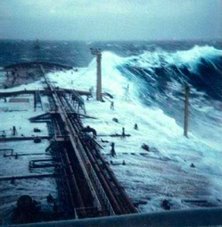
Rogue waves as high as a 10-story building have been offered as an explanation for the disappearance of ships as big as an ocean liner, despite the lack of survivors to tell the tale. Recently, remote sensors set up in the oceans of the world have confirmed that single rogue waves as tall as 100 feet occur more frequently than Gaussian statistics can explain. For the first time EEs have generated rogue waves in optical fibers and have confirmed the mechanism that generates them, which they say can occur in other media too, including the ocean.

"Rogue waves are an apparently random phenomenon that is seeded by noise," said lead investigator on the project Daniel Solli, a researcher at the University of California at Los Angeles (UCLA) Henry Samueli School of Engineering and Applied Science. "We have shown that noise with the correct properties can foster the generation of one of these rogue waves."

According to Solli and Bahram Jalali, a UCLA professor of electrical engineering and the research group leader, rogue waves are analogous to the butterfly effect, a phenomenon in which, under the right initial conditions, a butterfly flapping its wings can cause a hurricane. Of course, these initial conditions are exceedingly rare, but the bottom line for the butterfly effect, according to Solli and Jalali, is that weather is very sensitive to initial conditions, as is the generation of rogue waves.

"Like the weather, these rogue waves appear to be extremely sensitive to initial conditions," said Solli. "It is still a deterministic system, but one that is very difficult to predict, because a very, very minute change in initial conditions can have a dramatic impact on the result."

Researchers studying a microstructured optical fiber near the threshold of soliton-based supercontinuum generation observed the generation of rogue waves in the optical fiber, and they began modeling the mechanism. As a result, the researchers have now characterized the proper initial conditions for generating rogue waves in any medium.

"We show that a particular set of initial conditions are responsible for generating rogue waves," said Solli. "In our experiment we discovered that we were getting some rare events that were far larger than any of the neighboring pulses, and that led us to explore this connection between this phenomenon and the oceanic phenomenon which has a very similar kind of effect."

According to the researchers, rogue waves follow "L-shaped" statistics, as opposed to the more common Gaussian statistics. This accounts for the seemingly out-of-bounds size of rogue waves: in L-shaped distributions the heights of most waves are tightly clustered together, but large outliers also occur. Now Jalali's team is working on a more detailed model for the U.S. Department of Defense, which is aiming to harness the effect for military applications.

"The next step is learning how to engineer this phenomenon, because there must be some useful applications out there, if only we could predictably engineer the outcome of this event, which occurs very rarely now," said Jalali.

Other member of Jalali's team include UCLA engineering researchers Claus Ropers and Prakash Koonath. Funding is being provided by the U.S. Department of Defense and the Defense Advanced Research Projects Agency (DARPA)

Tropical Storm Olga

Seems like Tropical Storm Olga has made her stake in weather history as reported by Arthur Rabjohn CEM, Director Steelhenge Consulting Ltd.
www.steelhenge.co.uk

CARIBBEAN: Caribbean storm death toll rises

People were swept away in Santiago when flood waters were released The toll in the Caribbean from Tropical Storm Olga, a rare December cyclone, has risen to at least 38 confirmed deaths, officials say. Hardest hit was the Dominican Republic, where at least 35 people have been killed by floods and landslides. The death toll rose again on Friday after the bodies of 12 immigrants from neighbouring Haiti were discovered in Castanuelas, a town near the border. The UN has urgently appealed for $4m (£2m) to help the many left homeless.

National Hurricane Center Reports

NHC releases 2007 seasonal summaryNOAA also releases seasonal report


On the maritime front..

The main feature story of this blog has been the rescue of the s/v Sean Seamour II, that I have focused on is about to make news again. The USCG helicopter crew that rescued the three sailors from their potential watery graves during subtropical storm Andrea this past May are about to get decorated for heroism on December 19 at USCG Air Station Elizabeth City. I will have more as soon as the new medals are placed on their salad bars.


Swimmer Drew Dazzo in the helicopter resting before being evacuated with us to Cherry Point Military hospital for injuries sustained during our rescue, AC Lt. Comdr. Nevada Smith supervising the transfer while coordinating with operations.


KAB 101

Here is a shot many of you may not have seen of the KAB 101 incident
that we reported about back on October 29th and 30th. when reported large waves struck Mexico state-owned drilling platform Usumacinta which slammed into the Kab 101 Light-Production Rig on Oct. 24, killing 21 people.


On the weather lighter side....

If global warming, greenhouse effects, jet stream changes or just plain lousy winter weather or any lousy weather for that matter does not confuse you enough? Let's just add good ole Pat Robinson to the equation. The bad weather we are having is because?


RS

Tuesday, December 4, 2007

NOAA Service Assessment on Enterprise Tornado Demonstrates Need to Build Hazard Resilient Communities

Yep been kind of busy lately so my postings have been hit and miss. I will return to normal posting shortly.

In the meantime there has been a lot of talk about building better tornado shelters and resilient communities for areas prone to tornado's.

We already have both State and Federal legislation mandating WXRadio's for all new modular buildings. But without the proper emergency planning along with shelters and or resilient buildings that can with stand some form of tornado strike. We have a half hearted law, although no warnings are worse than some warnings.

NOAA Service Assessment on Enterprise Tornado Demonstrates Need to Build Hazard Resilient Communities

November 29, 2007

Enterprise (Ala.) High School officials and students followed appropriate safety measures prior to and during the March 1 tornado outbreak which killed eight students, but the event further demonstrated the need for such facilities to have hardened safe rooms, according to a NOAA National Weather Service assessment released today. The eight students were killed as a concrete wall collapsed onto them while seeking shelter from the EF4 tornado.

“The tragic events of March 1 show that even when people have ample time and opportunity to take cover from a devastating tornado, the need for proper shelter is imperative,” said retired Navy Vice Adm. Conrad C. Lautenbacher, Ph.D., under secretary of commerce for oceans and atmosphere, and NOAA administrator. “Despite warning lead times that exceeded national standards, 19 lives were lost. Our team concluded that survival in violent tornadoes often depends on reaching an adequate hardened safe room.”

In addition to the eight student fatalities in Enterprise, an additional six people died in a mobile home park near Newton, Ga., and five others in Alabama and Georgia.

A total of 31 verified tornadoes struck 45 counties in Georgia and southern Alabama, including 13 strong or violent tornadoes (EF2 or greater on the Enhanced Fujita Scale). The deadliest was the EF4 in Enterprise.

Hardened safe rooms, lined and topped with concrete and without windows, are designed to withstand severe sustained winds and wind gusts. However, these interior safe rooms are not practical for mobile homes, which often move off their foundation during extreme winds. The team concluded that a necessary component for tornado safety in a trailer park is a hardened safe room easily accessed and shared by the community.

Risk of fatality in a mobile home is 15 to 20 times greater than for those in permanent structures. Only seven percent of U.S. residents live in mobile homes, yet this is where around 50 percent of tornado fatalities occur. However, even permanent structures are at risk in tornadoes rated EF3 or higher.

“We saw permanent structures completely removed from their foundations during the March 1 outbreak,” said Glenn Lussky, meteorologist-in-charge of the National Weather Service office in La Crosse, Wis., and team lead for the service assessment. “Hardened safe rooms are essential for tornado safety. This is perhaps the only thing that could have made a difference for the students in Enterprise.”

At the time of the deadly outbreak, school officials were criticized for not releasing the students prior to or during the outbreak. Students and staff at Enterprise High School sheltered in place for two and half hours.

“Dismissing the students could have been just as dangerous,” said Lussky. “Tornado warnings were in place the entire time, and the team agreed that shelter in place was the best response.”

Since the Enterprise tornado outbreak, the National Weather Service has moved from a county-based system of warnings to a more geographically specific storm-based warning system. The new storm-based warnings provide more precise information about the location of severe weather and the direction it is expected to move.

Testing revealed that storm-based warnings would have reduced the warning coverage area by 58.4 percent. Nevertheless, the high school and the town of Enterprise would have been under a warning for the same amount of time.

“Three successive supercell thunderstorms moved over or near Enterprise during that time,” said Lussky. “We believe the warnings and response would have been the same under storm-based warnings. This is just one of those cases where everyone did everything they could. The only thing left is the hardened safe room.”

The National Oceanic and Atmospheric Administration, an agency of the U.S. Commerce Department, is celebrating 200 years of science and service to the nation. From the establishment of the Survey of the Coast in 1807 by Thomas Jefferson to the formation of the Weather Bureau and the Commission of Fish and Fisheries in the 1870s, much of America's scientific heritage is rooted in NOAA.

NOAA is dedicated to enhancing economic security and national safety through the prediction and research of weather and climate-related events and information service delivery for transportation, and by providing environmental stewardship of our nation's coastal and marine resources. Through the emerging Global Earth Observation System of Systems (GEOSS), NOAA is working with its federal partners, more than 70 countries and the European Commission to develop a global monitoring network that is as integrated as the planet it observes, predicts and protects.

The service assessment “Tornadoes in Southern Alabama and Georgia on March 1, 2007” is available online.

WEATHER NOTE

NOAA Service Assessment - Tornado's in Alabama and Georgia, March 1, 2007


MARITIME NOTES
From CargoLaw

80-ton French F/V Monbijou, with six crew, ran into difficulties in stormy weather and took on water in the English Channel off Dungness, on the French side of the Channel, on Nov. 30. One fisherman missing and feared dead. The vessel is semi-submerged and is expected to sink shortly as continuing stormy weather is preventing immediate salvage efforts. Pollution risk considered minimal. From our Sr. Correspondent Tim Schwabedissen (Sun. Dec. 2 2007)

80-ton French F/V Monbijou, with six crew, ran into difficulties in stormy weather and took on water in the English Channel off Dungness, on the French side of the Channel, on Nov. 30. One fisherman missing and feared dead. The vessel is semi-submerged and is expected to sink shortly as continuing stormy weather is preventing immediate salvage efforts. Pollution risk considered minimal. From our Sr. Correspondent Tim Schwabedissen (Sun. Dec. 2 2007)

350-ft freight M/V RSCL Express, loaded with 4,300 tons of wood pulp, sustained damage during storm and required Coast Guard assistance on Nov. 29 approximately 150 miles southeast of Cape Cod. The vessel incurred two 15-centimeter holes in its hull approximately 10 feet above the waterline, which were caused by the anchor striking the hull during severe weather. The Coast Guard deployed 210-ft cutter Dependable, which escorted the damaged vessel to port in Boston for inspection and repair. From our Sr. Correspondent Tim Schwabedissen (Sun. Dec. 2 2007)


RS


Saturday, December 1, 2007

US Coast Guard HH-60 crew receives award for May 7th rescue

Its confirmed, on December 19th the four US Coast Guard HH-60 crew members will receive awards for the extraordinary rescue of the crew of s/v Sean Seamour II last May 7th.

The vessel caught in a sub-tropical depression subsequently named Andrea, was further battered by a rogue wave estimated above 100 feet approximately 200 miles off Cape Hatteras North Carolina.
rom left to right, swimmer Drew Dazzo who in extraordinary circumstances managed to bring us to safety, Petty Officer Scott Higgins who saved the day bringing all aboard with a frayed cable (so reminiscent of the end of Kevin Costner' film "The Guardian"), "steel nerves" Lt. j.g. Aaron Nelson who followed the fleeting sea-anchorless life-raft in winds over 70kts, and finally, Lt. Comdr. Nevada Smith who took upon himself to undertake this rescue in perilous operational conditions (for those who may have seen Kevin Costner's "The Guardian", he played the role of co-pilot Krausse). Swimmer Drew Dazzo in the helicopter resting before being evacuated with us to Cherry Point Military hospital for injuries sustained during our rescue, Lt. Comdr. Nevada Smith supervising our transfer while coordinating with operations. It is difficult to find words of appreciation, even so many months later, for the commitment of these heroes as there is no doubt failing them we would not be here to extol their dedication. Neither should we forget the C130 crew who miraculously found us among the seventy foot waves,but also the three ambulance teams, three hospital teams and the commander of Cherry Point Military Hospital who mobilized the disaster relief of the American Red Cross to help us through this crisis. Finally, a moment of silence in remembrance of the crew of s/v Flying Colors that dissapeared eighty miles off our starborard, Captain Trey Topping, Rhiannon Borisoff, Jason Franks and Christine Grinavic, likely pitchpoled by the same rogue wave amplified by their closer proximity to the Gulf Stream.


Robin Storm previous s/v Sean Seamour II posts:

Summary of Action for CG6014 for the S/V SEAN SEAMOUR II- REDUX - Plus
WebExclusive EPIRBs and the s/v Sean Seamour II - Part III

WebExclusive EPIRBs and the s/v Sean Seamour II - Part II
EPIRBs and the s/v Sean Seamour II
NHC Report on Subtropical Storm Andrea
Cheating Death On The High Seas
The s/v Sean Seamour II & The Hatteras Trench
High Sea's Update On Sean Seamour II
The Story of the Sailing Vessel Sean Seamour II

gCaptain previous s/v Sean Seamour II posts:
gCaptain Exclusive - Sailing in Severe Weather
Lessons Learned


WEATHER NOTE:

CHICAGO - S N O W!

Thanks Jean!

RS

Thursday, November 29, 2007

2007 Tornado Fatality Information

Lydia LALady Lake FLPaisley/DeLand FLGentilly LA3 SW Caulfield MOMillers Ferry ALEnterprise ALPotterville GANorth Newton GAAmericus GA6 SE Clovis NM2 E Elmwood OKHolly CO13 SSW Canadian TXHaltom City TX4 E Mulberry SCEagle Pass TXGreensburg KSHopewell KS2 SSE Macksville KS3 S Bennington KSNorthwood NDParis MOKalkaska MIWilliamston MI
All times are CST.
NOTE: Tornado related fatalities are entered once confirmed by NWS Weather Forecast Offices.
Num Date Time Location Deaths F Watch

January Killer Tornadoes: 1 Fatalities: 2
01 Jan 4 03:45 PM Lydia LA 2 F1 WT001
Three mobile homes flipped over trapping seven people...at least five brick homes received major damage.

February Killer Tornadoes: 3 Fatalities: 22
02 Feb 2 02:15 AM Lady Lake FL 8 F3 WT015
Mobile homes completely destroyed.
03 Feb 2 02:45 AM Paisley/DeLand FL 13 F3 WT015
Complete destruction of mobile homes.
04 Feb 13 03:10 AM Gentilly LA 1 F2 WT018
Several homes damaged...trailers and a hotel destroyed.

March Killer Tornadoes: 10 Fatalities: 27
05 Mar 1 06:33 AM 3 SW Caulfield MO 1 F3 WT042
Damage reported to two gas stations, four mobile homes and two frame homes.
06 Mar 1 12:30 PM Millers Ferry AL 1 F4 WT044
Manufactured home destroyed.
07 Mar 1 01:05 PM Enterprise AL 9 F4 WT046
High School severely damaged.
08 Mar 1 04:35 PM Potterville GA 1 F2 WT046
Heaviest damage southwest of Potterville.
09 Mar 1 06:30 PM North Newton GA 6 F2 WT046
Mobile homes damaged.
10 Mar 1 08:22 PM Americus GA 2 F2 WT046
Significant damage to homes and hospital.
11 Mar 23 07:54 PM 6 SE Clovis NM 2 F2 WT070
Mobile home rolled.
12 Mar 28 07:30 PM 2 E Elmwood OK 2 F2 WT082
House and shed totally destroyed.
13 Mar 28 08:00 PM Holly CO 2 F3
Large tornado destroyed mobile home.
14 Mar 28 09:50 PM 13 SSW Canadian TX 1 F3 WT082
Trailer destroyed.

April Killer Tornadoes: 3 Fatalities: 9
15 Apr 13 06:10 PM Haltom City TX 1 F1 WT135
Damage to grocery store, several homes and a church steeple.
16 Apr 15 06:37 AM 4 E Mulberry SC 1 F3 WT145
Destroyed several mobile homes.
17 Apr 24 07:01 PM Eagle Pass TX 7 F3 WT179
An elementary school destroyed and a number of mobile homes damaged.

May Killer Tornadoes: 4 Fatalities: 13
18 May 4 08:45 PM Greensburg KS 10 F5 WT227
Large tornado, much of torn damaged or destroyed.
19 May 4 09:33 PM Hopewell KS 1 F3 WT227
Two houses destroyed...sheriff dies of injuries sustained when patrol car was damaged by tornado.
20 May 4 10:35 PM 2 SSE Macksville KS 1 F3 WT227
Several homes damaged or destroyed.
21 May 5 10:30 PM 3 S Bennington KS 1 F2 WT235
Woman killed when camper was damaged by tornado.

August Killer Tornadoes: 1 Fatalities: 1
22 Aug 26 07:45 PM Northwood ND 1 F4 WT653
One male fatality in mobile home. Significant damage to town of Northwood.

October Killer Tornadoes: 3 Fatalities: 5
23 Oct 17 11:05 PM Paris MO 2 F2 WT714
Mobile home tossed 1/3rd mile into field.
24 Oct 18 07:35 PM Kalkaska MI 1 F2 WT724
Considerable property damage.
25 Oct 18 08:45 PM Williamston MI 2 F2 WT724
Modular home with two occupants flipped into a pond.

StateKiller TorFatalities
FL 2 21
KS 4 13
AL 2 10
GA 3 9
TX 3 9
MO 2 3
LA 2 3
MI 2 3
NM 1 2
OK 1 2
CO 1 2
ND 1 1
SC 1 1
TOTAL 25 79
F ScaleKiller TorFatalities
F0 0 0
F1 2 3
F2 10 20
F3 9 35
F4 3 11
F5 1 10
F? 0 0
TOTAL 25 79
CircumstanceFatalities
Mobile Home 52
Permanent Home 15
Vehicle 1
Business 10
Outside/Open 1
TOTAL 79

Top/Climatological Data/Home

Updated: Sunday Oct 21, 2007 12:32 AM

Tuesday, November 27, 2007

Survivors tell of Bangladesh cyclone horror

By Pavel Rahman

Barguna - Azahar Ali was huddled with his family, reading from the Qur'an, when the cyclone roared in from the sea. First the power went out, then screaming winds blew out the windows and ripped off the roof. Then the sea rushed in, washing them away.

"I have lost everything," the 80-year-old man said on Monday recounting how he awoke in a rice paddy to find eight relatives - including his son, daughter-in-law and three grandchildren - dead, among the thousands of people killed when the cyclone hit Bangladesh.

Details of the devastation and the stories of the survivors are now beginning to emerge as rescuers reached areas cut off because of washed-out roads and downed telephone lines.

'The monster waves swept her away from me'
At least 3 113 people were killed and more than 1 000 are still missing after Cyclone Sidr struck on Thursday, said Lieutenant Colonel Main Ullah Chowdhury, an army spokesperson. But there were fears the toll could be much higher.

On Monday, in the village of Parulkhel, residents and rescuers used bamboo poles to prod flooded fields, looking for submerged bodies. Finding a woman's corpse, others rushed in with sacks and plastic sheeting to help lift it out. Onlookers gathered, and one weeping man identified her as his mother.

"Some were identified and taken away by relatives, we buried dozens of others near where we found them," said Ali Akbar, a volunteer.

Others sifted through the remains of the village - a chaotic jumble of mud and debris from the wood, bamboo and corrugated iron homes, fallen trees and bloated animal carcasses - looking for things to salvage. A rotten stench filled the air.

In the neighbouring village of Bainsamarta, Sheikh Mubarak, 40, sat among the ruins of his hut weeping for his 12-year-old daughter.

'Just before midnight the winds came like hundreds of demons'
"As our house was washed away by walls of water, I grabbed my daughter and ran for shelter. The monster waves swept her away from me," he said. "Allah should have taken me instead."

Survivors said many of the deaths could have been prevented but people failed to heed warnings to move to higher ground.

"Nothing is going to happen. That was our first thought and we went to bed," said Dhalan Mridha, a 45-year-old farm worker from the village of Galachipa.

"Just before midnight the winds came like hundreds of demons. Our small hut was swept away like a piece of paper, and we all ran for shelter," he said.

Meanwhile, the government and relief agencies stepped up efforts to get help to the devastated areas.

Army helicopters airlifted high-protein cookies supplied by the World Food Program, said Emamul Haque, a spokesperson for the WFP office in Bangladesh's capital, Dhaka, which is coordinating international relief efforts.

International aid organisations promised initial packages of $25-million (about R169-million) during a meeting with Bangladesh agencies on Monday, Haque said.

But relief items such as tents, rice and water have been slow to reach many.

In the town of Barguna long lines of anxious people formed at the market, waiting for word that help was on the way.

"We have been waiting here for several hours, but no relief," said Uthan Ching, who left clutching a still-empty plastic bag.

Government officials defended the relief efforts and expressed confidence that authorities are up to the task.

"We have enough food and water," said Shahidul Islam, the top official in Bagerhat, a battered district near the town of Barguna. "We are going to overcome the problem."

Some, though, predicted things could become even worse.

The Bangladesh Red Crescent Society, the Islamic equivalent of the Red Cross, warned the toll could hit 10 000 once rescuers reach outlying islands.

UN Secretary-General Ban Ki-moon said in a statement that several million dollars were available from the UN's emergency response funds, depending on the need.

Many foreign governments and international groups have also pledged to help.

The United States offered $2,1-million and two US Marine Corp. transport planes have arrived in Dhaka with medical supplies, said Chowdhury, the army spokesman

An American military medical team is already in Bangladesh and two US naval ships, each carrying at least 20 helicopters, among tons of other supplies, will be made available if the Bangladesh government requests them, Secretary of State Condoleezza Rice said in a statement.

Other governments and organisations that pledged aid include the German government, which offered about $730 000, the European Union with $2,2-million, and the British government with $5,1-million. France pledged about $730 000, Japan sent $318 000 in relief supplies, Italy's Roman Catholic bishops' conference said it was donating $2,9-million, while the Philippines said it would send a medical team.

Every year, storms batter Bangladesh, a country of 150 million, often killing large numbers of people. The most deadly recent storm was a tornado that levelled 80 villages in northern Bangladesh in 1996, killing 621 people. - Sapa-AP

MARITIME NOTES
UPDATE ON THISTLE ALPHA


Thistle Alpha


Petrofac, as duty holder of the Thistle Alpha installation on behalf of Lundin Britain Limited, can confirm that following the incident this morning, 116 non essential personnel have been down manned to the nearby Murchison and Dunlin platforms.

There were originally 159 personnel on board and 43 personnel remain on the platform. All are safe and well.

A fire was reported on the platform at 08.07 on November 25th in the turbine module and was confirmed extinguished at 10:00 am.

All relevant authorities have been notified. A full investigation as to the cause of the fire is underway.

The Thistle Alpha installation is located approximately 523 km (325 miles) north north east of Aberdeen and comprises a steel jacket supporting a three deck platform, accommodation and helideck.

Maria Hamilton, a spokesperson for Lundin Petroleum, said total oil production of the Thistle Alpha platform is 5,000 barrels a day. A spokesman at Petrofac also confirmed production at the platform has stopped completely.


UPDATE ON EXPLORER FROM CARGOLAW

From The Cargo Letter - Nov. 23 2007 -Tragedy Off Antarctica

ALERT>>>2400 gt passenger M/V Explorer (built 1969) ran into trouble about 0524 GMT Nov. 23, near King George Island in the Antarctic Ocean began sinking after she hit ice, near the South Shetland Islands. About 100 passengers & 54 crew members have been evacuated and are in lifeboats. Capt. the Chief Officer remained on board the vessel until everyone was evacuated. The vessel is owned by Toronto-based GAP Adventures. M/V Explorer hit a lump of ice off King George Island this morning and the impact left the vessel with a crack in the hull the size of a fist. Weather conditions were "fairly good" for this time of year, but it would be cold. Liner about to sink. The vessel had a 30 degree list. A rescue operation is being co-ordinated by the U.S. Coast Guard in Norfolk, Virginia, with the authorities in Ushuaia, Argentina. M/V Antarctic Dream, which is in the area, has been diverted to help the rescue. GAP Adventures said 23 Britons, 17 Dutch, 10 Australians, 13 Americans & 10 Canadians were among the passengers -- remaining nationalities of the rescued tourists are Irish, Danish, Swiss, Belgian, Japanese, French, German & Chinese. M/V Explorer was the 1st custom-built expedition ship -- known as the 'Little Red Ship' to aficionado, she became the first passenger vessel to navigate the North West passage in 1984 and was involved in rescue of crew from Argentine cargo vessel off Anvers Island, Antarctica, in 1989. From our Sr. Correspondent Tim Schwabedissen and our Correspondent A. Griffiths (Fri. Nov. 23 2007 am)


RS

Monday, November 26, 2007

Disasters Getting Worse -- US Government Must Be Better Prepared, Report Urge

ScienceDaily (Nov. 12, 2007)

Disasters are getting worse it seems but the federal government's preparedness has been limited to helping after a disaster has occurred. On the other hand, local organizations often do not have the resources or the training to effectively react.

Federal and state support must now be given to programs that enable local governments to work effectively with communities to prepare for and respond to all disasters. That is the conclusion of a new analysis in the International Journal of Emergency Management.

Colin Falato, Susan Smith, and Tyler Kress of the Health and Safety Programs at the University of Tennessee, have looked at the preparedness of local and federal governments in their response to natural and human-induced disasters and found them seriously lacking. They suggest that it should be the responsibility of local government officials as well as citizens to work together to adapt the disaster-response programs to suit communities' needs.

Historically, the belief that local knowledge and experience is best suited to dealing with common natural disasters, such as hurricanes, tornados and floods, has meant that responsibility for disaster preparedness and response has been devolved to local organizations and communities themselves. Federal government intervention has been limited to assistance after the disaster. The same is true for other natural, civil, technological, and ecological disasters, the researchers explain.

In the last 25 years, the researchers point out, the continental USA has issued almost 1000 disaster declarations (902) and been subjected to 442 natural disasters. Among these natural disasters are hurricanes, fires, windstorms, earthquakes, tornados and floods. But, disasters are not limited to natural events.

September 11, 2001 refocused the country's attention on disaster preparedness and the realization that there was a lack of preparedness for such disasters. One effect of the 9/11 Commission was to mould two new organizations charged with the responsibility of protecting the USA from a new era of technological disasters. The US Northern Command (NORTHCOM) is the military arm responsible for homeland defense and the US Department of Homeland Security, which leads a unified national effort to secure the USA from potential terrorist attacks.

Four directorates were brought together from Homeland Security, including the Emergency Preparedness and Response Directorate, which includes FEMA, and is tasked with domestic disaster preparedness training to help families make their homes safer from disasters of all kinds. This is similar in aims to the CitizenCorps developed by NORTHCOM. These initiatives are already having an impact on response capacity and equipment availability for certain communities in the USA. However, the rapid response required of a national disaster situation involves training local elected officials in every community to take control in a disaster situation.

The recent focus of US disaster funding has focused on terrorist events, but the benefits from this technological disaster preparedness orientation should crossover to natural disaster preparedness, the researchers suggest. In the US fledgling agencies are only now beginning to find their niche in the comprehensive overview of emergency management and the benefits they will be able to provide to communities have not been fully realized.

"It is the responsibility of the local governments to encourage the participation in disaster exercises and planning, and they must demonstrate a commitment to community disaster preparedness," the researchers say, "When these roles are met head on, then local communities within the USA will truly be better prepared when a local or national disaster, natural or technological occurs."

MARITIME NOTES
UPDATE ON THE BUSAN SPILL

USCG – finding answers to the COSCO BUSAN oil spill

The US Coast Guard released a statement from Admiral Thad Allen, Commandant, regarding the agency’s efforts to determine exactly what happened with regard to the allision of the container ship COSCO BUSAN with a pier of the San Francisco-Oakland Bay Bridge and the response to the subsequent oil spill. (11/16/07).

Hearing on San Francisco Bay oil spill

On November 19, the Subcommittee on Coast Guard and Maritime Transportation of the House Committee on Transportation and Infrastructure conducted a field hearing on the San Francisco November 2007 Oil Spill Causes and Response. As noted in the Summary of Subject Matter, the November 7 incident resulted in a spill of approximately 58,000 gallons of bunker fuel. Mayor Gavin Newsome of the City of San Francisco testified concerning his perception of the lack of coordination during the initial spill response. Rear Admiral Craig Bone, USCG, testified concerning the difficulty in quickly determining the volume of oil spilled and in the ongoing efforts of the Unified Command to keep other stakeholders advised on the situation. Dr. William Conner, National Ocean Service, explained the support his agency provided to the Unified Command. Mr. Mike Chrisman, California Resources Agency, stated that the response was immediate and consistent with approved guidelines. Mr. David Lewis, Save the Bay Association, testified concerning the need to assess the environmental damage and begin the remediation and restoration efforts. Mr. W. F. Grader, Pacific Coast Federation of Fishermen’s Associations, explained the difficulty his members faced when they volunteered to assist in the response effort. Captain Thomas Hand, San Francisco Bar Pilot, explained the training program and oversight mechanism of the Bar Pilots. (11/19/07).

RS


Friday, November 23, 2007

Sneaker or Freak Waves?

British hero father and son, 5, die after being hit by freak wave in Spain

My good friend and expert on freak waves PC Liu has more on this story!

Terror unfolded along the Spanish coastline this morning as a British holidaymaker and his five-year-old son drowned in a freak accident in front of their family.

The man, whose surname is Howlet, died after jumping into the sea to save his two children after they were swept into the water by a wave as they photographed the stormy waves along the coast.

Mr Howlet, 32, managed to pull his older child, a seven-year-old, to safety but drowned along with his younger son before he could reach the shore. His wife witnessed the tragedy from a few feet away but was helpless to save them.

Their bodies were later pulled from the ocean after being spotted by a coastguard helicopter.

Scroll down for more ...

Tragedy: The Spanish resort of Tossa de Mar, where the boy and his father drowned

A diver has told how he tried desperately to save the pair as they drowned off the Spanish resort of Tossa de Mar.

Argentine Ezequiel Mizrahi, 38, who runs a nearby diving centre, said: "The father was taking photos of his two sons on rocks right next to the sea when a wave knocked them off balance and swept them into the water.

"I raced to get my wet suit when I saw what had happened and by the time I got back local police were already on the scene.

"The father had managed to get one of his sons to safety but the current was taking him and his younger son further and further out.

"I tried to get across the breaking waves to reach them with the help of a rope the police gave me but it was impossible.

"Every time I tried the sea just sucked me under and threw me back onto the sand.

"The first time I attempted to reach them I could see the pair's faces. They were not shouting and were just struggling to keep their heads above water.

"Then I lost sight of them. By the seventh or eighth time of trying the police told me to give up.

"I didn't see the boys' mum in all the chaos but she was around and so apparently was their grandma.

"The local police reached the scene so quickly because a local politician had been walking nearby and alerted them on his mobile."

The tragedy happened around 11am local time this morning at a beach in the resort of Tossa de Mar near Girona in north east Spain.

Coastguards pulled their bodies out of the sea after a firefighters' helicopter located them floating in the water by a nearby lighthouse.

The dead man's wife and surviving child were being treated in hospital. The woman is thought to be suffering from shock.

A local hotel worker told how he had seen the two children at the centre of this morning's tragedy playing on the beach minutes before they were swept into the sea.

The man, who asked not to be named, said: "I drove by in my van about 15 minutes before it happened and saw them playing on the rocks by the water.

"The sea was pretty stormy, the waves were about two to three metres high and I thought it was a bit risky for the children to be there.

"It was definitely red flag-type conditions. I didn't see the parents anywhere.

"The place where it happened is near a beauty spot which overlooks the bay but there's no buildings nearby.

"We've been told a freak wave dragged both youngsters into the sea and their father died along with his younger son as he tried to save them both."

The diver Ezequiel added: "The sea was pretty stormy and there was a strong wind. The spray from the waves must have been reaching the ten-metre mark.

"The rocks are a lovely place to take a photo but not in the weather conditions at the time.

"Every so often three or four big waves would come along and they made the area where the family was very dangerous."

A spokesman for Spain's Civil Guard in Girona, which is probing the incident, said: "The father died after jumping into the sea to rescue his sons when they lost their footing on the rocks.

"He managed to rescue one but died after going back in for the other."

Tossa de Mar, around 20 miles south of Girona, is far removed from brasher resorts in the area like Lloret de Mar.

It is popular with families and couples. Mar Menuda where the tragedy happened is popular with scuba divers in the summer because of its clear waters.

A police spokesman said: "What we understand happened is that the father died as he tried to rescue his two children after they swept into the sea by waves.

"He managed to pull the older one to safety but died as he tried to rescue the younger one.

"The children's mother was on the shoreline and witnessed the tragedy unfolding.

"Coastguards pulled the two bodies out of the water."

A spokesman for local coastguards added: "There was a strong force seven to eight wind in the area at the time and the sea was pretty choppy with waves several feet high.

"The bodies were located at a lighthouse the other side of the bay from where the incident happened.

"One of our vessels retrieved the bodies after being guided to the area by a firefighter's helicopter."

The sandy beach where the tragedy happened, a sandy cove known as Mar Menuda, is thought to have been deserted at the time because of the bad weather.

Authorities have not yet disclosed the family's name.

Heavy rains meanwhile hit southern Spain, with more than 1,000 homes partly under water in Utrera near Seville. Dozens of people were evacuated.

In nearby Ecija, the River Genil was about to overflow its banks.

Today's deaths follow the drownings of three British holidaymakers in the Algarve this summer.

Robert and Deborah Fry, from Wootton Bassett, Wiltshire, dived into rough waters in a desperate attempt to save four youngsters during a half-term holiday.

They, along with friend and fellow holidaymaker Jean Dinsmore, also from Wootton Bassett, died in the ill-fated rescue bid off Praia do Tonel beach near Sagres on October 22.

The Frys' children, Rosie, 11, and George, nine, and Mrs Dinsmore's husband Roy, daughter Lydia, 11, and son Alexander, nine, survived the tragedy

WEATHER NOTE

THE PHILIPPINES: The Philippines is getting ready to evacuate 100,000 people from coastal areas in the central Bicol region as typhoon Mitag gathers strength and approaches. Recent rains have already saturated the ground around Mayon volcano in Bicol, this is why about 10,000 people have already been evacuated from its slopes. People were warned of possible flashfloods and rain-induced landslides. There is a risk of coastal villages being slammed by big waves up to 10 meters. Mitag, is currently a category 1 typhoon with winds of 120 km/h and gusts of up to 150 km/h, and if it doesn't change direction, it is expected to make landfall by Saturday.

UPDATE COSCO BUSAN
Cosco Busan Oil Trajectory Map


MARITIME NOTES
Iceberg smash sinks cruiseliner

The image “http://img.thesun.co.uk/multimedia/archive/00393/explorer_682_393764a.jpg” cannot be displayed, because it contains errors.

MORE than 20 British passengers are among 154 people forced to abandon a cruiseliner sinking in the Antarctic Ocean.

The captain and first officer gave the order to leave the MV Explorer after it was holed by an iceberg. They were the only men to remain on board.

A Foreign Office spokesman said: "We have not had any reports of anyone seriously injured. We are in contact with all the relevant authorities. STORY


RS

Wednesday, November 21, 2007

HAPPY THANKSGIVING!


From us at Robin Storm to all of our readers!

Remember those who are separated from their loved ones.

Those who are serving abroad in our armed forces.

Those who serve with the maritime service.

Those who bring us our weather reports.

And those who do not have what we all have today!


God Bless!

Monster waves less of a threat with smart radar

Monster waves less of a threat with smart radar

12:55 21 November 2007

NewScientist.com news service By Paul Marks

(Left - A new algorithm produces a more accurate video image of ocean surface elevations across a broad area (Image: University of Alcalá)

Waves the size of 10-storey buildings that rear up suddenly from an apparently benign sea are the stuff of sailor's nightmares. Such "rogue waves" can sink a ship or damage an off-shore platform, but a new radar early warning system could give crews a fighting chance to either evade the waves, or at least batten down the hatches.

Ocean Waves, a German maritime radar company, and radar expert Jose Nieto of the University of Alcalá in Spain, have developed a technology that promises to identify large waves. Details of the system were presented at a conference on wave forecasting held in Oahu, Hawaii, last week.

They developed software that makes sense of the radar measurements of a tumbling, frothy ocean surface, from an instrument fixed to the deck of a ship or the side of a platform.

"The reflected radar picture from the wave does not depend entirely on the wave's height, but also on other factors like the local wind speed, sea-surface roughness, and the wave inclination," Nieto says.

The new algorithm filters out these noisy parameters and produces a more accurate video image of ocean surface elevations across a broad area (see image, top right).

Mariners' tales

For centuries mariners have told tales of sudden monster waves. But because they occur only rarely – and fleetingly at that – their existence has been hard to confirm. One sign that they do exist is the inexplicable loss of enormous vessels at sea.

The Derbyshire, for instance, a 295-metre British bulk carrier, disappeared with all 44 crewmembers of the coast of Japan in 1980. An inquiry carried out in 2000 concluded that a rogue wave most probably cracked open the vessel's main cargo hatch, flooding the hold.

Then, in February 2001, two cruise ships, the Bremen and the Caledonian Star, were seriously battered by separate 30-metre-tall waves in the South Atlantic.

By chance, the waves that did the damage were roughly measured by two European Space Agency (ESA) satellites – ERS-1 and ERS-2 – that were using radar instruments to monitor sea-surface levels and happened to be passing over the area in question.

Early warning

With definitive proof that giant, freak waves do exist, research began in earnest on the developing a warning system for ships and offshore platforms – to give sailors and workers a chance to prepare for the deluge.

Tests carried out so far on ships in the North Sea and off the Spanish coast are promising, says Nieto. The algorithm detected groups of waves between 8 and 15 metres high up to 3 kilometres away. And, with changes to radar signal wavelengths, he thinks it should do even better.

Proving that the technology will spot rogue waves will be tricky, though. "A giant wave is a special case of the groups of waves we are successfully detecting now – but it would be a single mountain of water," says Jens Dannenberg, a physicist at Ocean Waves.

"It should do the job – but it's hard to prove when you do not have such a monster wave to test it on," he adds.


RS