Monday, August 20, 2007

Update Hurricane Dean & Hurricane History

According to RSOE Emergency and Disaster Information Service

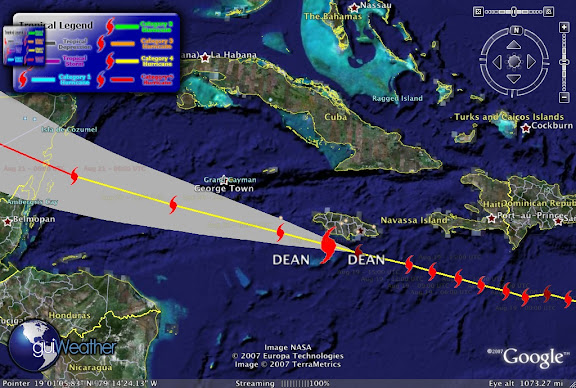
"Fiercely powerful Hurricane Dean strafed Jamaica's southern coast on Sunday, littering the capital of Kingston with fallen trees and windblown roofs after killing six people earlier on its run through the Caribbean. Dean was an "extremely dangerous" Category 4 hurricane, the second-highest on the five-step Saffir-Simpson scale, and could become a potentially catastrophic Category 5 near Mexico's Yucatan Peninsula, the U.S. National Hurricane Center said.

Jamaica's government declared a 48-hour curfew and the power company switched off electricity as the wind began to howl and pounding waves battered the southern coast. Sheets of rain pelted Kingston and streets were blocked by toppled trees and utility poles. Dean ripped off several roofs and a man was missing after falling trees tore into his house. "The dead center of the eye is south of Jamaica by a few miles. But the center is close enough to Jamaica that they are likely getting hurricane-force winds along the southern coast," said Richard Knabb, a storm expert at the hurricane center. Mudslides were reported in several parts of the mountainous country of 3 million people.


Local media reported 17 fishermen and women had been stranded ahead of the storm on the Pedro Cays, a small island chain in the open sea about 50 miles (80 km) south of Kingston, directly in the path of the hurricane. They were told to break into a coast guard building for shelter but officials did not know if they had done that. The government had urged residents to go to shelters. But many people, including those in one low-lying seaport town close to Kingston, refused to flee. "We are going nowhere," Byron Thompson said in the former buccaneer town of Port Royal, settled by pirate Henry Morgan in the 16th century. "In fact, if you come by here later today you will see me drinking rum over in that bar with some friends." Earlier in the day, tempers flared in shops where Jamaicans scrambled to stock up on batteries, flashlights, canned tuna, rice and water. Campaigning for August 27 elections was halted."


Dean May Strengthen into a Category 5 Hurricane on Monday While Impacting Grand Cayman Island...Rough Surf and Rip Current Threat Increases in the Florida Panhandle Waters on Tuesday and Wednesday...Dean to Impact Mexico's Yucatan Peninsula on Tuesday...

Current Storm Position as of Aug 20 - 03:00 UTC Category 4 Hurricane, Maximum winds of 145 mph and a pressure of 924 mb, Latitude: 17.6/Longitude: -78.

Coastal Watches/Warnings and 5-Day Track Forecast Cone [Image of 5-day forecast of predicted track, and coastal areas under a warning or a watch]


More images of Hurricane Dean can be found at Beau's Weather Blog


Hurricane History 1938

The New England Hurricane: New York, Connecticut, Rhode Island, Massachusetts, Vermont, September 1938
With weather radar and satellite technology ll, a hurricane brought the driving rain, battering salt spray and lethal winds of the tropics to landfall on Long Island, N.Y. The powerful storm overcame immense obstacles — cold water, east-moving ocean currents, sea-bound winds — to reach the dense, vulnerable northern cities and seashores, where it left catastrophe in its wake.

The New England Hurricane of 1938 started out as an unremarkable tropical depression just off the west coast of Africa, south of the Cape Verde Islands. It first caught the attention of weather forecasters in the United States as it passed north of Puerto Rico on Sept. 18 and 19 as a powerful Category 5 hurricane. But instead of pummeling directly into Florida, the hurricane skirted the Bahamas and banked north up the East Coast. Without weather radar and satellite technology, forecasters could only wait for news from ships caught in and near the storm. Finally, at 8:30 am on Sept. 21, a ship reported the hurricane just 100 to 150 miles off the coast of Cape Hatteras, N.C., 35 degrees north — an area considered the make-or-break point for New England-bound hurricanes. Usually, it's the break point: In 1938, it had been more than a century since such a powerful hurricane hit New England (in 1815). During normal summertime weather patterns, the east-flowing winds of the jet stream push impending northeast hurricanes out to sea. But on that September day, according to Harvey Thurm, hurricane program manager for the eastern region of the National Oceanic and Atmospheric Administration, reconstructed air maps suggest that the jet stream's flow bent southwards toward the Gulf of Mexico, and then blew northwards up the eastern seaboard. "Once the hurricane got caught up in that it was like a cork in a river's flow," Thurm says.

But even that would not have been enough to propel the storm up the coast. Warm water acts as fuel for hurricanes, and above Cape Hatteras, where the warm ocean currents of the Gulf Stream veer east, the water temperature begins to drop. "It's got to be a very powerful, very fast-moving hurricane to make it through the cold water," Thurm says. And it was: Traveling at 60 to 70 mph (twice as fast as many hurricanes), and aided by high-pressure systems to the east and west that formed a canal of low pressure, the hurricane muscled its way past Cape Hatteras, plowed through the cold water, and barreled into Long Island in just 6 hours.

Residents were caught off guard when, at 3:30 pm on the 21st, a hulking, foaming 16-ft. storm surge crashed ashore, spreading two-story-tall waves from central Long Island to Gloucester, Mass., about 250 miles apart. The surge enveloped shore towns, leaving standing water 6 ft. high and killing 29 in the small community of Westhampton, N.Y., alone. Survivors "grabbed onto telephone poles as boards, planks, and timbers pelted them," writes Everett Allen in A Wind to Shake the World. "The wind was southeast at well over 100 mph and the sand in the air was terrific." The troughs of towering waves left the bay floor dry, and the wind drove ducks backward in flight.

While the storm focused its force on the shore, waves littered the interior of Long Island with debris. The water tossed dozens of boats 300 ft. in from the coast, destroyed hundreds of houses, washed wreckage out to sea or deposited it inland, and scattered cars everywhere. The hurricane's relentless waves punched a hole through the beach at Shinnecock Bay, cutting it in two and creating Shinnecock Inlet, which still exists today. After devastating New York's coast, the hurricane's eye skipped across Long Island Sound and headed straight for Connecticut, Rhode Island and Massachusetts, hitting each with equal fury. Winds blew as high as 120 mph, mercilessly driving the storm surge into the shore. Continued...

In New London, Conn., at the mouth of the Thames River, the storm surge took the Marsala, a colossal 300-ft., five-masted cargo ship, along with its 8- and 10-ton anchors, and slammed it into the town's dockside warehouses, sparking a fire. Firefighters waded through chest-high floodwater to fight it for the next 10 hours. To the east, in Rhode Island, residents peered toward the ocean at what appeared to be a fast-moving fog bank. But when it drove closer, they realized, instead, that they were coming face-to-face with 40-ft. waves pushed by the storm surge. One hundred people were killed as the hurricane came ashore around Westerly and swept 500 homes into the sea.
The surge then worked its way north and west, funneling into Narragansett Bay and overwhelming the state's capital, Providence, at 4:45 pm — just a little over an hour past first landfall. Some Providence citizens retreated to the steps of the city hall as 14 ft. of water topped over vehicles, trolley cars and pedestrians. At the Biltmore, hotel guests hung knotted sheets out of their windows so that others caught in the flood below could grab them. At least 262 people were killed in Rhode Island, though in the 2003 book Sudden Sea: The Great Hurricane of 1938 author R.A. Scotti contends that the state's death toll was closer to 433. According to Scotti, plane crews performed the final tally by air, counting heads bobbing in the water.

The storm surge came ashore as far east as Cape Cod, Mass., where 8 ft. of water covered the resort town of Falmouth. Meanwhile, the eye of the hurricane headed straight up the Connecticut River and dropped up to 17 in. of rain as it pushed north toward Canada. The ground in western New England was already saturated from several days of rain, contributing to flood conditions. The Connecticut River rose 20 ft., burst its banks near the capital of Hartford and spread out 4 miles. Ninety-seven people died in Connecticut.

By 8 pm, not quite 12 hours after the hurricane passed Cape Hatteras, the storm mowed through interior Vermont, toppling tens of thousands of trees, and uprooting whole apple orchards in Burlington. In Montpelier, 50 miles south of the Canadian border, and 240 miles from Long Island Sound, the hurricane lashed houses with the salt spray it had picked up in the Atlantic Ocean. The hurricane crossed into Canada by 9 pm and faded away, leaving $6.2 million dollars in wreckage (or more than $15 billion in 2006 dollars) in its wake. In addition to killing nearly 700 people, the hurricane and the resultant flooding and storm surge injured 3500, left 63,000 homeless, damaged 75,000 buildings, and sunk 3000 boats as it came to shore. Continued...


The Aftermath

After more than a hundred years without a hurricane, the 1938 storm reminded northeasterners that they, too, are vulnerable to tropical-force destruction. And, because a storm must be incredibly fast and strong to reach New England, when a hurricane does come, it comes hard. Despite obstacles such as the jet and Gulf streams, five hurricanes have hit the northeast coast since 1938. The last one was Gloria, in 1985. Though none have connected with New York City, a direct, powerful hit could easily become the most catastrophic hurricane in U.S. history, based on the high population density and the difficulty of evacuating the island of Manhattan through the limited bridges and tunnels.

"It's a low-frequency event," says Thurm, who lives and works in Long Island. "But it would have a tremendously high impact. And it wouldn't take much of an adjustment in the upper air pattern to bring one right over New York Harbor." New Yorkers and East Coasters should know the basic National Weather Service nomenclature that is so familiar along the Gulf Coast. A hurricane "watch" is typically issued between 24 and 36 hours before a hurricane might hit, and means: Pay attention, something may be coming your way. A hurricane "warning" is more serious.

Issued roughly 24 hours before a hurricane might hit, it means: Get out of the way.
It took decades for NOAA and the National Weather Service to create the technology that would allow them to predict the path of hurricanes and warn the vulnerable and unsuspecting — exactly what didn't occur in 1938. Primitive radars came on line in the 1950s, and the more sophisticated Doppler radar wasn't operational across the United States until the 1990s. Today, forecasters also use satellites and computer modeling to predict a hurricane's path and warn the public before it's too late.

To help the weather service make their hurricane predictions, NOAA also operates a small air force of planes that fly into, around and in front of hurricanes. "Besides the hurricane hunters that fly into the eye of the hurricane, there's a NOAA Gulfstream G-IV that flies at high altitude sampling the storm environment ahead of a hurricane," Thurm says. "For example, in the case of a hurricane headed for the northeast, they'd be looking to see if there's a southerly flow [northbound jet stream] present, and if so how strong is it, and which direction is it heading. It's a whole new world compared to 1938."


RS

Sunday, August 19, 2007

Dean Slams Jamaica

By HOWARD CAMPBELL

The Associated Press
Sunday, August 19, 2007; 8:05 PM

KINGSTON, Jamaica -- Hurricane Dean pummeled Jamaica with gusting winds and torrential rains Sunday after the prime minister made a last-minute plea for residents to abandon their homes and head for shelter. Many residents ignored the call, however, while tourists holed up in resorts with hurricane-proof walls.

Dean, which had already killed eight people on its destructive march across the Caribbean, triggered evacuation calls from the Cayman Islands to Texas, and forced the Space Shuttle to cut short its mission. Cruise ships changed course to avoid the storm, but some tourists in Jamaica could not get away before the island closed its airports late Saturday.

The National Hurricane Center said the first hurricane of the Atlantic season was projected to reach a Category 5 classification with sustained winds of 160 mph before crashing into the Cayman Islands on Monday and Mexico's Yucatan peninsula after that. The Mexican mainland or Texas could be hit later.

Hurricane-force winds began lashing Jamaica on Sunday afternoon, said meteorologist Rebecca Waddington at the National Hurricane Center in Miami. Forecasters said Jamaica would take a near-direct hit with Dean's eye passing just to the south later Sunday night.

The government set up more than 1,000 shelters in converted schools, churches and the indoor national sports arena. Authorities urged people to take cover from the storm, which had maximum sustained winds of 145 mph and was expected to dump up to 20 inches of rain on the island.

But only 47 shelters were occupied as the storm began hitting, said Cecil Bailey of the Office of Disaster Preparedness and Emergency Management.

"For the last time, I'm asking you to leave or you will be in danger," Prime Minister Portia Simpson Miller urged residents earlier as the storm loomed offshore.

As of 8 p.m. Sunday, Dean was located 70 miles west-southwest of Kingston and was traveling west at 20 mph, the National Hurricane Center said.

George Lee, mayor of the Portmore community near the capital Kingston, said appeals to evacuate had gone unheeded. Some islanders said they were afraid for their belongings if they moved to shelters.

"Too much crime in Kingston. I'm not leaving my home," Paul Lyn said in Port Royal, east of Kingston.

Assistant Commissioner of Police Linval Bailey said police were sent to commercial districts to prevent looting and curfews were imposed until Monday evening. Police got into a shootout with looters at a shopping center in the central Jamaican parish of Clarendon, but no one was hurt, Constable Cheree Greaves said.

Authorities also cut power on the island to prevent damage to the electrical infrastructure.

Many tourists who did not get flights out took shelter at places like Sandals Whitehouse, a resort that has buildings capable of withstanding a powerful storm.

Trinice Tyler, a postal worker from Lake Elsinore, Calif., said she would weather the storm there "on my knees praying."

"I'm celebrating my 40th birthday today, and it's going to be a birthday to remember," she said. "I have mixed emotions. It's exciting, but I'm nervous. Am I going to make it home?"

Earlier in the day, fishermen hauled their skiffs inland and cruise ships changed their course to avoid the storm. Local media reported that 17 fisherman were stranded on the Middle Keys, small islands about 90 miles south of Jamaica. The Jamaica Defense Force advised them to break the padlocks off a building to seek shelter, Nationwide News Network reported.

In Galveston, Texas, residents remembered the 2005 Hurricane Rita evacuation when motorists from the coast ran into residents fleeing Houston, clogging evacuation routes for miles. Officials say they've worked out the kinks in the system, but many Galveston residents were skeptical.

"I've talked to a lot of people about this," said Chuck Lee, a resident. "They'd rather die in their homes than die in their cars on some highway."

In the Cayman Islands, tourists were ordered to board shuttle buses for the airport. Hundreds of frantic vacationers lined up at ticket counters for special flights home, and many slept on the airport floor. Cayman Islands Gov. Stuart Jack said all but 1,500 tourists were evacuated from the British territory by Sunday afternoon.

"It's kind of spooky," said George Mitchell, of Detroit, who missed his flight out. "We don't know what to do or where to go. It freaks you out."

In Mexico, tourists also streamed out of resorts on Yucatan peninsula and formed long lines at the airport to try to fly home. Twelve empty planes arrived Sunday to move travelers out, said airport spokesman Eduardo Rivadeneira. The state government set up 530 shelters with a capacity of 73,000 people.

Governments in Central America declared themselves on alert for the secondary effects of Dean, whose outer bands were already dumping rain and whipping up surf on their Caribbean coastlines.

In Nicaragua, a 4-year-old girl died when a boat she was on sank Saturday night amid high winds and waves in the Kukra River, El Nuevo Diario newspaper reported Sunday.

The hurricane created massive waves and surges high as 20 feet as it passed the Dominican Republic on Saturday, flooding roads and drowning a boy. At least two people were killed and about 150 homes were destroyed in Haiti, emergency officials said.

___

Associated Press writers Stevenson Jacobs in George Town, Cayman Islands; Michael Melia in San Juan, Puerto Rico; Evens Sanon in Port-au-Prince, Haiti; Lisa Orkin Emmanuel in Miami; and Carley Petesch in New York contributed to this report.

Deans Current Track


Current Storm Position as of Aug 20 - 00:00 UTC Category 4 Hurricane
Maximum winds of 145 mph and a pressure of 930 mb Latitude: 17.5
Longitude: -77.8

This is a recording of the Jamaican Prime Minister to the Jamaican people pre-strike.


Keep Posted...
RS

Dean Appproaches Jamaica

Dean's still a Category 4 storm is posed to strike Jamaica.

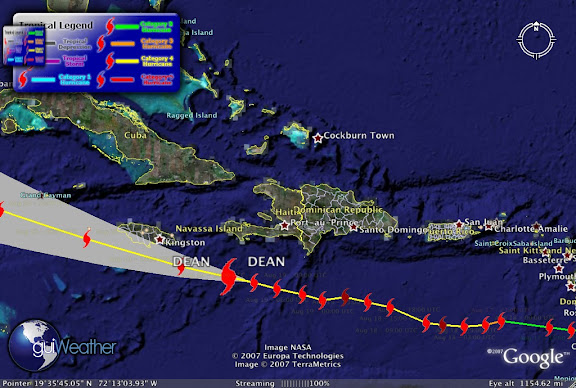
Its current storm position as of Aug 19 - 12:00 UTC is Lat 17.0 N/Long 75.1 W or about 130 miles/210km east southeast of Kingston, Jamaica.
Maximum winds of 145 mph and a pressure of 926mb..27.34 inches.

Dean's outer bands have reach the Island and the Jamaican government urged people to flee low-lying and landslide-prone areas, put troops and police on alert and bussed people to evacuation centers. (see story).

According to The Weather Channel, "as Hurricane Dean heads west-northwest, the northern end of its eyewall will likely strike a destructive blow to Jamaica later this afternoon. Rainfall amounts will be in the 5 to 10 inch range with some areas receiving as much as 20 inches. The heavy rains will lead to life-threatening mudslides.

Dean could be the strongest hurricane to strike Jamaica since 1950: stronger than Hurricane Gilbert in 1988 which was a category three when it crossed the island from end to end."


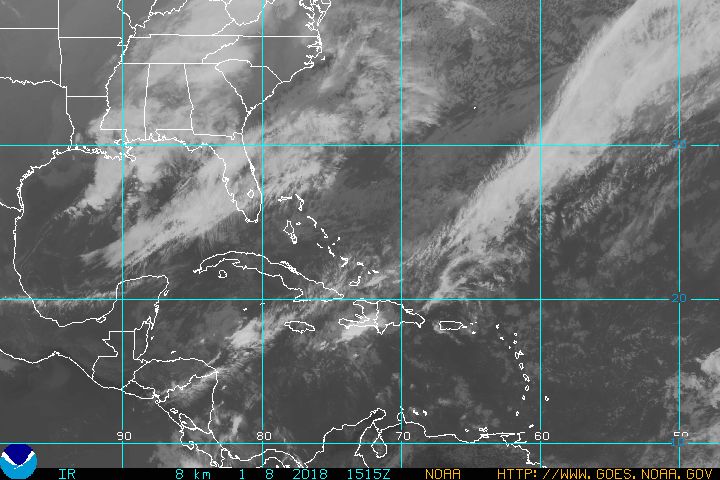
(Sat photo by GOES EAST)

Where will Dean go after Jamaica? Senior Director of Weather Communications for the Weather Channel discusses this on the Weather Channel Blog.


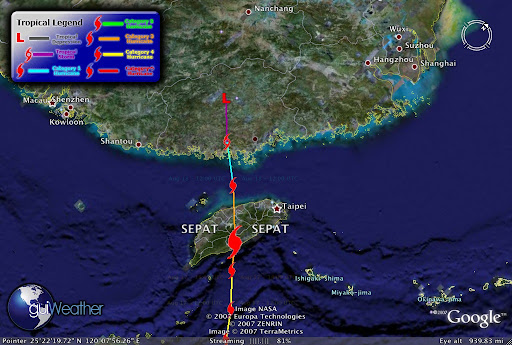
Super Typhoon SEPAT struck China's coase killing 15 and forcing the evacuation of 90,ooo.


We'll keep you posted!

RS

Saturday, August 18, 2007

Hurricane Dean

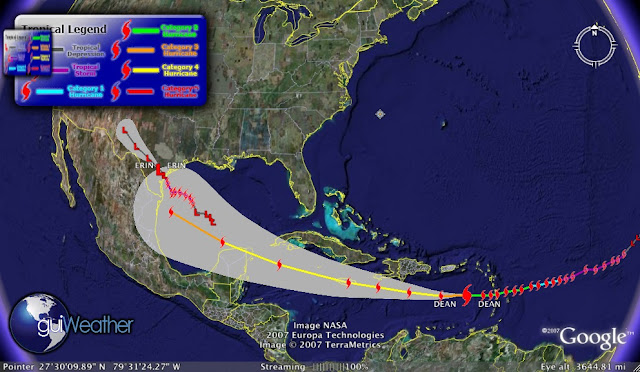
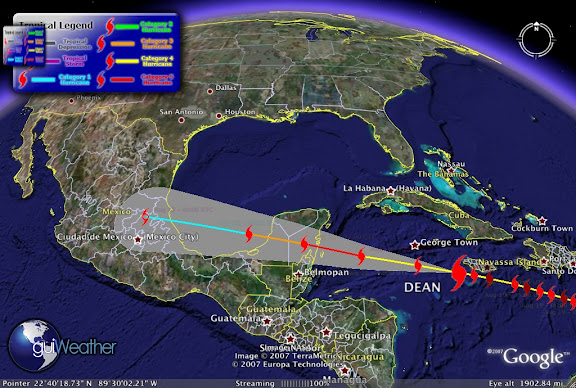
Its going to be a interesting weekend, especially with Hurricane Dean, now a CAT 4 on the move. We are going to follow the storm straight through the weekend. To top that we are going to tacking this storm with guiWeather by Google. The image on the left if Dean's projected path.

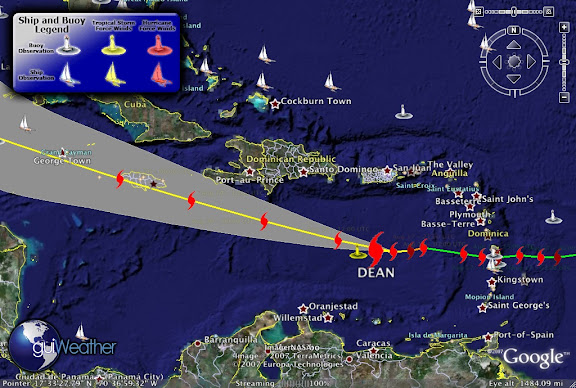
As we went to blog, Hurricane Dean is currently a Category 4 Hurricane, with maximum winds of 150 mph and a pressure of 930 mb, .27.46 inches. Dean was 700 miles, 1125 km east-southeast of Kingston, Jamaica and about 239 miles, 390km, south of San Juan, Puerto rico, moving west at about 18 mph (30 kph) at Latitude: 15.0 N, Longitude: -66.7 W. The National Hurricane Center predicted Dean may grow to a Category 5 storm the highest level on the five-step Saffir-Simpson scale, with 150 mph (240 kph) winds as it tracks across Jamaica to the Gulf, home to a third of U.S. domestic crude oil and 15 percent of natural gas production. Dean is following almost the same path as Hurricane Rita, though some at the NHC speculate that Dean will weaken some as it approaches the US Gulf.


Aug 18 - 05:50 UTC - Weather buoy- 42059 (Image above), which lies in the direct path of Dean reported currently, Temperature: 81°F, Dewpoint: 75°F. Wind: NNE at 45 mph gusting to 54. Pressure: 999 mb. Wave Height: 26 ft .. Now remember just because the buoy is reporting waves at 26ft does not mean that these waves are not higher on average.


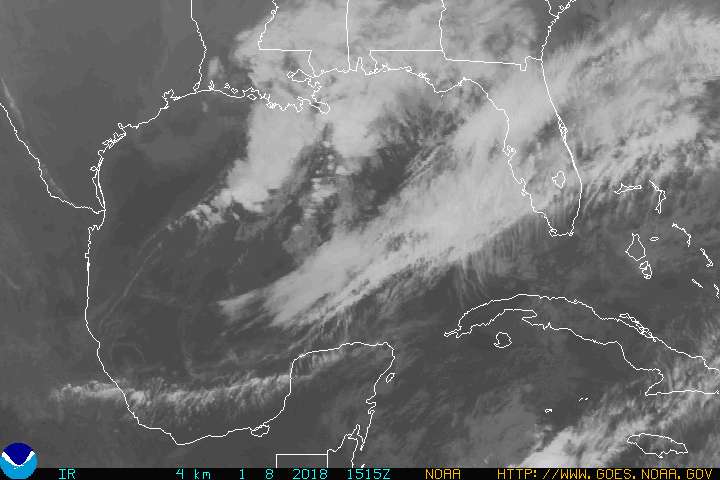
(Sat Photo GOES 1 Hurricane Dean)

According to press reports,

"Dean, the first hurricane of what is expected to be an above-average Atlantic season, lifted the roof off the pediatric wing at Victoria Hospital in St Lucia's capital, Castries, but patients had already been moved, officials said.

Heraldine Rock, an ex-government minister in the former British colony of 170,000 people, said the storm ripped roofs off houses and damaged at least two banana plantations.

"In one village, telephone and power lines are down, they're strewn all over the road, trees are uprooted and are blocking the roads," she said. "In another village, a landslide has been reported, cutting off any access to the airport."

Deputy Prime Minister Leonard Montoute said at least two people were injured when a tree fell on their house.

"I'm told that the coastal areas have taken a severe battering, there's debris all over Castries in the capital and flood waters on the roads," he said.

On neighbouring Martinique, an elderly man died of a heart attack during the storm and six people were injured, according to France's state office for overseas territories. Electricity company EDF said 95 per cent of homes were without power."


(Sat Photo by QuikSCAT of Hurricane Dean)

In this video shot on Antigua, Hurricane Dean's eye was some 100 miles away, but watch the wave action.


And then we have Dominica...


Here is some AP footage of Dean blowing through the eastern Caribbean Islands of St. Lucia and Martinique.


Let's not forget Super Typhoon SEPAT!


This Hurricane Dean has potential to cause some real damage along the Gulf Coast, hope we are prepared this time. Just a interesting note in hurricane history. Maybe with a little luck, Hurricane Dean will turn and follow the same track as its 1989 name sake "Hurricane Dean" did. So keep posted... Enjoy your weekend!

RS

Friday, August 17, 2007

Three new radars to boost weather warning system

Three new radars to boost weather warning system

A new radar system will make predicting severe weather easier in the Waikato, the MetService says.

The Government has approved funding for three new radars around the North Island. The first will be installed at New Plymouth airport next June.

MetService spokesman Bob McDavitt said the new radars would give them more accurate and faster information about pending weather patterns.

The other two radars will be installed in Gisborne and the Bay of Plenty. Specific sites and dates have not yet been confirmed but they will be installed within the next three years.

The radars will cost about $10 million.

Mr McDavitt said severe thunderstorms caused significant damage very quickly, but the new radars would enable smaller and isolated towns to get plenty of warning before storms hit.

Radars were the only way to track the path and progress of tornadoes and thunderstorms.

"You could get a text about a hail storm about to come," he said. "Then you can adjust your activities to meet the message. You wouldn't drive your car down to the supermarket then."

Mr McDavitt said having more radars would have been useful during the recent Taranaki tornadoes.

"We could have told people accurately when they would clear. There would have been more information to give."

The North Island now has two radars - one in Auckland and one in Wellington.

These radars cover only 25 per cent of the North Island. The three new radars will increase coverage to 80 per cent.

"It will make weather warnings more accurate. We'll be able to warn civil defence (units) if evacuations need to be made."

The regional council Environment Waikato emergency management officer Adam Munro said the radar in Taranaki "will greatly enhance EW's existing flood warning capability, by enabling the real time tracking and monitoring of severe weather systems coming into the Waikato".

Mr McDavitt expected the technology to be fully operational within 10 years and hoped to get "everything in place" for the 2011 Rugby World Cup.

Weather Story

Hurricane Dean


Tropical Depression Erin

Erin Weakens to Tropical Depression; Torrential Rain Heads Toward Flood-Weary Parts of Texas

By ELIZABETH WHITE

The Associated Press

CORPUS CHRISTI, Texas

Tropical Storm Erin made landfall Thursday as a tropical depression, bringing torrential downpours to Houston before aiming at flood-weary central Texas.

One person was killed and another was injured when a waterlogged roof collapsed at a storage unit at a Houston grocery store, Houston Fire Chief Omero Longoria said.

Erin came ashore at about 7 a.m. at Copano Bay, about 25 miles northeast of Corpus Christi.

"We're very fortunate. We're always prepared for the worst and we pray that we're wrong," said Corpus Christi Fire Department Deputy Chief Michael Hernandez. "For the most part it looks like we dodged a bullet." (See Storm Erin Deluges Houston)

Super Typhoon SEPAT


RS

Thursday, August 16, 2007

UPDATE - Dean Upgraded to Hurricane

Hurricane Dean could threaten Gulf of Mexico

Thu Aug 16, 2007 1:36PM EDT

NEW YORK (Reuters) - Hurricane Dean, which could strengthen into a Category 4 hurricane over the next few days, will likely cross the islands of the eastern Caribbean on Friday and could threaten the Gulf of Mexico next week.

Meanwhile, Tropical Depression Erin produced heavy rains over portions of Texas as it weakened after moving inland over the south Texas coast this morning.

The energy market is watching the weather models to see if Dean will enter the Gulf of Mexico and where it could disrupt the region's oil and natural gas facilities, which account for roughly a third of U.S. oil production.

The NHC issued hurricane warnings for the Lesser Antilles islands of Dominica and St Lucia. A hurricane warning means the NHC expects a hurricane to strike the warning area within 24 hours.

At 11 a.m. EDT, the center of Dean was located about 350 miles east of Barbados and about 455 miles east of Martinique.

Dean was moving quickly toward the west at near 23 miles per hour. This would put the center of the hurricane near the Lesser Antilles, which extend south from the Virgin Islands to Trinidad and Tobago, on Friday morning.

Dean is packing maximum sustained winds near 90 mph, making it a Category 1 hurricane on the Saffir-Simpson scale.

The NHC forecast Dean will strengthen into a Category 2 hurricane (winds 96-110 mph) within 12 hours, a Category 3 hurricane (winds 111-130 mph) in about 24 hours and a Category 4 hurricane (winds of 131-155 mph) in three to four days.

In five days however, the NHC expects the storm to weaken back to Category 1 strength (winds 74-95 mph) after moving inland over the Yucatan Peninsula in Mexico.

The seven major weather models were mixed on Dean's forecast track. Two show Dean in the Gulf of Mexico in five days. Three, including the NHC model, show Dean in the Yucatan in five days. Two show Dean in Belize or Honduras in five days.

The weather models only look out about five days. Beyond that, the forecasters say it is too soon to say whether the storm, which is still in the Atlantic Ocean, will enter the Gulf of Mexico.

If the storm crosses the Yucatan and enters the southern Gulf of Mexico, it might disrupt operations in the Cantarell Complex of Mexican oil fields beneath the Bay of Campeche in addition to the U.S. facilities in the northern Gulf.

The Cantarell Complex is one of the most productive oil fields in the world, supplying about two thirds of Mexico's crude oil output.

The NHC will issue another advisory on Dean at 2 p.m.

ERIN DOWNGRADED

Erin made landfall near Lamar, Texas and weakened to a tropical depression Thursday morning.

The center of Erin was located about 55 miles north-northwest of Corpus Christi, the NHC said in an advisory released before 11 a.m.

The depression was moving northwest at near 15 mph, while its maximum sustained winds declined to 35 mph.

The NHC said it would not issue additional advisories on Erin.


UPDATE: On Tropical Storm Erin

ERIN CROSSED THE TEXAS COAST NEAR LAMAR AND IS NOW MOVING FATHER
INLAND. SATELLITE IMAGES AND RADAR DATA SHOWS THAT THE DEPRESSION
STILL HAS A LARGE AREA OF RAIN WHICH IS THE MAIN THREAT AT THIS
TIME. THE DEPRESSION IS FORECAST TO MOVE TOWARD THE NORTHWEST AT
ABOUT 13 KNOTS UNTIL DISSIPATION.

RS

Tropical Storm ERIN

Tropical Storm Erin Heads for Texas


Thursday August 16, 2007 4:16 AM

By LYNN BREZOSKY
Associated Press Writer

SOUTH PADRE ISLAND, Texas (AP) - South Texas braced Wednesday for Tropical Storm Erin to bring torrential downpours to a state that already has had one of its rainiest summers on record.

As the storm's outermost bands of rain touched the Texas coast early afternoon, homeowners had already started heading to hardware stores in the Rio Grande Valley for supplies to board up their houses.

``They know the drill; they're familiar with it,'' said Ruben Dimas, assistant store manager at a Home Depot in Harlingen.

Gov. Rick Perry ordered emergency vehicles and personnel, including National Guard troops, to the Harlingen and Corpus Christi areas.

``Because storms have saturated much of our state this summer, many communities in this storm's projected path are at high risk of dangerous flash flooding,'' Perry said in a statement.

Cameron County Judge Carlos Cascos, the top elected official for the state's southernmost county, urged residents to evacuate trailers and mobile homes on South Padre Island, but he said that the storm appeared to have veered northward and that few vacationers appeared nervous enough to leave.

``About the only thing we're doing is picking things up off the ground so they don't blow around,'' said Caroline Douglas, a Kentucky resident who was with her husband Delbert at the island's KOA recreational vehicle park. ``Hopefully it won't be too bad.

But Mike and Rhonda Cates, visiting South Padre Island in their recreational vehicle, decided not to take any chances.

``We live in Lufkin and we went through Rita two years ago,'' Rhonda Cates said, recalling the 2005 hurricane that slammed into East Texas, jammed highway traffic and sent evacuees pouring into her small city.

``We're still cleaning up trees from that,'' she said. ``I thought, it may not be bad here, but it may flood along the way in Corpus. It's getting home that we're worried about.''

Out in the Gulf, Shell Oil Co. evacuated 188 people from offshore facilities in the storm's path.

Erin formed late Tuesday as the fifth depression of the Atlantic hurricane season and was upgraded to a tropical storm Wednesday when its maximum sustained speed hit 40 mph, the National Hurricane Center said. The threshold for tropical storm status is 39 mph.

At 11 p.m. EDT, the storm was centered 140 miles southeast of Corpus Christi and about 200 miles south-southwest of Galveston, according to the National Hurricane Center in Miami. Its top wind speed remained at 40 mph.

Erin was moving toward the northwest at around 14 mph and was expected to continue following that track for at least 24 hours. Erin's center was expected to be very near the Texas coast on Thursday morning, the center said.

Erin was likely too close to land to gain enough wind speed to become a hurricane, with sustained wind of at least 74 mph, said National Weather Service forecaster Tony Abbott in Brownsville. But the center said late Wednesday it could strengthen slightly before landfall.

Isolated tornadoes also were possible along the middle Texas Gulf on Thursday, the center said.

A tropical storm warning was posted for the Texas coast from San Luis Pass, about 50 miles southwest of Houston, southward to the border. The tropical storm watch for northern Mexico was canceled. A tropical storm watch means that tropical storm conditions are possible within 36 hours.

Three to 8 inches of rain was possible along the middle Texas coast, the hurricane center said.

A series of storms this summer poured record rainfall across Texas and parts of Oklahoma and Kansas, with one July storm dropping 17 inches of rain in 24 hours. Flooding was widespread across all three states. It brought Texas out of drought status for the first time in more than a decade.

At least 16 deaths have been blamed on flooding since mid-June.

Meanwhile, a hurricane watch was issued late Wednesday for a portion of the Lesser Antilles in the Caribbean as Tropical Storm Dean gained strength, forecasters said.

The watch, in effect for St. Lucia, Martinique, Guadeloupe and it's dependencies, Saba and St., Eustaties, was issued by local governments. A hurricane watch means hurricane conditions are possible in the next 36 hours.

As of 11 p.m. EDT, Dean was centered about 625 miles east of Barbados, according to the National Hurricane Center. It was moving west near 23 mph, and was expected to continue the same path over the next 24 hours.

Maximum sustained winds were near 70 mph. Dean was expected to become a hurricane sometime Thursday, forecasters said. A hurricane has maximum sustained winds of 74 mph.

In the Pacific, Flossie was downgraded from a hurricane to a tropical storm after sideswiping Hawaii's Big Island with only intermittent rain and moderate winds.

It was a close call: Flossie approached the biggest and southernmost of the Hawaiian Islands with winds as high as 140 miles per hour earlier in the week, making it a Category 4 storm. If it had made landfall, the powerful hurricane would have been the first to hit the isles since Iniki slammed Kauai in 1992, killing six people.

``The storm that never was,'' said Karin Funai as she chatted with friends over coffee at the Pahala Town Cafe. ``This was nothing.''

Hurricane specialists expect this year's Atlantic hurricane season - June 1 to Nov. 30 -to be busier than average, with as many as 16 tropical storms, nine of them strengthening into hurricanes. Ten tropical storms developed in the Atlantic last year, but only two made landfall in the United States.

---

Associated Press writer Audrey McAvoy in South Point, Hawaii, contributed to this report.


Strike Map

[Image of 3-day forecast, and coastal areas under a warning or a watch]


Retirement note:

After 42 years of federal service our internet friend and colleague Dr. Paul C. Liu, a Research Physical Oceanographer with NOAA;s Great Lakes Environmental Research Labotatory and the blogger of Freaque Waves, will be retiring at the end of August. Dr. Liu tells us that he will not be going to far away and will remian as a Scientist Emeritus so that he will still be around his research efforts.

He is conducting research into Rogue Waves and Explorations of Coastal Wave Characteristics. So please continue visiting Freaque Waves, and see what Paul is up too.


Congratulations Paul you have earned it! Keep us posted!

Our best always!
RS

Wednesday, August 15, 2007

Weather Updates - TS ERIN & TS Dean

MIAMI (Thomson Financial)
The National Hurricane Center on Wednesday issued a warning for the gulf coast of Texas as a Tropical Storm Erin inched towards landfall, as another storm named Dean formed in the Atlantic and headed towards the Caribbean.

Erin reached tropical storm status at 3.00 pm Wednesday, and the Florida-based Hurricane Center issued a storm watch for much of the state's gulf coast.

At 3.30 pm GMT, Erin's centre was located about 400 kilometres east of Brownsville, Texas, and some 480 kilometres northeast of La Pesca, Mexico.

Erin was moving in a west-northwest direction at about 19 kilometres per hour.

The storm had maximum sustained winds of 65 kilometres per hour, with higher gusts. Forecasters expected it to strengthen over the next 24 hours.

Meanwhile Tropical Storm Dean, which formed in the central Atlantic, gained strength and threatened to become the first hurricane of the 2007 north Atlantic season.

At 3.00 pm GMT Dean was located some 1,685 kilometres east of the Lesser Antilles.

It was moving at around 32 kilometres an hour towards the Caribbean on a path to rip through the islands of Puerto Rico, Hispaniola and Cuba.

The hurricane season normally extends from early June to late November, but US forecasters on August 9 warned that up to nine storms could still develop into hurricanes in the next months.

UPDATE: Tropical Storm Dean

DEAN INTENSIFYING OVER THE CENTRAL TROPICAL ATLANTIC...

A HURRICANE WATCH MAY BE REQUIRED FOR PORTIONS OF THE LESSER
ANTILLES LATER TONIGHT OR EARLY THURSDAY. INTERESTS IN THE LESSER
ANTILLES SHOULD MONITOR THE PROGRESS OF DEAN.

FOR STORM INFORMATION SPECIFIC TO YOUR AREA...PLEASE MONITOR
PRODUCTS ISSUED BY YOUR LOCAL WEATHER OFFICE.


UPDATE:
Hurricane Flossie


Hurricane watch cancelled for Hawaii

A hurricane watch was cancelled for Hawaii's Big Island hours after Hurricane Flossie turned the seas into roiling giant surf.

The Central Pacific Hurricane Center in Honolulu cancelled the hurricane watch as the storm weakened, although a tropical storm warning remained in effect late Wednesday.

At 11pm (1900 AEST Wednesday), Flossie was located about 280 kilometres south-southwest of Hilo and about 450 kilometres south-southeast of Honolulu. It was moving north-northwest at about 16km/h.

The hurricane centre downgraded Flossie to a tropical storm after maximum sustained winds dropped to 112km/hour.

UPDATE: Typhoon SEAPAT


Typhoon Sepat skirts Philippines, heads for Taiwan
15 Aug 2007 11:03:00 GMT
Source: Reuters

MANILA, Aug 15 (Reuters) - Heavy rain soaked Manila and the northern Philippines on Wednesday as Typhoon Sepat skirted northeast of the archipelago, triggering evacuations and flood warnings. In the capital, schools and government offices were ordered to shut and cars were brought to a near standstill as the rain flooded streets, forcing residents to wade to work. U.S. film director Quentin Tarantino, in Manila for a film festival, abandoned his limousine for a pedicab cruise through the floodwaters after being stuck in traffic for more than two hours. Tarantino, famed for his violent films such as "Reservoir Dogs", told reporters the trip aboard the cycle rickshaw to the presidential palace for an awards ceremony was safe and fun. "I've done more serious things than that," he said. The weather bureau said Sepat was not expected to make landfall in the Philippines, as it moves westward towards Taiwan and China. The storm brought winds of 160 km per hour (100 mph) and gusts of up to 195 km per hour, the bureau said. Officials said there were no reports of casualties or serious damage but over 200 people were evacuated in Manila.

Warnings were issued about possible large waves and storm surges along coastal areas and residents of low-lying areas and people living near mountain slopes were also advised about possible flash floods and landslides. Sepat is expected to slam into Taiwan on Thursday as a category 4 typhoon, one level below the maximum strength super typhoon, according to British-based Web site, Tropical Storm Risk (www.tropicalstormrisk.com). Tropical storms in the region gather intensity from the warm ocean waters and frequently develop into typhoons that hit Taiwan, Japan, the Philippines and southern China during a season that lasts from early summer to late autumn.


RS


Hurricane Flossie To Strike Hawaii - Pomaika`i Hawaii!

Hurricane Flossie is due to strike Hawaii sometime tomarrow afternoon.

The U.S. island of Hawaii has declared a state of emergency as Hurricane Flossie approaches the southern waters of the Pacific state. Flossie weakened on Monday from a Category 4 to a Category 2 storm.

But the U.S. National Weather Service says Flossie remains a "dangerous hurricane with a clear, well-defined eye." Forecasts say Flossie could come about 121 kilometers from Hawaii, the southernmost and largest island in the Hawaiian islands. Schools have been ordered closed Tuesday on the island.

(Photo by QuikSCAT)

From Jill one of our readers who resides on Oahu.

'I'm living hurricane Flossie....on Oahu. She's expected to pass by us sometime tomorro afternoon/evening. Should she make even a slight 1 to 2 degree turn north she'll dance across the top of us. I was at the beach with my camera about an hour ago...winds aren't much more than usual, 4 to 5 ft swells but I plan on going back down this evening and tomorrow morning as well as afternoon. "

Pomaika`i Jill and keep us posted!

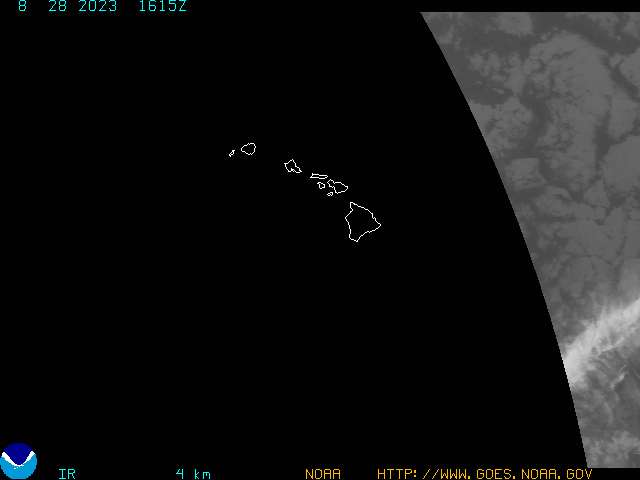
OFFSHORE WATERS FORECAST FOR HAWAII
GOES Hawaii SECTOR IR Image

Hawaii goes west infra red sector image


Ascending Pass (QuikSCAT)

The wind vector retrievals thought to be rain contaminated are colored in black. While not perfect, the MUDH rain flag appears to mark many of the suspect vectors in regions of probable precipitation, epecially in the tropical latitudes. Rain can contaminate the wind retrievals, especially in situations with moderate to heavy rain rates.

Descending Pass (QuikSCAT)


Pomaika`i Hawaii!

And if thats not all, we have;


CAT 1
Typhoon SEPAT heading for the Philippines


WAIT theres more! And we have;


Tropical Storm Dean...


[Image of probabilities of hurricane force winds]


Ooops almost missed one,

Tropical Depression FIVE


[full basin map of tropical cyclone activity]


RS.....

Tuesday, August 14, 2007

Memo reveals Proenza's days were numbered

Oh the games we play at NOAA/NHC. Here we have another article on Bill Proenza the former Director of the National Hurricane Center. So NOAA can't make up its mind about whether or not Proenza was removed because of his public statements about a critical satellite or because some of the children or staff at the NHC did not like his leadership style.

Lets just say that it remains to be seen whether some of the children ..eh..staff at the NHC who have now lowered the Atlantic Hurricane threat to some13 to 16 named hurricanes can actually live up to their statements.

Seems to me that if there is any question of lowered public confidence its in predicting hurricanes by some of the same children who complained about Proenza's public statements. Wonder if any of them will get relocated if those 13 to 16 named storms don't appear? Though I am now tracking Tropical Depression Four (TD4), think if these 13-16 storms don't develop, it time for some staff changes at the NHC....

Geez we need to grow up...

OrlandoSentinel.com

Memo reveals Proenza's days were numbered

Maya Bell and Mark K. Matthews

Sentinel Staff Writers

August 7, 2007

Days before Bill Proenza's bosses dispatched a team to the National Hurricane Center to evaluate his brief but controversial tenure as director, he already was on notice he would be demoted to an obscure office of the National Weather Service, an internal memo released Monday shows.

The main reason for the transfer, the memo said, was Proenza's repeated misrepresentations to the media about the consequences of losing the aging QuikSCAT satellite.

Two congressmen, whose subcommittees obtained the memo while investigating Proenza's abrupt ouster, suggest the two-page document supports the National Weather Service veteran's contention that he was placed on paid leave July 9 in retaliation for criticizing his superiors at the National Oceanic and Atmospheric Administration, rather than for leadership flaws documented by the assessment team.

Citing the memo, U.S. Reps. Brad Miller, D-N.C., and Nick Lampson, D-Texas, wrote to NOAA Administrator Conrad Lautenbacher last week, saying Proenza was being treated unfairly. They also said that if NOAA intends to permanently remove Proenza from the hurricane center, he should be returned to his former $150,000-a-year job as the director of the 10-state southern region of the National Weather Service.

'Extremely talented'

"We don't want this extremely talented public employee consigned to NOAA's backwaters because he spoke publicly about the potential loss of a critical satellite," Lampson said in a statement.

An NOAA spokesman would not comment. Proenza's attorneys, who are considering filing a lawsuit alleging retaliation under the federal Whistleblower Protection Act, could not be reached.

The previously undisclosed memo was from Mary Glackin, acting director of the National Weather Service, and Louis Uccellini, director of the National Centers for Environmental Prediction. Though the memo is undated, it was obviously written on or before June 22, the date the memo says Proenza was being "detailed immediately out" of the director's job in the Miami center and reassigned to NOAA's Office of Climate, Water and Weather Services in Camp Springs, Md.

In the memo, Glackin and Uccellini cited complaints from hurricane-center staffers that Proenza had misrepresented them in the media, causing "disarray and distraction" since he assumed the director's job in January. But they made clear that it was Proenza's comments about QuikSCAT that doomed him. He had told members of Congress that the loss of the aging satellite, already several years past its expected lifespan, would make storm-track forecasts as much as 16 percent less accurate.

"This action results from our lack of confidence in your ability to fulfill the responsibilities of your position," the memo said. "You have repeatedly misrepresented facts to the press regarding the impact of the loss of QuikSCAT data resulting in widespread media questioning our ability to deliver effective hurricane services."

Veteran forecasters said Proenza, by exaggerating the importance of QuikSCAT, had undermined the center's credibility and the public's faith in their forecasts. They said the satellite is a useful tool but they rely far more on data collected from reconnaissance aircraft to track approaching storms.

Why Proenza was still on the job when the five-member inquiry team showed up July 2 is unclear. But three days later, half of the center's staffers issued a statement calling for his immediate ouster. On July 9, Lautenbacher put him on paid leave.

'Leadership' failure

But the NOAA director, testifying before both Miller's and Lampson's subcommittees on July 19, denied that Proenza's QuikSCAT comments were responsible for his suspension. Instead, he cited the inquiry team's recommendation that Proenza be moved "due to his failure to demonstrate leadership" and not for "his public statements about the QuikSCAT satellite or NOAA leadership."

According to the NOAA Web site, the Office of Climate, Water and Weather Services oversees hydrometeorological and climate services and the design and implementation of future products and services. Its training chief "ensures NWS staff receives the training required to attain/maintain proficiency in providing accurate and timely forecasts and warnings to the public." The prior training chief was to have retired June 30.

Maya Bell, who reported from Miami, can be reached at mbell@orlandosentinel.com or 305-810-5003. Mark K. Matthews, who reported from Washington, can be reached at mmatthews@tribune.com or 202-824-8222.

Weather Story

[full basin map of tropical cyclone activity]


RS.....

Monday, August 13, 2007

50 drowned, 100 missing in Sierra Leone as boat capsizes

Aug 3, 2007 FREETOWN, Sierra Leone (Reuters) -- Around 50 people were feared drowned and more than 100 were missing after their boat capsized in heavy rain at the mouth of a river in Sierra Leone, police said on Friday.

A spokesman for a local boat owners' association said seven bodies had so far been recovered from the sea at the estuary of the Great Scarcies River, near Sierra Leone's northern border.

Police in the northern Kambia district estimated around 50 people had died based on accounts from the only two survivors found so far.

The boat, which was en route from the coastal capital Freetown to the riverside town of Rokupr, was believed to be carrying around 200 passengers when it ran into the choppy river waters, swollen by a week of torrential rains.

"Members of the Sierra Leone navy, backed by some members of the boat association, left in the early hours for the disaster scene to join local fishermen who have been searching since the tragedy took place," said the spokesman for the boat owners' association, Michael Asuman.

Authorities say that the heavy rains have washed away scores of homes in the hilly Freetown area over the last week, leaving more than 500 people on the streets.

Boating accidents are common during Sierr Leonea Leone's treacherous rainy season. Some 25 people drowned in July last year when a wave overturned their boat at the mouth of the Great Scarcies river.

Many of the vessels plying trade and passenger routes on inland waterways and off West Africa's coast are poorly maintained, with accurate passenger manifests a rarity.

Copyright 2007 Reuters. All rights reserved.This material may not be published, broadcast, rewritten, or redistributed.

Martiime Notes:

This from my shipmate at gCaptain.com
Tanker Grounded off Coney Island, NY

After experiencing a steering problem the tanker “White Sea” ran aground off of Coney Island New York. The Gotahamist tells us: Continue reading at gCaptain.com .

Casualties from Cargolaw.com:

Cari-carrier M/V Nobleza, Monrovia-flagged, was caught by strong wind and pushed against pilings in the Kiel Canal with its port side while passing from Brunsbuettel to Kiel-Holtenau on Aug. 5. The vessel lated resumed its voyage with minor dents. From our Sr. Correspondent Tim Schwabedissen (Thurs. Aug. 9 2007)

F/V Zhu Wan 4209 sank in a tropical storm in the waters of the Xisha Islands in the South China Sea on Aug 3. All five abaord were rescued by 35,500-ton German container M/V Northern Faith. From our Sr. Correspondent Tim Schwabedissen (Thurs. Aug. 9 2007).

Weather Story:

CHINA:Thousands of China homes flooded. More than 3,600 homes in southern China have been destroyed by floods resulting from a now fading tropical storm, Chinese state media has reported. The floods in Guangdong province have affected about 1.2 million people and caused an estimated 1.3bn yuan ($171m) of damage, Xinhua news agency said. The rain was caused by Tropical Storm Pabuk, which hit Hong Kong on Friday, disrupting transport and business.

The latest on Hurricane Flossie:

HONOLULU, Hawaii (AP)
-- Hurricane Flossie strengthened to a Category 4 storm Saturday as it spun more than 1,000 miles south of Hawaii.
art.flossie.satellite.noaa.jpg

Satellite image taken at 10:30 a.m. ET shows Flossie's position relative to Hawaii.

At 11 a.m. EDT, Flossie had intensified with maximum sustained winds near 132 mph, and was about 1,100 miles southeast of Hilo, Hawaii. Flossie was upgraded to Category 3 from a Category 1 overnight.

The storm was expected to weaken later in the day as it passed over cooler waters. It was traveling west at about 12 mph.

Jeff Powell, lead forecaster at the National Weather Service in Honolulu, said Flossie hadn't changed its course and was expected to pass the Hawaiian Islands early Wednesday with rough surf. A "ramp up" of surf on the Big Island was expected late Monday.

The island's southeastern shores could see waves of 8 to 12 feet, forecasters said, with the surf rising during the day Monday and peaking Tuesday. The island's South Point is the southernmost area of the United States.

State civil defense officials urged residents to be prepared because of the unpredictable nature of hurricanes. A one or two degree direction change, they say, could make a big difference.

"If this thing fizzles out, so what? Everybody should still be prepared," said Dave Curtis, spokesman for the state Civil Defense Agency.

Flossie formed as a tropical storm Wednesday about halfway between Mexico's southern Pacific coast and Hawaii. Its winds surpassed 74 mph, making it a hurricane, on Friday.

The last time a hurricane hit Hawaii was in 1992, when Iniki ravaged Kauai, killing six people and causing $2.5 billion in damage.

Hurricane season runs from June 1 to Nov. 30. In May, forecasters predicted that Hawaii and the rest of the central Pacific face a slightly below-average hurricane season, with just two or three tropical cyclones expected because of lower sea surface temperatures.The islands get an average of 4.5 tropical cyclones a year and one hurricane about every 15 years. Last year, the central Pacific had five tropical cyclones after the National Oceanic and Atmospheric Administration predicted two to three.

On July 21, a tropical depression moved past the Big Island, bringing a few inches of rain to the parched island but no major problems. Cosme, the year's first Pacific tropical cyclone, reached hurricane status for a day before it weakened.

Finally, how about a little rough seas off of the coast of Japan?


RS

Saturday, August 11, 2007

Hurricane Flossie

I am tracking Hurricane Flossie, currently tracking,

AS OF 500 AM PDT...1200 UTC...THE CENTER OF HURRICANE FLOSSIE HAS NOT YET CROSSED 140 DEGREES WEST LONGITUDE INTO THE CENTRAL PACIFIC HURRICANE BASIN. THEREFORE...THE NEXT ADVISORY WILL AGAIN BE ISSUED BY THE NATIONAL HURRICANE CENTER IN MIAMI FLORIDA.

=


I will keep you posted...
RS

Friday, August 10, 2007

NOAA UPDATES ATLANTIC HURRICANE SEASON OUTLOOK

NOAA UPDATES ATLANTIC HURRICANE SEASON OUTLOOK
Above-Normal Season Still Expected

NOAA image of NOAA’s 2007 Atlantic hurricane season update.August 9, 2007 — NOAA’s Climate Prediction Center today released its update to the 2007 Atlantic Hurricane Season Outlook, maintaining its expectations for an above-normal season.

As we enter the peak months (August through October) of the Atlantic hurricane season, NOAA scientists are predicting an 85 percent chance of an above-normal season, with the likelihood of 13 to 16 named storms, with seven to nine becoming hurricanes, of which three to five could become major hurricanes (Category 3 strength or higher on the Saffir-Simpson Hurricane Scale). (Click NOAA image for larger view of NOAA’s 2007 Atlantic hurricane season update. Click here for high resolution version. Please credit “NOAA.”)

The development of key climate factors through early August has increased the confidence of an above-normal season, and has also led the NOAA team to slightly tighten the ranges that had been given in their May outlook — due to development of La Niña-like conditions exerting influence. In May, NOAA predicted a range of 13-17 named storms, with seven to 10 becoming hurricanes, and three to five becoming major hurricanes.

NOAA image of conditions in the Atlantic Basin that can produce an above normal hurricane season. Please credit “NOAA.”The climate patterns responsible for the expected above-normal 2007 hurricane season continue to be the ongoing multi-decadal signal (the set of oceanic and atmospheric conditions that have spawned increased Atlantic hurricane activity since 1995), warmer-than-normal sea surface temperatures in key areas of the Atlantic Ocean and Caribbean Sea, and the El Niño/La Niña cycle, according to Gerry Bell, Ph.D., lead seasonal hurricane forecaster at NOAA’s Climate Prediction Center based in Camp Springs, Md. (Click NOAA image for larger view of conditions in the Atlantic Basin that can produce an above normal hurricane season. Click here for high resolution version. Please credit “NOAA.”)

“Most of the atmospheric and oceanic conditions have developed as expected, and are consistent with those predicted in May,” said Bell. “The biggest wild card in the May outlook was whether or not La Niña would form, and if so, how strong it would be.

“Today’s El Niño/La Niña forecast from the Climate Prediction Center indicates a slightly greater than 50 percent probability that La Niña will form during the peak of the hurricane season. But more importantly, we are already observing wind patterns similar to those created by La Niña across the tropical Pacific Ocean and Caribbean Sea that encourage tropical cyclone development. The conditions are ripe for an above-normal season.”

NOAA image of historical tropical cyclone frequency. Please credit “NOAA.”NOAA’s seasonal outlooks do not specify where and when tropical storms and hurricanes could strike. Nevertheless, during above-normal seasons many of the storms form over the tropical Atlantic Ocean. These systems generally track westward, towards the United States and the Caribbean Sea, thereby posing an increased threat to these regions. (Click NOAA image for larger view of historical tropical cyclone frequency. Click here for high resolution version. Please credit “NOAA.”)

So far this season, there have been three Atlantic named storms (Andrea, Barry and Chantal), which is slightly above average. On average, one to two storms develop in June and July. The Atlantic hurricane season runs from June 1 through November 30.

The 2007 Atlantic Hurricane Season outlook is a joint product of the scientists at NOAA’s Climate Prediction Center, National Hurricane Center, Hurricane Research Division, and Hydrometeorological Prediction Center. NOAA meteorologists use a suite of sophisticated computer forecast models and high-tech tools to forecast tropical storms and hurricanes. Scientists rely on information gathered by NOAA and U.S. Air Force Reserve personnel who fly directly into storms in hurricane hunter aircraft; NOAA, NASA and Department of Defense satellites; a network of Doppler radars and buoys and partners among the international meteorological services.

NOAA is dedicated to enhancing economic security and national safety through the prediction and research of weather and climate-related events and information service delivery for transportation, and by providing environmental stewardship of our nation's coastal and marine resources. Through the emerging Global Earth Observation System of Systems (GEOSS), NOAA is working with its federal partners, more than 70 countries and the European Commission to develop a global monitoring network that is as integrated as the planet it observes, predicts and protects.

Relevant Web Sites
Updated 2007 Atlantic Hurricane outlook (technical product)

Climate Prediction Center’s ENSO Diagnostic Discussion/Forecast


NOAA Weather Radio All Hazards

Hurricane-Related Services Provided by NOAA: Fact Sheet

NOAA Weather Radio All Hazards: On Alert For All Emergencies

Media Contact:
Carmeyia Gillis, NOAA Climate Prediction Center, (301) 763-8000 ext. 7163


Maritime Notes:


UK – update re MSC NAPOLI The Devon County Council issued a Situation Update regarding the wreck of the MSC NAPOLI. The bow section is scheduled to be towed to Belfast for recycling. Contracts are under discussion for removal of the stern section, which remains grounded. (8/8/07).


Weather Story - Chicagoland:
NZUS51 KLOT 100918
WRKLFP
ILZ005-006-012>014-022-INZ001-102100-

CHICAGO METROPOLITAN FORECAST
NATIONAL WEATHER SERVICE CHICAGO/ROMEOVILLE IL
400 AM CDT FRI AUG 10 2007

TODAY...PARTLY CLOUDY AND LESS HUMID. HIGHS FROM THE MIDDLE 80S
NORTH SHORE TO AROUND 90 SOUTH AND SOUTHWEST SUBURBS. NORTHWEST
WINDS AROUND 10 MPH BECOMING NORTHEAST.
TONIGHT...FAIR. LOWS FROM THE MIDDLE 60S FAR WEST SUBURBS TO THE
LOWER 70S DOWNTOWN. NORTHEAST WINDS 5 TO 10 MPH BECOMING LIGHT AND
VARIABLE.
.SATURDAY...SUNNY AND WARM. HIGHS 85 TO 90...COOLEST LAKESIDE. WINDS
BECOMING SOUTHEAST AROUND 10 MPH.
.SATURDAY NIGHT...PARTLY CLOUDY. LOWS AROUND 70. SOUTHEAST WINDS
AROUND 10 MPH BECOMING SOUTHWEST.
.SUNDAY...BECOMING MOSTLY CLOUDY. HIGHS AROUND 90...BUT TURNING
COOLER IN THE AFTERNOON. SOUTHWEST WINDS AROUND 10 MPH BECOMING
NORTHEAST IN THE AFTERNOON.
.SUNDAY NIGHT...PARTLY CLOUDY. LOWS IN THE UPPER 60S.
.MONDAY...MOSTLY SUNNY. HIGHS IN THE UPPER 80S.
.MONDAY NIGHT...PARTLY CLOUDY. LOWS 65 TO 70.
Stay cool, stay dry and stay safe.
RS

Thursday, August 9, 2007

Crazy Weather


Where do we start? Chicago had tornado warnings with 3.50 " of rain per hour and Brooklyn got hit with a EF2 Tornado. But thats not all. While its quiet in the Atlantic there have been some 12 Typhoons in the Pacific, with another four tropical depressions under watch. Flood's? Try China and Britain are competing for the worlds largest ark contest. Lets not forget New York City! Extreme weather has raged in Bulgaria, Pakistan and even Romania and two tornado's in the Philippines.

So whats in store for us today in Chicagoland? More of the same, so let's sit and watch the sky's and the radar for another day..


Stay cool, stay dry and stay safe...
RS

Wednesday, August 8, 2007

Storm spotter helps others

By JIM MISUNAS, Sentinel Editor


McPherson's Jerry Bruce might save your life someday. He'll offer common-sense advice about safety during severe storms in his lecture at 7 p.m. tonight at the First Baptist Church, 600 E. Marlin.

The National Weather Service advance storm spotter will deliver his talk, “Storm Chasing in Kansas.” Admission is free and anyone may attend.

Bruce offers common-sense advice built on 27 years of storm spotting. He said staples for a well-equipped storm shelter include water, non-perishable food, sturdy shoes and a whistle.

“If you're ever in trouble, a whistle will attract attention more quickly than shouting,” he said. “Plus, you can blow a whistle for a long time after your voice gives out.”

Bruce, the safety coordinator for The Cedars Retirement Center, relays on-site storm conditions to a command center and to local media on storm conditions. He contacts various media sources to view live radar and check on storm movement.

His well-equipped vehicle carries a cell phone, portable TV with antennae and a ham radio. The signal for the American Radio Emergency Services ham radio is helped by repeaters installed in Canton and Marion County.

“The ham radio operators often are able to communicate information if power is down,” Bruce said. “Passing out timely information is a key.”

He considers storm spotting a hobby, albeit dangerous at times. He's had a few close calls and can travel more than 600 miles in a day. Most times, he'll station himself southeast of a severe storm capable of producing tornadoes.


“I'm happy to get out and help people,” he said. “When you're spotting you want to give yourself at least one way to get out of the way of a storm in case it turns your way.”

Bruce said he appreciates his supervisors at The Cedars, who provide him the flexibility to leave work when the forecast calls for the probability of severe weather. That was the case May 4 when Bruce left McPherson to monitor a severe storm in southwest Kansas that developed into an EF-5 tornado.

“I was watching TV that day and when I saw a storm was southwest of Greensburg, I decided to head down there,” he said.

When another storm spotter was unable to report conditions near Greensburg, Bruce was the primary source of information for KAKE, Ch. 10. Bruce was close enough that he monitored winds topping 90 mph east of Macksville. He tracked the storm from Kiowa County to Barton County.

“I knew it was a serious tornado and there was a high probability that people had died,” Bruce said. “I told Jay Prater of Channel 10 that the storm meant business because it was causing severe damage. Greensburg took a direct hit.”

Ten people died from the storm, a toll that would've been worse had the people in Greensburg not heeded the 30-minute advance warning provided by the National Weather Service in Dodge City.

“People fortunately got the heck out of town, which no doubt saved some lives,” Bruce said. “A National Weather Service meteorologist in Dodge City saw there was no other storm that would slow the storm down. He issued a timely warning that saved a lot of lives.”

Weather Story - Chicago


HEAVY RAIN POSSIBLE ACROSS NORTHERN ILLINOIS TONIGHT INTO EARLY THURSDAY MORNING..

UNTIL 12:45PM CDT

Urgent - Immediate Broadcast Requested Flood Watch National Weather Service Chicago/Romeoville IL 432 AM CDT Wed Aug 8 2007

...Heavy Rain Possible Across Northern Illinois Tonight Into Early Thursday Morning...

.An Upper Level Disturbance Across The Rockies Will Race Into The Upper Mississippi River Valley Tonight. Southerly Flow In Advance Of This Short Wave Will Continue To Bring Very Warm And Moist Low Level Air Into The Region. The Combination Of This Disturbance And The Moist Air Mass Will Create A Potential For Heavy Rainfall Tonight.

Winnebago-Boone-Mchenry-Lake Illinois-Ogle-Lee-De Kalb-Kane- Dupage-Cook- Including The Cities Of...Rockford...Woodstock...Waukegan... Oregon...Dixon...Dekalb...Aurora...Chicago 432 AM CDT Wed Aug 8 2007

...Flash Flood Watch In Effect From This Evening Through Thursday Morning...

The National Weather Service In Chicago Has Issued A

• Flash Flood Watch For Portions Of North Central Illinois And Northeast Illinois...Including The Following Areas...In North Central Illinois...Boone...De Kalb...Lee...Ogle And Winnebago. In Northeast Illinois...Cook...Dupage...Kane...Lake Illinois And Mchenry.

• From This Evening Through Thursday Morning

• Thunderstorms Are Expected To Spread Into Northern Illinois Tonight. These Thunderstorms Will Have The Potential To Produce Heavy Rainfall Late This Evening Into Early Thursday Morning. Many Locations In The Watch Area Have Received Very Heavy Rainfall Over The Past Few Days...And Additional Heavy Rainfall Tonight Into Early Thursday Morning May Lead To Flash Flooding.

A Flash Flood Watch Means That Conditions May Develop That Lead To Flash Flooding. Flash Flooding Is A Very Dangerous Situation.

You Should Monitor The Latest Forecasts And Be Prepared To Take Action Should Flash Flood Warnings Be Issued.


Stay cool, stay dry, stay safe...

RS